I've recently come to the belief that in North America,
And I presume elsewhere in the world,
We being society at large,
Have lost our ability to judge risk.
And by that I mean,
We don't have a good sense of what behaviors have high risk,
So high likelihood of a bad outcome,
And what behaviors have low risk.
And first,
Risk is the product of the likelihood of something happening and the magnitude of the effect.
So it might be the case that something is very likely to happen but the effect is very small,
That would be one risk,
Or something else might have a very low likelihood of happening but the effect is very big,
But those two situations might have the same risk because it's the product again of likelihood and magnitude of the outcome.
And I believe one of the effects of losing our ability to judge risk is our intense focus on safety.
And by focusing so intently on safety,
Which is generally good,
We've forgotten to take appropriate,
Measured,
Life-giving risks.
So I'm going to go for a walk and I'm going to invite us to meditate together on this concept of risk and to replay moments in our lives recently where we've had the opportunity to engage with risk,
How we've approached it,
And how we might actually introduce more perceived risk without introducing more actual risk.
So I'm going to go for a walk and if you want to come for a walk with me that would be great and if you want to stay right where you are then that's fine too.
I'm going to get my jacket and head outside.
I'll meet you there.
I'm outside and I'm going for a walk on the traditional territory of the Lekwungen-speaking peoples and I've moved recently and now I recognize the Beecher Bay First Nation and their stewardship of the land.
When I was a kid I used to do regular kid things in those days.
This is the 80s and 90s that we're talking about.
And often my mom would call out as I'm leaving,
Have fun and be careful.
Which of course is a perfectly fine thing for a parent to say.
Of course it captures the sentiment and she's saying it all out of love.
And I wish she had said something like,
Have fun and find yourself.
Or have fun and find purpose.
Or have fun and find purpose.
Or what about this one,
Have fun and scare yourself.
I'm a fan of the sentiment,
Be sure to do something scary every single day.
Now I'm not encouraging reckless or dangerous behavior.
But I am encouraging adventure.
I am encouraging taking risks that help us to understand about ourselves and about God.
I am encouraging taking risks that help us to grow and push our comfort zones and our boundaries.
Some of these might be physical,
Some of these might be more emotional or spiritual.
So I wonder what risks have been real in your life lately.
Or what risks you might add to your life.
And I want to distinguish between actual risk and perceived risk.
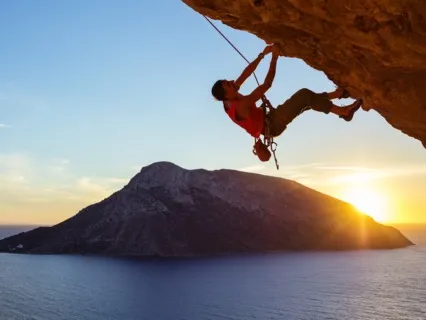
And I'm going to use rock climbing as an example.
In rock climbing,
It always,
To me anyway,
Seems quite risky.
Whether I'm even just a few feet off the ground or dozens of meters off the ground,
It always feels dangerous.
And yet when I think about it,
When I study the anchors,
Especially in top rope climbing,
There's almost zero actual risk.
I'm not going to hurt myself.
I might scrape myself on the rock.
But the likelihood of me plummeting down to severe injury or worse is just so slim.
And yet it feels risky.
So the actual risk is quite low as long as we are trained and know what we're doing.
But the perceived risk is high and so my heart rate is elevated,
The endorphins are pumping.
I feel amazing whenever I go rock climbing.
And I learn a lot about myself.
I understand my fears,
I understand how to confront my fears,
I understand which fears to listen to and which fears to override.
And if we never put ourselves in scary situations,
We never develop that sense.
We never get to distinguish actual risk from perceived risk.
And we never get to push those boundaries.
We never get to grow.
So I invite you to consider some risky situations in your life lately.
First let's think about it in terms of physical risk.
Scan back over the past day or week or month.
And consider a time when you were in actual physical risk.
When was there an actual risk to your physical well-being?
Tune in to that moment.
Try to engage all your senses.
Try to recall what happened,
What was going on.
I trust this isn't re-traumatizing in any way and if it does feel uncomfortable then of course hit pause or stop.
With that experience firm in your awareness right now,
Recall how you knew it was risky.
What did you hear?
What did you see?
What did you feel?
What was the smell in the air?
How did your body respond?
What thoughts occurred to you?
How have you integrated that experience that posed an actual risk to your physical well-being?
Have you decided just to avoid that scenario entirely?
If this is when you were riding your bike,
Have you just hung up your bike and abandoned it?
Or using that same example on the bike,
Have you found a way to travel that route more safely?
Just become aware of how you've responded to that risky situation.
How did you talk about it with others?
That's an important part of integrating experiences.
What did you say?
What was your response?
What was their response?
Maybe you have other practices of integrating experiences like this.
Journaling or posting on social media or something.
Ranting.
How did you integrate that?
And how are you different now?
If you've had some time to integrate it,
What changes have you made?
What have you made of that fear?
If it was actually risky and you perceived the risk,
Surely you had a reaction of fear.
What have you done with that?
Has it parked itself in your body somewhere?
Added tension?
Have you been able to override it if you want to?
Convincing yourself that you weren't actually in that much danger?
What have you done with that fear?
Hold on to that fear for a moment.
Get right in the experience.
Notice how your body responds in this moment to reliving that fearful experience.
Is your breathing different now that you're in that experience?
Has your heart rate increased now that you're in that experience?
With that first,
Give thanks for being alive now.
However you give thanks,
I invite you to offer gratitude for just being alive now.
Even if you were injured or seriously injured,
You're listening to this,
So it could have been worse.
Just give thanks for this breath.
And now experience the moment after the fear subsided.
To what did your fear give way?
Was it peace or equanimity?
Was it anger?
Was it frustration?
Was it embarrassment?
And then consider when you first felt calm and peace.
It's rare that somebody transitions immediately from fear to peace.
It's possible.
But consider when you first felt peace and calm after that risky experience.
Maybe it's the moment you realized you were okay in some way.
Maybe it's not until you got home and gave your loved ones a hug.
Maybe you still haven't found peace.
Recognizing our responses and how we've integrated our experiences is an important part.
The experiences that go unintegrated inhibit us from judging risk well in the future.
Maybe you need to do something differently next time,
Or maybe not.
We've considered an experience that brought some physical risk.
Let's shift our awareness now to something that brought some emotional risk or vulnerability.
Consider a time when you had to put yourself out there in some way,
Or were forced quote unquote out there in some way.
When your emotional well-being was put at actual risk,
Be present to that moment and that experience.
Try to relive it as best you can with all your senses.
What did you see and hear?
What did you feel?
What was the smell in the air?
Who was around you?
How bright was it?
What was the air like?
Was it windy?
Was it clear?
Be in that moment of emotional vulnerability.
Notice how your body is responding now to recalling that experience.
At the time,
It's likely that your heart rate would have increased.
Your breathing rate might have increased,
It might have gotten shallower.
What happened after that?
After that moment of actual risk to your emotional well-being,
What happened after?
To what did that fear,
If it was fear or anxiety or unease,
To what did those give way to?
Give way.
And at what point after that did you find peace and equanimity and calm again?
Maybe you're still in that state of vulnerability.
Maybe you haven't moved into peace and common equanimity yet.
Trust that eventually you will.
What have you changed as a result of that experience of emotional vulnerability,
Of actual risk to your emotional well-being?
What's different now?
What do you do differently?
Do you think differently?
What's different now?
And is that what you want to be different now?
These experiences of high risk leave us out of control.
Sometimes that's the hardest part,
Is that loss of control,
That loss of autonomy.
How might you regain an appropriate level of control over that situation?
What do you need to do to make peace with that situation?
So that you can integrate it into your being,
Not worry about it,
Not dwell on it,
Acknowledge that it has changed you,
And you are the one in control.
Let's consider an experience when you could introduce risk to your life.
Again,
Let's not introduce reckless or meaningless risk,
Especially if it involves other people or might put you in a situation of needing care.
But what are the ways that you can bring risk into your life in a measured,
Purposeful way?
Maybe there's something you've been working on that requires taking some risk to get to the next level.
Maybe you play a musical instrument and it's time to perform,
But that seems risky.
Maybe you engage in a sport or activity and there's a goal that you've been working on,
But to get to the next level requires some risk.
First identify what that is.
What is the risk you want to introduce in a measured and purposeful way?
What do you need to be able to take that risk?
What training do you need?
What equipment do you need?
What support do you need from other people?
On a recent hike,
There was somebody slacklining across an inlet,
Likely 200 meters wide.
He had a harness and a fall arrest device,
So he was safe.
No actual risk,
Unless some of that stuff failed.
But the perceived risk would have been immense.
He had his friends there to spot him.
They couldn't help him or do anything,
But they were there for support.
What do you need from others to be able to take that risk to which you're being invited now?
And what do you need to do to mitigate the actual risk,
But keep the perceived risk high?
How can you mitigate the actual risk,
But keep the perceived risk high?
Maintain a sense of danger without being in actual danger,
Or without being in reckless danger.
Now visualize yourself taking that risk.
What are you picturing in terms of weather?
Are you inside,
Outside,
Daytime,
Nighttime?
What are you smelling around you?
What are you seeing?
What are you hearing?
And now go through the emotions.
You're in this risky experience.
It's stressful.
You're worried.
There's a sense of fear.
Be present to that.
Remind yourself that you've taken steps to mitigate the actual risk,
But it still feels like there is a threat.
That fear is real.
Notice what's changing in your body.
And then imagine yourself having completed this experience,
And you've returned to a state of peace and equanimity and calm.
Stay in that calm.
Imagine yourself after this experience.
How are you different?
What have you changed about your life after this risky experience?
How does that feel?
My hope is that you will do something that brings some risk to your life in a measured,
Purposeful way,
In a way that allows you to uncover something about yourself.
It allows you to uncover something about your relationship to the sacred,
To God,
Recognizing that very few of our wisdom gurus have said,
Stay safe.
Because a life worth living is a life that involves some risk in some way.
And as we take measured risks,
We become good judges of risk.
And it scales up so that we can find,
So that we can create and be part of the kind of world we want to live in,
Where love abounds,
Meaning and purpose abound.
And each of us continues our journey toward wholeness.
I offer you gratitude for joining on this journey.
May you know peace.
Until next time,
I'm Greg.
Peace.