You may have heard the term implicit bias.
You may have heard it a lot lately.
It refers to the thoughts and assumptions that we make about people based on their identity markers,
On a level of which we are not even aware.
Humans make assumptions about others based on their appearance,
And we're not even aware of those assumptions.
This is a huge challenge,
And I'm convinced the best way to solve this conundrum is to move those thoughts and assumptions from the subconscious into the conscious.
In other words,
The challenge before us is to make our thinking conscious,
To be aware of what we're thinking about people.
So,
I invite you on this practice.
First,
I'll offer a lengthier preamble to the practice.
Then we'll move through a practice three times to help move our thoughts and assumptions from our subconscious to our conscious.
Nobel Prize winner Daniel Kahneman discovered that 98% of our thinking is what he describes as fast thinking.
Fast thinking is thinking that happens subconsciously.
It's how we give answers or solve problems seemingly intuitively.
When I pick up a Rubik's Cube,
I'm thinking slowly about how to solve it.
My friend down the street,
However,
Picks up the same Rubik's Cube and solves it while in a meeting and not paying any attention to the puzzle.
His thinking is so fast it's basically undetectable.
Another example is playing guitar.
When I move my fingers from chord to chord,
It takes me a painfully long time compared to somebody who has practiced those same chord progressions and they don't even have to think about where the fingers go.
It just happens.
I'm thinking slowly,
They're thinking fast.
Humans could accomplish nowhere near the 35,
000 or so decisions we make every day if it weren't for fast thinking.
Fast thinking saves lives.
Consider that the emergency medical technicians administering cardiopulmonary resuscitation,
Or CPR,
Aren't thinking through the protocol,
They're just doing it.
Fast thinking is how we survive.
The trouble with fast thinking though is that it leads to bias.
It's happening so fast that we aren't able to evaluate it or test its validity.
We need to ask,
What am I thinking?
What is the source of this thought?
Is that a valid source?
And what would other sources say about this?
Answering these questions takes an inordinate amount of time,
So we tend to skip the process altogether.
But it is important to practice.
So in light of the growing and disturbing racial tensions that I presume is happening everywhere around the globe,
I invite you on this practice of examining your thinking process,
Specifically as it pertains to your reactions to other people's identity markers.
And this works best if it's a stranger.
And this might actually be best suited for a walk down a busy sidewalk,
If that's available to you.
Otherwise,
Your mind's eye or imagination will work just fine.
First,
As always,
Take note of what's happening in your body.
How is your breathing?
Where is there tension?
What adjustments are you able to make if you want to as you prepare for the practice?
Take a few moments to settle into the practice.
Did you notice any changes in your body when I said the phrase racial tensions?
What happened?
What images came to mind?
Maybe there were some news stories that came to mind.
Was there a change in your heart rate,
Breathing,
Or the tension in your muscles?
Offer that bodily response gratitude.
After all,
It's part of who you are.
And open the exit door.
Seek to clear your mind and body of the preconceived notions we carry with us.
Take some time now to be open to emptiness.
Whether in your imagination or reality,
So whether you're sitting in your meditation space or walking down the street,
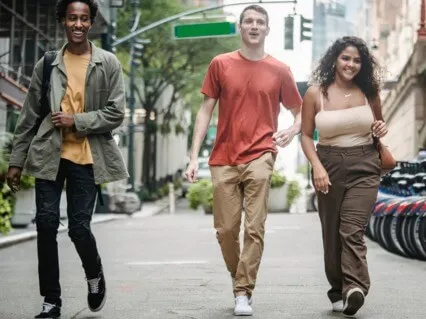
Begin to notice the people you're passing.
As the next person passes,
Take note of the first thought that comes to mind about that person's outward identity markers.
What did you think about them?
It was a fast thought,
Our first thoughts are fast thoughts,
And likely difficult to notice.
But being fully honest with yourself,
Even if it embarrasses you,
Pay attention to that thought.
Say it silently by mouthing the words so as to integrate the fast thought with your consciousness using your frontal lobe.
Or if you're alone,
You might say the thought aloud.
You had no control over that first fast thought.
It was the product of what you've been taught,
What messaging you've received from other people,
From news media,
From social media,
And from other sources.
In that moment,
You did not choose to have that thought.
When you became aware of that thought,
You may have had an emotional response.
Pay attention to it.
Your emotions should inform your thinking.
Now,
Still paying attention to that thought,
The one you mouthed a few moments ago,
Try to uncover the origin of that thought.
For example,
Was there a lesson from your childhood that ultimately influenced that thought?
Or is there something you've seen in entertainment media that ultimately influenced that thought?
Can you think of a conversation that might have influenced that thought?
Now,
You're paying attention to that initial thought still.
You're also paying attention to the various sources of that thought.
Are those sources reliable?
Do you suspect those sources themselves to be well-informed?
Are they based on good information?
Is there evidence available that might challenge the sources of your thought?
Now,
Consciously think the opposite of your original thought.
Maybe you just add the word not somewhere in the sentence,
Or maybe there's an opposite descriptor you can use.
Mouth the words of this new thought,
Silently,
Or if you're alone,
Aloud.
What is your emotional response to this new and opposite thought?
Does it feel better or worse?
Be present to that for a few moments.
We'll go through that cycle again.
Whether you're actually passing people on the street or imagining it,
Observe another person you're passing now.
Notice their attributes,
But don't stare,
That gets awkward.
Notice the first thought you had about that person.
Mouth,
Silently to yourself,
The words of that thought.
Notice your emotional response to that thought.
Focusing on that same first fast thought,
Consider the sources of that thought.
Consider childhood experiences,
Formal education,
News media,
Social media.
Now,
Consider whether those are reliable sources for the thought you had.
And now,
Test out the opposite thought.
And notice what happens emotionally as you do that.
Remain present to that for a few moments.
Let's move one final time through that cycle.
In your imagination or in reality,
Pass someone on the street.
What's the first thought that comes to mind as you pass them?
Mouth the words of the thought.
How do you respond emotionally to that thought?
What are the sources of that thought?
How reliable are those sources?
Test the opposite thought and observe what you can learn from your emotional response If this has been confronting,
Take a few moments to,
As best you can,
Forgive yourself.
We do not choose our fast thoughts.
Our biases are real,
And they have a real impact through the things we say and do.
Knowing our biases is the first step toward fairer thinking and then toward a fairer world.
Correcting our biases is a lifelong journey,
But a worthwhile one.
It can be painful.
It can be confronting.
But ultimately,
It leads to improved relationships and new life.
The goal is not to replace fast thinking with slow thinking.
Humans can't function that way.
We need fast thinking.
The goal is actually to improve our fast thinking,
Make the thinking more rigorous and better by slowing it down on occasion and then eventually speeding it back up.
I follow the Christian tradition,
Where Jesus has attributed this sentiment.
Now there is no Greek or Jew,
No male or female,
And by extension,
No rich or poor or black or white and so on.
This isn't to say we are all the same.
This isn't to erase those things about ourselves that are actually important.
Clearly,
We are not all the same.
Nor is it to pretend we don't notice our differences.
Obviously,
We do.
The teaching,
Though,
Is to remind us to treat all people with love and dignity above all else.
Despite even the greatest of differences,
Humans are drastically more alike than we are different.
We are all loved.
We are all capable of loving.
The hallmark is that each of us has an equal opportunity to live a flourishing life.
So I invite you to test your thinking constantly.
Slow it down every once in a while.
To gradually speed it up with intention,
Keeping love and dignity at the forefront.
I thank you for coming on this journey.
It wasn't an easy one for me,
But I found it a worthwhile one.
Until next time,
I'm Greg.
Peace.