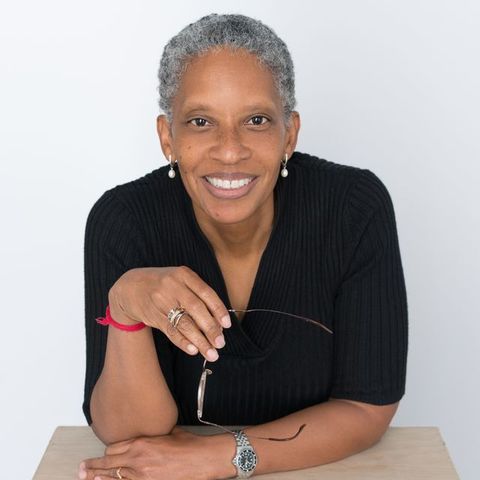
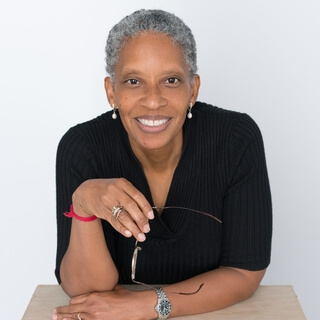
We have guests here today,
And I would like to bring in Ms.
Ayu with me,
And we're going to talk a little bit about Buddhism and life in itself.
But more importantly,
I think most people know that I'm a practicing Buddhist.
And if people haven't known,
Now you know.
But one of the things,
So introduce yourself,
Ms.
Ayu,
Please.
So my name is Pamela Ayu Yatunde.
I go by Ayu.
I'm one of the founders of Center of the Heart,
A wellness practice that includes pastoral counseling,
Yoga,
Conflict resolution,
And community.
I am the co-editor of Black and Buddhist,
What Buddhism Can Teach Us About Race,
Resilience,
Transformation and Freedom,
And other books and articles on Buddhism.
So I want,
People can find you later,
And I'll put the links in later,
But where can they find you?
So I just want to get that out of the way.
If they want to like contact you and talk to you and visit your books and things like that.
Yes,
I can be contacted at our website,
Www.
Centeroftheheart.
Org.
So this has been one kind of a year.
And when it comes to race relations and Buddhism,
I know I've tried to,
And I will continue to activate people's healing process so they can activate their loving process.
So,
But race relations is very high.
And I know it seems like it,
Why do we have to call it such these didactic names?
Like it's got like this pillar,
Like,
Boom,
It's racism.
Right?
And I don't think that helps us,
But the fact is that it is there.
So how can,
How have you seen Buddhism help race relations in the whole?
Yeah,
In the home,
Did you say?
In the whole.
In the whole and just in the whole.
I got it,
In the whole.
Well,
What I see is a,
Again,
A process of recognizing racism,
White supremacy,
As some would say,
Superiority complexes of one kind or another,
Inferiority complexes of one kind or another,
Delusion about the self,
The identity,
Clinging,
All of this.
What I see now is that people are bringing these teachings to bear,
To understand why we treat people the way we do and how we can prevent additional harm.
Since Buddhists are about understanding,
Suffering,
Committing to not harm,
Right view,
Right seeing and so on,
Compassion,
All the power of me's,
Then as the Buddhist communities continue to grow and diversify in the United States and people bring the causes and conditions of their particular suffering,
Right?
We are working through it.
That's the way I see it.
Unfortunately,
If people continue to only look at- But you can leave it there if you had just left it there,
But there was going to be an unfortunate scene,
Wasn't there?
Yeah,
So right,
I know,
But you know,
Right?
I'm sorry,
We have not arrived at the Pure Land.
We have not arrived at the Pure Land yet.
Unfortunately,
But it's not a- A deficit.
It's not a perpetual barrier.
That sometimes when we look at the suttas and the sutras as the only source of authority on what is good,
What is right and so on,
What we'll find is an absence of teachings in our particular cultural context,
In our particular historical context.
And so it is our task then to see if these teachings can be applied to the situation we're in and some of them can be,
Some of them won't be,
And then we fill in the blanks.
That's our work to do in Buddhist community.
So what are those things that you filled in specifically in the black community?
I know I get looked at like a unicorn,
But see people,
There's another one.
And you saw me talk to Dr.
Larry Ward.
So please,
I'm not a unicorn,
But how can we help the black community understand that,
Understand?
Understand that there are black Buddhists.
Yeah.
Or just understand that they can have this bridge.
Yeah.
There are a lot of ways.
There are a lot of ways to help folks understand.
Recently,
I met an African,
Actually Jamaican American Baptist pastor who said I was the first black Buddhist he had met.
And when I think about it,
I think,
And he lives on the East coast.
I don't want to over-identify,
But he lives on East coast.
I encountered Buddhism when I lived in the San Francisco Bay area.
In the San Francisco Bay area,
It's unlikely that you'll find many people who are shocked by the fact that there are black people who practice Buddhism,
Right?
So there's a regional issue there.
But sometimes it takes time to break down the barriers of how we identify religiously.
For example,
If someone really wants to get to know us,
Really,
Really wants to reconnect or connect with us as kinfolk,
And they're coming from a Christian lens.
And part of that Christian lens includes unconditional love.
And the other part of it includes a complete devotion to Jesus Christ.
And so here you are,
Right?
Hey,
Aren't I lovable?
Aren't I deserving of this unconditional love?
Right,
Right.
Yes,
However you need to accept Jesus Christ as your Lord and savior,
Right?
So it's- There's a condition to it.
Yeah,
There is a condition to it.
So I would ask,
But if you're really interested in living out that unconditional love,
And Jesus is your guide,
And you recognize me as kinfolk,
Is it possible that the stories of Jesus' encounters with people who did not believe as he believed,
Yet he accepted them as kinfolk?
Can that be a bridge for you,
For accepting me as your kin,
Worthy of complete love and complete generosity?
And the answers we hear is yes,
But.
Right,
And so it takes time.
It takes time.
So that's good,
That's encouraging.
Yes,
But.
And then the but would be,
Okay,
Yes.
And would you still look deeper into that,
Deeper into that?
One of the things that I love and a resource that we can use are the teachings from Thich Nhat Hanh on Christian and Buddhist dialogue.
Those are great resources.
I know I've listened even to the Dalai Lama and my repochet.
He talks about the love that we can all just completely share as beings,
Right?
And that joyful light of lifting,
It's possible.
It's there,
Right?
So what holds us back?
Our conditions.
So talk to us about how human conditions have broken us and how they keep us away.
Well,
From a Western psychological point of view,
Brief answer is that from the start of our birth,
Outside the womb,
We begin to interpret certain things unbeknownst to us.
Pain and suffering can come from our parental units or unit,
Not providing what we need exactly when we need it all the time.
Right.
And that begins the brokenness.
That's one way of understanding it.
From a Buddhist point of view,
It is the clinging and the craving and the grasping of it all that keeps us in the cycle of human suffering.
So what might it be like for us to understand that just as human beings,
That we're going to suffer,
That there are a variety of reasons for suffering.
That there are a variety of reasons why we suffer.
That this,
And even in that suffering,
Still,
It is a precious occurrence to be a human being.
And that because in this brokenness and this suffering and this preciousness all combined,
All of it's in there.
That because we are human,
We have the capacity to work towards unraveling those threads of suffering and pain.
And I know,
I constantly say these things,
Keep practicing,
Keep practicing.
And everyone,
I get asked these great questions,
They'll say,
Hey,
Dr.
P,
What do you mean by the practice?
Don't you mean like training?
I'm like,
No,
There's a practice involved after training.
Training is learning.
To me,
Training is learning something.
Practice is the doing of what you've learned,
Right?
So you can go to a training facility for anything.
But then after you leave,
You're done training,
So how are you going to take that training and put it into your action of doing?
That's practice,
Right?
And so develop the practice of living,
Called the living sciences,
Right?
Because I've talked to you before we got on air,
Most people know I always do like a lot of emotional sciences and with the epidemiology and the cellular science and how it affects our body,
But understanding that life is a source.
It's a whole complete source that we soak in and transmit at the same time.
It's the saying hurt people hurt people,
But hurt people hurt themselves.
And that's the healing process that somehow we have to get past race relations.
Can we get past those words or do we,
Do you think we will have to keep those words and still move past it?
You know,
Here's something that I learned and maybe I just had to leave where I was living at the time to learn it.
But every,
Perhaps every region in the country has its own history,
Its own particular history.
And there are still wars that we thought were over,
That people are still fighting.
So until we can commit to living in the present moment with people who are right around us,
Rather than living in the past of someone else's shadow,
And trying to resolve those past difficulties,
Those past challenges,
We're still going to talk about race relations in this country.
It seems to be the key word this year is diversity inclusion.
And I'm pulling out the hairs I don't have on my head.
Cause I'm like,
Okay,
So now you've named it,
Which has been named long ago,
Prior to your diversity inclusion,
Which means acceptance.
Why,
What was wrong with that word?
Is that a real difficult word?
Cause I actually looked at three of those words and I put them on paper and I do this and I look at them and I was like,
Diversity,
Inclusion,
Acceptance.
Acceptance is all of this.
And more diversity seems like it signals out a sickness and inclusion singles out separation.
So it seemed like we still have to,
We keep dividing ourselves with these words.
And I think it's done on purpose.
So you think when people use the words,
Diversity,
Inclusion and equity,
That there's something underneath that,
That they are aware of,
That actually perpetuates the opposite.
Yes.
Oh,
So you're gonna make people upset with you,
Dr.
Paul,
By saying that because there are a lot of people,
There are a lot of professionals,
Who make a lot of money.
Off of it.
As DEI experts.
And you're suggesting that they know that what they're doing actually perpetuates the opposite.
Absolutely.
When you have a young boy coming from an inner issue environment,
And it doesn't have to be inner city,
It could be suburbia,
It could be the Midwestern.
And you emphasize the environment that they're coming from to try to take them from to a to,
You keep referencing the from.
So you never leave it.
So if we're talking about equality,
Then you're hyper-vigilantly telling me I was never equal.
Now that saddens me.
That's just- I see what you're saying.
That's sad to me.
I mean,
I know it.
Why do you gotta keep telling me?
You know?
I see what you're saying.
It's really,
If I'm following you correctly,
It's about who's owning the power of defining the reality in that situation.
Right.
But then what,
On the other hand,
On the other hand,
Did you happen to see the photograph or video of the governor of Georgia,
Governor Kemp,
Signing this voting legislation in his office?
You saw that?
Yes.
And you saw the sister knocking on the door who got arrested.
Correct.
Right.
So what do you say about situations like that as it relates to acceptance?
How do you get people who are even closing off their office,
Including only people who look just like them,
To sign a bill that impacts the entire state with the potential for excluding over half of the state?
Yes.
How do you get a mentality like that to accept the reality without using the words represented by DEI?
I think you said it in the statement,
Accept the reality.
What is your reality?
I mean,
I think people have not really vocally or vocalized their reality.
Like,
What do you see?
What are you seeing?
What are you feeling?
What is your observation?
What is your observation with self,
Right?
Because it's this mirror,
Right?
This mirror cells and all this.
But what is that observation you're seeing that is so damaging that you have to keep pushing it?
If you can explain that,
I'll never knock on your door.
Really,
Because I don't think they could explain it because they don't know it.
I don't think they fully know.
They know the repercussions.
They know the outcome,
But they don't know where it stems from.
And if,
Because if they knew where it really came from,
Then they would,
Then they don't have to agree with what it is.
And if that's agreement,
Then that is acceptance.
Because I'm not even trying to change your thoughts.
I'm just trying to,
If you can agree on what you see in yourself is what I see in myself is what we see together.
So what I'm hearing you say,
Dr.
Paul,
Is this,
That if we were to approach this conversation with a dualism,
Right?
So you've got,
Let's say on one side,
The DEI folks,
And on the other side,
You've got the racially segregated folks,
Right?
What I hear you saying is whatever side you're looking at,
Neither side knows the truth that you're speaking of.
Correct.
Okay.
Then we do have a problem,
Don't we?
Yes.
That's because that is the problem.
So the solution,
Does Buddhist,
Now I don't mean to interview you,
But.
No,
No.
You've got me thinking.
Is there anything in Buddhism for Buddhist practitioners and non-Buddhist practitioners alike that could help in the way of having a dialogue about getting to the real?
One of the teachings is,
You know,
Is the observer and the seer.
Who's the observer?
What are you observing within yourself,
Your seeing?
And I think that's the question that can be asked with oneself,
With the self,
Right?
So,
And then is that like you said it dualism,
You're separating all these factions.
Like even people,
When I know I,
When I tried to commit suicide many years ago,
Whatever,
That I was,
I had,
I phrased it as,
I had all these separate catalogs of divisions within my own personal mind,
Life and health,
Like I was a soldier and I'm a dad and I'm this and you've got all these different categories.
And when the books just fractured open,
I was lost.
And really there's only one book and it's got one page in it,
In itself.
And until you,
We all have that one book instead of all these different books.
And I think that's how I look at it,
I think that's how I look at it at the DIE people.
They got all these different separations and categories and it's like,
We're reading a log of,
It's like we're cataloging or we're creating columns of people by numbers.
I don't think we can have unity if we are in columns,
Because even on the piece of paper you separate us,
Even if it's by name and number.
So how do we live with this?
Because there is a quantification of things in our society.
We're constantly quantifying,
Right?
And judging based on quantity more is better,
Than the more,
I guess you could say the enlightened responses,
Less is better and all this kind of stuff.
But we do quantify and we do judge by quantification.
And we see when there's an absence,
Right?
It's very loud,
When there's an absence.
Yes.
If a DEI person came to you and said,
You know,
Dr.
Paul,
Help me understand this differently so that I can respond differently.
And so that we can just be a place that accepts,
Just accepts unconditionally.
What are the few steps that you would advise them to do?
Practice,
I mean,
Would practice be part of it?
Sounds like it.
It would be part of it,
Because we would have to slow down our observed mind.
Like what is our observational mind seeing?
And I think that is,
Once we slow that down,
Your vision comes internally to a singularity.
Now on the phases,
I'm not a big singularity form in physics or anything like that,
Because I think there is multi issues.
But for the mind,
It is a single,
It can come to one.
You're not the black man who's six-three,
Who's a dad,
Who's this,
And you start adding these things on.
No,
I'm just human.
I am a living force,
I'm a life force.
So yeah,
Bring them into the,
And so it's,
Metaphorically,
Can you just go to the store or do you have to go to the bread store?
Yeah.
I mean,
How long does it take you to shop?
I mean,
It must take you like all day.
Okay,
Yeah,
So we're living in a supermarket.
I know you're living in a supermarket.
Everything we have is right here in the cosmos.
Yep,
Yep,
It's right here.
I hear what you're saying.
And still,
There seems to be some kind of,
I don't know,
Privilege to be able to live that way.
Mm-hmm.
To be able to,
To be able to observe one's mind and one's self and recognize who we truly are or what we truly are beyond the constructs of these things we call race.
Right.
And gender.
Because they're constructs.
Yeah,
They are constructs.
And yet,
The perception of that construct by others can get us hurt.
Yes.
So there's that reality too.
So how do I carry myself as a cosmic being,
Life force?
Right.
How do I carry myself,
Know myself as that and never be convinced otherwise,
No matter how dehumanizing the treatment is?
So I've lived in that situation.
I had lived in North Dakota for a long time and it was one early morning.
I was out getting ready to go to my studio and I stopped off to get some coffee.
And down this road,
The speed limit's 25,
I was going 35.
But it's 4.
30 in the morning and it's an all,
And the coffee shop opens up very early,
Almost like at five.
So I was going that way.
The cop pulls me out.
He stops me,
I pull over.
He pulls me out and he says,
Can you step out of your car?
I step out of the car.
And he says,
Can you turn around?
I turned around.
He said,
Could you put your hands behind your back?
No,
He didn't say anything else.
My license,
Original,
Nothing like that.
He stepped around,
He handcuffed me and he sticks me on the ground.
He calls for backup.
Backup comes.
And I still don't know yet that this was speeding.
The cops come,
He didn't say anything.
And he says,
The other cop comes and he puts his hand on my back while the other cop is at my car.
He says,
Where's your registration and your license?
This is the first time besides handcuffing me,
He's talking to me.
He said,
My license is in the console.
I always keep my license in the console,
In the middle or this was a minivan.
And so it was like right here.
And he opened up,
He gets in,
Registration's right there.
He says,
Okay,
All this was a ticket for speeding going 35 in a 25.
He handcuffed me because I'm a large black man compared to him and he has to keep his safety.
This is what I found out later from another cop person I knew.
Very harmful I think.
I was quite sad after,
Because he let me go,
He goes,
Oh,
Here's your ticket.
And it was,
Wow,
Right?
This is,
So I cried.
I still,
As I'm thinking of it,
It's bringing up that emotion.
And I think that's what we talk about was that when we are reliving things and we're not noticing the feeling we get from it,
We hold it in and that turns into unhealthiness and that can get you killed.
Because then I would act out later,
Even if it's similar case came up.
I don't wanna be put on the ground again.
I was just speeding,
I would end up talking fast.
And so then I'd be living in the trauma.
The traumas will start speaking in every time,
If any time I ever got pulled over.
So we have to understand that who is speaking and what is speaking and when are you speaking?
Is it the trauma?
Is it the life force?
Or is it your confusion of not knowing what they are thinking?
I can't do all that.
I can only feel my love for myself and to give love through my actions and be calm about it.
It's the best.
Will that keep me alive?
I don't think about it as much,
But when I do think about it,
It could still get me shocked.
Of course.
Because we know it happens.
We know what happened to Breonna Taylor.
If she'd be almost questionable,
It's like,
It doesn't even matter.
Did she raise her voice?
Would it have mattered?
He'd never explained why he was pulling him over.
She was just driving.
We're like,
What's the problem?
And she still gets shot.
You know,
Dr.
Paul,
You bring up something that's very sensitive,
Right?
And also I hear an invitation in it as well.
The sensitive part is about the fact that you're able to make choices,
Even though you had an experience that could have deprived you of being able to make a choice when traumatized,
Right?
And everyone's trauma experience is different,
Right?
What they take in,
How deeply it is taken in,
How defining that moment is if they survive it,
And then how long it takes to recover to some degree.
And do they recover through psychotherapy,
Through practices in grounding oneself,
Or just let time take care of it.
So all these different trauma experiences and healing modalities,
And you also made an invitation that I heard,
I heard the invitation is no matter how hurt you are or have been,
No matter how degrading the experience and no matter how traumatizing it is,
Look at it.
Look at it,
Look at the experience,
The living life force experience dynamic in your body so that you know what you're operating out of.
That's the invitation I hear.
And then I could say,
But Dr.
Paul,
That is too painful.
I need to dissociate from that in order to live.
What are you telling me?
Well,
Pain isn't hurtful,
Disassociation is.
Because I don't have to add another word onto love for it to be more than love.
I either love or I don't.
Pain by itself is okay.
Disassociation is the hurt part and that's the killer because you can love even in pain,
Even in sorrow,
There's still love.
Yes.
There's still the action of love.
There's still the life force of love and life.
We're not saying you're never going to have pain,
But understand and feel and let it maturate and grow and let it grow leaves and let it grow.
Cause it doesn't stay hurtful or destructive.
Only disassociation does.
Because once you ignore something,
Then you give no intention to.
And if you don't give intention to a plant,
It will die.
This is very,
If your viewers don't know this about you,
Not your viewers,
Your listeners,
If they don't know this about you now,
If they didn't know it,
Now they know it,
Which is you are,
And forgive me if you don't like what I'm about to say,
You are a vulnerable black man.
In other words,
Regardless of what society says,
You are supposed to appear to be,
Right?
The facade you're supposed to have,
The roughness and the toughness and all that,
That you are willing to experience pain,
Hurt and vulnerability.
And you're inviting other people to do that.
Yeah.
Yeah.
Because you know,
If we do that.
Right.
Right.
What's on the other side of that?
Acceptance.
Okay.
Yeah.
Right.
There is.
It's right there waiting for you.
Yeah.
Yeah,
But it may not happen exactly like that.
No.
There might be some other things to be experienced in between like your resistance,
Your own internal resistance to acceptance,
To self-acceptance,
Right?
How many messages in our society tell us that we're supposed to be other than who we are?
Right.
It's tons of it.
We can't get in a car.
We don't even have to turn the radio in the car and itself tells you otherwise.
And when someone says,
What do you mean?
I said,
And I took them to their car.
And I said,
Get in your car.
Don't turn any radio.
So what's this car telling you?
I don't know.
It's my car,
But it's talking to you.
She's like,
What do you mean?
I'm like,
Just listen.
Oh,
I remember when I bought it.
Yeah.
Yeah,
I remember that I had to ask my this for this extra loan and I had to,
It was,
Then I realized that my credit wasn't good.
I said,
It's talking.
Everything in this,
It talks to you.
And once you quiet your mind,
You'll hear it talk to what it wants you to be and what it doesn't want you to be.
Because when you're driving your car,
Most people go,
Man,
That's a nice car.
Why are you driving your car?
They go,
That's a nice car.
So your car is saying to you,
I would like a new car because obviously for you to notice it,
You must've been feeling that this isn't enough for you.
So it's talking again.
Well,
The most,
I think one of the most powerful things we can do is to listen.
As you put,
As you underscore,
To listen to everything that is communicating to us and listen for a long time.
Because I do really believe that the listening and listening for a long time and discerning is what leads us to the answers we're seeking.
Ms.
Yayu,
Thank you so much for joining me on Bridges Live talking with Dr.
Paul.
I thoroughly loved it.
I could talk to you for hours.
Thank you so much for your invitation and for your mission.
Thank you.
Thank you.
Thank you.
And one day when all this is over,
I fly out to where you are to visit your center.
I would just love to do so.
Sounds good.
I love it.
Love the thought.
I'll be looking forward to it.
Thank you,
Dr.
Paul.
Enjoy the rest of your day.
And I'm here for you.
If you ever want to give me a call and chat.
So thank you.
And thank everyone for listening to Bridges Live.
And of course,
You can always reach me at drpaulwdiagmail.
Com.
If you have any questions and comments,
Just please,
And I'll get back to you.
But most importantly,
Learn how to live and live in life.
Thank you.