Hello,
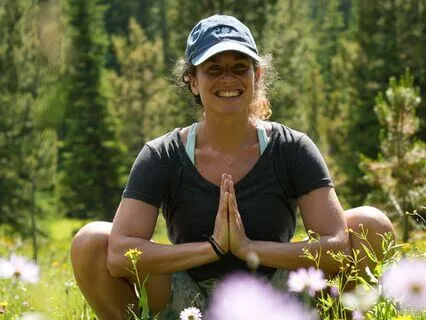
My name is Autumn and I'm going to lead you through a short guided meditation.
You can use this meditation whenever most serves you.
To get started,
I recommend sitting upright.
If you choose to lay down,
That's totally fine.
You just might find yourself drifting off or the attention might be a little bit harder to stay focused.
If you're seated upright in a chair,
See if you can scooch a little bit forward on your chair and plant your feet flat on the floor,
Sitting with your spine nice and tall and relaxing your shoulders away from your ears.
From here,
Keep your eyes open to start.
Take in what's around you,
Maybe noticing some small details in the room that you're in,
Or maybe you're outside and you're noticing some small details in nature.
Seeing if you can be very present with exactly where you are.
This doesn't mean your mind won't jump to thinking about other things.
It just means that you're continually bringing your attention back into the present moment.
Using our senses can really help us do that.
Take just a couple of moments to notice what you can notice with your eyes in the space around you.
When you're ready,
Taking a moment to either soften your gaze or close your eyes,
And now taking stock of how your body physically feels.
You might notice some spaces of tension or some other spaces of ease.
See if you can pay attention to where your body feels sensation.
The challenging thing is bringing attention without judgment.
Can you bring attention to where your body feels sensation without reacting to it or feeling like you need to fix it or feeling like it's right or wrong?
It may help to scan from the very top of your body,
From the very top of your head to the very tips of your toes,
Nice and slowly going down your face,
Through your neck and jaw,
Through your chest and shoulders,
And maybe all the way down to your toes,
And noticing if there's any parts of your body that grab your attention.
Picking up a particular area that you feel maybe some tightness or a lot of sensation and seeing if you can invite a little bit of ease into that space.
Just a little bit more.
Not fixing it,
Not working against it,
But just inviting some more ease,
Some more spaciousness.
And then from here,
Take a couple of deep,
Full breaths.
As you inhale,
See if you can fill up through your belly,
Your ribcage,
And your chest.
And as you exhale,
Can you release out from your chest,
Your ribcage,
And your belly?
Notice if your shoulders hike up towards your ears,
And see if you can soften them down and bring that breath more into the belly,
The ribs,
And the chest,
And less into the shoulders and the neck.
And now,
Can you expand that breath in a 360 direction?
So all the way in the front,
The sides,
And the back of your body as you inhale and exhale.
Now seeing if that in-breath can come in through your nose.
And then that out-breath,
Try it out through your nose,
See how it feels.
And then the in-breath in through your nose.
And then this time,
Try that out-breath out through your mouth,
See how it feels.
And now you get to choose,
Breathing in through your nose and out through your nose,
Or breathing in through your nose and out through your mouth.
Seeing if that in-breath can be a little bit longer,
A little bit slower,
A little bit fuller,
And then that out-breath can be even longer,
Even slower,
Even fuller.
So in-breath,
Nice and full and slow,
And out-breath,
Even longer,
Fuller,
And slower.
Taking a couple more,
Just on your own time,
In your own rhythm.
And then when you're ready,
Letting go of any control over your breath,
And seeing if you can find a soft focus.
For a lot of us,
It's on the breath,
Whatever it's naturally doing,
That inhale and that exhale.
And if you notice a tendency to try to control it again,
Notice that tendency.
See if you can be the observer of that.
You are watching your tendency to try to control your breath.
You're not trying to fix it or change it,
You're watching it,
You're observing it.
If the breath feels like a difficult thing to find your focus on,
Then you can bring your attention into the sensations in your hands.
Typically we feel a lot of vibrating,
Tingling,
Aliveness,
Or maybe you just feel some subtle sensations in your hands.
And so whether you're choosing to bring your attention to your breath,
Maybe to the sensation in your chest,
At the tip of your nose,
In your throat,
Maybe just to the whole body breathing,
Or whether you're choosing to bring the attention into your hands,
Keep your anchor point,
Keep the one thing that you choose to bring your attention to throughout this practice today.
This is what you're going to keep coming back to when the mind inevitably moves to something else,
Which the mind just tends to do.
A lot of times we think meditation is just all bliss and peace and a completely quiet mind,
But really what meditation is,
Is learning to work with the very active tendencies of the mind and to keep bringing the attention back,
To keep training the attention back to the breath or to sensation.
So now,
Taking a couple of minutes just to practice keeping your awareness on your anchor point,
When you notice the mind jumps to something else and you lose focus,
See if you can bring it back without judgment to your anchor point.
If you notice the mind is wandering for a very,
Very long time and it feels really hard to bring it back to the anchor point,
Can that be okay?
It's just about the practice,
Letting go of perfectionism,
Of it needing to be right or done in our particular way,
Just continuing to have the attention or intention of bringing the attention back to your anchor.
Taking a couple of moments just in silence to practice this.
Even if the mind gets lost or distracted a thousand times,
Even if it feels like you're very impatient,
Very restless,
Very tempted to get up and move or to do something,
Or it feels frustrating when you find a little bit of quiet and then the noise comes back,
Can you keep practicing?
Can you stay with the practice,
Bringing that attention back again to the breath or the sensation in the hands?
If you feel either pride or judgment or another sort of reaction,
Can you just notice that rather than getting carried off into it or by it?
You become the observer of the emotions that come up,
Of the thoughts that come up.
The observer that keeps coming back to this anchor point,
To this place of steadiness.
Noticing if there's a part of your body that you're holding tension in and seeing if you can find a little release,
A little softness once again.
Attention back to the anchor point,
Finding softness and release,
And if it feels uncomfortable or challenging,
Just trusting in this process,
This process of release and this process of coming back.
When you are ready,
Take a moment to take a couple of deep,
Full,
Intentional breaths,
Just like we did at the beginning.
Inhale nice and full and slow,
And exhale even fuller and even slower.
Just a couple of those.
And then whenever you're ready,
Maybe blinking your eyes open,
Gently taking in the surroundings,
Maybe using your sense of touch and maybe touching your hands along the fabric of your clothing or of the table or chair or whatever is nearby,
And seeing if you can connect with what is physically here right now.
A lot of times our thoughts tell a story and we're caught up in the story,
But what is actually physically here right now?
See if you can connect with that.
And then in your own time,
Slowly moving back into your day.
Thank you all so much for practicing with me.
Once again,
My name is Autumn.
I hope you have a beautiful rest of your day or evening,
Whatever time it might be.
Thank you.
Bye.
Bye.
Bye.
Bye.
Bye.
Bye.
Bye.
Bye.
Bye.
Bye.
Bye.
Bye.
Bye.
Bye.
Bye.
Bye.
Bye.
Bye.
Bye.
Bye.
Bye.
Bye.
Bye.
Bye.
Bye.
Bye.
Bye.
Bye.