As you settle into your seated posture,
Taking care of the hips are above the knees.
You might use some extra cushions or fold a blanket and then the knees are supported.
You can have your feet flat on the floor,
You can have legs crossed as most comfortable for you.
So many of us so much of the time kind of rush into our meditation posture.
We're like,
Okay,
I'm going to meditate now,
Blah.
And it's not so helpful.
It can be really supportive to spend some time.
Take the time in the beginning to get comfortable.
It supports our practice.
So for me,
Sitting cross-legged on the couch is never going to work for me,
Right?
Maybe you'll get it dialed in.
If I'm going to sit cross-legged,
I like to be on the floor,
Have a Zafu under my butt and get my knees down and my back long and strong.
And for me,
If I'm going to meditate on the couch,
I just lie down.
I enjoy lying down and resting.
Yeah.
If we're going to fall asleep,
It's not so helpful.
But lying down is great,
And I mean like back on the couch,
Legs extended,
Lying down.
It's a formal posture for meditation.
Sitting the Buddha taught,
Sitting,
Walking,
Standing,
Lying down in whatever position the body is in.
We can be mindful of it.
We can wake up in any posture.
There's a way here in the States,
In this convert Buddhist way that I'm a part of,
That there has been this preferencing of sitting meditation,
Of seated meditation.
That's meditation.
Even in the Insight community that I'm also a teacher in,
We refer to it as like,
I'm going to go,
I'm going to sit.
Or how was your sit?
And it's like,
Not everyone's sitting.
Can we help ourselves like move away from that language because all the postures are supportive.
So taking time at the beginning of each quote unquote sit to check it out standing,
Walking,
Lying down,
Seated,
What's most supportive and then if we choose,
Whichever posture we choose,
How can I get comfortable?
So we have a posture in which we're relaxed,
Which is so important,
And alert.
Not so relaxed,
We're falling asleep.
And not so alert that we're tense.
It's a balance.
It's a dance to land in between those two things.
And as we keep practicing,
It gets clearer to us how to land there.
It's not like we're supposed to have it all figured out when we start.
It's a,
I think another big delusion.
It's like,
Oh,
So sorry,
You know how to do all this like,
No,
It's a practice that develops over time.
So I keep putting the time in.
Yeah,
Finding that comfortable posture,
Whatever it might be and checking in,
Ensuring that the hips are above the knees if we're seated.
The knees are supported,
The legs are supported if our legs are crossed,
Rooting down through the knees.
If we're sitting in more of an upright chair like posture,
Checking that our feet are flat on the floor.
And then the back is long and strong.
The crown of the head lifting up toward the sky.
Mostly I recommend a little of course there are times when something else is more helpful.
Mostly I recommend for a seated posture that there's nothing behind the back so that the back can hold itself up.
Like you feel that length.
Of course,
Sometimes the body needs support,
That's fine.
Nothing wrong with it.
Just to name that lengthening can really help us with wakefulness and presence.
And if we have a skeleton stacked,
We can also find ease the muscles of the back can relax onto the skeleton.
And it can be helpful to feel a weight tugging down at the coccyx or the tailbone,
The tip of the spine,
Rooting us down into the earth,
Feeling that weight,
Feeling the hug of gravity,
Pulling us down to the core of the earth.
So you just might feel where the where the butt is making contact with the furniture,
Bringing awareness there.
Feeling that beautiful embrace of Mother Earth,
The hug of gravity.
And then bringing attention to the crown of the head,
Inviting the crown of the head to lift up to the sky.
We can find the crown of a head by imagining where we would put a crown on our head if we would wear a crown,
A gold crown or a crown of flowers.
I saw the top of the head,
It's a little further back,
Allowing that to live up to the sky,
Which causes the chin to talk ever so slightly,
Lengthening the back body lengthen in the neck lengthen in the whole of the spinal column.
And it's also support to increase in awareness.
Feeling the length and strength of the spine and inviting allowing the muscles to relax and release.
And noticing if there's any sensation in the body,
Perhaps a broad sense of the whole body or maybe a particular sensation in the body that's pleasant.
Pleasant might be the experience of resting.
Or maybe pleasant is a stretch.
Is there a sensation of the body that's neutral?
That's neither pleasant nor unpleasant,
But what we call neutral.
Maybe just a sense of the body,
Resting down into the earth,
The felt sense of the weight of this body mapped by the earth.
There's a neutral sensation and neutral sensory experience that we can rest into we can become aware of.
And then attend to allowing the body to rest.
And of course,
Attention will be drawn to all other kinds of things,
Thoughts,
Emotions,
Some unpleasant sensation in the body,
Story,
Some judgment,
Sound,
Smell and taste,
A sound taste,
A sight.
This is only natural,
No problem,
No problem.
We can become aware of this.
Oh,
Hearing,
Thinking.
We can notice how that feels in the body.
Oh,
Pleasant.
We feel it in the heart and feel it in the gut.
We feel it in the chest.
Or perhaps something arises in the field of the awareness that we judge as unpleasant.
You can notice that sensation in the back perhaps.
It's just an unpleasant sensation.
In that awareness and that tuning in,
Oh,
It's just an unpleasant sensation.
It loses its grip a little bit.
We have a little freedom from the aversion that can accompany unpleasant.
It's like,
Okay.
And we can rest in awareness of unpleasant or we can return to a broad,
Spacious awareness or this experience of the body settling.
Imagine that something else arises in the field of awareness quite naturally.
If we allow it to,
If there's space,
We can practice just resting,
Allowing the body to heal,
Getting out of the way.
We don't need to do anything.
We can just be.
We can just be.
We can let the tears fall.
We can let the fires of anger burn.
We can hold ourselves with love and compassion and care.
I'll often bring my hands to my face to hold myself with love so that I can feel how I'm here with myself.
I forget all the time,
But guess what?
We're always there.
I got you.
It's one of my favorite expressions for supporting myself in moments of difficulty.
There are plenty of moments of difficulty in life.
I got you.
I'm here for you.
I'm here with you.
Take that on one would say my darling fear.
I'm here for you.
My darling anger.
I'm here for you.
My darling grief.
I am here for you.
And that tuning in that tending to whatever is arising and passing.
That's the magic of mindfulness,
Or as I said,
The miracle of mindfulness.
That's the goods.
Gradually learning to show up for ourselves.
The gentle pressure of skin on skin that we can offer ourselves can be so nourishing.
It's an embrace,
A physical manifestation of love and care and tenderness.
I got you.
I'm here for you.
Those of us who grew up in environments where the people whose care we were in,
In theory,
Are our caregivers,
Our grandparents,
Our parents,
Our aunties,
Uncles,
Our gender expensive,
Gender nonconforming siblings of our parents,
A family friend,
Those people whose job it was to take care of us,
Those of us who grew up in those environments where those people,
Those so called adults weren't able to do it.
We don't have or we lack models of what care looks like.
And some of us can have the misperception because we didn't receive the care when we needed it as young people,
That we're not worthy of it.
So part of the journey of practice is to come to know,
Oh,
Is that a story that I'm believing,
That I'm not worthy?
And if it is,
Practice holding that story,
Holding that little girl,
That little child,
That little boy,
That little being,
Holding them with care,
With tenderness,
With love.
I got you.
I'm here for you now.
I couldn't be there for you when we were little because I was little too,
But now I'm grown.
I'm learning.
Sorry,
It took me so long,
But I'm here now.
I'm learning how to show up for us.
We can call into our minds an image of ourselves as a little one.
Maybe invite that little being to sit down in front of us,
Or perhaps we have an image of a particular moment in our lives and we can just see ourselves as a little one in a specific situation.
And we can love on that being,
We can love ourselves up.
Seeing the difficulty and the suffering,
Perhaps,
Perhaps the wellspring of compassion springs forth.
Boy,
That was hard.
Oh,
Girl.
Oh boy.
Oh,
One.
Oh,
Little.
I am here for you.
Now we can pick ourselves up,
Our little,
Little ones.
We can pick ourselves up and hug,
Embrace,
Swing around,
Dance,
Soothe,
Caress.
I got you.
I got you.
We're safe now.
It's okay.
And we can hold ourselves while we sob,
While the fires of anger,
The flood of grief passes through us.
It's okay.
It's okay.
Those people who were charged with our care,
They did the best they could.
For sure,
100%.
The best they could.
And it was unsatisfactory.
Okay.
Not because of a lack of love or lack of desire or because they didn't think that we were important,
But because that's what they could do.
And as we learn to hold ourselves with care and tenderness,
We start to recognize the truth of this.
But it's not a reflection on us.
It's just some particular amalgamation of causes and conditions led to these environments.
It wasn't their fault,
Not our fault.
It was no one's fault.
More from Thay.
If we see a plant that isn't doing well,
We don't blame the plant.
Like that's not what happens in the mind.
We see the plant's not doing well and we investigate.
What do you need?
More water?
Less water?
More sun?
Less sun?
Maybe a little fertilizer?
Oh,
Maybe you need to be staked.
You need some supports.
Oh,
Maybe the cats have been chewing on it.
Maybe we need to put it somewhere else so the cats can't nibble on the leaves.
We have enough presence of mind,
Enough awareness to not blame the plant.
So gradually over time,
We can bring that awareness to ourselves and slowly not blame ourselves and recognize,
Oh,
There were causes and conditions.
There are causes and conditions and we can't know all of them.
That's not how it works,
Turns out.
But we can know that that's what's at play and we can practice resting and embracing.
I love you.
I got you.
Or some other words of your own design that support you and bring yourself tenderness and care.
And we can rest.
We can rest down into the earth and allow ourselves to be held by her.
We can sway a rock.
We can hum.
And we can love ourselves up.
And rest down into now,
Into this moment,
Not the one before,
Not the next one,
But this moment.
We can feel this body resting.
Resting.
Resting.
We might become aware of a flow of energy in the body,
This flow of blood,
Of chi.
We might notice a tingling or pulsing in the hands or the feet.
Or maybe the point of contact where the body is making contact with the couch or cushion,
Mat,
Floor,
Chair.
Whatever it is that you're resting on to,
Resting into.
Tuning in.
What does it support you in this moment,
Tuning into the experience of resting?
Alright,
Allowing ourselves to be warm.
And something else shows up in the field of awareness.
No problem.
A thought,
An emotion,
Some sensation,
Pleasant and unpleasant or neutral,
Sound,
Ascent to sight.
Hoped being in our ability to hold it all.
There's room for it all.
For many years I've practiced with the phrase,
There's room for this too,
Which got shortened to this too.
I began to experience myself as a vast ocean.
I could hold the totality of experience.
This is what arose through practice through years of diligent practice.
Sometimes I get caught in the storms,
No problem.
And we return and we rest and we love ourselves up as best we can.
Maybe we can only love ourselves up for like three beats.
We're off and storing again,
No problem.
We practice,
We practice.
We practice greeting ourselves with tenderness and care,
With love and kind attention,
Coming to know what's present in us.
And as we're able to notice what's present,
We're seeing if our experience of that experience is pleasant,
Unpleasant,
Or neutral,
Tuning in to how it is received in the body and how the body heart mind is responding.
Letting go of the stories and tuning into the direct bodily experience as much as we're able to without pushing,
Without insisting,
Straining,
Or striving.
Drive me in becoming aware.
I got you.
I'm here for you.
I'm here for you.
I'm here for you.
Imperfectly,
Yes.
And I am here for you.
Imperfectly,
Imperfectly human.
I love you.
I love you.
You are important to me.
You are important to me.
I know I haven't been there all the time.
I'm learning.
I'm growing.
I'm learning.
I'm growing.
I'm not pretending to do it perfectly or claiming that I will do it perfectly into the future.
I'm committed to developing my ability to hear you and meet you.
You're a little one in me.
I love you dearly.
I know you selfless self.
We rest into the body,
Into the earth,
Feeling how the earth is supporting us,
Holding us,
Loving us,
That hug of gravity that's always there.
Earth is holding us close.
We can rest into that.
Resting,
Opening,
Becoming aware of whatever it is that we are aware of,
Special involvement,
Wanting to fight it or try to make it other than it is because that doesn't work.
By coming to know and embracing with love and care and tenderness.
Got you.
I love you.
Resting,
Resting down,
Letting go,
Embracing.
Noticing any bit of settling that might have occurred through this period of practice,
Noticing how the body feels now.
How is it similar to and different from the way the body felt when we began?
Just coming to know.
Sure judgments and assessments might arise.
And can we just know,
Free from emotions of good,
Bad,
Right and wrong.
How does the body feel more pleasant,
Less pleasant?
More tired,
Less tired,
More awake,
Less awake.
It's all good.
There's no goal.
We're just resting and becoming more aware.
More of this moment,
Aware of ourselves here and now.
The only being we'll ever be and the only place we'll ever be is here and now.
Of course,
Here now keeps changing.
We can't be anywhere else as much as we might try.
The future is yet to come and the past is already gone.
All we have is the present.
And as Ty taught us,
We care for the future by caring for the present.
And we care for the past by caring for the present.
As we care for ourselves and heal,
Everything gets taken care of.
We become kinder and gentler and less reactive and less judgmental of ourselves and others.
More accepting of life as it is.
Always unfolding out of our way.
We cultivate our ability to be with things as they are,
To be with ourselves,
To befriend ourselves amidst the joys and the sorrows of life.
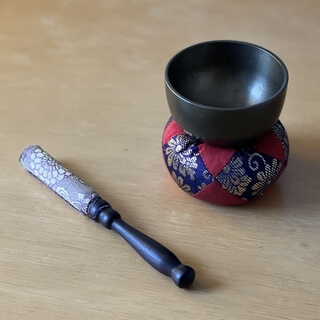
And we'll close this period of practice by enjoying the bell,
Receiving the sound of the bell arising and passing in awareness,
Feeling to rest.
Gradually bringing in movement and light.
Caring for this physical body,
Listening in what does it need?
How can I be kind to myself in this moment?
I'm quite fond of twists.
And when sitting cross-legged,
It's also quite helpful to bend forward at the hips to release the low back.
And once sight comes in,
If you're sighted,
Looking around the space in front of you,
Taking it in the colors,
The shapes,
The reflections and the shadows,
Allowing the heart,
Mind and body,
Allowing this nervous system to receive this physical space.
And if it's available to you,
Noticing how it lands in the heart,
Mind,
Pleasant,
Unpleasant,
Neutral,
What's the experience in there?
It's profound to come to tune into that.
Great freedom can come from just tending to that,
Tracking that.
Something that's very interesting about pleasant,
Unpleasant and neutral in Buddha speak,
That's Vedana.
It's the second foundation of mindfulness in the Satipa Tana Sutta translated often in Insight Meditation to Feeling Tome.
The Buddha offered an analogy for Vedana.
It's as if you had a puddle of water,
And one drop of water drops into it.
I have such an easy time accessing that image.
I can remember going to the Kodak Museum in Rochester,
New York.
And there are all of these pictures of the crown that occurs,
A drop of milk with land and this cup of milk and just this big,
Big,
Big thing.
Or in San Francisco at the Exploratorium,
There's a device that you can like try to catch the moment with a flash photograph.
And it's this huge event.
And it's gone so fast.
And if you have a puddle of water,
You drop that drop of water in,
In an instant,
It says that nothing happened.
Just gets absorbed immediately.
And Feeling Tome is like that this experience of pleasant,
Unpleasant or neutral or Vedana,
It passes very quickly.
And then the next one comes.
But mostly we don't experience the passing of it.
Because we're caught in the story about how it's not the way we want it to be.
And it happens whether it's something that we like or something that we don't like,
We can have a pleasant experience.
And then we want more of it.
And now we're missing the pleasant experience.
I can relate to that and going on hikes and then getting to a vista and thinking,
Oh,
I should go hiking every day.
It's like,
That's not what my life allows for.
I can stand here and join the vista.
And unpleasant,
Oh,
Man,
It's so sticky.
Like,
How can I make this go away?
Instead of this other path that actually is quite effective to embrace it,
And be with it,
I got you.
I'm here for you.
It's okay.
Scientists have found out what the Buddha knew 2600 years ago,
That emotions only last max 90 seconds.
I think that people actually are saying that they will last 30 seconds,
Or maybe it's less than that.
But we feed them with our stories with these beliefs.
And it can feel like it goes forever.
And it really can be quite activating.
When we practice being aware,
Oh,
This is unpleasant.
And we can read it like tie teaches us so beautifully.
Oh,
My dear anger,
My dear grief,
My dear sadness,
Whatever it is,
We can greet it.
Oh,
This is an unpleasant moment.
Got you.
There's a freedom there.
Because we're not fighting reality.
Thanks for your attention.