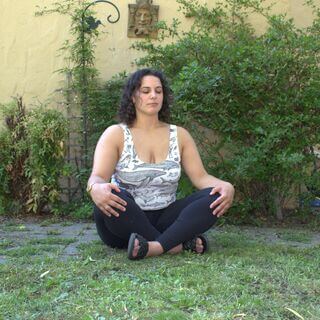
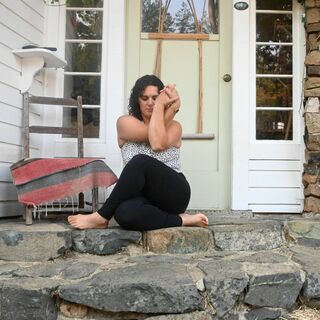
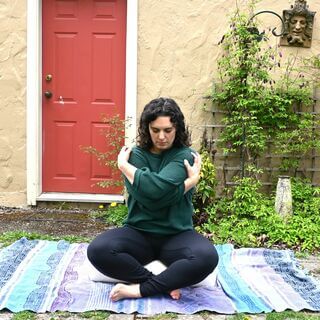
Today we will be working through somatic tracking for pain with specific movement.
So when we're thinking of this specific movement that gives you pain or causes you some anxiety,
Every time that you do that movement your brain gets a message from the nerve fibers in that area that says danger,
Stop,
You're causing damage.
What's happening here is that your brain is interpreting these neutral sensations as dangerous.
It's like if I were to toss you a baseball and your brain thought it was a ball filled with giant spikes on it,
You would respond as if it was something dangerous.
So with this somatic tracking our goal is to teach the brain that the signals that are actually neutral are safe and to help your brain to interpret them more accurately.
For your brain to agree that I am tossing you a baseball and not a spiky ball.
Now every time that you do the specific movement that causes you pain and anxiety,
I assume you experience a spike of anticipation of pain or maybe some anxiety before or even afterwards.
This is your brain being on high alert and preparing to protect you from that metaphorical spiky ball.
So what we're going to do with this somatic tracking exercise is bring the pain together knowing that the pain itself is an inaccurate reflection of danger and to regulate any of the anxiety that you experience with this movement.
Our goal is to help get that anxiety down when the pain comes up and to help you to stay calm while you are facing it.
So even if you are feeling a little bit anxious right now with doing some movement and somatic tracking that is completely normal.
Let's start with a little bit of grounding for this anxiety.
You can close your eyes or you can keep them open.
Whatever feels best for you in the moment.
Bring your attention to the physical sensation of your breath coming in and out.
And you can focus on the breath wherever feels comfortable for you,
Whether that's your chest,
Your stomach,
Your nose,
Anywhere that feels nice.
And you can take some time attending to yourself in this way,
Attending to your breath,
And helping to familiarize yourself with this nice sensation going in and out.
Perhaps think back to the sensation of anxiety or fear around the movement we're going to do and just notice how that feels now.
Maybe it feels a little less anxious as we've regulated the breath.
We're helping your brain to feel safe,
Despite that we are going to do something that may bring about some pain.
And if it does bring about some pain,
We know that you are still safe.
So just take a few more of those nice and easy breaths,
Paying attention to that sensation,
To feeling grounded and settled.
Now whatever movement you're thinking of that causes you pain,
I want you to try and do that movement at about 20% of your usual intensity or your usual speed.
And notice what this feels like to you.
Maybe you can rate the pain you're experiencing on a scale from 1 to 10.
And if the pain comes on,
That's okay.
We want to teach your brain that the movement is safe,
And if we don't have pain,
It's hard to do that.
So if the pain comes,
Just let it come.
And now come back to those grounded breaths.
Let your body settle as you breathe in and out.
And remind your brain that the movement we just did is safe,
That you're okay right now.
And now if you can,
Let's do the movement at about 50% of speed and intensity.
And you can notice how this feels,
Perhaps giving any pain that came up a scale of 1 to 10 again.
Maybe you're experiencing a little bit of anxiety right now too.
That's okay.
Your body and your brain are perhaps a little shaken right now.
And I imagine that usually this point in movement you might start worrying.
You might start thinking,
Will I be able to finish this movement?
Will I ever be able to do this without pain?
But instead of going down that road of anxiety,
We're going to calm your system back down.
And that way we can help to have your brain associate pain with something more calming.
So let's just take a moment to come back to that grounding breath.
Enjoy that sensation.
Let yourself know that you are safe in this moment.
And then once more,
I invite you to do that movement again at 50% speed or intensity.
And you can notice how the pain feels now.
If there's any anxiety,
You can notice how that feels.
And just as before,
Come back to the breath.
Allow your system to understand that you are safe.
It is safe for you to let your guard down.
If you're feeling any sort of tension or anxiety,
Just let yourself know that you can let it go in this moment.
You can sink into the sensation of the breath.
You can always come back to those feelings and sensations later.
Right now there is nothing else that you need to do.
We're simply just getting exposure to the sensation of that movement in a more positive state.
This pain that you experience with this movement is an opportunity to practice.
Once again,
Deep breaths in and out.
A few more deep and gentle breaths.
Now let's see if you can do this painful movement and pay attention to the breath at the same time.
See if you can enjoy this movement and this activity,
Regardless of what it feels like in your body.
See if while you do this movement,
You can keep one eye,
One part of you inward on the breath.
This breath that has been enjoyable for you and grounding and regulating.
Try and let yourself let go and pair these things together,
Knowing that you are safe.
And when you feel like you have had enough of the movement,
You can just come back to that calm breath again.
Taking some moments in and out,
Noticing that sensation anywhere that feels good.
Reminding yourself that you can always come back to this positive,
Enjoyable breath.
And you can stay here with the breath as long as you would like.