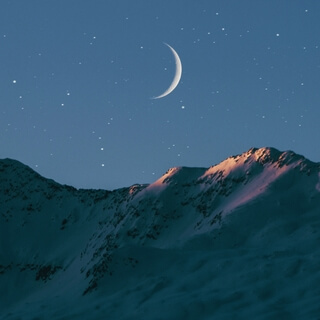
Welcome and thank you for joining me this evening to release the energy from your day and drift into a deep and restful sleep.
Sometimes when I have trouble sleeping and life feels a little heavy,
I like to think about how incredibly fast the universe is.
It can be strangely comforting to remember how small we are in the grand scheme of things.
So tonight I'm going to share with you some true facts about our universe,
And I hope that it brings you comfort to reflect on and imagine the wonderful things out there in the sky above us.
Let's talk about stars.
There are an estimated 70 sextillion stars in the universe.
That is 70,
000 million million million stars.
It is roughly ten times as many grains of sand as there are on the planet Earth.
Neutron stars are my favorite type of star.
A neutron star is the remnant of a very large star that collapsed and died in a supernova explosion,
But didn't have quite enough mass to become a black hole.
Neutron stars are relatively small,
About 12 and a half miles in diameter,
Roughly the size of Manhattan,
But they have about 1.
5 times the mass of our sun.
That is a lot of mass packed into a very small space.
Neutron stars are incredibly dense.
Just one sugar cube of neutron star matter would weigh about 100 million tons on Earth.
Neutron stars can spin at a rate of 600 rotations per second.
Our star has not gone supernova yet.
It is a 4.
5 billion year old yellow dwarf star.
A medium sort of star about halfway through its lifespan.
99.
8% of the mass in our solar system is made up of our sun alone.
All of the other planets,
The 146 moons circling our planet and other planets,
All of the dwarf planets,
Asteroids,
Comets,
And everything else in our solar system makes up only.
2% of the mass in our solar system.
The sun makes up the other 99.
8%.
Our sun is far from the largest star in the universe.
The largest star we know of in the universe,
UY Scuti,
Is roughly 5 billion times the size of our sun.
In other words,
If our sun were a single grain of sand,
UY Scuti would be the equivalent of 1000 gallons of sand.
If an airplane flew all the way around UY Scuti,
It would take 1200 years.
Here's another thing about our sun.
At the surface,
Our sun is about 5000 degrees Celsius,
Or 9000 degrees Fahrenheit.
At its core,
Our sun is about 15 million degrees Celsius,
Or 27 million degrees Fahrenheit.
A photon traveling from the core of our sun can take 100,
000 years to travel from the core of the sun to the surface.
That photon gets jostled around inside the sun for thousands of years before it finally shoots out into space in the form of light.
There are many other fascinating things in our little solar system.
Jupiter's red spot is a giant storm larger than the size of the Earth,
With winds traveling 400 miles per hour.
This storm has been active for at least 300 years already.
One of Jupiter's moons,
Europa,
Has a salty ocean with more water than all the oceans of the Earth.
Scientists suspect that Europa may be one of the likeliest places we will find life in our solar system.
Jupiter has 79 moons in total.
We of course only have one moon.
Our moon may have been formed when a small planet-sized object struck the Earth and many tons of rock were cast off into orbit around the Earth,
Eventually gathering into our little moon.
Or another theory says that our moon may have been floating out in the solar system and gotten captured by the gravity of the Earth.
Saturn has the most moons of any planet in our solar system,
With 82 moons.
Saturn's rings are very wide,
About 270,
000 kilometers across,
Or 170,
000 miles.
But if you look at Saturn's rings from the side,
Like the edge of a sheet of paper,
They are only about 10 meters or 30 feet thick.
Neptune is more than 30 times further away from the Sun and the Earth.
The only spacecraft that has ever reached Neptune was the Voyager 2.
It took Voyager 2 12 years to reach Neptune from the Earth,
Traveling at 42,
000 miles an hour,
Or roughly 19 kilometers per second.
The largest mountain in the solar system,
Olympus Mons,
Is located on Mars,
The second smallest planet after Mercury.
Olympus Mons is also the largest volcano in the solar system,
Larger than the entire state of Hawaii.
Our solar system is a strange and wonderful place,
And we are part of the Milky Way galaxy.
Our galaxy is quite large,
With more than 100,
000 million stars,
Including our Sun.
And all of those stars encircle a supermassive black hole at the very center of our galaxy,
Known as Sagittarius A*.
Sagittarius A star is at least 4 million solar masses,
Meaning it has the mass of at least 4 million of our suns.
Sagittarius A star is so massive that it bends the fabric of space-time.
Our little sun also bends the fabric of space-time,
But to a much lesser degree.
A clock on the surface of our Sun would run 6 seconds slower than a clock on the Earth,
Due to the Sun's mass and gravity.
In fact,
Everything with mass compresses space-time just a tiny little bit.
On the Earth,
A person on the top floor of a very tall building will age just a tiny bit faster than someone who remains at ground level,
Who is deeper in the gravitational field of the Earth.
But supermassive black holes like Sagittarius A*,
At the center of our galaxy,
Compress space-time much,
Much more.
If you stood on the edge of Sagittarius A*,
For one minute,
700 years would pass on Earth.
Sagittarius A star is responsible for holding our entire galaxy together.
Black holes have such powerful gravity that nothing,
Not even light,
Can ever leave a black hole once it passes the event horizon.
But your imagination is powerful,
And that's exactly what your imagination is going to do right now.
Because we're leaving Sagittarius A*,
And we're going to talk about some other nearby galaxies.
One of the largest galaxies ever discovered is Alcionius,
Named after the son of Oronos,
The primordial Greek god of the sky.
Alcionius is roughly 160 times larger than our own galaxy.
Other than its massive size,
Alcionius is a fairly ordinary galaxy with a supermassive black hole of a fairly ordinary size.
There are many galaxies in our neighborhood of galaxies,
But they are very far away.
The closest galaxy to us is Canis Major Dwarf.
Canis Major Dwarf Galaxy is 25,
000 light years away.
That means it has taken 25,
000 years for the light that bounced off of Canis Major Dwarf 25,
000 years ago to reach our eyes today.
And what we are able to see of the Canis Major Dwarf Galaxy is actually what it looked like 25,
000 years ago.
Canis Major Dwarf is an irregular galaxy,
Meaning it's not a spiral or an elliptical galaxy.
It is less structured than those types of galaxies.
The nearest large galaxy is Andromeda,
Which is roughly 2.
5 million light years away.
In our universe,
There are an estimated 2 trillion galaxies,
Each with millions of stars of their own.
Our universe is 150 billion light years across,
Meaning if you shone a light from one end of our universe,
It would take 150 billion years to make a journey all the way to the other side.
Our universe is roughly 13.
7 billion years old,
And we humans have existed for about 1 million years.
If the whole history of the universe were compressed into one single day,
One 24 hour period,
Humans would only exist in the last 4 seconds before midnight.
Our entire lifespan would be only a few ten thousandths of one second.
There are 30 to 40 trillion cells in your body.
99% of your body is made of oxygen,
Hydrogen,
Nitrogen,
Carbon,
Calcium,
And phosphorus.
You also contain small amounts of sulfur,
Potassium,
Sodium,
Chlorine,
And magnesium.
All of these elements were formed in the explosions of stars over the past 4.
5 billion years,
All leading to you being here,
In this life,
In this moment.
You are made of stars.
You are the universe experiencing itself.
Your time here on Earth is fleeting and precious.
You are a rare and precious being,
Capable of fathoming the entire universe around you and your place within it.
A tiny little creature,
Sleeping while the world spins madly on,
Dreaming a great big dream,
The size of the universe itself.