I wanted to just go a little bit more into compassion this afternoon,
And in particular self-compassion,
Because traditionally in Buddhism we start with ourself when we cultivate any of what we call the Brahma Viharas.
So whether compassion or loving-kindness,
Sympathetic joy or equanimity,
The traditional phrase is,
To all is to oneself,
Which is sometimes a little bit difficult for us,
And I think generally speaking we tend to find it easier,
At least I speak for myself,
I find it a bit easier to develop compassion to others than I do to myself.
And this shows a little bit of an imbalance,
Because we are also in need of our own love and compassion.
You know,
We have to live with ourselves all the time,
And yet we find it difficult to develop that compassion towards our own struggles and suffering sometimes.
So I wanted to talk a little bit about that and really emphasise how to use that compassion in our relationship to whatever arises in the body or the mind,
Including our meditation objects.
Even you can develop loving-kindness towards the breath,
By approaching the breath with a very warm and engaging attitude,
With an attitude of gentleness,
Not trying to control the breath but just approaching it and saying,
Would you like to come in?
It's a different kind of relationship than going after it and grabbing it and dragging it into our mind.
So self-compassion helps us to have this very gentle and warm quality of friendship towards whatever comes into our awareness.
So we're emphasising that during this next three days,
A little bit more than what exactly we're aware of.
That's not so important because that changes anyway and we have less control over that.
But what we can influence is the way that we handle whatever arises.
So I was reading a little bit by someone called Kristin Neff and she studied a lot about self-compassion.
And I thought it was quite interesting because she identified three different areas of self-compassion.
And she said that it's,
For example,
Emphasising an attitude of kindness over an attitude of judgement,
Especially self-judgment.
Because when we judge things,
We can't really understand them.
In a way,
We've already sort of said,
Okay,
I understand this,
It's done with and you put it aside.
When you judge a person,
It's very hard to meet that person with fresh eyes.
You've already put them in a box.
And then we lose a little bit of that heart's responsiveness when we meet them,
Especially if you're thinking negative thoughts about somebody before you meet them.
You tend to bring that into the dynamic when you're with that person.
So it's about learning not only to relate to people in a kinder way with more of a sense of openness and non-expectation or judgement,
But also reflecting in that way when you're alone,
Reflecting on people's motivations and trying to look at them in the best possible light.
So kindness over judgement is the first one.
And then she also said it's about a sense of common humanity over identification.
Because sometimes we can get so kind of boxed into our own world,
Right,
And whatever's arising,
We can tend to take about that it means something about us.
I'm feeling bad,
I'm feeling a bit miserable this morning,
Can quickly lead into I shouldn't be feeling this way.
It's wrong to feel this way.
I'm a bad person because I feel this way.
And this process can happen so quickly.
We make it all about ourselves just because we're feeling a bit run down or tired.
The other day I did my back,
As I told you,
Playing around with my niece.
And I heard this voice come into my head,
Oh,
That's because you're playing around and you're a nun and maybe you shouldn't have been.
And so very quickly this thing that we call the inner tyrant or the inner critic can come in and start to judge and start to make it about us.
And that's where the suffering really kicks in.
Whereas actually you could look at it differently,
Oh,
I was just having fun,
I was just expressing kindness towards my niece and it happens.
Everybody has a body which gets tugged about and can pull muscles and get strained from time to time.
So this is a universal experience of suffering.
And that's only physical,
That's not really the big stuff.
So the other aspect of self-compassion she identified was,
What was that one?
Yeah,
Awareness over identification and also common humanity over isolation.
So just this beautiful sense that there's something bigger than us and we're all connected,
We're brothers and sisters in sickness,
Old age and death.
Nobody can escape that,
Everybody has to go through that at some point.
But it's when we think we're in this alone that sometimes our suffering really consolidates and we get this strong sense of self as though this is happening to me and nobody else can understand me.
And these kind of thought patterns can be very isolating in and of themselves.
So one of the things that really helped me with my practice from the beginning really was I started with Goenka on these 10-day retreats which are very intensive,
A lot of sitting meditation.
And very focused,
About 12 hours a day and you don't look at anybody,
You just stay in your own little space.
And this was a really wonderful start to develop some mindfulness and some awareness of what was happening in the body and the mind.
And especially how these two were inter-relating,
Which I found really fascinating.
But one of the things I could see could become a potential problem was if I would do a lot of retreats and start to get a little bit,
Not obsessed,
But too focused on whether I was progressing and whether I was getting nearer to my goal.
And I found that serving the retreats was a great antidote to that because when I give voluntary service I'd see so many different types of people coming through the centres and into the retreat.
People from the West,
People from the East.
Most of the time I was in India and there were people from all kinds of different backgrounds and ethnic groups,
Sometimes women from villages,
Maybe illiterate women coming in.
I heard a story once about one lady who didn't have any money to get there but somebody gave her train fare just so she could come.
And you'd have all these people in one place,
Sometimes 500 people on some of the retreats.
And during the ten days I could see that everybody went through a similar process,
Even to the point where certain days on the retreat you'd feel a certain energy in the room,
As though everybody was having a particularly hard day that day.
And then towards the end,
Day eight or nine,
It would all start to settle.
And sometimes you'd speak to people at the end and say,
Didn't you feel there was a lot of anger in the hall on day three?
And they'd be like,
Oh yeah,
I also experienced that.
And what I started to see from this was that we all shared a very similar experience,
Although we were individuals within that experience,
But also that there was a certain range of emotions,
Feelings and experiences that any human being could go through.
And nothing in that range was sort of out of touch for anyone.
It was all part of the human condition.
So it's not that our thing is special,
Whatever we're going through is special,
Or that we're the only person to experience these things.
Although sometimes it can feel like that,
And at those times,
We're much more likely to start sort of turning that in on ourselves.
There's something wrong with me.
Why am I feeling this way?
And I was going through quite a hard time several times in my monastic life.
But in particular,
I remember a few years ago,
Being in a monastery where I wasn't really happy,
Even though I felt that the conditions were almost ideal,
Beautiful forest,
Really lovely nuns in the monastery,
But something didn't feel right.
And I find my teacher one day and I just said,
Oh,
I just don't know what to do with myself.
I just don't feel good.
Like what's wrong with me?
And his answer was so lovely.
He said,
The only thing that's wrong with you is that you think there's something wrong with you.
And that was like such a relief for me because again,
It was pointing to suffering being normal part of human life.
And the only problem with that suffering is that we don't want it,
We want to get rid of it.
And we make it about us.
And this is where the inner tyrant can really kick in.
So the inner tyrant is sort of a phase that's been coined,
I don't know whether in psychological circles first or meditation circles.
But it basically refers not to some existing being that's solid,
And that's always going to be there.
But just to a pattern of thinking that we've somehow adopted,
It's been conditioned perhaps by the way we were brought up or by our schooling,
You know,
By the voices around you.
And we've internalized these ways of speaking to ourselves,
Which are actually pretty harsh.
Come on,
Get up,
Get on with things.
Why are you so lazy?
Why don't you ever,
You know,
Just get up bright and refreshed?
Or voices that try to undermine us.
I had a voice in my teens that was something like,
Oh,
I won't be able to do this project,
I won't be able to do this exam.
And I went to a counsellor at one point and she said,
Why don't you just turn it around?
How did you do in your last one?
Well,
I got straight A in my last one.
Well maybe you'll do the next one well as well.
And of course that was much more likely than flunking the next one.
But this voice inside was so,
It's what you call the perfectionist,
Always having to live up to some ridiculously high expectation.
And if I've done well last time,
I'm never going to do that well again.
And these voices are very strange because in a sense they're trying to protect us.
They're trying to say,
Okay,
Work hard so you can be successful,
So you can be happy.
But in fact,
They're so undermining and demeaning that they sap us of energy.
And they weaken our sense of self-esteem.
So it's very nice because in the Buddhist text,
There's a lot of teachings about how to undermine these kinds of unwholesome thoughts.
And he doesn't use the word inner tyrant or inner critic,
But he calls them the wrong ways of thinking.
So there's a sutta called Dvaita-vitaka Sutta,
And it means two kinds of thought.
And the Buddha too struggled with negative thinking before he was enlightened.
So in this sutta he says,
What if I separate my thinking into two kinds?
And so on the one hand,
He put the thoughts of ill will,
Thoughts which are basically fueled by negative attitudes,
Negativity,
Not wanting,
Not liking.
And also thoughts of desire,
Thoughts of wanting,
Thoughts of craving.
And also thoughts of delude,
Like stupid thoughts,
Basically.
Thoughts which are very unhelpful,
Cloudy,
Deluded.
The kind of thoughts you want to follow sometimes,
But you really shouldn't until you're a bit clearer.
I always say never make decisions when you've got doubts in your mind.
Wait until they subside.
So on the one hand,
He put these thoughts,
And on the other hand,
He put three other kinds of thoughts.
And those other kinds of thoughts are exactly the same as the three right intentions,
Which are the second factor of the path,
Which I referred to earlier.
So the other thoughts are the opposites,
In a way the antidotes of these.
So instead of sense desire,
We have renunciation.
Quite an unpopular word.
But I like to think of that as a kind of putting down,
A letting go.
So instead of grasping and striving and craving and running after pleasures of the senses,
We learn to just put that down and look inward for happiness instead.
So it's just loosening the hand.
You don't have to put everything down straight away,
But just that slight release and slight sort of giving up,
Simplifying.
So thoughts about this,
Thoughts about contentment,
Letting go.
And then as an antidote to the thoughts of desire,
Oh sorry,
That was antidote to thoughts of desire.
And an antidote to the thoughts of ill will,
Of course,
Is thoughts of compassion and loving kindness and non-ill will,
Non-harming.
So how can we care for this?
So rather than,
Ouch,
This is difficult,
I want to get rid of it,
Or I'm hurting,
I don't want this,
When's it going to end?
We actually ask,
Okay,
This is painful.
How can I be with it?
How can I care for this moment?
What is it that's needed to bring some compassion and some love to this situation?
Even if it's just to open the heart a little bit,
Because we can't always dwell with infinite compassion and metta towards everything,
But we can at least attempt to dwell in a non-aversive state and let go of that little bit of resistance and tension and not wanting.
So that leads to a release of suffering.
And the nice thing was that the Buddha was saying,
When he recognised that there were these two kinds of thinking,
He could actually make a choice.
Because until then we're kind of the slave of our thoughts and we're pulled from this way to that way,
All around in a big spin.
But he was saying that when he realised that those thoughts were obstructions to wisdom,
Led to difficulties and led away from liberation,
Away from enlightenment,
Then he could put them down,
Then they subsided almost by themselves.
But the other thoughts on the other hand,
He said,
Even if he would think of them for a whole day and night,
There would be no obstruction,
There would be no difficulty resulting from that because these thoughts are wholesome.
So he said the only problem is if he would think about it for too long and to the point where he would get tired.
So again,
This is quite interesting because it's sort of showing a gradual process from moving from very unwholesome,
Disturbing and upsetting thinking to kinder,
Softer,
More constructive thinking,
More wholesome thinking.
And eventually,
Once they subside,
You get into more and more stillness.
But it's a process.
We can't just go from unhealthy thought patterns straight into lots of peace and silence in the mind.
But sometimes I think it can be really helpful to challenge these thoughts.
And if you have,
For example,
A thought that says,
Oh,
I'm not good enough,
Things never work out for me,
Just replace that.
Maybe you can even talk back to that inner tyrant and say,
Well,
Look,
I know that maybe that's what you've been told in the past,
But that's not really the case.
Have a look at this,
Have a look at that.
You've succeeded before.
People value you.
People see your worth.
But there's another side to this.
So you can actually take these things up and challenge them from time to time.
And being able to talk to yourself in a soothing,
Calming way is one of the things that really stimulates the feeling of well-being.
Even in neuroscience,
They found that certain kinds of ways of thinking stimulate what is called,
I think,
The limbic system.
Yeah?
So they stimulate a stress hormone to be produced.
The kind of fight-flight response that happens when you're under attack.
But the problem is we're actually attacking ourselves inwardly.
And we're stimulating those same stress hormones in our own body and mind.
Whereas when we speak to ourself kindly,
With soothing words,
With warmth,
With affection,
We're stimulating what's known as the affiliative system in the brain.
I don't know if it's really a place,
But I think it's the cortex.
And that's the center that's responsible for increased empathy,
Understanding,
And even creativity.
So when we learn to speak to ourself in a beautiful way,
In a loving way,
The way that you would speak to a best friend.
My best friend's here today,
Actually,
But I'm not telling you who she is.
But I was thinking earlier,
I don't think we've ever had a harsh,
Unpleasant,
Unkind word.
And this is in 40 years of friendship.
I mean,
I don't know if we've ever been irritated.
That's another thing.
Maybe some of our behaviors irritate each other.
But all I've ever felt from my best friend and other close friends is a sense that they are looking at me in a good light,
In a positive light,
And giving me the benefit of the doubt,
On things where you could interpret my behavior one way,
But a friend would interpret it a different way.
They'd always look at you in the best possible light,
And they'd give you their time and their attention,
And really try and understand.
So we'd never talk to our best friends the way we talk to ourselves.
And I always think if you could just take out the content of your mind,
And you had to display it on a big screen,
It'd be quite embarrassing.
We wouldn't do it.
But no one sees this,
And sometimes we don't see it.
The same friend I mentioned earlier who wanted to transcend herself through some kind of self-hatred,
She realized after years and years of practice that she was actually swearing to herself sometimes to get her to do things,
Speaking to herself in such a harsh way.
And that shocked her when she realized it.
But then that can be the beginning of change.
There's another very nice way of challenging thoughts taught by someone called Byron Katie.
I don't know if you've heard of her.
But her question is always to take a thought,
Write it down,
And ask,
Is this true?
And at first,
Of course,
We say,
Yeah,
Yeah,
It's true.
Is it really definitely true?
And that's much harder.
And then she says,
OK,
How about if I turn it around?
So you basically put a completely different interpretation.
So instead of,
I never get my needs met,
I do get my needs met,
Or I sometimes get my needs met,
Or even I always get my needs met,
And then ask that,
Is that true?
And it's really interesting because sometimes you find that's truer than your original thoughts.
And you get to feel how each thought feels.
So try out this one,
Try out that one.
Which one feels better and kinder?
And then she asks,
Is there a reason to keep that negative thought?
Give me a reason.
And then people are like,
Oh,
Actually,
Yeah,
That thought's just bringing me down.
Maybe it's not true anyway.
But the Buddha goes one step further,
In a sense,
And he says,
Is it beneficial?
So not only is it true,
But is it beneficial?
And if it's not,
Then there's no reason to keep that,
Even if it's true.
Because it's only harming you.
And if you harm yourself,
You're not going to be much use in helping others.
We have to learn on ourself,
First of all.
I mean,
At the same time,
I do think that we can develop compassion to others and later learn to include ourselves in that ringing.
Some people say you can't really love anyone until you love yourself.
But then I think we'd be quite dysfunctional in life,
If that were really the case.
So sometimes we can learn these things by the company that we keep.
And that can include wise friendship,
Or just being around people who represent kindness and safety to you.
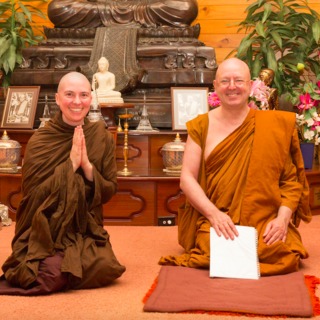
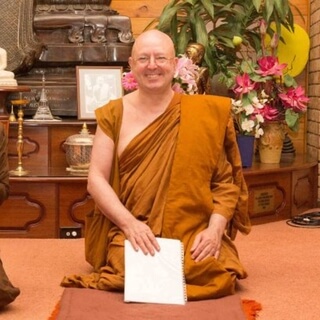
So I have a wonderful teacher,
Ajahn Brahm,
Who some of you might know.
But whenever I'm around him,
I just get such a sense of deep acceptance,
That it really puts me at ease.
And I feel I don't have to be anything.
I don't have to be different than I am.
I don't even have to remain the way he thinks I am,
Because I'm not boxed.
And that just gives enormous space for growth and for relaxation and feeling at ease.
And when you do feel at ease,
You tend to grow.
I said before about self-improvement not really being the goal of the practice.
But the irony is that when you accept yourself,
You start to grow naturally.
Growth happens.
Because you actually come in contact with the reality,
First of all,
In accepting that.
And it becomes natural for the mind to let go of habits that are no longer serving it.
Sometimes we're not very friendly towards our body either.
And that's why I said at the beginning,
Please,
You know,
If you want to lie down,
If you want to take extra cushions,
If you want to move in the meditation,
It's perfectly fine.
Sometimes we don't realize until we get sick that our bodies are not our slaves.
So don't do what we want them to do when we want them to do it.
And I guess most of my life I had a fairly fit body.
But I lived in Burma for many years.
And after several years of sitting long,
Long,
Long hours in one position,
Also because it was so hot,
It wasn't just that I was,
You know,
Strong willed or really into my meditation.
Sometimes you didn't want to move because it was so,
So hot.
Any sort of energy that you expended just increase that inner heat.
So I sit there dripping with sweat.
Over the years,
I contracted a stomach infection,
Which I still have 12 years later,
And got quite sick.
And so I had to have some treatment.
At one point,
They actually put me on steroid medication,
Which was really strong and very debilitating,
Especially when I tried to come off the medicine.
To the point where I'd think,
Oh,
I'm going to just walk,
You know,
Down the street,
Maybe a mile.
And I just assumed that my body would follow that command,
But it wouldn't.
Suddenly my body would sort of come down the stairs,
I'd get extremely hot,
You know,
The adrenaline would be racing,
Trying to come off these steroids,
And I'd have to go back to bed.
So it was very humbling,
You know,
To realize that my body wasn't under my control anymore.
I couldn't just order it to do whatever my mind felt like doing.
So that was really interesting.
And I had to actually kind of take a relook at my whole practice,
Because at that time,
My teacher was encouraging us to sit for many,
Many hours without moving.
And I'd quite got into it,
And the mind would be very bright and very strong at the end of those sits.
But then I noticed that if I would sit a few less hours,
I'd feel like somehow I hadn't done enough.
And then I was like,
Oh,
I've started to measure.
I started to measure my practice and feel that I have to sit for long hours in order to progress.
So I thought,
Yeah,
Something's a bit amiss here,
And it's not doing my body much good anymore.
So I tried to talk to my teacher and said,
Well,
You know,
I think I need to be more gentle and do more walking meditation.
But the whole culture of that place was to sit and to sit and to sit.
And I felt that he didn't really understand my need to just start listening to my own body.
So even in monastic life,
Even when you're fully committed to full-time practice,
Full-time meditation,
Sometimes you have to listen to your own inner wisdom,
Even over and above your teacher or your preceptor,
Because only we know what our body needs at any given time.
And part of becoming sensitive,
Developing respect and kindness is really listening in and making our own decisions and also having the confidence to know that you're on the right path.
And for me,
Again,
It's very helpful to come back to these right intentions,
Because if you are acting from intentions of kindness,
Gentleness,
And letting go,
That's the renunciation,
The letting go,
Making peace,
Being content,
Then you are on the right track.
It's going to give good results eventually.
And even at the time that you're generating these attitudes,
There's a certain softness of the mind.
You'll notice that it has results.
I mean,
Often nowadays,
I arrive at retreats or teaching invitations quite exhausted.
And in the past,
I would have just pushed through.
But now I just take time to rest,
Because I know this isn't about me.
It's not my personal failing if I'm tired.
It's just nature.
The body,
The brain have been busy.
And I'm weary.
So why not have a little rest,
Have a sleep?
I recently spent two whole days on retreat at Gaya House.
It was a seven-day personal retreat.
But the first two days,
I was sleeping a lot.
And I noticed that there was a change.
I wasn't judging myself for that.
I just went with it.
And by the third day,
I was bright and refreshed and really ready for the practice.
But I practiced in my time scale.
I don't go by a schedule.
I practice when I feel in the mood to practice.
So again,
I encourage everybody here to do the same.
So that's being a friend to the body.
But how do we be a friend to our mind?
Of course,
One way is to start to use different ways of speaking to ourselves.
If you do want to practice with positive thoughts or thoughts of loving kindness,
Thoughts of compassion,
You can actually substitute the thinking that's going on constantly sometimes with just short phrases such as,
May I be happy,
Or with compassion,
It would be more,
May I be free from suffering,
Or may I learn to be kind,
May I meet this with kindness.
Just feeling into what resonates for you at any given time.
And you can just plant that phase into the mind and just listen.
And put it in there and then give some space,
Give some silence to feel where that's pointing to.
And in time,
This can be a cultivation.
You can practice with these phrases in a whole sitting if you want to.
And sometimes the gaps between the phrases get bigger and bigger.
And slowly,
Slowly,
It's like you're kindling a fire.
The phrases are the kindling that you put on the fire and then the space that you leave is the chance for that fire to take off.
And you start to feel a sense of emotional warmth.
The mind is being pointed in a certain direction and feelings of compassion and kindness start to arise.
But again,
We don't do that for those feelings to arise.
It's just a natural consequence.
And the Buddha said,
As long as you have those wholesome thoughts,
The unwholesome thoughts can't coexist.
You can't simultaneously have a thought of kindness and a thought of ill will.
So at the very least,
Even if you don't get the emotional feeling of compassion,
You're stopping the enemy of aversion,
Of cruelty,
Or sort of more,
Violence is a strong word,
But harmful thoughts.
So this is one really skilful way to work with the mind.
And then there are many other ways,
Such as evoking feelings of warmth and safety.
One of the things I was doing in my retreat in Perth recently,
I'm usually spending three months of the Rains retreat with my teacher over there.
And at one point I was going through quite a struggle with the system because there's still,
Unfortunately,
It's a very patriarchal system and I was the only nun and I was going behind the monks in the arms line,
Even though I'm very senior to most of them.
And it sounds like a small thing,
But actually when you're in a community and you feel something's unfair,
It can be quite disturbing,
Especially when it doesn't seem to align with the general sort of way that that community is going because Ajahn Brahm has given the full ordination to women,
Which is wonderful.
But there are certain aspects of the organisation that haven't really come into full alignment with that yet.
And he's very open to it changing,
But not everyone there was.
So I was feeling quite distressed at one point and trying to meditate,
But just basically sitting with a lot of emotional disturbance.
And it took me about half an hour of the meditation to remember to check out my relationship with my experience because I was so close to it.
It's like it was in my face and I was really,
I was the pain and the distress and the doubt.
And then I just realised,
Gosh,
How am I relating to this?
What about making peace?
And it was almost an instant transformation.
I just sort of evoke this feeling of warmth,
Almost like if you imagine somebody who's very kind to you or even a part of yourself,
Like for me it was imagining myself as a big sister to myself,
Sort of an older,
Wiser mentor to my own emotions,
To my own struggles.
And so I just kind of infused that warmth into the relationship and almost in an instant it gave way to peace and even to bliss,
A little bit of bliss,
Which was very nice.
And it all came back again a few days later.
But at least I realised where the problem was.
And as usual,
It was the relationship problem.
Most things in life are relationship problems.
We all have them.
Another nice one that I did at some time when I felt I needed more support was to picture myself.
So you can use imagination,
Visualisation.
And I pictured myself sitting with all my teachers around me,
Four particular teachers who've been of great support to me.
So one in front,
One behind and one either side.
And I just sat there and it was like,
Let me just imagine that their love and their compassion is flowing into me.
So it was really lovely because not only did it connect me with the kindness,
It also took me out of the picture a little bit.
So it wasn't up to me to be kind and to be warm when I didn't feel it.
It was up to them.
So that was very lovely.
And all these things,
Again,
Stimulate that centre in the brain,
Which is responsible for feelings of warmth and empathy,
Kindness.
And they soothe us.
They soothe our mind.
They soothe our body.
Sometimes when you get the attitude right,
You find everything just relaxes,
The body and the mind.
So it's lovely.
I mean,
There's many,
Many different ways and I can't really talk too much longer because I'm talking a lot.
But I just wanted to encourage a little bit of creativity and exploration and just finding ways that work for you to first of all evoke those feelings.
Sometimes it can be an aspect of nature.
That's another one to point out because we don't all have those kind of role models or friendships.
So sometimes you could even imagine you're sitting on a beach maybe or under a tree and the warm sun shining down and you can hear the breeze in the grass and just really evoke a sense of safety and ease.
And that can be a little start to your meditation and you can take that inward.
So that's enough from me for now.