Sometimes it's nice to focus directly on the freedom from suffering and the potential for that freedom.
And that is actually a definition that comes from the Tibetan tradition.
So they define compassion as the felt wish for all sentient beings to be free from suffering and the causes of suffering.
Which is a really lovely definition,
But I think there's one thing missing from there which has been covered by other psychologists and other groups.
There's a place called,
I think it's the Good Life Centre,
And they say that it's the response that arises when witnessing the suffering of others that motivates a desire to help.
So it then moves into this kind of sense of action,
Taking action where it's necessary.
So it's not only a sentiment,
But it also has to manifest in daily life,
In a wise response.
And it was very nice because obviously a lot of us have been aware of the things that have been happening in the news at the moment.
And one of them,
Of course,
Is this brutal killing of George Floyd in America.
And some very,
Very upsetting footage that in a way is a relief that we've been able to see that because these things have been going on for long enough without us really realising it or wanting to know.
And I really liked one of the responses that another nun put up on the Facebook recently.
And I just wanted to read it out because it also addresses this idea of suffering and the causes of suffering.
And this is directly from the Buddhist suttas.
It's from the Chakravarthi Sihananda Sutta.
I don't know that sutta actually.
And this is where the king asks the Buddha for advice on how to address violence in his kingdom.
And the Buddha replied,
Highlighting that it was because the king failed to provide money to the poor that poverty increased and violence ensued.
And he says,
In this way,
Monks,
Money not being given to the poor,
Poverty flourished.
And because poverty flourished,
Theft flourished.
Because theft flourished,
Weaponry flourished.
And because weaponry flourished,
Murder flourished.
So here she made a very nice comment.
This is Ven.
Somer in New York.
She said his advice was to give money to the poor and not to stop telling people to be violent.
Sorry,
Not to tell people to stop being violent.
Of course,
In other suttas,
The Buddha totally condemns and nowhere in the suttas does he ever condone violence.
So I just want to get that really clear from the outset.
He says that only love can appease hatred.
By hatred,
Hatred is never a peace.
But the point here is that he wasn't judging people's response.
He was actually saying don't expect oppressed people to behave in one way or another,
But address the causes of distress at its source.
Once you eliminate the reasons for people to protest,
There won't be any protest to address at all.
So I thought that was very timely and relevant and also ties in with this definition of suffering and the causes of suffering.
It's not enough just to say,
May we be free from suffering.
May all beings be free from suffering.
We actually have to look at what's underneath that suffering and address that and address the causes.
So in the suttas,
Compassion is described as one of the boundless,
Immeasurable states of mind.
There's a so-called cetavimutti,
Which means a liberation of mind.
And that liberation of mind,
Of course,
Is liberation from what we call the five hindrances.
So it's not final liberation.
That only comes around through wisdom that can be developed on the back of these Brahma Viharas.
But it does undermine the hindrances to the extent that we can enter deep states of samadhi.
And the five hindrances,
Again,
Are based on greed,
Hatred,
And delusion.
So desire,
Hatred,
Cruelty,
Animosity,
Negativity,
And anger.
Doubt,
Restlessness,
Sloth and torpor are the classic five hindrances that we're aiming to liberate our mind from.
And compassion is particularly focused on overcoming the motivation or tendency for cruelty to arise.
So it's the direct antidote to cruelty.
And the Buddha says in the Jomini Kaya 20,
Two kinds of thought,
He actually says that whenever a thought of cruelty arises in the mind,
You have abandoned thoughts of compassion to cultivate that cruelty.
So just by allowing these thoughts in the mind and neglecting compassion,
Which cannot coexist with thoughts of cruelty,
You're actually allowing that cruelty to flourish.
And obviously the converse side of that is that by developing compassion,
We're actually crowding out the mind with so many good qualities.
You're filling it up with these feelings of benevolence,
Thoughts of freedom from suffering,
Wanting another's release from suffering,
That cruelty has no place to apply.
And these Brahma Viharas are called divine abidings because they're places where even the devas,
The Brahma,
The so-called godly beings in the Buddhist texts dwell.
And we can make these places our dwelling homes in everyday life.
Many of us might be well practiced with metta.
A lot of you have been coming to my metta groups.
And compassion is just another way that love manifests itself.
You can almost see the four Brahma Viharas as different ways that love expresses itself according to what it comes in contact with.
In other words,
It's an appropriate response of love.
So if you meet somebody who's suffering,
Especially if they're in deep turmoil,
Deep grief and agony,
Especially after witnessing something like this killing,
It's sensitive in any way to say,
Well,
May you be happy?
I mean,
They're far from happy.
Their immediate concern at that time is to be free from oppression,
Free from suffering and free from the causes of suffering.
So compassion manifests in response to suffering and it's a way to alleviate that suffering.
It's really nice because I was practicing metta one day and it gave me a sort of experiential understanding of how these Brahma Viharas almost meld into each other and also are quite natural when they meet various situations.
I was practicing metta quite intensively.
And I just changed my object from my best friend to a lady in Burma who used to support me.
Quite a poor lady and who'd had a very difficult life.
She lost one of her daughters in India to asthma when her daughter was only about 25.
And actually subsequently her son died too,
Who was the main breadwinner in the family.
And he was living in Kolkata and sending money home to Burma.
Nevertheless,
This lady was incredibly kind and even traveled all the way from her village,
Which was a couple of hours,
To make a little tiffin tin,
Like these little metal tins full of food that I could eat when I was really sick,
Like some very simple khichdi and some prawns.
And there was very little I could eat at that time.
And so she would do anything.
She'd really go out of her way to help others.
So I started saying metta to her just out of gratitude.
And lo and behold,
The whole feeling of that metta started to change into what I would recognize and identify as compassion.
And I found that so incredibly intuitive,
Like as though love has its own wisdom,
Innate within it,
That it responded in that way when she came to mind.
And shortly after that,
I carried on with the same words of loving kindness,
I think,
But just with this sense of compassion and a real opening of heart to suffering.
I guess to the universal suffering of beings.
If you have lived in poor countries or in any countries where there's maybe racism or oppression or disease,
Famine,
And all the other difficulties that we experience,
But are so much more evident in certain places,
It does engender this really deep sense of connection with existential suffering,
The fact that this is part and parcel of human life.
And in fact,
For most of us here,
The fact that we can come to a Dharma talk this evening from the comfort of our own homes implies that we're probably in the top like 1% of the population in terms of resources,
Safety,
Privilege,
Wealth,
Comfort,
Etc.
Even though we have our struggles.
So going to these places and sort of getting that sense of the universality of suffering really helps this compassion to broaden and expand.
And from there,
I found my heart just went into a sense of equanimity.
It just went into this sense of,
Yeah,
There are beings born into this world,
Into samsara,
And we're going to suffer no matter what in our own ways,
And a real sense of perspective and peace with that.
But this came as a result of the other Brahma Viharas.
It didn't just jump to the equanimity without going through some of that ability to actually meet and face suffering.
And I think this is so,
So important because what can often happen with compassion is that,
Well actually it's not with compassion,
It's one of the scientific definitions now has,
And also some of the neurological research,
Has shown that empathy and compassion are actually,
Can go hand in hand,
But are actually very different qualities.
Yeah.
So compassion really focuses on the wish for freedom from suffering.
And as such,
It's a very happy state of mind because it's focusing on that freedom,
That happiness.
Yeah.
It's not getting sunk in the suffering.
And it's more like feeling for another,
Sorry.
Yeah.
Feeling for another.
Yeah.
Feeling for them,
Feeling for their pain,
Wanting them to come out suffering.
Whereas empathy is more of a resonance with that suffering.
It's more of a feeling with them.
So you're actually in somebody else's shoes and it's almost as though you take on some of their pain.
And I'm definitely very empathic and I can sort of sense people's pain quite quickly.
And I guess also their happiness and joy,
Which is also very nice in a sense.
And I think the empathy also,
I respect that quality in myself and I don't want to sort of say that this is a negative thing,
But the danger with empathy is that when it's when it becomes too strong,
It can lead to empathetic distress.
So what the neuroscientists used to call compassion fatigue has been proven now in neuroscience to actually be empathy fatigue,
Not compassion fatigue,
Because compassion lights up different areas of the brain,
Which are associated with like positive emotions and soothing affiliative systems of the brain.
Whereas empathy actually can light up the pain centers in the brain,
Right?
But empathy has two courses.
First of all,
You see that suffering,
You resonate,
You respond,
And that's a good thing.
That's a healthy thing.
But from there,
It can either lead into empathetic distress.
If you're too focused on the suffering and getting embroiled in that,
Getting really bogged down in that,
And you know,
Just focusing on the suffering and the pain,
Or it can lead to compassion,
Which is a much less,
Surprisingly less self-centered emotion,
Because you're not so caught up with what's called distress tolerance.
Sorry,
Like lack of tolerance,
I guess.
So the painful emotions come up in empathy,
But you don't have tolerance to face them.
You get bogged down,
You know,
They can make you ill,
They can lead to burnout.
Whereas with compassion,
You have more capacity to manage distress,
To cope with difficult feelings,
To cope with anxiety or depression.
It actually gives you resources and improves your health.
Yeah,
It has an effect on the immune system.
So there's a difference there.
But I think it's important to remember that,
Because I was always a little concerned when people said compassion is so distinct from empathy,
That it's almost,
I don't know,
I interpreted it as though they were separate,
But they're not separate.
It's just that we have to be careful not to go into empathetic distress.
Yeah,
So compassion is focusing on that freedom of suffering.
And compassion can never be too strong.
You can develop as much compassion as possible.
And the more you develop it,
The more you incline your mind to compassion,
The more that becomes your character.
Yeah,
The Buddha said,
Whatever we frequently reflect and ponder upon becomes the inclination of our mind.
And these then become the Brahma Viharas,
The places that we can frequently dwell in,
And frequently resort to as a refuge and as a source of nourishment and,
And healing as well.
Yeah.
And these are the states of love,
And love which is directly connected to suffering,
To the suffering of beings.
So actually,
Compassion requires a lot of courage.
You know,
There's such a thing as fierce compassion.
And even just today,
I was telling my co hosts,
I put up something on my Facebook page,
Just you know,
Petition to sign to support,
Well,
Justice in America,
Basically.
And it was interesting,
The responses that provoked,
Mostly very supportive,
But some were not.
And some seem to question even,
You know,
The fact of a non standing up for what she thinks is right.
I mean,
I feel that as a spiritual leader,
I have a moral imperative to speak out against violence,
And I will do that.
But that really did bring about quite a lot of backlash.
And I got a particularly nasty private message from somebody who'd been arguing on that page.
And you know,
I think that everyone on that page was very respectful in their approach with this person.
But I got a very nasty,
Outrightly abusive message.
And it was clearly intended to sort of intimidate me into not taking a stand.
And it just made me realize that compassion has to be brave,
It has to be strong,
It has to be bold.
You know,
Because people will want you to retreat.
They will want to intimidate you,
Especially if you're speaking up for something that may impact on their rights or their privileges.
And so compassion isn't this kind of,
It's not going to make you soft or weak.
I really love what Jacinda Ardern says,
Actually,
She says that empathy doesn't make you weak,
It can be a strength.
And I think that's manifested in her leadership.
You know,
She obviously has a lot of compassion and empathy.
And that's what makes her so strong and effective as a leader.
So how does all this relate to self compassion?
This is the big question,
Isn't it?
Because most of us,
I think,
Can develop compassion towards others fairly easily or fairly naturally,
At least from time to time,
When various situations come to mind that are,
You know,
In need of compassion.
But self compassion sometimes carries with it a resistance and a few obstacles.
Yet the Buddha did say that we have to develop compassion as metta,
As sympathetic joy and equanimity to all as to oneself,
Not only to others,
But to oneself,
And ideally from the starting place with oneself.
So why do we have so many mental blocks to compassion?
And I think I already touched on one of them,
Which is this fear that will become weak.
And that's just confusing compassion with a kind of submissiveness or a kind of selfishness or even an indulgence,
You know,
That to give myself compassion is quite indulgent,
I don't deserve it,
You know,
I should be thinking about others.
And sometimes we have this sort of such a strong,
You know,
Tyrant or inner critic that we actually find that an obstacle to developing self compassion,
As though we have to be perfect in order to deserve our own empathy and care.
But the Buddha is not saying that we have to be perfect at all.
It's not about curing,
As Ajahn Brahm always says,
He usually says a doctor's job is not to cure,
It's to care.
So in meditation,
We become our own doctor,
In a sense,
We're not looking into our body and mind at our emotions in order to cure them,
To fix them,
To change them,
But just to care about them,
To open up to them and to understand what's really happening.
And that includes with compassion,
That includes soothing oneself being able to soothe.
So mindfulness in a sense says,
This is difficult,
It becomes aware of the difficulty,
Aware of the suffering,
This is anxiety,
Or this is depression,
Or this hurts,
My knee just hurts.
Compassion says,
How can I care for this?
So there's a slight difference there.
It's like something additional to bare mindfulness.
The other nice little,
Ajahn Brahm calls it kindfulness,
But he also has another definition which is related to this fella.
This is my Ajahn Bear.
So when I practice looking at this bear,
I'm practicing bear awareness.
So that's his other little definition of compassion and kindness mixed with mindfulness.
Bear awareness as opposed to B-A-R-E,
Which is sometimes we think it's bear,
But it's actually not because we're just carrying our conditioned tendencies with it.
If we have a tendency for self-criticism,
Whatever we're aware of,
We're just judging it the whole time,
Right?
But if you add that compassion,
That kindness to the way that you're aware,
It's actually undermining negativity,
Ill will,
And cruelty,
Self-cruelty,
Which we can carry with us,
Being far too judgmental and critical of ourself.
Sometimes we can have self-compassion if we feel our life's going well and we're doing well,
And it's a sense of,
Yeah,
I'm okay with myself.
But then when we slip up or maybe make mistakes,
Suddenly that compassion just disappears.
So it wasn't really a very deep and penetrative self-compassion.
It was quite superficial because compassion allows us to make mistakes.
It doesn't expect perfection.
As I said in the meditation,
It's the way a Buddha would regard us,
Right?
With so much compassion,
You're making mistakes because you're human,
Because you're doing the best you can given your input,
Given your information available,
Given your conditioning and all the resources you have at hand,
Whether internal or external.
But you are a human being and it's okay to make mistakes.
That's how we learn.
So that shouldn't be a reason to deprive ourselves of this self-compassion.
And then another really interesting thing that one of the psychologists,
Paul Gilbert,
Discovered is that sometimes people are,
And I think I've also seen this in myself,
Sometimes we're afraid to give ourselves self-compassion because we're afraid that once we start to care,
We'll suddenly realize how in need of our own love we really are and how we've deprived ourselves for so long with that care.
Or how lonely we are.
We don't want to meet that loneliness.
We're afraid that it's going to overwhelm us.
And so this self-compassion seems a little bit intimidating.
It's easier to just carry on being busy and getting involved in things and pushing our way ahead in life.
We're worried that if we take a step back and just care for ourselves,
We won't be able to function in the same way in the world.
Again,
This is actually the opposite thing that happens with compassion.
We become more resourced to face difficulties and obstacles and to have a clearer mind and a better way to discern the right decisions that we have to make in everyday life.
So I want to talk a bit about how we actually start to practice this self-compassion and again drawing on some research that I've been listening to.
I've joined this online retreat with Bhikkhu Anilio who's a very famous scholar of Buddhism and also practitioner.
He does a lot of meditation.
I think he spends at least half his week in personal meditation and he's doing this course on mindfulness which is really quite deep.
And each lesson looks at a particular theme.
So the last lesson was compassion and empathy and mindfulness.
And there was a lecturer called Diego somebody who I forget his name,
But he was a neuroscientist and he looked at all these studies on empathy and compassion as I said,
But also one which was really interesting about the way that we were aware.
And he said there are three different ways in this particular study that people train in compassion.
One way was just to train in mindfulness,
Just to train in presence,
Being aware of distress,
Their own distress,
Just coming in contact with that.
And that group actually when they were tested in a stressful situation had higher stress levels than the control group because they were more aware of their pain and distress and they didn't have the tools to cope with that.
The group that then combined,
These were people that were doing the previous group,
The presence group were people that were just doing breath meditation and body scan,
Okay,
Plain body scan.
The next group were the affective group and they were practicing something more akin to compassion so they were doing love and kindness practices,
Probably compassion practices too,
And also having discussions with each other about how compassion felt,
Right.
And when those groups were put in a stressful situation their results,
Their stress levels were lower than the ones that just practiced with presence.
But then there was another group and they added something called perspective.
And I find this really interesting because this is not my strength,
My strength is probably the compassion and the loving kindness,
But not always the perspective,
Right.
That's more like the equanimity,
The standing back and observing.
So the perspective was something to do with being able to understand and objectively observe and work with one's thoughts and emotions.
So to actually be able to start working with those thoughts and emotions.
So I wanted to talk a bit about these in sort of how they can work together from a Buddhist perspective.
And what I always try to do in the meditation,
Aware that right effort is so important on the path and precedes right mindfulness,
I always try to infuse any awareness practice with that warmth,
With that kindness,
As a way of looking,
Way of regarding experience.
So that's the bare awareness,
Right.
You all need to get teddy bear.
Somebody sent me this anonymously,
Which is the epitome of kindness and compassion because it's a beautiful bear.
And it reminds me about self compassion and bare awareness.
So we actually add this kindness into the way that we're aware as though that kindness is flowing with your awareness.
Wherever the awareness goes,
Kindness follows like the light and warmth of the sun.
So it's like a way of befriending yourself,
A way of caring for yourself and becoming intimate with experience.
And this can also carry a sense of perspective with it because in order to understand how we relate to something,
We have to see that there's an object there and there's something watching here.
This is just an illustration.
It's not literal,
But the way I like to see it is the sort of the observer here and the observed here and in between that there's a space.
And in that space is the way,
Is the relationship between the two.
So it's really the same thing as if you meet a friend and you're having a conversation.
It's not just you say something,
Then they say something.
Between you there's an energy,
Between you there's a certain way of relating.
You can either feel that there's some tension there or you might feel that there's kindness and warmth there.
There's a certain attitude there.
And if you kind of fill up that space with kindness,
The person who enters that space feels respected,
Feels that this is a friendly place to be.
Right?
So in the same way we can make our mind a friendly place to be by adding that kind of right intention,
The intentions of loving kindness,
Compassion,
Gentleness,
And letting go rather than desire and clinging and wanting.
We can add these to the way that we're all aware.
And hopefully a lot of you are quite well practiced in that by now,
Or at least can take a step back when you realize you are getting sucked in and just do a slight tweak in your attitude.
And this has worked so well for me in so many situations.
You know,
I've been kind of sitting,
Feeling disturbed,
Feeling like I'm sort of,
I think I'm being compassionate and I'm kind of staying with it and feeling the pain.
And at a moment I realize,
Oh,
There's a resistance here.
I'm being with it so that it goes away.
There's a slight agenda.
And at that moment,
If you catch yourself and you can actually change the way you're observing to a compassionate way of observing as though you're getting in touch with a wiser,
More compassionate part of yourself.
And from that place,
You look at your experience and in a moment it can just flip and even give way,
Not only the suffering releases,
But it can give rise to immediate feeling of peace or even bliss.
And this has happened so many times to me,
Sometimes quickly,
Sometimes more gradually as that attitude starts to become refined and I can add more and more kindness and care into the experience.
Another way of doing this of course is to do what we did just now and to kind of evoke feelings and an atmosphere of safety and kindness by maybe imagining a being,
Maybe a Buddha,
Maybe a teacher.
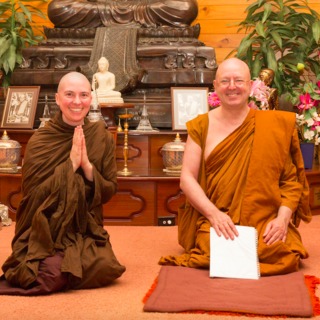
Sometimes I sit myself between the Buddha Ajahn Brahm and my other two main teachers on either side and I just let myself dwell in that environment,
In that atmosphere and soak it up.
And it's very beautiful.
It also contributes to the letting go aspect of meditation.
It's like,
I'm here,
You did the work,
I've turned up,
Let the teachings take over.
It's kind of an attitude of just giving yourself to the practice without trying to control or expect anything in return.
And then yeah,
Like a safe place is also a good thing.
And this psychologist,
Paul Gilbert,
He's written a big fat book on compassion.
I would totally recommend it.
And I'm not always into like psychology,
But this is,
It has heaps and heaps of Buddhist related practices in it.
It's about this big,
This big.
And it's wonderful,
Paul Gilbert.
And in there he talks about having like a compassionate friend.
So you,
You develop this being so that you can readily draw on that imagery or on that sense of their presence whenever you need to.
And also a compassionate place.
So like I was saying,
Maybe a place with sun setting and the waves of the sea are just lapping up on the shore or whatever else you might be under a nice big copper beach tree like I am fairly often in the park.
And so I really recommend this,
This book.
But as well as that,
What I found quite helpful with presence,
With being aware in a kind way is to notice when I'm getting sucked into the difficult,
The difficult emotions or the difficult sensations and just notice that my mind's getting contracted,
It's getting pulled in.
It's what they call negative bias,
Negativity bias.
We like to find the suffering and focus on it and fix it.
And sometimes we just need to pull back and give it space.
So you can actually energetically shift your awareness from say being very tightly contracted or focused on an area to being wider.
And this may include just staying with the outside of the body or even spreading your awareness beyond your body into the room.
I was doing this during one period of my life,
Which was very,
It was like one of those kind of crisis points,
Like a turning point where you don't know what you're doing.
And I was just literally without anything.
I think there was no more support.
And even my parents had said they're not going to pay for my ticket to Australia that year.
And I was kind of stuck in England and I didn't know what was going to happen next.
And there were quite a lot of difficult emotions coming up,
Just kind of a sense of heaviness and almost like crushing inward on my body.
And I just kept on for that whole three weeks of self retreat,
My practice was to keep expanding,
Keep expanding,
Keep going outward,
Outward,
Expand,
Feel the whole body,
Feel the whole room.
And by the end of those three weeks,
My whole energy changed.
I just felt incredibly light and really ready for the next step.
And that proceeded beginning and then coming back.
That was right at the start.
And so my attitude to being sort of so-called stranded suddenly shifted.
And I thought,
No,
This is how,
This is my challenge now.
And this is a wonderful thing to be doing.
So that was wonderful.
And that's quite an effective way to practice in the sense that you're not avoiding the difficult feelings.
You're with them.
You just give them a bigger container.
Yeah.
You're not like trying to bypass them or kind of go to the breath and focus on the breath and avoid all those feelings and just get away from it.
You're actually including it so that your mind can have an expansive sense of calm.
And then when the breath arises,
You can be with that breath in its entirety and it almost just fills the whole body and mind until the body starts to fade and becomes very,
Very light.
Yeah.
So this is a really nice way to work as well.
And then I wanted to talk a little bit about the thoughts and how to work with thoughts.
I came up with this little acronym,
R.
R.
A.
S.
S.
To help me remember a sort of sequence that I usually work with when I'm working with thoughts.
So R.
R.
A.
S.
S.
Is like RAS.
RAS.
So the whole point of this is to start to sort of come out of being a victim of our thinking process,
To get a bit of a perspective on where our thoughts are leading us and to try to learn to guide thinking in a wholesome and helpful way.
Yeah.
Because thoughts have so much power.
You can just experiment yourself,
You know,
Put a negative thought in there and feel the resonance of that.
Put a positive thought in there.
Feel that,
How that feels.
It's totally different.
It's totally different.
And yet we can become so kind of fixated on seeing things a certain way.
You know,
We sort of keep going down these loops and particular pathways that are just leading us to more and more stress.
And I do it myself still from time to time.
My thinking seems so real at that point.
And I've lost all perspective on the fact that I'm not in a very good mood to begin.
So of course,
My thinking is going to be a little bit negative.
It's not to be believed.
I don't know about people here,
But I find that one of the common denominators for me being in a bit of a low mood,
It's almost always tiredness.
Almost it's bound to lead to more negative thinking and a lower mood just because I don't have the energy of the mind at that time.
You know,
So self-compassion can include going to bed on time and,
You know,
Really looking after yourself in a proper way,
Looking after your body,
Cooking yourself nice food,
Being out in nature for long enough,
Not just staying in the home.
Even if it is dangerous to get out,
There's ways to do it.
You can go out early morning,
You can wear a mask if you feel more protected that way.
You know,
There are things we can do to really nourish ourselves and that do show a certain sense of self-compassion.
They also help when you are stuck with the thinking,
You know,
And you're just getting kind of down a rabbit hole.
Just open up again,
Feel the nature,
Listen to the birds,
Get that perspective,
That standing back.
So anyway,
To go through my little acronym,
It starts with R for recognize.
So this is where we recognize the content of the thought,
Right?
But we recognize the content of the thought,
Not in a kind of very judgmental and hostile way like,
Oh,
Look at this,
This is terrible,
But in a kind and gentle way,
Just recognize what's present.
Yeah,
That's the first step.
So that's that awareness again,
That mindfulness.
And then the second step is to relax,
Especially if the thinking is distressing or disturbing in any way,
Just to relax and get that sense of context.
You know,
Maybe go to the breath,
Do a gentle body scan and just get some presence established first of all.
So that's why we usually start with the breath or the body,
Just to establish yourself in the present moment.
And that already can help to bring us out of the conceptualizing mind.
And then the next thing is to accept those thoughts.
So to take away the struggle,
You know,
These shouldn't be here,
Why are these here?
I shouldn't be having this thought.
I always think like this,
This is terrible.
Or to just be believing and rolling in those thoughts.
Yeah,
That's not really accepting.
So accepting means kind of understanding that they're there,
And even validating them,
You know,
Okay,
It's okay to have this thought and to empathize with that.
You know,
It's quite understandable that I'd be thinking this way,
I didn't have a lot of sleep,
I watched something disturbing on the news.
You know,
This is the way I've been conditioned to think.
So we can accept that thinking so that we have some amount of objectivity around it.
And then the next thing is to stand back from that and to recognize whether that thought is leading to your benefit or to your harm.
Yeah.
So we accept it because we have to understand what's happening.
But then we stand back and we say,
Okay,
Is this thought worth keeping or not?
And the Buddha was very clear again in the Madhyamunikaya,
Two types of thought it's called.
Yeah,
Two types of thought and it's two types of three thoughts.
So on the one hand,
You have thoughts of love and kindness,
Thoughts of compassion,
And thoughts of letting go or renunciation,
Giving,
Giving away.
And on the other side,
You have thoughts,
The opposite three,
Thoughts of ill will,
Thoughts of anger or animosity,
Thoughts of cruelty,
Again,
The opposite of compassion,
Thoughts of cruelty and harm,
And thoughts of desire,
Sensual desire in particular.
And the Buddha said he recognized those three,
You know,
Which ones they were,
Whether they were the wholesome ones or the unwholesome ones.
And after recognizing that,
He rationalized with himself,
Well,
Is this leading to my benefit or not,
Is it enlightenment or not?
And when he realized it wasn't,
He abandoned those thoughts.
And in another sutta,
It actually says he substituted.
This was the first method to start to overcome the negative thinking was to substitute.
The unwholesome thought with a more wholesome thought.
So that's the fifth one,
Substitution.
Yeah.
So when we substitute,
We guide our mind towards more compassionate thoughts.
And I really like,
Again,
I think it was,
I forget who said this,
But somebody said you can even have thoughts about the thought.
So what you can do instead of saying,
Oh,
This is all so terrible,
I'm hopeless,
It's all going wrong is take one little step back and say,
Oh,
I'm having the thought that this is terrible and this is going wrong.
Yeah.
So that's a thought about the thought.
It's still the thought,
But you're recognizing that there's someone having the thought.
That means you're a little bit separate from the thought.
The thought is not you.
Right.
So this is one thing you can do.
Another thing you can do is actually empathize with those thoughts.
As I said before,
You can add a different thought such as,
Oh,
I'm sorry to hear that you're feeling that way,
But it's understandable.
You know,
You've had a hard day and,
You know,
Your friend didn't call when she said she'd call and I know you really value reliability and you can actually talk to yourself the way that a friend might talk to you.
Right.
So this is again where you can bring in this compassionate imagery,
The compassionate friend,
And imagine how they might respond if you had that thought.
They probably console you,
Soothe you,
You know,
Try to turn it in a different way so that you're not just going down this track of,
Oh my goodness,
Everything's going wrong.
Nobody loves me.
Yeah.
Just because you had a thought and it's so difficult,
You know,
Not to get hooked on thoughts.
Sometimes they seem to have so much truth to them and yet they're never true to reality.
So always one step away from feelings,
One step away from reality.
And then the another way of thinking or speaking to yourself is just the outright substitution of the unwholesome thought with the thought of compassion.
And that's what we were doing earlier in the meditation.
If anyone of you tried that,
It was just to inject a thought there,
A thought that points the mind to freedom from suffering.
You know,
May I be free from suffering?
I did this the other day.
I watched that terrible video and I'm glad I've watched it because we need to know what's happening.
But I watched it at the wrong time of day.
It was quite interesting because when I and Anandabodhi came on to give a talk a couple of days ago,
She also watched it at the wrong time of day,
Right before bed.
I don't know why.
Maybe nuns are always busy right up until then or something.
Well that's our only kind of personal time or something.
But I found myself sickened to the point of wanting to vomit.
Like I almost had to run to the bathroom.
And then I found my breath was very strong.
Like really,
And I just stayed with that.
And I realized presence is not enough because it's late night and I need to sleep.
So I just added,
You know,
May all beings be free from suffering.
And I just kept on saying that and focusing on that freedom from suffering.
May they all be free from suffering.
May they all be free from suffering.
And gradually,
Gradually,
I just soothed myself to sleep.
So this is really powerful because if we are able to soothe ourselves,
We're also able to open up to suffering when it's necessary to.
And not to recoil or withdraw or bypass the problems in the world.
You know,
Sometimes we need to speak up when it's important to.
That's what's called being an ally or manifesting thoughts of compassion into speech,
Into action.
This is very much part of the Buddhist path.
The Buddha always said that not to kill doesn't only mean to abstain from killing,
It also means to protect life.
With rod and weapon laid aside,
Compassionate to all beings,
Protecting the life of all beings.
And speaking words that go to the heart,
That heal divisions,
That unite the divided.
This is straight from the Buddhist text,
Majjhima Nikaya 51.
So this is really important and I think this also stops the empathy that we may have going into empathetic distress and trauma.
And it's from the place when it does go into that empathetic distress that we don't have the capacity to respond wisely anymore.
And it is more likely that further violence will accrue.
I often sort of look at these kind of things and I just think,
Yeah,
You know,
With all the rioting that was happening in America,
I mean,
It's coming from a place of trauma and distress.
And if people had more of an ability to generate compassion for their own suffering before taking action,
Then they'd be coming from a different place and it wouldn't be so likely to lead into unwholesome ways of responding.
And this is not to judge them because I understand,
You know,
That we can't understand.
I understand that we can't understand the trauma that's happened to those communities,
The black communities in America in particular.
Yeah,
But if we can develop compassion and focus on that freedom from suffering,
Starting with oneself,
Then we have a chance to really generate compassion in all the directions just as we do with the matter.
The Buddha said,
You know,
Abundant,
Exalted,
Immeasurable,
Without hostility and without ill will.
I will abide,
Pervading one quarter,
All quarters,
That means all around and above and below,
With compassion,
To all as to oneself.
Yeah,
So this is the practice and we can start from where we are in daily life and in our discussions with others in the way we use our privilege if we have privilege,
And in ways that really heal some of the suffering in the world.
But I really want to encourage you to learn compassion for yourself because it will build up that tolerance to difficult feelings,
To anxiety,
To stress,
And help you to focus and be proactive in the freedom from suffering for yourself and for all beings.
Okay.
So I think that's all for tonight.