Okay,
So this is Ajahn Brahm here,
And we are scheduled to do a guided meditation for the first 45 minutes.
And the guided meditation,
I hope you can hear clearly enough.
But if you can't even hear clearly enough,
Even to begin with,
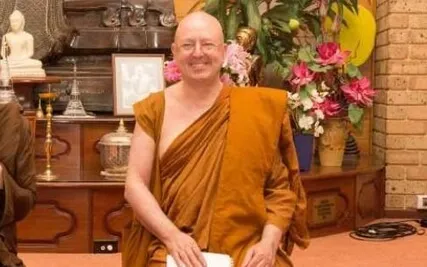
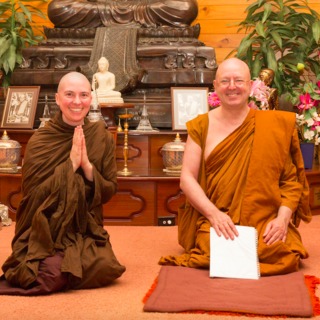
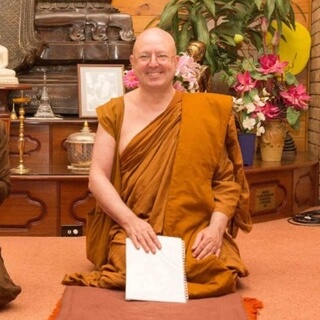
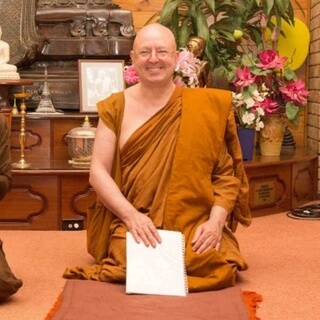
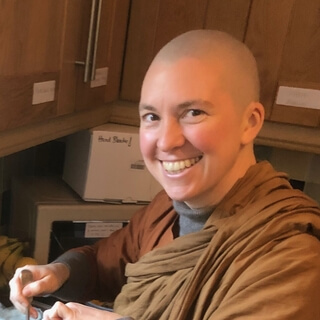
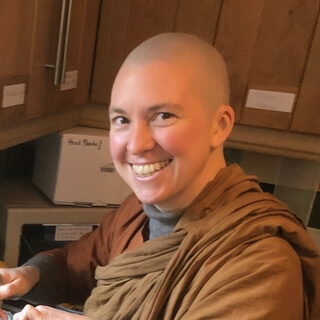
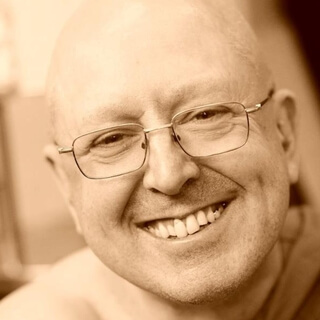
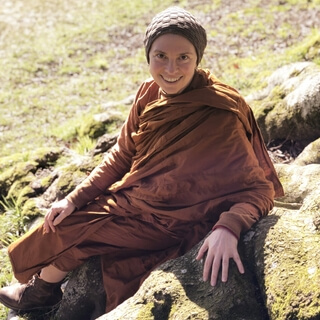
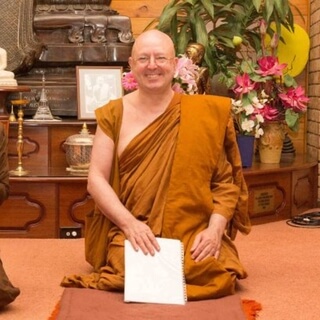
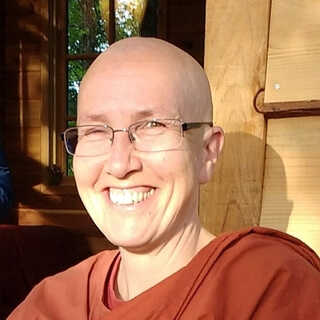
Open your eyes and see the image of a monk or a nun,
Because sometimes that can inspire and calm people.
I hope that in your rooms,
Wherever you are meditating,
It's peaceful for you.
I know I mentioned before that if you're in a noisy place,
Or a place where there are many distractions,
Just imagining that you're in a bubble with your eyes closed is not that hard to do.
When somebody comes up and makes a noise,
Just don't allow it to penetrate the bubble in which you are meditating.
And that means that in this very crowded and busy world,
You can find opportunities to meditate almost anywhere.
And you may notice that,
Why does Ajahn Brahm start the guided meditation talking?
And the reason is because it is giving a couple of minutes to set the tone,
Even by speaking.
Hopefully that my voice can calm you down and bring you to a certain level of peace.
And then when you close your eyes,
You can take that peace even deeper.
I've often noticed,
It's what happens before the meditation,
It's important to see how deep the meditation can go.
If you're running around and suddenly stop,
It's just like the engine is still too hot.
And it takes a long while for the engine to cool down.
So if you're being calm and peaceful before the meditation starts,
It makes it much easier.
Very good.
So now,
Having said just a few words,
I'd ask you to close your eyes.
When your eyes are closed,
To become aware of the feelings in your body.
Those feelings in your body are important because it is like your body is telling you,
Please,
My legs aren't in a good place,
My back is not in a good place.
When you're starting to meditate,
Many of you have meditated many,
Many times.
And so the body knows what you're up to.
You just have to listen when it says,
Today,
I need my butt to be more comfortable on the cushion.
That's what my butt is telling me.
So you adjust the position.
You move.
And it might tell you that,
No,
Your legs need adjusting.
So listen to your body right now.
That ability to listen and to act with kindness is what we do throughout the meditation.
That listening is just a metaphor for being aware,
Being mindful.
When I say to listen,
You're not listening with your ears.
You are being mindful with your awareness.
You can feel your body.
It's quite amazing to me that many people live their life and they're not aware much of their body at all.
They're aware of thoughts and plans and memories.
But when you are a meditator,
You become much more sensitive to your physical body.
And when you are sensitive to your physical body,
You can learn from it.
You learn how to sit.
You don't learn from the books.
You learn from your own experience and your kindness and respect to your own physical body.
So I am being aware of my body right now as well as talking to you.
I'm just checking to see that my body is as comfortable as I can possibly get it.
Of course,
There are many types of comfort.
There's a comfort when you just want to fall asleep.
There's a comfort which is best for meditation.
And for me,
That comfort is usually sitting cross-legged.
And it's strange.
I've tried many different postures for meditation.
And I just like the Burmese meditation position.
Even though I've never been to Burma,
Been close and seen many Burmese monks.
But that is where there's no pressure on my legs.
Because I've been doing this for so many years.
My legs are used to this.
I like sitting straight up,
If at all possible.
My body seems to understand that this is a meditation posture.
And so it sets itself up for meditation.
For so many years,
I make sure I don't waste this time on thinking about problems or fantasies or anything else.
It's not just you set yourself up in a quiet place.
In a place where you won't be disturbed by others.
You make sure that your mind is not going to go off course by solving all the many,
Many difficult problems you have in your life.
I did mention a little bit this morning about all the difficult roles which I play in my life.
I know that.
I make sure when I meditate,
I don't allow any of those problems and problem-solvings to come up in my meditation.
This is one purpose in my meditation.
And that is to have calm,
This beautiful awareness and silence in the mind.
As if I tell my mind at the beginning of this meditation,
Be aware,
Be kind,
So we can enjoy silence.
That's all.
I don't tell my mind to go to any of these amazing meditations like Jhans and stuff.
With enough mindfulness,
Kindness and silence,
Those are the causes of these deep meditations.
I just have to look after my mind,
Make sure it doesn't wander off.
Because I know from long experience that the best solutions come from silence.
After the meditation is finished,
When I start to come out of the meditation,
And I open my eyes,
Any problem in my life or in my responsibilities to many Buddhist societies and communities,
Any of those problems can be solved so much easier after emerging from silence.
So I convince my mind of the importance of silence.
And I've convinced it for so many years.
And I know from those experiences of deep stillness how important they are,
How valuable,
How precious.
They are like priceless jewelry entrusted to me.
I make sure I never lose them.
This is more priceless than jewelry.
This is like the triple gem,
The Buddha,
The Dhamma,
The Sangha,
The Dhamma.
And because of that,
I value the stillness.
So when I start,
I've looked at my body.
Because I've done that part of the guided meditation many times,
I think you should know how to do it.
You start with the place furthest from your head.
And I start at the toes,
Simply because most people in our Western world are just too into their heads.
So going a long way from your brain to your toes can be quite challenging.
Anyway,
Right now,
Can you feel your toes?
If you find that difficult,
Wiggle your toes.
All you are doing is making a neural connection from your brain to toes.
When people say,
Why?
Why?
Because it just shows you how mindfulness can be strengthened to any part of your body and then to your mind.
When I realize that my toes are comfortable,
I never rush these things.
Because even if my toes are comfortable,
They appreciate recognition.
Like everybody appreciates being recognized.
It makes them relax,
They don't feel so afraid.
Strange to say you can have toes which are afraid,
But it's similar.
Then go up to your feet.
I know my feet,
Strange thing to say,
But we are good friends.
I look after them when I need them to do things.
They very happily oblige and they feel great right now.
I go to my ankles,
Which also,
I can get the feeling in the ankle.
After a while you notice every part of your body has a different feeling to it.
Unfortunately we don't have names to describe that,
But that doesn't matter.
It's ankle feeling.
I know when those ankles are sprained,
They have a particular type of unpleasant feeling.
I don't judge it,
I know it.
And then today my ankles are fine and I just move up,
Gently up the body.
It's not so much what you do as how you do it,
Which develops deep meditation.
So I go slowly,
Slowly up my lower legs.
As I mentioned this morning,
When you are mindful,
Kind and peaceful,
Those sensations can be very delightful.
That's why it's quite easy to do.
It's fun,
It's joyful.
Scaling up my body,
I get to my knees,
The knees are in good shape right now.
So I sweep past them,
Just pausing a little to make sure everything is OK.
I don't want to discriminate one part of the body over another part of the body.
We are a team,
We work together.
So after passing the top of my knees,
Go up to the thighs.
Maybe it's because I don't do much exercise.
I have to keep myself fit,
Going up past the thighs.
You can feel them,
They are usually extremely comfortable.
Go to my butt,
The buttocks.
And this is always something which teaches me.
I'm going to sit in meditation for quite a long time,
45 minutes or maybe longer.
You've got to make sure that those buttocks are comfy.
You can't make them 100% comfortable.
There's pressure on them,
So I don't try to get rid of that feeling of pressure on the buttocks.
I just make sure they are as comfortable as possible.
Give them that attention without trying to cure them,
To care for them.
And as I go past and go up to the rest of my body scan,
I always notice that after a little while you can't feel the sensations in your butt.
The reason is because it's a constant type feeling.
And the body can only notice feelings which change,
As they get worse or better,
To throb,
To pulsate.
Otherwise it becomes an ambient feeling which disappears.
I go up on my back.
Sometimes people have trouble with their backs.
I remember just having sciatica many years ago,
And I was bent like an old farmer which I used to see in Thailand.
It took me about six months of exercise to overcome that problem.
Other people gave me advice,
But it was hopeless.
You had to find the knowledge of your own body,
The wisdom and the kindness,
To be able to heal problems which are sometimes unique to your body.
But now I can feel my back.
And as I mentioned before,
For me,
I stretch my back.
And after stretching it,
I know how to let go.
The back has become so loose,
So at ease.
I kind of know that now I don't need to do anything until the meditation finishes.
Sometimes you can meditate for hours like this.
And then again I go to the waist,
And make sure that the insides of my body are relaxed.
In the same way that I relax my back,
Relax my butt,
Relax my legs and my toes,
I relax my intestines and colon.
Feel it.
The wonderful thing about mindfulness,
It does allow you what we call feedback.
You can notice just how the feelings in your intestines or colon or whatever,
How they change.
And I know how to,
As I say,
Relax to the max.
I've practiced that by trial and error.
So now I can take a part of my body,
Like my intestines,
And just relax them fully.
So there is ease.
What was an ache a few minutes ago,
Now it becomes peaceful.
It disappears.
It's what you learn by mindfulness,
And trying this and trying that,
And finding what works for you.
I go up the rest of my body,
Stomach,
Spine,
Maybe a good lunch today,
Thanks to Annie,
And thanks to somebody.
Further up to my lungs,
I can feel my whole torso,
Trying to recognize every part of it and relax it to the max.
Even right now,
My torso just feels so at ease.
It's a delightful feeling.
Sometimes people ask me,
How can you love yourself?
As many people say,
It's an important part of the spiritual journey.
This is a very effective way.
Please love your body,
The home in which you live.
Go to my shoulders,
Feel them now a bit tight.
I learn to loosen them.
When you loosen something like your shoulder muscles,
It is like they've been stretched.
Now I let go of both ends.
I learn how to do that.
If you want to be able to relax those muscles,
Just try this,
Try that.
And every time you try something,
Just with your mind,
It gets worse,
It's the wrong direction.
Every now and again you do something,
You think something,
It does feel more relaxed.
I notice that shoulder muscles are like guitar strings.
When they are tight,
Something hits it,
There's a ping.
When they are loosened,
Something hits it,
Boom.
When they are really loose,
Something hits it and there's no resonance.
That is one of the keys to understanding is resilience.
Resilience is not just shoulder muscles,
But your whole life is so relaxed.
If something hits it,
And for ordinary people it might really create a loud,
Ah,
But when you're relaxed,
It hardly makes a sound at all.
You're loose and resilient.
I get down on my arms,
Pass my elbows.
Sometimes you do knock your elbows.
I remember falling off ladders several times,
Building monasteries,
And my wrists can ache and hurt.
They've never been broken,
Surprisingly.
Right now they're fused,
Same with my hands and my fingers.
My fingers don't usually experience pain,
But nevertheless I want to ensure that they too feel comfortable.
I kind of inquire,
Fingers,
Hand,
How are you?
What do you need?
I care for everything.
I care for my fingers.
Fingers care for me.
Go back up to my shoulder,
My neck,
Making sure that the head is well balanced on top of the neck.
If anybody had their eyes open and see me just moving my head backwards and forwards on my neck,
I want to find that best position,
Most comfortable.
And then lastly I go to my head.
Muscles around the eyes and the mouth,
And anywhere else on the head.
I'm aware of them.
How do they feel?
The muscles around my eyes are tight,
So I loosen them.
Not so much as to open the eyes,
Because I prefer the eyes not to be bothering me with sights.
I just loosen the pressure so the eyes remain closed,
But not tightly screwed shut.
Same with the muscles around the mouth.
If you can,
Without disturbing yourself,
Put a little smile on your mouth.
Meditation is meant to be delightful,
So having a little smile,
Even a fake smile,
Can often help meditation go deeper easily.
And then I can feel my whole body sitting here,
Joining as many parts together as possible.
Obviously as many parts of the body which I wasn't aware of at all,
That weren't a bother to me.
The main parts I watched and relaxed.
And I must honestly say I enjoy this part of the meditation every time.
Looking at my whole body,
Having deliberately relaxed every part of it which I could.
And it's like a car which is well tuned up,
Full supply of petrol,
Ready to go into deep meditation.
Not just wasting time,
That degree of carefulness is something which is so important for every stage of the meditation.
I'm not going to rush.
And then from the body I go to the mind.
And I appreciated that question either last night or the night before.
What is the mind?
And again,
Go to one of the qualities of the mind,
One of its important parts.
You don't see the whole of the mind,
Just see that part of the mind which is called peace.
We all know what peace is.
Not fully.
We know enough of the qualities of peace to be able to recognize it.
This is peace inside of you.
Not in the world or in the family or anything outside.
Peace inside of you.
Peace has a quality of contentment.
A quality where it's good enough and you don't have to do anything,
Change anything.
Like sitting in a chair in your room which is comfortable,
And having nothing to do,
And be at ease not doing anything.
The moments are peaceful.
Don't look at the big picture of your life or the world.
Just look at this moment in your mind.
Is it at peace?
If you're noticing the peace in my mind right now,
It really is delightful,
It's wonderful to watch.
Peace has a component of pleasure in it.
Not the pleasure which disturbs a human being,
But the pleasure which calms one down,
Which results in relaxation,
And even stillness.
So peaceful there's nothing to do.
Why disturb the peace?
You deserve peace.
If you just watch as I am aware of peace,
The peace gets deeper and deeper.
It gets more,
Call that tangible.
You don't need to imagine it,
It's there.
Peace of mind.
I always notice that the peace of mind,
It's always,
It can only live in the present moment.
The past is just too troubled for everybody.
The future is too uncertain.
This moment is here.
We've all got the wonderful good fortune of being able to spend this moment now in meditation.
We can be at peace with this.
Being at peace means not seeing the faults in this present moment.
Being grateful to have this moment of freedom.
Freedom from having to fix things up.
Freedom from having to do something to make it better.
Freedom not needing to do anything at all.
To relax in a thorough physical and mental way.
Already when you start to feel that peace,
You see it get deeper and deeper and deeper.
You become in the present moment.
The past and the future are just kind of meaningless.
They have far less value than the peace you can experience right now.
Quite naturally your mind will settle on that which it finds of greatest value,
The most important things,
And that is peace.
You stay in peace.
You don't need to think about it,
Contemplate it.
The more you experience peace,
The more you understand it.
Peace,
Like many of the qualities you go to in meditation,
Is kind of shy.
If you try to tell its name,
It gets embarrassed and runs away.
If you try to capture it,
It will run and hide.
If you leave it be,
It is always there with you.
You don't own this.
You are just kind to it.
Let peace energize you.
It gives you confidence that you can meditate.
And it is delightful.
As you will notice sooner or later,
As you are aware of peace with kindness,
Your awareness grows and you notice that you are silent.
You are not asking to think about.
There are no names needed.
You don't need to take notes.
Your memory will be able to recall what happened and why.
That is the job of memory.
You don't need to take notes.
Just enjoy the silence,
The stillness in this present moment.
To sustain it,
Be careful not to do anything.
It is kind of self-sustaining as long as you don't get involved.
Don't be like the backseat driver giving instructions.
Stillness happens.
The mind loves it.
Given a chance,
It will stay there.
And already for me this happens every time.
When I get peaceful and silent,
Soon I notice I am becoming aware of my breathing.
It is the last thing which is making a sound,
A noise,
A feeling.
Even now my breath is very soft.
I don't control the breathing.
I don't say long breath,
Short breath or whatever.
I let my lungs do the breathing.
I do the watching.
I do the kindness.
In that way,
Very soon you notice the breath as it comes in.
It comes a beautiful,
Delightful breath.
It is not just like the ordinary breath which I breathe.
It has these qualities which the Buddha described as pity,
Sukha,
Delight,
Joy.
Once you can experience joy,
Contentment,
Just breathing in one in-breath,
Breathing out one out-breath.
I do call that the pivot point in meditation.
After that you are on your way.
Let it progress by itself.
Stay like that for a long time.
Watching the delightful breath coming to your body.
Watching the delightful breath go out.
If your attention does zoom in,
All the stuff on the outside,
Sounds,
The feelings in the body,
Tend to fall off your screen.
You don't eject them.
It happens naturally when you focus inwards.
All you have is this little breath happening now.
Not controlling it,
Observing it,
Giving it kindness.
Again,
Please excuse me,
But I have to be quiet now.
I am meditating too.
My mind demands me to enjoy.
I am getting close to the end of this meditation period.
So don't open your eyes yet.
How do you feel inside?
Is your mind like right now?
How much peace and joy can you perceive?
What worked for you?
What didn't work?
Don't be afraid to try new things in meditation.
Doesn't work?
Fine.
Now you know it doesn't work.
It does work.
You found a wonderful new way which feeds the peace of mind.
And also how delightful is it?
As a monk,
As a nun,
These are our happy abidings.
Sit in meditation in peace and joy.
Where you want nothing in the whole world.
Moments of contentment.
Peace.
How does your body feel?
Your body may have had an ache here or pain there.
The more stillness and peace you develop in meditation,
The healthier your body.
It has a chance to heal itself.
And when you are ready,
Please open your eyes.
And then start moving the body again.
As you come out of this brief meditation.
And smile.
A smile helps take the happiness and peace of the meditation back out into the world.
Thank you for giving me the opportunity to teach.