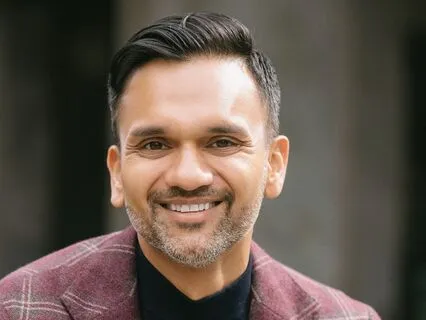
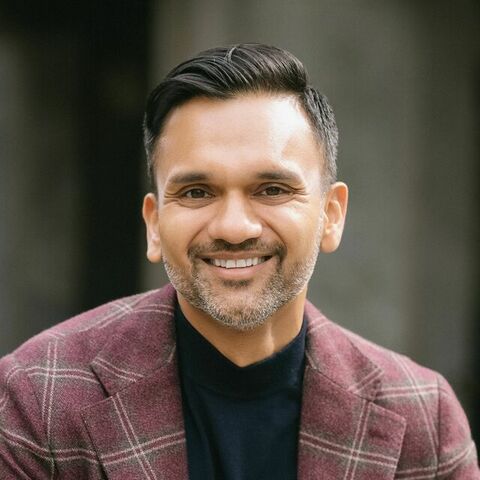
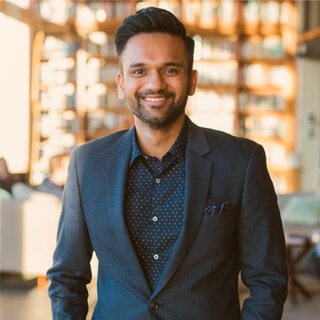
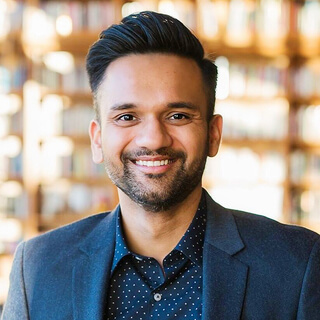
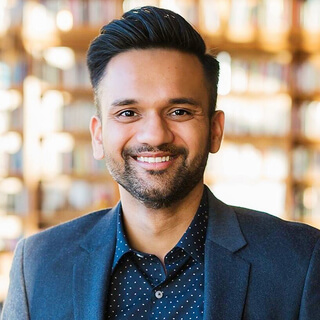
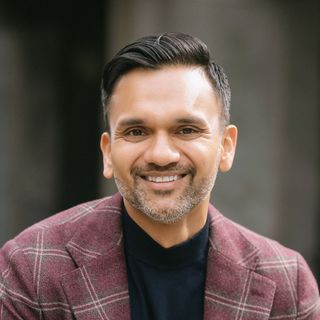
I'll be speaking to you today about sustainable compassion,
Wise leadership and self-care for times of change.
I'm really thrilled to be here and I'd love to introduce myself before we begin.
So by training,
I'm a lawyer,
A scientist,
A meditation teacher,
Author of a book called Breaking Bias.
And for the past decade,
I've trained over a hundred thousand people at hundreds of organizations in meditation tools to overcome identity-based division.
But beyond that,
My professional accomplishments,
I'm also a gay immigrant of color and I'm a poly-spiritual.
I am a member of a Christian church here in New York City where I'm based,
As well as a practitioner in the Buddhist lineage as well as Kriya Yoga.
So today,
As I'm speaking to you about this topic of sustainable compassion and wise leadership and self-care,
I'm really bringing to the forefront these various traditions that have animated my life over the last 40 years.
So without further ado,
Let's begin.
One of the things that I really wanted to speak to you about is how do we bring what are essential skills,
I would say,
Of wisdom and compassion to the forefront in a really perilous time,
In a time of a lot of confusion.
If you look at the world around us,
You'll notice that a lot has changed and a lot is changing quite rapidly.
You know,
Many scholars and philosophers call the times that we're living in is a time of poly-crisis,
Of ecological collapse,
Of social and political hyper-polarization,
Technological acceleration,
And uncertainty with AI,
With robotics,
But also an epidemic of mental health challenges that not only affect us internally with respect to depression or anxiety or loneliness,
Hopelessness,
But also affects our relationships with,
Of course,
Ourselves,
But also with one another,
With the larger world we're a part of,
With the planet,
With other animals,
With the communities we're a part of,
With our sense of nationhood or ethnicity.
So it's a turbulent time of a lot of change.
And for me,
As I was reflecting on what to share with you all today,
I was really reminded to kind of go into some of the deeper teachings that really led me to write my book,
Breaking Bias.
So today I'll be really speaking to you about the wisdom piece of how we incorporate that in our lives and the compassion piece.
But before we kind of jump into this,
I'd love to also acknowledge that just hearing some of these words coming out of my mouth might be difficult,
Right?
There may be some discomfort or uncomfortable affect that may arise,
You know,
And I'd love to invite you to really hold that with compassion,
With kindness.
You know,
Notice the body sensations of the discomfort.
Perhaps there's a contraction or a tension somewhere in the body.
You just take a moment to really notice what that is.
What are those sensations like?
Where are they?
You know,
For me,
This is the somatic intelligence of our body telling us something.
And this is where we bring the power of mindfulness,
The power of our awareness.
We shine that light on that discomfort and really bring a sense of kindness and compassion to it.
So it could feel like it's being accepted,
It's being acknowledged,
It's being seen.
So we can slowly shift it,
You know?
So this work of building sustainable compassion is one I'd like to use.
I like to use a metaphor of a garden.
You know,
We're really tilling the garden of our mind,
Tilling the garden of our mind,
Heart,
Of our consciousness with wholesome and skillful mental and emotional states,
Things that bring us joy and slowly really plucking out,
You know,
The negativity,
The negation and things that are just not helpful day to day from that garden.
So I hope this metaphor is going to be helpful for us as we go deeper into today's talk.
So one of the first things I wanted to begin with today is the blueprint that really has been a guiding star for my life,
My professional life,
Or since I went to law school about 15 years ago,
Which is a quote by Dr.
King,
Dr.
Martin Luther King Jr.
And he said that our goal is to build a beloved community.
This will require qualitative shifts in our souls and quantitative shifts in our lives.
And for me,
I,
You know,
Whenever I reflect on this quote,
I'm always just really surprised by the depth of this vision that he held for us,
This beloved community,
This community where all beings belong and the fullness of who they are.
And also how we get to this beloved community,
We create it by ourselves through making qualitative and quantitative changes in our lives.
And we begin that process right here with this being,
This being that is most present here in this moment.
So it's really a call to leadership for me and for me,
You know,
Leadership is really something each and every one of you is.
You know,
We often think,
I'd love to invite you to actually think about the word leader and notice who comes to mind when you think of that word.
Perhaps a politician,
Perhaps a head of a company or an organization,
But I'd like to now invite you to face an image of yourself next to the word leader.
So this is a practice of stereotype replacement.
This is a practice of supplanting and building new neurotransmitters.
But to also acknowledge that you are a leader,
Whether you've been conditioned to think that way or not,
But you are a leader,
Perhaps in your workplace,
In your community,
In your family.
But even if not in any of those places,
You're a leader in your own life.
And a leader is really someone who sets the vision,
You know,
Sets the direction,
Makes decisions,
Embodied in certain values and has the courage to move towards that vision,
Regardless of the challenges that confront them.
And that is really the invitation of,
You know,
Our life's journey,
As I like to think.
And this is what Dr.
King has been really asking of us.
And for me,
You know,
Another person that I really admire is Gandhiji,
Mohandas Gandhi,
Who has helped,
You know,
My ancestral home of India gain independence from the brutality of British rule.
And he often says that,
Be the change you wish to see in the world.
And for me,
That's really powerful because he's asking us to be the change.
So whatever we wish to happen out there,
Peace,
Love,
Kindness,
Unity,
Be that.
And that is kind of the ripple effect that we'll have through just being that into the world.
So hopefully you can begin to see that,
Wow,
Like as you reflect on this idea of leadership and what you're called to do,
What you're called to bring in this time of,
You know,
Poli crisis,
Well,
Whatever it is that you want,
You can be.
And how do we be that?
And this is where wisdom and compassion can be our wonderful,
Wonderful companions.
So I'll share a little bit more about that now,
And then we'll practice.
So I'll speak for about 20 minutes or so after this,
And then we'll do a meditation practice together for about 10 minutes.
So you can get an embodied experience of how do we shift?
How do we make that shift within ourselves to really embody wise leadership and self-care?
So as you begin,
I'd love to begin with a story about my own life.
You know,
I've shared a little bit about my personal identity and professional background,
But a lot of people are surprised that someone like me has been working on this topic of bias and overcoming divisions and polarization,
And then also complementing that with meditation,
Like how did this all come to be?
So,
You know,
Basically this has been my life's journey.
This has been my life's purpose.
And one of the reasons how I found this work is,
You know,
I moved to the US when I was very young,
I was about 10 years old.
So I remember quite a bit of what it was like to first be an immigrant to the United States in New York in particular,
But also feel being othered,
You know,
By the society that was around me,
Oftentimes for no other reason than my being,
The way I walked or the way I talk,
The inflection in my tone,
My accent,
My skin color,
My heritage,
You know,
And many of these things I had no control over.
And yet I was being,
You know,
Taunted for it.
I was exposed to a lot of challenges,
Particularly in the aftermath of 9-11,
Where people who looked like me were presumed to be terrorists and told often to go back to where they came from.
And so these little micro cuts were really kind of the formative beginnings of becoming American for me in this country.
And,
You know,
What I did at the time,
Because I didn't have the emotional wherewithal to really be with these painful experiences,
I just suppressed them deep within and did what I thought was best,
Which was accomplish and be professionally successful.
And I continued to do that.
And I was very successful at it until I got to law school where,
You know,
Being in that pressure cooker environment,
And it all just came to a boil,
I would say,
Where,
You know,
It was 2009.
So I would say it was like 16 years ago.
You know,
It was right before the beginning of my second year of law school.
I found myself on the ledge of my 18th floor window about to jump off.
And here I am standing on the ledge and I'm basically having all these thoughts in my mind about the things I've been called,
The ways I've been treated or mistreated,
And all the emotional affect that accompanies this experience of being othered.
And my mind is racing and it's telling me to jump and jump and jump.
And I do,
I jump.
Now I'm here,
I'm not a ghost clearly in front of you,
But I want to say that I don't understand what happened next but instead of falling onto the Midtown Manhattan traffic below me,
I fell back into my apartment.
And for me,
That was really the gift of life that was given to me by a mysterious reason.
I still don't know how that happened.
And within a few moments,
I reached out to someone who,
For help,
Who lived quite far away,
But happened to be in my neighborhood at that time and showed up in my apartment right away.
And the rest is history,
You know,
And the next day I began my own breaking bias journey.
And in that journey is what I've discovered,
You know,
Basically the gems and the jewels of,
You know,
A lot of ancient spiritual wisdom,
But also modern neuroscience,
How it's speaking the same language,
Using different vocabulary,
But speaking the same language.
And one of the things that I've understood,
And that I speak a lot about,
You know,
At the intersection of science,
Spirituality,
And social change,
Is that every challenge that we confront in our world together today has a root cause.
And,
You know,
In the Buddhist tradition,
There's often,
One of the things that's often said is that anything we experience is a consequence of certain causes and conditions.
You know,
There is,
The world itself is so deeply interdependent,
Everything that happens.
And for me,
What I began to see is that a lot of these ideas that I held about myself were actually just ideas.
And these were ideas that my mind was exposed to through my conditioning.
And my mind latched on to those ideas because the more I was exposed to them,
The more they felt like they were real.
Whether they were true or not,
They were real.
And that is what bias is.
Bias is the root cause of all of the challenges that we're experiencing in our world together,
Whether it's ecological collapse,
Which is a bias towards the earth,
Thinking that it's an object to be extracted,
To be dug into,
To be exploited,
To be owned,
Right?
It's very different from ways of being that existed pre-modernity and still exist today,
But just not the dominant ways of being.
But it's a relationality piece,
Right?
Or the way I felt othered and different because of my sexuality or my color or my ethnicity.
This idea of feeling better than.
And this is what's known as an imposed design of separability.
This is Vanessa Andriati's work,
Which I love.
And she really defines this idea of colonization or colonialism as the imposed design of separability that causes cognitive,
Thoughts,
Affective,
Emotions,
And relational impairment.
And this is bias.
The way I define bias is learned habits of thoughts or learned false ideas that distort how we perceive,
Reason,
Remember,
And make decisions towards ourselves and towards others.
So our day-to-day decisions is really being programmed into our minds through conditioning.
And that is a consequence of,
And the consequence really is suffering.
So we can speak about it from a scientific perspective.
You put one plus two equals three,
Right?
You put the certain ingredients,
You get a certain output.
And in the Buddhist framework,
It is these causes and conditions that,
You know,
Which are really fueled by underneath unwholesome ways of being,
What's known as the defilements.
Right,
This is anger.
But the biggest defilement that we experience is this illusion of separability,
This illusion that we are separate from one another and therefore better than,
Worse than,
Equal to,
You name it.
Now,
This is delusion.
This is what's known as avidya in the Buddhist canon or,
You know,
In the scientific parlance,
It's illusion because we're not separate.
These bodies that we're a part of is made up of the earth.
Every single element in it is made up of the earth,
Right?
The food that we eat comes from the earth that our day-to-day interactions,
The fact that you're listening to me right now through this recording,
You know,
How many millions of people had to come together,
How many causes and conditions had to come together for this interaction to take place in time,
Place,
You know,
Across time,
Place and space.
So that is kind of,
It's mysterious,
It's mystical.
At the same time,
It's wisdom.
And this is kind of one of the things that one can cultivate by really reflecting on this.
And for me,
You know,
When we forget that interbeing,
Interdependence is our way of being,
That we are connected to one another,
That we are with one another,
That's when we get into trouble.
You know,
This is,
So this is the invitation to really cultivate this idea of remembering our interdependence.
And as I discovered through my research that whatever biases,
Whatever ways our heart,
Minds feel colonized,
Right,
By ideas that have,
You know,
Cognitive or affective or relational implications in our day-to-day,
They have five causes.
You know,
There are five causes that have really created these experiences,
These somatic experiences,
Emotional experiences,
These intellectual experiences of feeling separate from the earth,
From one another,
From technology,
You name it.
And these five causes are first a narrative,
A story that has been constructed,
Which is rooted on separation,
On better than,
Worse than,
On being other than.
And that's really important.
You know,
For example,
There's a story that's been constructed called race.
And the story of race,
The fact that they're fundamentally different human races that are biologically determined is an idea.
It's a false idea,
But it's a story.
It's a really powerful narrative that has punked the global human imagination.
It's only 250 years old,
But it was constructed by a bunch of dudes who collected skulls and found one particular skull,
Very beautiful,
That happened to be from the region of the Caucasus.
And they anointed that skull,
The name Caucasian,
And then simultaneously gave that skull and anyone that may have resembled the body that was around the skull,
We're still talking about a skull,
By the way,
Certain qualities,
Positive,
Temperamental,
Intellectual,
Aesthetic qualities,
Simultaneously giving a whole host of negative qualities to human beings that didn't belong to that particular group.
And that story has spread around the world in the last 250 years through the remaining four causes.
And that is how this particular bias,
In this case,
Racial bias,
Is really constructed.
But this could be applied to gender bias.
This could be applied to religious bias.
This could be applied to disability bias,
But it could also be applied to the way we feel about the more than human world,
The non-human world,
Animate world,
Whether it's trees or animals or the land itself,
And then our relationship with the elements.
So that's the first cause,
A narrative,
A story.
Second cause is policies.
So policies that are constructed based off of this false narrative.
So in the United States or in Australia or in South Africa,
Prescribing to this false story,
There were a lot of policies and laws that were constructed that prevented human interaction across human beings,
Same species,
Based on the way humans were perceived or racialized.
You know,
A lot of these ideas still exist in many places.
If it's not race,
It may be religion,
It may be ethnicity,
It may be gender,
Right?
But policies really build a social container for how human beings interact.
And the remaining three causes are really the way our brains are learning these stories.
Social contact,
Which is our trusted spheres of influence.
So human beings,
Whether it's in person or virtually,
That we expose our attention to,
People who we trust,
Whether it's our family members or friends or teachers or religious leaders,
But also in social media groups,
You know,
On the news,
Right?
So that's how,
You know,
Those stories are,
Whether they're conscious or unconscious,
Those impressions are being filtered into our own consciousness.
The fourth cause is education or,
You know,
Oftentimes we're miseducated about this stuff.
You know,
You'd be surprised how many doctors and lawyers and teachers I've worked with in the last 10 years who still believe that there is a biological gene for race,
That black and white humans are fundamentally different species,
Even though we're 99.
9% alike.
And there is probably a more genetic similarity between a black and a white person than two black people possibly and two white people.
That's just the mystery of,
You know,
Human genomics and human variation,
But,
You know,
That's rational.
But here what we're talking about is something very emotional,
Which is how perception is created.
So education is the fourth cause,
And the fifth cause is media.
You know,
Where our attention goes,
Energy flows,
And that's how our behaviors grow,
Our habits grow.
So this is really how we've been trained to feel separate,
And it's a consequence of certain causes and conditions.
Now,
Just as we've learned these challenges,
We can unlearn them.
This is the beauty of neuroplasticity,
And this was really my saving grace,
Right?
The reason why I'm here today is because my saving grace was the acknowledgement,
The recognition that,
Wow,
Like my brain has been wired to think a certain way and make these negative associations with,
Particularly with this human that I am,
Right?
This body that I was born into because of my color or my ethnicity or my sexuality.
And through meditation,
And particularly five tools that I'll share with you,
I can rewire my brain.
I can rewire my nervous system.
And this is really the invitation for sustaining compassion,
Which really begins with self-care.
So two of the things that are really beautiful for me that I'd like to bring in from both the yogic traditions and actually all three of my traditions,
The Hindu,
Buddhist,
And Christian traditions is this idea of ahimsa or non-harming.
You know,
The Christian tradition,
One of the first commandments is thou shall not kill.
And the Buddhist and Hindu traditions,
Ahimsa is really the beginning of the path,
Non-harming.
In the Yamas and the Niyamas in yoga,
Ahimsa is the first.
And what it really means is that we act from a place of non-harming in our thoughts,
Words,
And actions.
So as we begin to cultivate this practice of mindfulness,
Of meditation,
We come from ahimsa,
But then we also hold compassion or karuna.
So if there is violence arising,
It is a consequence of many,
Many causes and conditions.
And we hold that arising with compassion.
So we don't judge ourself for it.
Okay,
And if judgment comes,
We still hold compassion for that judgment.
Because part of the way we're going to rewire this neural circuitry,
Our habits and patterns is to really engage it with love,
As opposed to shaming,
Blaming,
And guilting it.
How far does that get us?
Just reflect on that in your life.
How far does shame,
Blame,
Guilt get us?
Not very far.
So this is why compassion is so,
So powerful and important.
And just as there are five causes to all of these challenges,
There are five solutions.
There are five solutions to them.
What I call PRISM,
PRISM tools,
Or PRISM is an acronym for five of these tools.
And these are the tools that we use while we practice meditation.
And that's really important because what we're doing in meditation isn't just observing the breath,
While that's important,
Or cultivating a certain state,
But we're actually engaging our mind,
Our heart,
Our body,
And our awareness in a way that helps us release the hold of these false narratives,
That helps us release the hold of these unwholesome and unskillful emotions and mental patterns.
And that takes practice,
Right?
We're really building new neural transmitters,
New associations,
New habits through practice.
And we practice this with PRISM tools,
And PRISM really is an acronym that stands for five tools.
And we begin PRISM with actually M,
And we make our way up to P.
And M is a practice of mindfulness or strengthening our awareness,
The becoming mindful of our bodies,
Our affect,
Body sensations,
Our thoughts through practice.
This is often what we're doing when we're on the cushion,
When we're meditating.
It's basically getting a hold of our attention.
Where is it going?
And then reclaiming that attention,
Bringing it back.
When we move to stereotype replacement,
And we practiced this earlier when I asked you to imagine yourself as a leader,
Because what that does is that when we notice a stereotype arise in our mind or a negative association arise in our mind,
We immediately replace it with opposite.
So we're basically weakening the association that we have to certain concepts and ideas.
And for me,
For example,
One of the associations I had because I had learned it for a long time,
Even though there was very little evidence around it,
Was that I was lazy,
Right?
So whenever that thought came up for me for years,
I would change it.
No,
Hardworking,
Hardworking,
Persistent,
Perseveres.
Perseveres.
So in using a whole host of vocabulary,
I was able to really shift that habit within myself.
And then we move to individuation,
Which is the practice of individuating or separating from group-based association to the individual.
And not making these gross generalizations because we're all,
There might be bell curves out there,
But every single one of the points that make up a bell curve is a unique point.
And to really appreciate the fullness of that uniqueness.
And that requires cultivation of curiosity.
Tell me more is my favorite phrase whenever I'm in a place of wanting curiosity,
And one can practice that with oneself.
And then we move to hard practices.
So R stands for prosocial behaviors or a whole host of positive mental and emotional states that we can actively cultivate.
States like loving kindness,
Compassion,
Generosity,
Gratitude,
Forgiveness.
And we'll practice some of these together.
And then lastly,
Perspective taking,
Which is a practice of visualization.
Imagine being in the shoes of another,
But also imagine making new possibilities,
Living in a world free of war,
Free of bias,
Free of division.
What would it take?
I mean,
In order for us to get to what it would take,
We first have to imagine it,
Right?
Because as we're speaking,
There are people imagining colonizing Mars,
Building HEI,
Artificial General Intelligence,
And a whole host of other things.
But it started with that visualization,
Imagining the possibility of God.
So for me,
It's really imagining the possibility of a beloved community,
Right?
Just imagining and feeling into that,
And then working our way into,
Well,
Who do I need to work with?
Do I need to collaborate with?
Or can I build that in my own sphere of influence,
In my own little unit?
And that's perspective taking.
And based on the science,
It takes anywhere,
As little as 18 days to build a new habit,
To up to 200 or so days,
So depending on your temperament.
But really beginning to employ these tools in your day-to-day,
As an act of self-care,
To really release the hold of how our minds and our hearts and our bodies have been colonized by the fiction of our separation from one another and from the living earth.
And that is really the invitation.
When I say breaking bias,
It's really about neuro-decolonization.
We're really releasing,
Transforming,
Kind of plucking out those weeds that have been planted in us at the neural level.
And we're building the possibility of a beloved community.
This is the work of really shifting our consciousness and to really move it towards what's wholesome for sustainable compassion.
And as we do that,
Of course,
We hold ourselves accountable,
But also we hold our mistakes and our errors with compassion.
So we grow from them.
We hold ourselves accountable.
And we promise ourselves to not make those mistakes again and again.
So that is the promise of wise leadership and self-care for our times of change with sustainable compassion.
So thank you all so much for your time and your attention to listen to me here.
We'll shortly practice together in a guided meditation.
And if you'd like to stay in touch with me,
Please find me at themorewithanu.
Com.
And you can also find me on Instagram,
On Substack and LinkedIn at anuguptaNY.
So I look forward to staying in touch and I hope you take really good care of yourselves.
Talk to you soon.
Welcome back,
Everyone.
My name is Anu Gupta and I will be offering a 10 minute guided practice.
Around sustainable compassion and wise leadership and self-care for times of social change.
So as we begin our practice,
I'm gonna set up my timer here.
I'm gonna invite you to come to a comfortable seated position,
Generally by staying your feet on the ground below you.
Your spine straight and relaxed.
Your chin parallel to the ground below you.
And if it's comfortable,
Bring your eyes to a gentle close.
You can also place your gaze at a stationary point in front of you,
Something that isn't moving.
And for the first few moments,
I'm gonna invite you to just become aware of your body.
Notice if there's any holding,
Any tension,
Any contraction in any part of the body.
And see if you can soften and relax.
Relax into this moment.
Perhaps your jaw,
Your tongue,
Your shoulder.
Relax,
Release.
Using your breath to ease into the fullness of your body,
Every crook and every corner.
And then if it's comfortable,
I'm gonna invite you to bring your hand to your heart and then curl your lips towards your ears in a smile.
And see if you can just share the following phrases,
The following well wishes towards yourself.
May I be free.
May I be free.
May I be free from colonial thinking.
May I be free from feeling separate from people different from me.
May I be free from feeling separate from people different from me.
May I be free from feeling separate from feeling separate from non-human beings.
May I be free from feeling separate from non-human beings.
May I be free from feeling separate from the earth.
May I be free from feeling separate from the earth.
May I be free from greed,
Hatred,
And delusion.
May I be free from greed,
Hatred,
And delusion.
May I be free from greed,
Hatred,
And delusion.
May I be free.
May I be free.
And now extending that freedom to all beings everywhere in all six directions.
May all beings be free.
May all beings be free.
Beings above,
Beings below.
Beings to the east,
Beings to the west.
And beings in the past,
Our ancestors.
And beings in the future.
Our descendants,
Those yet to come.
May all beings be free.
May all beings be free.
May all beings be free.
Just breathing,
Letting go of the phrases.
And you can gently bring your hand to rest on your lap or on your knees,
Lifting it off your heart.
Just taking our time to really savor the somatic experience of freedom.
Notice any sensations that may be arising and really savor them.
Keeping your attention at your breath.
And allow your body to feel ease.
Allow your body to soften into freedom.
Freedom from domination,
Freedom from false narratives,
Freedom from limited beliefs,
Freedom from judgment,
Freedom from rejection,
Freedom from anger.
And let this body really rest in a state of peace,
In a state of ease.
Just gently breathing in and breathing out.
And as we come to close this practice,
I would invite you to share the following phrases with yourself.
Just notice what arises.
In all the ways I may have hurt,
Harmed,
Abandoned,
Or neglected myself,
Knowingly or unknowingly,
Out of fear,
Pain,
Confusion,
Or anger,
I forgive myself.
I forgive myself.
I forgive myself.
If that's too difficult,
Perhaps I have the intention to forgive myself.
Just one more time.
In all the ways I may have hurt,
Harmed,
Abandoned,
Or neglected myself,
Knowingly or unknowingly,
Out of fear,
Pain,
Confusion,
Or anger,
I forgive myself.
I forgive myself.
I forgive myself.
Or I hold the intention to forgive myself.
I hold the intention to forgive myself.
I hold the intention to forgive myself.
And just let these words,
These vibrations,
Rest in the garden of your consciousness,
In the garden of your mind heart.
Not needing to force it,
Not needing to do anything,
But just resting,
Yin.
It's as if you've sprinkled some seeds on this rich soil of your mind and your heart.
And with a sense of delight,
And patience,
And humility,
You allow these seeds to sprout when they're ready.
Then after your next exhale,
You can bring your chin to your chest,
Stretching the back of your neck.
And after your next exhale,
You can open your eyes if they were closed,
And return to our shared space together.
Thank you so much for practicing with me.
Thank you so much for listening.
And may the fruits of our practice be of benefit to all beings everywhere.
May we all be free from colonial thinking.
May we all be free from racism,
Sexism,
Homophobia,
And all forms of isms and phobias that divide our humanity.
May we remember our interbeing.
And may we be happy.
Thank you again.
And I look forward to practicing with you another time.
Take good care.
Bye-bye.