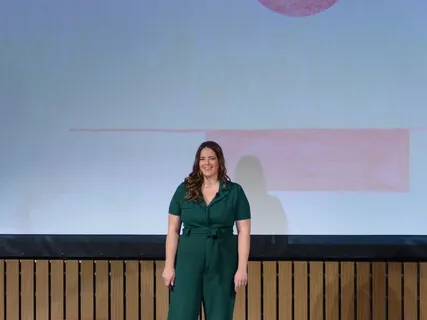
What if I walked onto this stage and for a whole 18 minutes,
I said nothing?
What if the idea we're sharing that I offered you tonight was the space to develop your own ideas?
What if we just sat here in silence?
Before you start to panic,
I'm going to invite you to notice what happened for you in those 10 seconds when you considered what it might be like to sit here in silence for 18 minutes.
How did you feel?
Nervous and awkward?
Panicky?
Did your palms start to sweat?
Were you bored?
Did you judge me?
Were you closed or open to the idea?
Maybe you were closed,
But when I just asked that last question,
You told yourself you were open.
You just witnessed me make room in my talk for silence.
In music,
There's a specific notation called a grand pause,
Which is a rest with a fermata over it.
It's a deliberate musical notation meant to emphasize silence as an essential part of the music.
Tchaikovsky used it in his fourth and fifth symphonies.
Beethoven used it in the final movement of his famous ninth symphony.
Almost all notable composers of the last several centuries have utilized the grand pause somewhere in their works.
When using actual words,
The only thing notating silence is the space between words,
Commas,
And occasionally a period.
When speaking,
For most of us,
That space all but disappears.
But in music,
There are no spaces.
There are actual notations for the deliberate importance of the space in the collective whole of music.
The rest.
If we were to merely look at these remarkable moments in music as just transition periods between sounds,
Rather than as an essential part of the music itself,
Much in the way that we do with words,
We'd be missing the full picture of what's being communicated.
In certain cultures,
Particularly in North America,
There's a communication style,
And it's called conversational layering,
Which most other cultures experience as can't get a word in edgewise.
And it highlights an interesting phenomenon we face in the world today.
We are not aware of the power of the space and how it can have more impact than we know.
Instead,
We fill space mindlessly.
Because silence would be too painful,
Too uncomfortable,
And too scary.
We've put an overemphasis on knowledge,
Information,
Ideas,
Intellect,
And words.
Our minds are cluttered with it,
And most of us can't seem to even turn it off anymore.
Information overload has clogged our creative capacity,
And none of us feel safe to explore the space in between,
Whether out in the world or inside of ourselves.
So it's really getting communicated in silence.
What can we actually begin listening for?
In music,
When a grand pause is executed well,
The audience,
Director,
And musicians alike use that space to really feel the vibrations resonating off the instruments during that moment of pure,
Planned reverence.
People who use a grand pause well in their lives do the exact same thing.
It's pure,
Planned reverence.
It's the complete opposite of an awkward silence,
Which most of us experience as our minds starting to race with all sorts of wild and crazy thoughts that we could potentially use to break the silence and make the pain go away.
You may find this hard to believe,
But behind the words and the noise and the information and the incessant thoughts,
Our body has a language all its own.
I'm not talking about body language,
Which most of us experience as a physical form of communication that conveys information rather than with words.
Beyond verbal communication and nonverbal body language,
There's a whole other form of communication that governs a lot more than we realize.
We are energetically communicating through the cellular structure and in vibration that emits off of our bodies constantly.
It's way more subtle than a smile or darting eyes,
And it's a lot louder than we think,
Even though it seems quieter.
It's also significantly more important as it pertains to the current crisis we're facing as a civilization.
Human beings have never been so isolated in their relatively short existence as they are today.
Almost half of Americans report feeling lonely,
And in the last century or so,
We've moved away from our communities,
Lost our capacity for relational intimacy,
And probably the most gravely,
No longer have access to the vital accountability that comes from being deeply connected to one another.
And the epicentre of that crisis is our disconnection from ourselves.
We've stopped listening to our bodies,
And as a result,
We can no longer hear one another when it counts.
What I'm telling you is something you've all experienced before.
I can personally contort my body and my mouth to convey a specific piece of information,
But what could actually be happening on an energetic and cellular level could be completely different.
Many of us can feel it.
All of us are constantly responding to it,
Knowingly or unknowingly.
This is the energetic communication I'm talking about.
According to the late neuroscientist,
Candace Pert,
The molecules of emotion,
A kind of neuropeptide,
Change the chemistry and electricity of every single cell in the body and mind.
Feelings and the energy that we give them literally alter the electrical frequencies generated by our bodies,
Creating a non-verbal communication that can't be seen.
This reality was something I knew to be true long before I realised there were actual scientists studying it.
You may have intuitively known it too.
But knowing something is there and becoming fluent and masterful in speaking this silent communication are two completely different things.
My personal experience is that until I started discovering the actual tools to learn this language,
I did everything I could to avoid listening to it,
Because that would mean I would have to get humble and admit that I don't know everything,
And as a recovering know-it-all,
I can attest to just how hard that was.
If you've ever attempted to learn a language,
You may be familiar with this situation.
You walk into a classroom,
Sit down at a desk,
And when class begins,
The teacher starts saying things to you that you don't understand.
You think to yourself that maybe he'll eventually stop and start to translate so you can figure out what the heck is going on,
But he never does.
At some point a few classes in,
You start to relax a little.
You now know how to greet the person sitting next to you and introduce yourself,
And if you're lucky,
You can count to ten.
This is how you learn a language.
Immersion.
Practice.
Paying attention.
And a whole lot of listening.
Remember at the beginning when I said that I was going to hold space for you to develop your own ideas?
We could have sat here for the whole 18 minutes,
And it's possible you may have in that time developed an idea or two worth sharing,
But that would have depended a lot on me and how well I held that space for you.
I could have sat up here and served Facebook and let you guys fend for yourselves.
Or I could have tuned into my body,
Opened up wide,
And given you 100 per cent of me and my undivided attention and my emotionally invested belief in your capability while you put together your ideas.
That attention and intention not only would have dramatically altered the cells in my body,
It would dramatically alter what you were capable of creating.
In both cases,
It's silent,
But in the latter one,
A lot more is being transmitted.
What that means is that when we're not paying attention to the vibrations that are coming off of our bodies or what's being emitted from others,
That can have a pretty dire impact on the people and environment around us vibrationally.
So,
Let's reverse the rules.
Let's imagine that in the very first sentence of my talk,
There was one person in this room who judged me and thought I was a Looney Tune.
The emotional vibration of that judgement would impact the cellular structure and the cellular vibration coming off of that person and would change the vibration of this entire room collectively.
Yes,
You have that much power.
This kind of power will impact the quality of my talk for everyone,
Even the people watching the video months later who aren't even in this room.
It's the reason why so many talks start out with questions designed to engage the audience and get them opted into what the speaker is sharing.
Because when every single person in this room is on board with me and is curious,
I can get deeper into what I have to share.
There's literally more energy available for us to expand on really big ideas.
But I want to bring your attention to something very grave that's happening around the world culturally,
And it's this.
When we disagree with one another based on things that are said,
Because we think we know better,
We close off.
And that creates an insane amount of counterproductive energy that we have to contest with instead.
It also prevents creation and expansion from even happening.
Because when adversarial energy is in the room,
That occupies any energy that could be spent on growth or innovation or birthing new ideas.
You,
As our audience,
Actually have a very important role.
To hold space for me and the other speakers on this stage tonight.
In order to hold space for us,
You're going to need to tune into your body and recognise whether you're open or closed.
When you really learn how to speak this language fluently,
Genius can be created before your eyes.
How can you and the audience today make us brilliant?
Simply by tuning into and opening up to your own body's communication.
The most effective way to do this is to slow down,
Get quiet,
And get vulnerable.
And one of the best ways to get vulnerable and open up is to get curious.
To be clear,
I'm not talking about getting inquisitive,
Which is looking for answers.
I'm talking about getting curious,
Which is living in the question.
Our pursuit of immediate answers and our conditioning toward instant gratification is partially why we have such a hard time being curious.
Looking for answers literally feels safer in our bodies.
If you've ever been out to dinner with friends when someone asked a question that no one knew the answer to and felt that painful compulsion to reach for your phone so that you could Google it,
You know what I'm talking about here.
I want to give you guys three questions that you can ask yourselves today that will hopefully help you become a little bit more curious.
And it will simultaneously help you open up to the unknown.
What don't I know?
What am I not hearing?
What can't I see?
And here's an encouraging scientific fact for you to chew on that will hopefully make asking these questions a little bit easier and hopefully not immediately pulling for answers.
According to the largest dilemma of astrophysics,
What we experience as our known reality actually accounts for about 4% of what really exists.
4%.
That means that what we don't know is 96% big.
It's a pretty huge proportion of unknown things to discover.
There's a lot out there that we know nothing about.
We've been reluctant to explore this vast landscape inside of ourselves because it feels really unsafe.
When Google shared the results of a two-year study they did on what made a successful team,
The number one factor was psychological safety.
One of the deep truths I found to be true in my work as an emotional intelligence expert is that psychological safety is found in a person's progressive ability to open up,
Listen to,
And most importantly,
Trust their own body's communication.
Despite our best efforts,
Our body's communication is a language that we can't hide.
We can't cut ourselves off from it or bury it underneath words or noise either.
In fact,
Attempts to do so ultimately result in us sending pretty mixed signals.
Once we learn how to speak our body's language fluently though,
We won't want to hide,
Avoid,
Or push it away.
We'll want to exalt it.
When we hold space and are willing to feel and listen,
We can get anywhere together,
And I mean anywhere.
The IPCC report of 2018 implores addressing human behavior in enacting a global response to the current climate crisis.
This could be one way to get us there.
Yes,
We are that powerful.
My suggestion to spend an 18-minute talk not talking is a bit avant-garde.
I know.
These aren't called TED listens.
They're called TED talks.
And by trusting that there's more to communication than what we see or hear,
Our true impact is undeniable.
Did you hear me?