Welcome to the mind-chimp guided meditation.
Let us start with first exploring what exactly are we trying to do before starting on the details about the meditation technique.
We will try to build up the capacity to let go of thoughts by continuously bringing our attention back on an anchor.
As the attention favors the anchor,
It automatically practices letting go from distracting thoughts.
There are many kinds of anchors that can be used in this technique.
In mind-chimp,
We will use breath as an anchor.
Breath is the simplest and most used anchor,
Also taught by the Buddha.
Breath is always with us.
It's real and bringing our attention to it brings us to the present moment.
Let us perform a couple minute prep before starting.
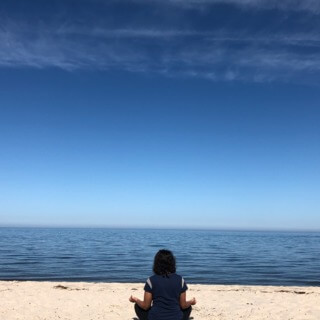
You can sit cross legged on a mat or you can sit on a chair.
Be aware of your bottoms before you start and balance your weight evenly.
Try to keep your back as straight as possible but not tense.
Gently close your eyes.
Before you start,
Think about an image that triggers a natural outpouring of love.
Image of pets or kids when they were little is usually very effective.
Think of a time when you were a small kid and you were taken care of.
Try to experience the feeling of,
I'm taken care of and hence nothing to worry about.
Relax and let go of the tension in the jaw,
In the shoulders and any other place in the body that feels tight.
Now we will go into belly breathing which increases our capacity of not getting distracted by thoughts.
With longer practice,
It may also reduce the number of thoughts generated in our mind.
The technique is quite simple.
Make sure your belly goes up when you breathe in and it goes in when you breathe out.
This is different from chest breathing where the chest goes out and the belly goes in when we breathe in and the chest goes in and belly out when we breathe out.
Focus on the belly as you breathe.
Breathe in,
Breathe out.
Breathe in,
Belly out.
Breathe out,
Belly in.
Do it a few times.
Now put your attention on the sensations in your back,
Specifically around your spine.
Move the attention from the bottom of the spine to your neck and back down.
Now synchronize this up and down movement with belly breathing.
Move the attention up slowly as you breathe in and move it down along the back as you breathe out.
This will help further quiet our active mind.
Let us repeat this a few times.
Move the attention up your spine slowly as you breathe in and move it down along the back as you breathe out.
Breathe in and breathe out.
Now that your mind has calmed down and the attention is starting to get focused,
We will move into the meditation.
Bring your attention to the breath.
You don't need to breathe differently,
Just the normal belly breath.
Watch when it enters the nostrils and comes out.
Observe the warmth or the coldness.
Watch the gap between the in and the out breath closely.
Observe the sensations it creates below the nostrils and above the upper lip.
We are using breath as an anchor in this technique.
If your attention wanders into other thoughts,
Get it back to the breath whenever you become aware of the fact that you have wandered.
We are trying to gently favor the breath.
We don't want to judge ourselves or the thoughts that distracted us.
We want to stay equanimous.
If your attention does not wander,
Continue to watch the breath and the sensations it creates with more awareness.
You may zone out or move into the gap between the breath and thoughts sometime during the practice.
As soon as you realize you are in a zone,
Bring the attention back to the anchor.
Keep your awareness on your breath.
Be aware of your breath.
Watch the warm breath in and out and the sensations it creates above the upper lip.
If your attention wanders into other thoughts,
Get it back to the breath whenever you realize.
No need to judge the thoughts or the drifting away.
We are practicing letting go of thoughts and coming back to the anchor.
Continue to watch.
Vavor the breath.
Keep the awareness.
Keep the awareness of your breath.
Watch the warm breath in and out and the sensation it creates above the upper lip.
Keep your awareness.
Continue to watch.
Vavor the breath.