Thank you for being here for our second in the series of meditation.
Today our focus will be called Strengthen the Mind.
Notice your thoughts.
Notice your body.
We will begin in a comfortable seated position and that's very much open to interpretation,
Whatever that means for you,
Sitting on the floor,
Sitting in a chair.
My one recommendation is a couch sometimes is too soft.
There's too much cushion in a sofa or something of that sort.
So something that you can sit on that gives you support,
That you can really feel a strong support from your base and in your back.
And then once you feel well supported in your seat,
Again,
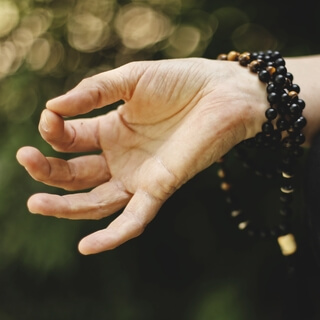
You can choose to sit with your palms up.
If you feel you need a little more energy today,
If you're feeling a little groggy,
Or you could flip your palms to face down if you feel you're too scattered and you need to be more settled and grounded in your body.
And if you're not sure,
You know,
Just sort of pick one and trust that it's probably the right way.
And then you can choose to either close your eyes or let your gaze trail towards the floor.
We'll take a moment to just scan through the body.
I call it checking the weather today.
What's the weather of the body like?
You know,
What are you feeling in the body?
Anything that arises that you notice as sensation is valid.
And what are you feeling in the breath?
Are you feeling the breath?
And what are you feeling in the mind?
And partly to me,
This means your thoughts.
And it also means to me your emotions.
And this is a process that's just like looking out the window in the morning and saying,
Oh,
Does it look like it's going to be sunny or gee,
The snow is really pretty on the trees.
You're just noticing what's there.
And a reminder from our previous session,
Meditation is not about having no thoughts.
It's about being aware of your thoughts.
And it's a practice of putting some space between your thoughts,
Your body and your breath.
And that over time,
As you continue to practice,
This improves your reactions.
And there's science behind it.
In a Wisconsin study,
They found that people who meditate regularly have high levels of gamma wave activity,
Which leads to better control over thoughts and reactions.
High levels of gamma wave activity leads to what's called neuroplasticity,
Which is the brain's ability to adapt and change over time.
And all it takes is a few minutes every day.
Let's bring attention back to the breath.
And today we'll practice a few techniques.
And the first is simply to breathe in through the nose and out through the mouth.
Again,
Just breathe in through the nose and out through the mouth.
This exhalation through the mouth can help you to release stress,
Anything you're holding on to.
So you might even visualize something that needs to leave,
Just breathing it out.
If it's helpful to you to continue to breathe in through the nose and out the mouth,
You're welcome to stay with that.
But you might just let your breath come back to in and out the nose.
And we'll just take another breath or two there.
The second breath technique we'll be using today is often called ujjayi breath.
Sometimes we call it an ocean wave breath so that we hear a resonant sound of the breath.
This is an action that we take in the back of the throat,
As though you would fog up a mirror or a glass.
So on your exhalation,
You might breathe out the mouth with that sound,
Like you are fogging up a glass or cleaning your glasses.
So try that a few times in through the nose,
And this time out the mouth with a ha sound.
Now once you get the feeling of this,
You can close the mouth and just breathe in and out the nose.
But you might hear the sound slightly at the back of the throat.
And now you're welcome to continue with that breath if it feels comfortable and natural.
You're also welcome to just breathe in and out regularly.
And with inhalation,
You can think to yourself,
Now I'm breathing in.
And with exhalation,
Think,
Now I'm breathing out.
And you can continue with that.
And I'll leave you in a quiet space for about three minutes.
When your mind strays,
Just come back to the breath.
Notice the breath in the body.
And you might bring some movement,
Maybe rubbing your thumb across fingertips.
Notice the belly and any movements deep inside.
And let your awareness again just spread through yourself as you're sitting here.
Notice whatever it is you're sitting upon.
Notice the feeling in your back.
And then as you begin to lift your gaze,
Just notice something in the room around you.
Let your eyes settle on something.
Just take it in with your eyes.
And you might look around the room,
Just noticing the space you're in.
And a few words by a teacher named Paramahansa Yogananda.
Learn to be calm and you will always be happy.
Take a breath in.
You might take a little pause at the top of the inhale.
And then a deep exhale out,
Either through the nose or the mouth.
And maybe do that twice more.
Just a deep breath in.
Perhaps a tiny pause.
And then exhale.
And one more.
Good.
Thank you for practicing with me today.