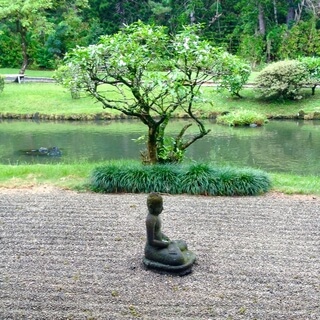
The talk tonight is about no self.
So originally in Burma,
Now Myanmar,
Dharma talks were given from behind a screen,
Like a screen like this.
And there wasn't anyone in front giving a talk because the idea was that it was just pure Dharma coming through.
There was nobody there,
No self there.
And then later when I did a retreat with Upandita about 30 years ago,
The Burmese monks would have a fan that they put in front of their face.
So it got a little less no self,
But the idea was still there.
And in the first 500 years of Buddhist artwork,
There actually wasn't a Buddha figure,
A human figure represented when the artwork wanted to depict the Buddha,
They put an empty pair of shoes,
A tree or an empty chair.
So the idea was in the artwork,
They weren't trying to represent this personhood or a sense of self.
So we still have a kind of a current day representation of this no self concept from like the artwork,
Which is when we go into a meditation hall,
We often take our shoes off before we go in.
It's not just for cleanliness.
It's the idea when you leave your shoes outside the door,
You're leaving yourself outside the door,
You're leaving your issues,
Your problems,
Your beliefs,
And you're entering the hall empty of you,
Empty of self.
So as we start on this topic of no self or not self,
It's really important to note that in the teachings of the Buddha,
He really,
In the Pali Canon,
He really avoided a debate about this question or subject of self.
He wasn't into debating it.
In the Samyutta Nikaya 44.
10,
When a wanderer asked the Buddha point blank whether there was a self or not,
The Buddha remained silent.
And later he explained to his attendant Ananda,
He said he remained silent because quote,
To respond either yes or no to this question would be to side with opposite extremes of wrong view.
And that this question had no helpful answer that could be given.
So it was best to remain silent.
Also in the Madhyamakaya,
The Buddha advised all the monks to avoid getting involved in such questions as what am I?
Do I exist?
Do I not exist?
Because according to him,
They led to answers like I have a self or I don't have a self,
Both of which according to the Buddha,
Is called a thicket of views,
A writing of views,
A contortion of views that get in the way of awakening.
So why even talk about no self then?
Why is this attributed to the Buddha's teaching?
No self is referenced in the Buddha's teachings because it's a strategy,
A strategy for awakening,
Rather than a philosophical debate.
Some scholars reference this as the no self strategy of the Buddha.
So before we go further,
I want to look at some wording here.
I've been using no self and not self in a kind of more fluid way.
But there is technically a difference between the two words.
The word anatta in Buddhism means no self,
Meaning there's no separate or permanent entity called you.
More like self is a verb,
An ever-changing set of causes and conditions versus the noun we often imagine it to be.
So this is the Buddhist word anatta or no self.
And then you have the word anatman,
Which in Sanskrit means not self.
This is more like,
It's still,
This anatman is like anatta in that there's no permanent or separate you.
But anatman additionally emphasizes the interconnected and interdependent nature of self.
The idea that nothing exists in isolation or separation.
So there's no permanent you,
But there's also this interdependence.
So an example of this might be,
In order for us to breathe,
Our lungs need the trees.
Our body needs the sun.
There's this interdependent quality of things that exist here now.
I'm going to be using both words interchangeably,
But I want you to realize that I'm referring to both the absence of a separate you and this interdependent nature of you together.
So this no self or not self,
Again,
Is not a philosophical doctrine or a debate,
But it's a strategy of the Buddha.
A strategy for what?
Strategy for freedom.
Freedom from suffering.
Liberation.
The Buddha felt that the root cause of all suffering and all negative emotions was this belief in a separate self.
So he was really passionate about this.
This was like an important teaching.
The root cause of all negative emotions was this belief in a separate self.
So his not self strategy was a way of reverse engineering suffering,
Reverse engineering suffering.
And he taught this illusion of a separate self.
This wasn't about you or I.
It was in all things.
He said in the Digha Nikaya 279,
All phenomenon are not self,
All phenomenon,
Not just you and I.
So everyone and everything is empty of this separate existence.
And per the Buddha,
When you could see things accurately that there's not a separate self,
You'd just be aware of this empty phenomenon rolling on.
And that when you're aware of this empty phenomena that things don't belong to you,
We have a life-changing insight that can lead you to total liberation.
So this was a big deal,
His not self strategy was a way to total liberation.
So the past and the meditation that we practice,
The past actually means seeing clearly into the three things.
V is three.
Past is seeing clearly into the three things that lead to liberation.
What are these three things?
They're suffering,
Impermanence,
And anatta,
Or no self.
They're called the three doorways for insight to happen.
Supposedly,
As when we awaken,
We're pulled through one of these doorways.
Our insights pull us through either the suffering door,
The impermanence door,
Or the no self door.
This is how awakening happens.
So let's look at this not self strategy of the Buddha as one of these doors.
He listed it as one of these doors that insight and awakening can happen.
The first thing that happens when you believe in a separate self is there's a me here and a you out there.
We create a divided state of subject on object,
A divided state.
I'm here and that's over there.
And then a whole bunch of things ensue from there.
Then we have to get things or push things away.
And it becomes a whole lifetime of wanting,
Not wanting.
Upandita,
My teacher,
Used to say that it was like you were always trying to seek things.
And then once you got them,
You were guarding them.
So he would laugh and he'd go,
You're always guarding or seeking,
Guarding or seeking.
You're on one side or the other.
And this is because of this belief in a separate self.
One of my friends who's a meditation teacher and psychologist,
He said he was watching his daughter one day,
She was like getting close to age three.
And she's normally a calm kid,
Right?
All of a sudden she grabbed her toy with anger and she said,
Mine.
And he took a breath and he was like,
Okay,
Here we go.
That sense of self came online and she also realized she had my toy,
That guarding and seeking.
This belief in a separate self,
Of course,
It's developmental.
It happens and we're learning about being free of this.
It starts early.
It can create,
If we don't have the awareness,
It can create a struggle the rest of our lives.
When I was 22 and I just started practicing,
I went to my first job in Seattle as a social worker and I was on the bus,
Taking the bus to work.
And in front of the University of Washington,
They had a big wall and somebody had graffitied in huge letters on this big wall outside the university.
They'd graffitied,
Work,
Buy,
Consume,
Die.
And here I was going to my first job and I looked at that and I went,
Yeah,
That kind of can sum up samsara,
Work,
Buy,
Consume,
Die,
If we're caught up in this separate me.
So,
Let's go deeper into this no-self doorway.
The Buddha spoke of the illusion of,
Quote,
I-making and my-making,
And probably the better lexicon for today's language would be selfing.
It's like we're taking selfies all day long and you know how irritating that can be when you see somebody taking a lot of selfies?
Well,
We're doing this in our mind all day long.
You can imagine the tension that creates.
We don't even realize.
We're identifying with our thoughts and emotions and we don't just get to be that empty phenomenon rolling on that I talked about,
Because the self and this identification with the self becomes like a magnet or flypaper and then everything sticks to it.
So,
When a thought comes along or a feeling,
They get stuck to you and you have to pull them off.
And then,
Because they become my thoughts and my feelings,
And then we're defending them and fighting for them,
And it just creates this whole big stuckness when it's just empty phenomena rolling on.
Your thoughts are just a sound.
They're just a sound.
Imagine if your thoughts were no different than a bird song.
Sometimes I encourage people to do that in meditation.
Your thoughts are just a bird song.
They'd just be sounds coming and going.
You wouldn't grab onto them as the me,
Right?
And you can sometimes just watch.
The mind is just an audio clip.
You have an audio clip in a file and just to see it like that.
But how does this illusion of selfing develop?
We all seem to have it.
How does it develop?
The Buddha said the illusions comes from not seeing clearly into what's called the five aggregates.
His primary not-self strategy was mindfulness of the five aggregates.
So,
What are these five aggregates?
They're material form or the body.
They're feelings,
And this is not emotions,
But feeling,
Tone of pleasant,
Unpleasant,
And neutral.
That's always arising.
They're perception.
That's the third.
Mental formations is the fourth,
And that does include thoughts and emotions,
And the fifth is consciousness itself.
These five things come together and make it seem like something's happening as a you.
They create the illusion of a separate you,
And the Buddha broke these five things down for us to see,
Almost like you'd slow down a movie.
So,
You could see the frames and see that it's not really what you think.
When you slow a movie down,
You can see,
Ah,
It's not what I thought.
There's nothing here.
So,
Breaking these down into these five things is a way of reverse engineering the you again.
The Buddha said,
You know,
There's a deconstruction process,
And the Buddha said,
I gained absolutely nothing from perfect enlightenment,
Because it's a breaking down what you thought was here into these components where it's just empty phenomena rolling on,
And Sufi mystic Rumi,
His refrain in the later stage of practice was,
Dissolver of sugar,
Dissolve me.
So,
Again,
It's this dissolving process,
And my teacher actually said to me one time,
He said,
You know,
Amita,
When you start practicing,
It's like you become a TikTok in the mouth of the unconditioned or the source,
And you're just going to slowly dissolve back to the one.
So,
A way of understanding these five aggregates of self,
Form,
Feelings,
Perceptions,
Mental formations,
And consciousness is the analogy of the stars and the Big Dipper.
So,
You know,
There's really no Big Dipper there.
There's just seven stars in a pattern,
Right?
But every time we look up at the sky and see it,
We go,
Oh,
There's the Big Dipper,
And we have to like kind of point it out and see it and name it.
We're conditioned to see it,
Like the sense of self.
We're conditioned to see those seven stars,
And it's not that there aren't stars there.
It's that group of stars doesn't really represent anything other than what our minds created.
We made up the Big Dipper.
So,
There is a body,
Mind,
Consciousness,
All these five things,
But they don't represent a separate you.
We're just made up of these five stars.
So,
Let's look at the Buddha's core teachings on dismantling this illusion of self via the five aggregates.
The first one is material form.
We identify with the body as self,
And most Buddhists,
You know,
We know this.
We're not the body,
Right?
You know,
If you pay attention to the body,
It's pretty easy to see.
It's out of our control.
We have like these fragile water balloon bodies,
It doesn't take much to injure them or break them or puncture them,
And we know we're going to die.
That's pretty clear.
So,
Ultimately,
It's hard to completely identify with self and the form,
The self as form.
When I was in my 30s,
I was really blessed with a body worker who was also a mentor body worker,
And she told me early on that,
You know,
It's really good that your body ages,
And I was like,
Why?
And she said,
Well,
You know,
When it's time to die and death is going to take your body,
You're not going to argue with death.
By the time you're 70,
You're like,
This body is suffering.
Everything's decaying and it's painful.
You're not going to have some illusion about the body being this great thing,
This wonderful form you need to be.
And I've never forgot that.
It made me really,
As I age and things start to get more unpleasant,
To just see that that's an appreciation that the form is not me and I don't need to hang on to the illusion of it being me.
The next three aggregates,
I'm going to combine them together,
Are feeling tone,
Perceptions,
And mental formations or thoughts and emotions,
And we identify most with this set of three,
Especially with the mind and emotions as me.
In fact,
We filter almost everything through our thoughts about it.
We're addicted to our narrative,
And most of the time we prefer our thoughts to what's real.
We enjoy the narrative of something,
Sometimes even more than the actual experience itself,
And you might bring close attention throughout your day to what's happening when you're going places.
Is this the mind narrative that we're lost in or are we in the actual?
Because we're often experiencing our thoughts about things rather than experiencing things directly.
It's mind on mind on mind on mind throughout the day,
And not to judge yourself or berate yourself,
Just to start to see this,
To start to see this.
The other day when I was looking at this,
I went to the beach here in Hawaii and I realized,
Wow,
You're at the beach,
This beautiful place,
But then you're looking at other people and having thoughts about them or about yourself or about what you do in the ocean,
And it's just like,
Here you are in this beautiful place and it's a thought movie going on top of what is this running audio clip.
Whether we see it or not,
It's there,
But the Buddha had a teaching to counteract this constant narrative,
This audio clip.
He did have a teaching.
It's in what's called the Bahia Sutta,
And a man named Bahia,
Who was about to die,
He didn't realize it,
He only had a few seconds left,
He asked the Buddha for the most succinct teaching.
And the Buddha replied,
In the scene,
There is just the scene.
In the herd,
There is just the herd.
And he went through all the sense doors in that Sutta,
But what does this mean?
It means that your eyes are not thinking.
The eyes don't have thoughts.
In the scene,
There's just the scene.
It means your ears are not thinking.
Your ears do not have thoughts.
In the herd,
There's just the herd.
The narrator or audio clip is extra,
And the Buddha is trying to get us back to this bare attention without the audio clip,
Like turning the mute button on,
Resetting,
So we can see what's real,
Because our narrative is often in the way of the real.
The narrator could be like a third wheel.
Often,
I had an allergy the other day,
The mind is like a wet sheet of paper between the real.
It just gets in front of everything.
So,
As a practice throughout the day,
You can challenge this notion of this separate narrator you.
You can challenge this notion,
How to do this.
I have what's called a series,
A couple of microdosing practices,
And they're little practices you can do throughout the day,
Little reminders,
Kind of insight inquiry practices,
And a couple of research studies have shown in the last couple years that these microdosing,
I call micro practices,
Are actually almost as effective as an hour of sitting a day,
When research studies showed that.
So,
They're powerful things to do and they can loosen this narrator you,
And I'm going to offer two microdosing practices for this and then two later.
The first is to notice there aren't two minds.
There's not a separate you talking and another you listening.
There aren't two minds.
There's only one awareness.
There's only one sound.
There's not two,
And just kind of remind yourself of that.
There's not two here.
The second microdosing practice is to look at the source of thought.
Look at the source of thought.
A great question to ask all day long is,
What's the source of mind?
When that narrator comes in,
When you're at the beach,
What's the source of these thoughts?
Where do thoughts come from?
Mind is a secondary thing,
A third wheel,
And what we're trying to do is confirm and identify with the source,
The awareness that's primary,
Rather than the secondary thing of mind.
So,
You can use thoughts,
Instead of them being like psychic irritants,
Your thoughts,
You can use them all day long as pointers to the source.
The other day,
Ajahn Chanti mentioned in a talk,
He said you can slide down the I-thought like sliding down a pole back to the source all day long,
If you want.
Slide down that I-thought.
Slide down any thought.
Take it back to its origin.
If that's too confusing or difficult or you can't identify with that,
Just notice the stillness that all thoughts come out of.
The stillness.
What would this moment be right now without your thoughts about it?
Yeah,
Just that right there.
This moment without your thoughts about it.
And you can come back to that throughout the day.
The last of the five aggregates,
The Buddha talked about these five aggregates that we confuse as a separate self,
Is consciousness.
So,
It really feels like we have a separate consciousness and we often make consciousness another thing that we possess.
My consciousness,
My awareness,
And we funnel everything through this small aperture called my consciousness.
The Tibetans said that doing this is like seeing the world through a straw.
You know,
This little you,
Right,
Amida,
And we're looking at everything through this little aperture of me called my consciousness.
And it's like looking at the sky through a straw.
So,
When you can,
Imagine just taking away that and it becomes the consciousness,
The awareness.
And then you're not filtering it through this limited you,
But your consciousness can become the field it all happens in.
Take away the straw and the consciousness can get bigger,
Can become this field it all happens in.
And the other day,
I woke up in the morning and my awareness was the whole room.
It was everything all at once.
It had moved out of that small me and the awareness was everything.
And it was really fun because I saw like,
Oh,
Amida was no different than the chair or the window.
I mean,
It was still,
The me was still important,
But the awareness was everything all at once.
It was kind of like a macro or totality consciousness.
And it was beautiful in the time that that was present to see that the needs and the clinging and identification with anything in here just naturally fell away.
And everything was included as one equal whole.
Consciousness saw everything as one equal whole,
Rather than that tendency when it comes through us to make everything about me.
So,
It was really fun.
It was too bad it didn't last forever,
But it was really nice to get a glimpse of this truth of,
Oh,
When it's a bigger we,
A bigger totality consciousness,
Macro consciousness,
This kind of clinging to self really just naturally is not there on its own.
And you don't have to wait for something like that to happen.
Just keep reminding yourself that you're the awareness.
Not my awareness,
But the awareness.
And you can think of it like,
You know,
In the summertime in the Midwest or some places,
Maybe you have lakes there,
Ponds,
You know,
They cordon off the swimming area for kids to swim in.
And,
You know,
They put down the rope and it's like you create the rope here.
There's Amita here.
There's Vic there.
There's Irene.
There are little ropes cordoning off our swimming area.
But we do this in mind only.
It's all the same lake.
It's all the same water,
And it's the ability to see that oneness versus the ropes that separate everything.
And I like to do a visual and finishing up with these five aggregates,
I like to do a visual of,
You know,
Taking these five aggregates out,
Letting them go,
And coming back to just the you,
The field of awareness it all happens in.
So this is the you.
It's nice if you don't have your camera on.
It's a glass bowl,
And there's four little eggs in it,
Colored eggs.
So we take the first one out.
The first one is the body.
We are not identifying with the body.
The body's not me or mine.
So we take that out.
And feeling tone.
Feeling tone is not me or mine,
The second aggregate.
The third aggregate,
Mental formation or perception.
Perception's not me or mine.
The fourth aggregate,
I made the golden egg thoughts and motions because that's our golden egg,
Isn't it,
Our thoughts.
So that's not me or mine.
Now we have the bowl left itself,
This clear bowl,
Consciousness.
You take that away.
That's not me or mine.
Okay,
Take away consciousness.
Then you just have this.
All you.
All you without identifying with any of those aggregates.
You're the whole room.
Take the straw away.
So we're using this no-self strategy to reverse engineer the you,
To empty out the contents like the colored eggs.
So you're in the context.
You're in the context of it all.
Which takes us back to the Sanskrit word anatman or no-self,
The interconnected nature self.
We're going to end on talking about this word.
Anatman is this interconnected totality.
And actually,
It's fascinating.
Some people in the science world are beginning to really verify this anatman or no separate self.
I don't know if any of you know Donald Hoffman,
But he's a cognitive scientist with a PhD from MIT.
He and Bernie Katzoff,
Who's a computer engineer and philosopher,
They've been having these discussions and doing research.
And they claim that they can mathematically show that they're conscious agents that are fundamental and therefore beyond space time.
Donald Hoffman says this,
There are conscious agents that are beyond space time.
They look like many,
But are only one.
They act like different agents,
But are only one.
From any two agents,
You can get unlimited new qualia from their fusions.
And yet,
There's only one agent.
He then goes on to say,
There is one fundamental consciousness,
But Cantor's hierarchies of infinity precludes us from ever being able to describe the one because it has infinite representations.
One fundamental consciousness with infinite representations.
That's the not-self.
So,
A way of accessing this not-self throughout the days to orient to this source that I mentioned earlier,
On a bigger level,
You can do this by not getting caught up in the character in your daily movie,
Which means looking back at the projector.
Make sure as a practice,
Look back at the projector.
Where does all this form,
Thoughts,
Emotions,
Where do all these five aggregates come from?
What's the light that makes it all happen?
And then identify only as the source,
The light of the projector,
Not the impermanent aggregates.
It's the same light creating Amita,
Irene,
Vic,
Mari,
The same light creating the planets,
The plants,
The ocean.
Know yourself as the same light that creates everything when you turn around and look.
Where's all this coming from?
I have a nice picture.
I'll just stop my video to show it of this Buddha that's just all light.
I mean,
Maybe you can see it.
There we go.
Yeah,
It's just like the light is streaming through this Buddha.
All light.
That's the source appearing as a form,
Right,
As the Buddha.
And you can know yourself as that light that's streaming that form.
So,
Even if you work with depression or anxiety,
A lot of people I work with have these kinds of difficulties,
Just keep remembering.
Don't lose sight of the ultimate you,
This light,
Because ultimately your awareness itself or your essence is never depressed.
Your essence is never anxious.
Your awareness itself is never stuck.
And the other day,
I was talking to one of my students.
She was really stuck and trying to make things,
Not getting things happy.
Things are not happy for her,
And I said,
Your character's never going to be happy in samsara.
You know,
Your character will never get it right because it's impermanent here.
And even if you get like one of these insights like that I had the other day,
Then it's gone.
Or you get money,
Then it's gone.
Or it's here,
And job,
And a person,
And a joy,
And sorrow.
It's the land of impermanence.
One of my teachers said it was like trying to get things right in samsara is like rearranging the deck chairs on the Titanic.
It's like you can get them in order and all nice and spiffy and stuff,
But the ship is going down.
So whatever colors you put on those deck chairs on the Titanic,
And no matter how expensive they are and beautiful and wise those chairs are,
They're going down.
So know what's the deathless.
The Buddha called it the deathless.
Know what's the you that's below these five aggregates,
These stories,
These concepts.
There's an Ojibwe saying,
Sometimes I go about in pity for myself and all the while a great wind carries me across the sky.
So it's this bigger thing.
Know what this bigger thing is.
Awareness,
The awareness.
And what's really fun and beautiful about awareness is it gives you all these possibilities.
So you can like zoom in on a bug on your floor right now,
Infinitely zoom in on it.
Or you can infinitely zoom out at the night sky tonight when you go outside.
And this awareness you,
It's really cool.
It can go on forever if you start experimenting with it.
The taste of an orange can just keep going.
A blessing,
A meta blessing that you do can just keep going.
Not the flavor,
The impermanent flavor of the orange or the impermanent sound of the blessing,
But the awareness itself that holds it and produces it can just keep going.
And when you know yourself as this totality,
Nothing can break you.
Nothing can break you.
And if things start getting confused with AI and what's real and what's not real,
AI is artificial intelligence for those of you who don't know.
You'll know who you are.
Nothing can break you.
Who could be broken or die when you really know yourself as the awareness?
And yet here we are,
We have these finite water balloon,
Fragile water balloon bodies and our infinite awareness self.
It's such a conundrum.
One student wrote to me about her mother who she took care of,
Who died of dementia.
She said,
I could see my mother becoming infinite love,
Even as she seemed to be getting more and more confused in her thinking.
The finite and the infinite.
So in closing,
I wanted to give you two more of these microdosing practices,
These little practices you can use throughout the day.
And these are for the not-mon or not-self strategy.
So pretty much along the lines of what I already mentioned,
Looking back at the movie projector,
Try to see your character in the movie all day long.
See yourself as a character in a movie.
And one person said,
Oh,
I don't know if I like that.
It creates a sense of a separate,
An outsider me.
And we're not doing this to create depersonalization or dissociation.
If that happens,
Don't do this practice.
It's just here to create more wisdom for you.
If it helps you go see yourself as a character in the movie,
To un-velcro from your identification with yourself all day long,
Then do that.
Do that.
I like to see this body and mind almost like an avatar in a game,
Like a video game.
And so throughout the day,
I'll just use this practice to bring awareness to my avatar and how she's moving in the game.
And then watching everything in the game,
It just becomes this playful curiosity of this pure awareness,
Watching things be done and watching other characters,
Other avatars in the game.
And I'm not getting so blended or attached to the me when I can do this.
More watching how things happen than fighting off life.
When you're blended with a character,
It becomes this fight,
Like I said,
A me here and a there,
And you have to protect.
But when you're watching the avatar from awareness itself,
It's just really fun.
Oh,
Look,
This is happening to the character now.
Byron Katie,
When somebody was about to take her life,
She had the thought,
Oh,
I wonder if this is how she dies.
I wonder if this is how she dies.
So again,
It's moving to this macro awareness.
And the last microdosing practice is to change out the eye language as a practice.
If you want to try this,
It's really fun.
So,
In our culture,
We've become really aware of making sure we have accuracy around pronouns,
The he,
She,
Or they now.
So,
If we really want to be accurate,
Let's stop using the eye language.
It's just creating more illusion of a separate you.
So,
Train the mind with different language that's more inclusive,
That's more accurate.
So,
If we were going to use more accurate language,
It might be awareness is seeing this or life is doing this.
Or sometimes I just play around,
Because it could be true.
Infinite love is doing this.
That could be these pronouns for you.
Instead of I'm driving the car,
Life is driving the car.
Instead of I'm washing the dishes,
Infinite love is washing the dishes.
Imagine what that does for the drudgery of you all day long.
You could even try that now.
Instead of you're listening to the talk,
Awareness or infinite love is listening to talk.
Life,
The screen,
Empty screen is giving the talk and listening.
Life,
Awareness,
Infinite love.
Switch out the pronouns.
Have fun with this.
And why we do this is because it weakens that wet sheet of paper that's between us and the real.
And when that wet sheet of paper starts to weaken,
The truth can discover you.
The truth can discover you.
That's all it ever is.
True nature,
The truth discovers you.
You don't find it.
Don't create that illusion.
More and more I'm finding that this practice,
And I've been doing this for,
Gosh,
It's embarrassing to say 40 years now,
But more and more I find it's about consent,
Consent,
Letting the truth just discover and consenting more and more.
And the other day I just had this feeling and image of,
Oh my God,
This is a consent to 100% unconditional love inside and outside.
It's a consent to 100% unconditional love or truth,
Whatever you want to call it.
Same thing,
Love,
Truth.
And I was like,
A part of me was like,
Are you ready for that?
It's not for the faint of heart,
This consent,
24-7,
Forever,
Unconditional love,
100% forever,
Or truth forever.
That's what you're consenting to.
So just feeling that,
That's that commitment to the no-self,
The not-self.
All day long,
Consenting.
I'd like to close with a poem by Dorothy Hunt,
And it's called The Altar of the Present Moment.
And it's about a two-minute poem,
So just relaxing and listening.
And this poem exemplifies the different pieces of this talk about letting go of the five aggregates we cling to as me,
And recognizing that you are the altar itself,
That anatman of interconnectedness.
The altar of this moment.
Place everything you can perceive,
Everything you can see,
Hear,
Smell,
Taste,
Or touch upon the altar of this moment and give thanks.
It is over so soon,
This expression,
This single moment of your precious life,
This one heart pounding itself open with fear or wild joy,
This one breath rising in the cold winter air smoothly and gently or coughing and sputtering.
Bow while you can before this one taste of afternoon tea warming its way to your belly or the fragrant orange exploding its sweet juice in your grateful mouth.
You have to love the antics of your mind imagining life should only be sweet.
The bitter makes the sweet and life is both.
It is whole like you before you think yourself into pieces.
Place this moment's pain and confusion on the altar too and give special thanks for such grace that wakes you up from sleeping through your life.
Pain is greatly underrated as a pointer to unknowing yet greatly overrated when taken as identity.
In this moment your eyes meet mine and there is a single looking.
What is peering from behind our masks?
Can it touch itself across the room?
Place your palms together.
Touch your holy skin.
In another moment it will shed itself.
What will you be then?
What were you before you had two hands?
What are you now?
You cannot capture that and place it on the altar of this moment.
It is the altar and this moment's infinite expressions and the seeing and its own devotion to itself.
You are that.
You are that.
The one and the all.
The all and the one.
Consenting.