The First Nations or Native American people had a clan or a society called the Fox Clan,
And it was an inter-tribal clan,
And it was made up of the most fearless warriors.
And this is what was written in the societies of the Plains Indians,
And anthropologists in 1916 wrote that people in the Fox Clan,
Because they were so fearless,
They were called doomed to die or already dead.
And each tribe at war had what's quote-unquote four staff-bearing warriors who went in battle were expected to plant their staffs in the ground and stay by their standards at risk of their lives.
They planted their stake in the ground.
That was the stand they took.
If the battle moved way far away,
They were way far away.
And if the battle moved up around them or past them,
They died or they were just in the midst of the battle.
But their whole purpose as a Fox Clan was to put their stake in the ground and say,
This is what I stand for.
I'm willing to die for it.
Now that's fearlessness.
Doomed to die.
So I think in the Dharma,
It's that sense of what are we willing to take our stand in?
What are we willing to put our stake in the ground for?
And that's not a frozen sort of immovable.
It's an immovable of I know who I am.
This is what I stand for.
What does that mean for you?
And this can happen at any age.
There's a samurai story of an old monk and all these samurai were invading this village and everybody had left except this tiny little monk.
He stayed behind and samurai booms into the monastery,
Looks at him and says,
Don't you know I could run through you with my sword without a blink of an eye?
And the little monk looks up at him and says,
Oh,
Well,
Don't you know I could be run through by your sword without the blink of an eye?
And in that moment,
The samurai bows down to him,
Becomes his student.
That little monk took his stand.
He knew who he was.
He was fearless.
And when we know who we are,
We're fearless.
And they say that the greatest gift of the Dharma is fearlessness.
Fearlessness.
They also say that meditation is the path of the deathless.
To die before you die.
Subudanda the Bodhi tree,
When he was being attacked by the armies of Mara,
Warriors one by one,
He was willing to die.
He sat under that tree and said,
I'm willing to die.
He put his stake in the ground.
And each one of us has to find what that stake means for ourselves.
And part of the Dharma,
As you saw this afternoon,
Is a willingness to face everything you've run from.
You come in in the afternoon when you're tired or in pain and scared or anxious,
And you just face what's there.
Takes patience.
They say that the reason we get on our knees in prayer is because there's nowhere to run to.
So maybe the greatest gift that you had tonight was seeing that you could face parts of yourself you thought you couldn't face.
In the end,
It's not having to leave any part of ourselves out.
So a few things about cultivating fearlessness.
Fear generally depends on two things.
The first is the illusion of time.
The second is the illusion of self.
Fear always needs a future.
Anytime you're in fear,
You're in the future.
Fear also needs an illusion of separateness.
So there's a story of a monk and he's in a cave by himself and he starts painting a tiger.
And he paints it so realistically as he's putting the last brush stroke on the tiger,
He looks at it and he gets terrified and he runs out of the cave saying,
There's a tiger in the cave.
It was because in that moment there was that illusion of something separate,
Illusion of his own creation.
He believed his own mind.
That's what we do with fear.
It becomes our self against something else.
That's always what creates fear.
You don't have your self versus something else.
You don't have any fear.
True fearlessness is nothing to defend.
You knew you were going to die next week or today.
What would you defend?
Would you defend your body if you knew it was going to die?
Would you defend your values?
Would you defend your thoughts?
Probably not.
Krishna Ramurti wrote in his book,
What Are You Doing With Your Life?
Good title,
Isn't it?
Fear always exists in relationship to something.
Otherwise there is no fear.
Thought breeds fear.
When you give total and complete attention,
There is no observer at all.
And it is the observer that breeds fear because the observer is the center of thought.
It is the me and I,
The self,
The ego.
When there is no thought,
There is no observer.
That state is not a blank state.
So I know Krishna Ramurti can be kind of intense and heady,
But it's important to realize what he says.
Fear exists in relationship to something other.
And no observer is not a blank state.
To put it even more simply,
Fear is just a clench in our system.
It's some place that we got contracted through trauma,
Through the illusion of self.
It's a place where our system,
The flow in our system gets stuck.
That's all fear really is.
And it can happen physically,
Spiritually,
Emotionally.
I work with people with all levels of trauma,
From simple to horrific.
And of all the tools and techniques that I could say working with trauma,
I would say the one thing that heals is love,
A loving connection.
And you go back to where the system is clenched,
And through loving connection,
You meet the person and you unclench it together.
And I would say,
And I think a lot of therapists would say this,
That secondary trauma occurs when we have something difficult happen to us and there's no one there to connect with.
We're alone.
No one meets our pain.
So we get this secondary trauma of lack of connection.
So the way to unclench the clench and undo the fear in our system is connection and love.
And that kind of connection can happen any different way.
It can happen through another person,
A family member,
A therapist.
It can happen through the sangha,
Through a community of practitioners.
It can happen like in the meditation we did where you can feel power greater than yourself.
We're really swimming in connection.
We're swimming in connection.
So you can find it anywhere,
Anywhere.
Don't have to wait for the right person.
And part of reason why loving kindness or Metta works so well is it's a reconnecting with yourself and with all the wounded places inside.
And that's part of the practice of fearlessness.
It's part of the practice of meditation,
Unwinding,
Unclenching all those places where we're held.
And part of working with those clench is not just to look at where we're wounded,
But to look at the you that's bigger than emotion.
Ellen Lu calls it the love that's bigger than emotion.
And that's part of the practice too is this awareness,
This love,
This you that's bigger than any of the pain you've been through,
Any emotions that will pass through this body and mind.
It's being held in a bigger awareness of you.
And to start to know what that is.
Every time you come on retreat,
Every time you sit on the cushion,
It's like you have a piece of paper in front of a light and you're poking a hole in it.
Every time you show up for yourself and connect with where you might be wounded or clenched or afraid or in illusion,
You poke a hole.
It pretty much after a while,
The illusion of where we're held starts to fall away and this bigger you gets revealed.
So don't underestimate the power of every sit you do.
So even if you don't have much trauma in your life,
And generally all of us have something,
But we still have this clench in our gut that's called the just the clench of self,
Of self energy.
It's just that sense that we have this body and mind and we tend to want to protect it and defend it.
So even when you get through all the areas that we protect and where we're afraid in our bodies through trauma,
There's just this basic clench that we get to work with.
It's not a problem.
It's just there and it's learning to notice it.
One of my college friends,
He studied Tibetan Buddhism and he said that the students of his teacher used to try and jump out in front of doors and startle his teacher and catch him by surprise and his teacher would never startle.
They asked him one time about that and he said,
I have no startle response because there is no one to be afraid.
Actually they've done research with Tibetan monks and they've shown that previously they had fought a gun going off without you anticipating it would create a startle response,
But they made the sound of a gun going off to monks who were hooked up to MRI machines and they had no startle response.
And they realized for the first time in this research with Tibetan monks that the startle response was not a guarantee in our system.
Comes back to that basic clench of self.
Now don't try jumping out in front of doors because I will have a startle response.
Part of being fearless is not just letting go of where the clench is,
But it's strengthening and knowing who you are.
The Dharma is very good at doing that.
Those of you who have been practicing for decades can attest to how much more you know who you are.
And any really good warrior training is based on knowing who you are.
In Hawaii,
All of the warrior trainings are based on knowing deeply who you are.
They call it in the naau.
Naau is in your gut.
Know who you are in your naau.
My teacher's teacher,
Kahu Abraham Kawai,
He lived in Kauai.
His training was,
As part of his warrior training,
He was part of the very old ancient training Hawaiians warriors.
He had to take poison and move it through his body so mindfully and so quickly that he didn't die.
Not everyone survived this.
You really would have to know who you were.
You would have to be part of the Fox Clan.
You would have to take your stake the minute that poison was put in your body to not die.
They also were put out in the middle of the ocean in the dark of night,
All these warriors in training,
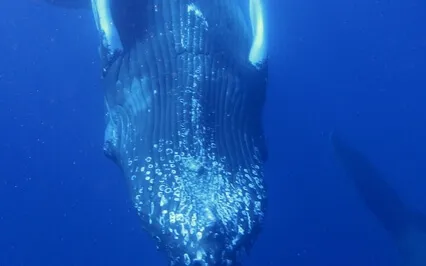
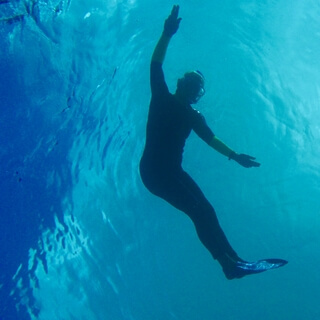
And they put shark chum and they were asked to swim miles back to the shore with sharks all around them.
One of their friends did not make it.
Kahu Abraham Kawai did.
You have to know who you are.
If you don't know who you are,
You die.
That's taking a stand.
That's the fearlessness the Dharma can teach you.
Luckily,
We're not being asked to take poison here,
Although I think more and more there's a poison in life that we have to learn to filter.
There's a confusion in life that we have to learn to move through ourselves.
We can't drink the Kool-Aid.
In Zen,
There's a Koan or Riddle,
And it says,
If you're hanging from a high branch on a tree and you're hanging only by your mouth and your teacher walks below you and you're destined to fall.
You're way up high,
Right?
You're destined to fall and die.
Your teacher walks below you and says,
What's the one true thing you can say to save your life?
What are you going to say?
You open your mouth and you're going to fall and die.
If you don't open your mouth,
You're going to eventually fall and die anyway because you can't hold on by your mouth forever.
So what's the one true thing you can say to save your life?
And I'm not going to give you the answer.
There is no answer.
It's the way you relate to it.
It's kind of a head scratcher,
Isn't it,
That one?
Kahu Kawaii,
Who survived that poison taking in the shark,
He said,
Finally you understand yourself to be the walking,
Breathing truth.
Finally you understand yourself to be the walking,
Breathing truth.
Maybe that's the one true thing.
And learning to move that poison through,
Learning to take your stand like the Fox clan.
We don't do that just once.
We do it many,
Many times throughout our life.
We do it when we lose someone we love.
We do it when we get Parkinson's disease.
We do it when we get dementia.
One useful thing that I found in helping stay focused on knowing who I am is to keep the fear and doubt moving.
Sometimes I think of it like herds of cattle just move,
Just keep moving.
The fear comes in and just let it move through.
Not Velcroing to when fear comes up.
Not belonging as a psychiatrist friend of mine said,
Are you getting your PhD from MSU making,
Well he didn't use the word stuff,
He used another swear word,
But making something up,
Making stuff up.
We do that,
We get our PhD from making stuff up.
So it's being able to not Velcro to emotions to let them move through.
Rilke said,
Let everything happen to you,
Beauty,
Terror,
Just keep going.
No feeling is final.
Let everything happen,
Keep going.
No feeling is final.
That's the meditation hall you're doing that.
Let it all move through.
In Hawaii if you get pulled under by a big wave,
You don't fight it,
You don't struggle,
You just wait because waves come in sets and naturally in a few minutes there will be a lull and you can get to safety.
A lot of people don't know that but I think that's really true.
I've coached people with panic attacks and generally panic we've discovered lasts about five minutes if that much.
So if it's a big wave that knocks you over,
A fear of anxiety,
You can just stay with it and wait until that lull comes,
You can move to higher ground.
A lot of our emotions just occur in a wave-like pattern.
They come in and they come out.
So it's learning to manage those waves of fear and part of the key is not to indulge and not to push away.
You're not trying to keep fear out but you're also not blending with the fear as well.
As Ramana Maharshi says,
I mentioned earlier,
Let what comes come,
Let what goes go,
See what remains.
Let everything move through.
There's nothing you need to do about it and when you let everything come and move through,
What you often see remains is stillness and there's a quiet space within you that's always here,
Always remains.
The Buddhist text,
The Dhammapada says,
Let the wise make islands of themselves which no flood can overwhelm.
It's this flood of emotions,
Of fear,
Of anxiety,
Of craving,
Of anger and finding that still quiet place in you that is not of those things.
That bigger you can be found here or it can be found inside.
It can be the center of your center as well,
Still quiet space,
Center of your center.
We were talking earlier about how in a boat,
When a boat's totally rocking in a very tumultuous sea and everyone's getting seasick,
The captain knows there's a specific spot in the very center of the center of the boat where nothing moves.
So if somebody's really violently ill,
They know they can take that person to the very center room of the boat.
The same for you.
You're being rocked on the sea of fear.
See if you can find that center of your center,
Just even right now,
That interior room of your boat.
And the beautiful thing about the center of our center right now in your body is it's the center of all things.
My teachers calls it the center of the center of everything.
The center of your center is beyond birth and death.
It's your face before you were born.
It's the one true thing to save your life.
And the more you contact this kind of quiet space inside,
The center of your being,
The more you'll notice that there's a sort of causeless joy that can develop in your life.
And this has really taken me by surprise because my mind tended to dwell in depression most of my life.
So the last few years,
I've just noticed that independent of whether I'm having chronic pain from the Lyme disease that I've had for years or just having a really stressful day or something horrible has happened,
That there can still be this kind of causeless joy that's like humming along independent of the circumstances of the body and mind.
It's like that still quiet space.
It's like a coexisting causeless happiness.
It's not about me and I didn't create it.
I mean,
It belongs to all of us.
That's the only reason I'm mentioning it.
That you too can have this still quiet space that is not conditioned,
Is not dependent on what's happening in your body and mind.
And it doesn't happen all the time,
But it happens more and more.
Surprises me.
Something that can't really be extinguished.
And part of that is seeing that it's not so much about me anymore or the body and mind as much.
You know,
You'll hear parents say when they have their first kid,
Like,
Oh,
One of the big realizations is,
Oh,
It's not about me anymore.
Which is a good thing.
You know,
You want it to be about that loving connection.
But the longer I go on in the practice,
The less and less it just seems to be about me.
And that's a relief.
There's less and less to be afraid of and to defend.
My teacher Ajahn Chanti says,
Reality is squeezing the ego's will out of you.
Isn't that a great image?
Reality is squeezing the ego's will out of you.
So as it becomes less and less about us,
Because we're being squeezed.
So just let that happen.
Don't be afraid to let reality squeeze your will out.
And then,
You know,
As the personality comes in,
Or as I've been calling it this retreat,
Different parts of you,
It can be kind of funny.
Oh,
There's an anger part.
There's a wanting to get even part.
You know,
They just like walk through the room.
I mean,
They're not a big deal.
I don't have to argue with them.
I don't have to pretend they're not there.
Eventually,
Our humanity and our divinity are just rolled into one.
And it's not something we try and seek.
Ajahn Chanti said,
Looking for peace is like looking for a turtle with a mustache.
You won't be able to find it.
But when your heart is ready,
Peace will come looking for you.
So that turtle with the mustache,
That peace will come find you when you keep poking the holes in the paper,
When you keep putting your butt on the cushion,
When you keep letting yourself be humbled by anger or joy when you get on your knees.
And then in the end,
It's almost like it comes back full circle and nothing has happened.
The Buddha said,
I achieved absolutely nothing with perfect enlightenment.
I achieved absolutely nothing with perfect enlightenment.
It's like we all get to be Dorothy in the Wizard of Oz and we get to have the monkeys and the yellow brick road and the witches.
The point is to love that process wherever you find yourself.
One teacher said,
We're both actors and the play itself.
We're the actors in the play and the play itself.
When you see that,
You see nothing happens.
So to close with that sense of if nothing happens,
There can be this fearless love.
There can be fearlessness.
There can be loving the process.
We've got this constant flow of humanity coming back and forth.
Why not love?
Why not love all parts of you,
All parts of everyone?
This is exemplified to close in the example of a Tibetan nun.
She has a little hut at the foot of Mount Everest in pretty harsh conditions.
And she's been meditating for 45 years,
Solitary,
Completely solitary.
And all day long,
Every waking hour,
She does these three loving kindness prayers just over and over and over again for 45 years,
All day long.
And she's never really been spoken to,
But they managed to get a few minute interview with her,
Mathieu Ricard.
And she was just so joyful.
And what she said was,
In her one bit of wisdom in 45 years,
She said,
The main thing is to give up all elaborate practice and simply remain in the Buddha mind.
And you don't need robes to do this.
Anyone can do it.
And she,
As a young woman,
She escaped a suitor who wanted to take her in marriage.
She escaped by crawling down a toilet hole.
She so wanted to practice loving kindness.
So she's doing this practice now as we speak.
That's fearless.
Knowing who you are,
She took her stand.
She went down a toilet hole.
She said,
I need to practice love.
This is who I am.
I'm not going to be married off.
And I'm going to do it for the welfare of all beings.
And I'm going to remain anonymous.
They didn't even say in the movie what her name was.
So be willing to begin right now to see what you want to lay claim to,
Put your stake in.
What's the one true thing you can do to save your life?
You can say you can do.
Be willing to know who you are and enjoy the process with complete love.
Nothing better to do.
As they say in Hawaii,
Be aloha.
Be the state of aloha.
So let's sit for a minute.
Thank you for listening.
To learn how you can support the teachers and Dharma Seed,
Please visit dharmaseed.
Org slash donate.