Welcome to the Heart Mind Way podcast,
Adventures in Consciousness.
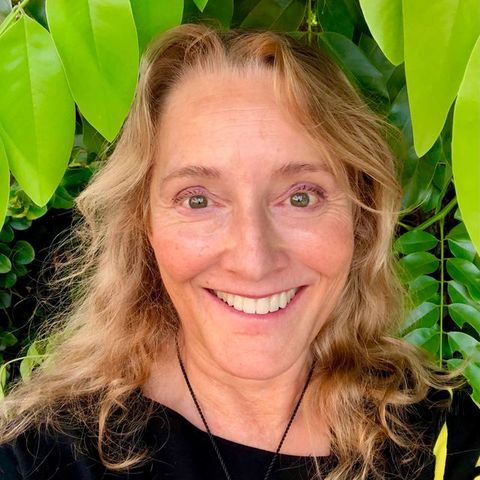
Today's guest is Amita Schmidt,
And Amita Schmidt is a long time practitioner of meditation and a devotee to the path of personal growth and transformation.
She used to be a meditation teacher at IMS,
The Insight Meditation Society from 2000 to 2006.
And she's written a book on Deepa Ma,
Who's one of the great masters.
And she also is a devotee student of Adyashanti.
She's a therapist on Maui,
Not sure if I said that.
And this is a great conversation.
One of the things which really stood out to me from the conversation is just the heartfelt energetic quality that I had when we were talking.
And also when I was editing our talk,
I was feeling that energetic,
That energy in my heart,
And it was really a nice feeling.
We talk about a bunch of really cool things in this talk.
We talk about Adyashanti.
We talk about the reincarnation of Dogen and speculate as to whether or not Adyashanti is the reincarnation of Dogen.
We talk about having a root guru and pure Zen and how this is it,
Man,
This is it.
This is all we've got,
The present moment right here,
Right now,
No past,
No future collapsing into the now.
So we talk about that.
We talk about how everything is one and dropping the illusion of the individual self and the play between the survival instinct and the force of evolution to always grow,
Change and evolve.
We talk about how you,
Yes,
You,
All of us,
Including you are the infinite and how you are already dead.
How it all gets destroyed.
We talk about the teaching of impermanence and we talk about realizing exponential love and grasping onto beliefs and experiencing awakening and Amita share some of her awakening experiences.
And we talk about Amita's spiritual practice and overcoming depression because Amita had some really severe depression when she was young.
And then you learn a little bit about what her therapy practice on Maui is like and internal family systems therapy and mindful conscious awareness and how I was raised farm tough.
So we talk a little bit about my past and how I was raised farm tough and what it's like living on Maui and relaxing into oneness and the absolute and the relative.
So we discuss that.
And then we finish talking about Adyashanti again and some quotes from Dogen.
So it's a great podcast.
It's a great talk.
I really enjoyed it.
And I know you will too.
Here is Amita Schmidt.
What is going on here?
What is going on here?
There is something going on here.
There is something going on here.
It's a pleasure to meet a fellow student of Adyashanti because Adyashanti like holy man jolly.
And that's definitely one of the things I want to chat about today.
But I feel like he is such an extraordinary,
Being doesn't feel like quite the right word,
You know but like just as a representative of human potential and what's possible,
You know,
And he's still human,
Right?
And so it's not like enlightenment is this magical thing where you've transcended the human condition.
You're still human.
And,
You know,
But at the same time you have a really different and higher level of approach.
And just even,
I'm sure you've experienced this like his telepathic abilities,
His ability to take his consciousness,
Have it leave his body and then put it inside my body or anybody's body,
Look around,
Come back out and tell you things about yourself that like he articulated things to me that put words to stuff that I knew but had never articulated as clearly or had as much clarity on it until he said it.
And I was just like,
Oh wow,
That's so point on.
So.
Yeah,
He's got incredible amounts of wisdom.
Did you hear that somebody said he was the reincarnation of Dogen and he didn't really kind of dispute that.
It was interesting.
He mentioned it once in a retreat.
I've never heard that.
Yeah,
But when you read Dogen and that kind of cutting through wisdom that almost like instantly can wake people up that that's like,
So him it's perfect.
And he kind of jokingly said that in a retreat but then I'm like,
It's interesting he would mention that.
It always stuck with me that he said that.
What,
Anything come to mind for you from Dogen?
No,
Just that simplicity of Dogen's teaching.
Like I can't remember a Dogen saying right now but just that cutting through fears,
You know,
Wisdom teachings,
Like Aj is a wisdom teacher.
You know,
He always used to have that,
The sword of Manjushri guy,
The Manjushri with the sword.
I love that.
Yeah,
The sword that cuts through all illusions.
Yeah,
Now he's got Konyan around him too but he's just so perfect like that.
And he's so clear.
And I think like you said,
Todd,
We're so lucky to be around in his lifetime,
Really his lifetime.
And when I first met him,
It was back in like 2003.
And it was sort of early days in his scene.
I mean,
At those times you could actually go up on stage and sit with him and talk with him.
And then he got farther and farther away as the years went on.
But I kind of got to know him personally cause I managed one of his retreats and I knew his manager.
And,
You know,
It was really cool to know him personally and to have actual individual interactions with him outside of the Dharma scene.
And to see he was exactly the same.
If anything,
He's super shy and quiet.
And,
You know,
We were at a whole dinner gathering with Joseph Goldstein and he and Wukde were there.
And he hardly said anything.
He's very quiet in person.
And so it was interesting just to watch.
He had the same flow,
The same everything.
And everyone who worked for him didn't have a single thing to say.
He's never out of integrity ever,
Ever,
Ever.
So,
You know,
In all the years,
So 2003 to now,
That's almost like what,
20 some years.
Not one moment of lapsing.
It's pretty,
Pretty amazing.
And I wanted to share too,
Like what you were saying about the changes.
I've always felt too,
That he has this deep ability to go in people's bodies and just feel.
And at one retreat,
He actually said that he was doing that.
I kind of suspected like you did.
But this woman just kept talking.
And at one point he said to her,
He said,
"'Could you just please be quiet?
"'I'm trying to rearrange your psyche.
'" He said.
And I was like,
Oh,
Uh-huh,
That's what you're doing.
So he has a vibratory quality.
And I don't know if you know,
But there was one retreat,
Maybe a couple that he said that when he first woke up,
I guess it was his number three awakening.
He talks about these Tammy Simon's new Sounds True podcast,
His three awakenings.
But he had the psychic power ability to enlighten people.
And he said that he used it for a couple of people and it was the biggest mistake of his life.
So he never used it after that.
He said it,
He didn't go into details about why that ended up so badly.
But he said that he just made a vow,
Like never to use that psychic power to awaken people.
And he said,
Don't ask me to do it.
But I guess he saw the dark side of helping the butterfly out of the cocoon too quickly,
That syndrome.
So he just said,
Oh,
Even though I can do that,
I'm not going to do it.
So that kind of shows Todd why he's such a powerful teacher because he actually has this psychic power that he's not using,
Which can wake people up,
Which probably would be reading inside people like you said,
And that kind of almost vibratory knowing of where people need to shift and change.
So that really puts him in a different category than most Dharma teachers for sure.
Even if he wasn't the reincarnation of Dogen.
Wow,
That's so rich.
And there's so much just right there that,
Like even as we're talking just beyond the level of the mind I'm just feeling like such an amazing energy in my heart.
Like almost like some presence,
Or energy of the universe or you,
Right?
Your energy,
Wherever this energy is coming from.
It's just like,
It just feels so wonderful.
And like,
I don't know,
Like that's so valuable.
Yeah,
Yeah.
He's a root guru for both of us,
You know,
And the Tibetans use that phrase root guru.
I know the Vipassana and Zen folks don't,
But you know,
I've had such a deep love for him ever since the day I met him.
And he's always been really fierce with me since like day one.
And I could tell you that story in a minute,
But there's just been such a deep love and connection with him.
And it was really neat the last time I saw him,
I managed a retreat here for him in Maui.
And they,
When you manage one of his retreats,
He takes you out to dinner,
Him and Mukti take you out to dinner.
And I brought my ex-husband at the time.
Wait,
Were you married to him at the time or at the time was he your ex?
I was married to him at the time.
Okay.
Now he's an ex.
That's funny.
He kind of was dominating the conversation a little and Mukti was so sweet.
She kind of pulled him aside,
My ex,
And she said,
Let Ajahn and Amita have a little time because they have a very special relationship.
And- Wait,
She called him Ajahn?
Ajahn,
She said Ajahn.
Oh,
Adya,
Adya,
Okay.
Yeah,
She said Amita and Adya have some special,
They have a very special connection,
She said.
And it was like in that moment she named it and then we went off together just to talk.
And it just was like,
Yeah,
There is a real,
Like you said,
Just an energy there with whether it's the root guru or just that we've been kind of in different paths for 20 years.
I've seen him in the beginning to now and it just,
There's that vibratory heart thing like you were feeling about.
He's an amazing,
And from day one,
He said,
I don't know if you've heard this,
He said that he set his whole organization up like a circus tent.
And I heard that from day one and I kept that in my mind because he said,
I don't want buildings,
I don't want something to protect and to have to defend and that gets complicated.
He said,
I want like a circus tent,
I can take it down anytime.
So all my people are volunteers,
The building I have,
I rent,
I don't own anything.
It's all just transitory.
And if I wake up one day and it's over,
It's over.
And I was so impressed by that,
Like just complete non-attachment to his whole organization.
And it made me realize from 2003 on,
Like he could just quit anytime,
You know?
So I did a lot of retreats because I'm like,
This could be his last.
And luckily he didn't and he still hasn't quit,
But I realized how non-attached he was to being a guru and a teacher and having a whole scene around him.
I mean,
You can feel that in all his teachings,
But it was good right from the start to know that.
Great gift of impermanence,
Yeah.
Yeah.
So his first teaching with me,
I'd been like a Vipassana practitioner for like 20 some years on my first retreat with him.
And it was a bit of a thing because of Vipassana people really didn't,
They,
You know,
The non-dual thing doesn't jive well with the traditional Theravada Vipassana people.
So I got a fair amount of flack for even following Ajahn Chanti.
And at one point in my career,
I kind of had to decide like it was either doing the non-dual with him or sticking with a traditional Theravada.
And I,
Of course I made the choice for the non-dual because it's more real and it was where things were flowing.
But- Yeah,
And such an incredible teacher in that space.
I mean,
It's like,
Let me follow this guy who's just radiating.
Right,
Yes.
I mean,
And it's also so crazy that like,
You know,
In these teachings,
Which ultimately are teaching the formless,
They so often get mired in the form.
You know,
It's like,
What do you mean this sect or that sect?
You missed the whole point.
I know,
And the Theravadans,
Especially one teacher,
He'll go unnamed,
But he was like,
You know,
Important person in the Vipassana scene.
He said,
Look,
He talks about not meditating and we'll have none of that,
You know.
And he even suggested when Ajahn talked to the staff that Ajahn couldn't mention about non-meditation.
And I said,
Look,
I don't think Ajahn's gonna be open to any suggestions about what he's supposed to say or not say,
And I would never do that.
But I realized at that point,
I had kind of a fork in the road.
So I really chose to stay with Ajahn,
Which really meant I wasn't part of the whole teacher track.
I fell off the teacher track I was on in the Vipassana scene,
Which was good.
That was a hard- There's a little bit of institutional bureaucracy and hierarchy and politics,
You know,
That I've just seen from the outside in some of those circles.
Yes,
And thank God it was so much better because Ajahn's fresh and alive and everything he does is real and he doesn't teach from a doctrine and it peers in,
You know,
It's immediate in the now peers in.
Yeah,
There's even a phrase for that,
I think in Zen that's not coming to mind for me right now about when you give a good Dharma talk and it's just coming from your essence.
Yes,
Yes.
So,
But so I showed up at the first retreat and I'd had all these years of practice and I got picked to go up on stage and he just,
You know,
That spiritual seeker when you've been on the path a long time,
He just looked at me and he said,
Your 20 years have been a waste of time.
And he just goes,
You might as well have been meditating for a Cadillac or,
And I'm like,
Really?
And he's like,
Yep.
He's like,
This is it.
And he like pounded the chair and he goes,
This is it.
He goes,
If you're trying to seek anything other than here now,
This is it.
And he just like was yelling at me and I'm like,
Really?
This is it?
You know,
Waking up,
Not waking up.
He's like,
Yep.
And it just,
It was really like that very Zen moment getting hit by the stick.
And what an amazing thing to have said to you though,
Like,
Sorry,
You've wasted 20 years.
You might as well have been meditating on a Cadillac.
What did he mean by this is it?
Like,
This is it,
This is it.
There's nothing else right here.
You're getting nowhere.
It's this chair,
It's this glass of water,
It's this talk.
Everything else is just fantasy,
Right?
Is that what he meant by this is it?
I'm being a little bit dramatic just to emphasize like there's nothing else.
Exactly,
And there's no past.
You don't have 20 years of practice.
You don't have anything that you thought you were doing to get to wherever.
He just was like,
Boom.
Like he collapsed everything and then the now.
So I came with this whole thing of,
I'm a 20 year practitioner.
Yeah,
Where's my little badge in here.
Let me give you my resume.
I mean,
I wasn't,
I just was sharing my history.
I wasn't trying to like,
You know,
Where.
But we do that in the mind.
That's what I'm saying,
Right?
Like we think,
Okay,
You know,
Come on,
Where's my diploma or where's my result or where's my reward.
And I also was like coming to the retreat,
Like,
Well,
How can I make this even better?
You know,
And he just took away the future.
He said,
There's no enlightenment.
You know,
There's no past.
Just like,
He just was like,
Boom.
He just collapsed from like a lightning bolt and all right,
This is it.
And I just was like,
Whoa,
Okay.
I remember I said,
Well,
Oh,
Well,
And he goes,
Well,
That's resignation.
He goes,
No.
He's like,
This is it is not a resignation moment.
It's like,
You step in with a hundred percent joke.
Like this is it,
Yay.
And he just showed me like where in the Hawaiian word is pukas where all your empty spaces are,
Where your gaps are in your practice.
And that was a big gap.
The future,
The past,
The path.
I had the idea of the path and he really caught that.
So yeah,
And then there was just a lot of fierceness all along,
You know.
Like one time this injury that I just got surgery for,
Actually I had a mountain biking accident and tibia plateau fracture.
And I went up and I was in a wheelchair on that retreat.
And he's like,
You asked for this.
And I was like,
What?
A lot of people got mad about that,
But he's like,
He goes like everything that happens to you,
You're bringing it to,
You know,
You're asking for this.
And you're,
I don't know,
It was just an interesting moment where he just pointed out I wasn't a victim of anything,
Right?
Well,
I mean,
And that also points to this idea of forces at work,
Which are beyond our understanding,
Including our own unconscious.
And I spoke with one individual and he was like telling me,
No,
Qualify that as benevolent forces at work,
Which are beyond our understanding,
You know,
To bring us things and like just the mystery of this existence and how we so often just,
You know,
It could be in,
You know,
This was my reality for so long.
It's just like taking,
Like,
This is it,
Like this,
Whatever I saw,
Just like,
You know,
That was reality and then learning and then seeing enough,
Having enough experiences where like the things,
You know,
Giving more credence to stuff,
Which is beyond normal average ordinary everyday,
You know,
Experience and awareness like synchronicities or,
You know,
Like us,
Like,
What is it that draws certain experiences or Eckhart Tolle says,
If two people get in a car accident,
It's their pain bodies that brought them together,
You know,
It's like,
Wow,
What is going on here?
Of course,
Well,
I've been working with a new teacher who's really accessible one-on-one because it's hard with Adja,
You know,
He's so inaccessible and I kind of need,
I need extra help with one-on-ones and he talks about,
I think he's fully awake like Adja and he talks about how- Who's this?
He's nowhere,
You can't find him anywhere.
His name's David Thomas.
He's a 33 year old African-American guy.
He only has one thing online and it's that Buddha at the gas pump interview,
You know,
Rick Archer,
But it's a long story how I ended up working with him,
But he keeps emphasizing that everything is one thing and you and I only think we had the idea that we're a separate self,
But it's all one thing interacting and awakening together,
Almost like the way DNA intertwines,
Todd,
Like we're all waking up together and it's all one awakening and Adja points to this and talks about this too,
But it's nothing is separate at all.
So like you and I talking is influenced by like a million things colliding as one,
As this one fabric.
And so we've been,
David and I have been talking a lot about just that whole thing.
And then he keeps also talking about how nothing is happening and that's a really hard one to work with,
But he's like,
Look,
When you really look at this life as the dream state,
So think about in a sleeping dream.
In a sleeping dream,
You never move.
All this stuff happens,
But there's just one you and you never move,
Right?
And when you wake up,
You go,
Oh,
Wow,
Like Dorothy and the Wizard of Oz,
This whole thing happened,
But nothing happened,
Right?
And he says that this,
Our existence right now,
We're being dreamed by the source,
The awakeness itself,
And when we wake up,
We see nothing happened.
We never moved from the bed of the absolute and the one thing that we always,
Just this one thing,
Having a dream of mind.
So it's,
I don't know,
That kind of hopefully ties into what you were saying about how,
Of course,
It's all one thing,
Because if you and I are both being dreamed by the same awakeness,
Then.
.
.
It's very trippy,
And it,
You know,
David jokes,
He says,
You know,
You're going to vanish.
You know,
When you really get this,
There's only one thing that Todd,
Todd Eriese's,
Todd Vanish's,
And you just return as,
You then,
You're just the source dreaming you,
Dreaming the character you,
Dreaming the character me,
Like whatever is dreaming you is dreaming me right now,
And when we know that as who we are,
Then of course that's just one awakening,
Right?
And the trippy thing is I saw in the last like few months working with David is that,
You know,
Your character in the dream can't awaken any more than a character in a sleeping dream could be enlightened,
Like it,
I've been trying to awaken my character all these years,
And I just saw how funny that was,
And the one dreaming the wholeness is already complete,
And awakening doesn't even apply,
So.
It's a dropping of,
A dropping of those illusions of the individual self.
Yeah,
And I noticed sometimes there's grief about that,
Like David was saying,
He's like,
I'm not going to do that,
I'm not going to do that,
I'm not going to do that,
I noticed sometimes there's grief about that,
Like David will joke and be like,
Well,
What are you grieving?
I'm like,
I don't know,
There's something about the separate character,
The avatar,
I was telling him like,
As much as I know it's just an avatar more and more now,
There's still like,
We like the avatar,
We've been using it all this time,
And there's something about having it be destroyed,
Or just erased into the one,
That does bring up some grief,
I think.
It's a really interesting,
Like if we step back and just look at things from like a 30,
000 foot view or whatever,
Of nature at work and the process,
The cycle of creation and destruction,
That is basically the engine of nature and evolution and iteration and change,
And just like whatever is occurring now with the human experience in humans,
And you're born into form,
And at first,
Then as we're babies,
Psychology kind of tells us that there's little differentiation,
If no differentiation between the baby's consciousness and its environment,
But then the baby starts to recognize,
Oh,
These hands are mine,
I actually have some control over them,
And then we kind of come into more of a individual perspective of self and other,
And me,
Mine,
Right,
And temper tantrums,
And then the ego forms,
And then we go through life and we get ground down by life,
And then are on this journey of like first half of life acquiring an acquisition,
And last half of life,
Like,
Ah,
The hip's going out,
And like having to release and let go,
And it's this journey of like,
Non-dual to dual,
Back to non-dual,
Or from nothing to something back to something,
Or from self-absorption,
Like,
Hey,
I don't exist unless you wipe my butt and feed me milk,
Right,
Because I die without people focusing on me,
Like everybody's got to focus on me when you're a baby,
You need to be focused on,
But then you learn to focus on others and help others,
And you go from self-orientation to more selfless orientation,
Eventually,
You know,
Like no self,
And you have to release and let it all go,
And it's just like,
I think about the spiritual path,
Or the path of,
You know,
Maturation and emotional growth sometimes is that arc from,
You know,
Self-orientation to selflessness to no self,
And it's just a really interesting process to reflect on from 30,
000 feet of that entire cycle happening for almost 8 billion people all around the planet.
Right,
Right.
And it's also,
It's built,
Like,
I don't know if you listen to Ram Dass,
But he's like,
You've been born human,
Take the curriculum,
Right?
Fellow Maui resident,
Used to live in Maui.
Oh,
And have you heard that phrase?
Yeah,
Yeah.
Yeah,
Like we've been born as humans,
Take the curriculum,
And there's this yearning,
There could be this yearning within us to like realize more,
And like,
Oh,
I want to achieve that higher level.
Well,
That's what nature does.
Nature always wants to kind of go to the next level to evolve,
Right?
I mean,
That's how we got here from primordial soup,
According to science,
Right?
Is slow evolution,
Slow improvement,
Slowly reaching to that next higher level.
So within us is that yearning to reach to that next higher level.
Yeah.
So it's like,
That's part of being human is like,
Okay,
We're here,
We're a self,
We have this individual perspective,
And we've been built to reach to that next higher level,
Which is releasing the self.
And it's just a really interesting process.
Right,
And the question is,
Todd,
Is that your yearning,
Or is that the totality doing it via you,
Like the way a seed grows,
The seed doesn't have intentionality,
Right?
But it's growing via the totality.
So you have to look at,
Is our spiritual awakening and path even our own,
Or is that just the totality maturing each of us like a seed?
You know,
The totality is waking each one of its children up as itself,
As itself.
Just take the you out of it.
And it seems to be an evolutionary process,
Because part of me is like,
Well,
If that's what you want to happen,
Come on now.
You know,
But like at the same time,
Birth is hard,
Right?
And evolution is hard,
And it's operating on a time scale,
Which is really different,
You know,
Than our little small slice of 80 years,
If we're fortunate,
We get 80 years.
Right,
Right.
Think of it this way.
If you really knew right now that you were the infinite,
Eternal totality,
Okay,
If you really grokked that,
That you were all of it throughout all time forever,
Where would there be a problem?
Where would there be greed?
Where would there be hatred?
Where would there be fear?
If you really grokked that,
Oh,
I'm all of it,
All at once,
Forever,
Throughout every dimension.
We're not just talking about the human realm.
There's many dimensions.
You are all of it.
Like it's this huge math equation.
When you wake up,
You get,
You're the whole equation,
Not just one of the characters in the equation.
You go,
I'm the whole equation.
And then where's there a problem when you're looking at the characters,
You might go,
Oh,
Earth,
Man,
That's a difficult equation or piece of the equation.
But when you look at the whole equation,
There's no grasping,
There's no fear.
Where would there be a problem when you're all of it?
Like everything,
Like before time,
You're that too.
And that's how big we're going with this waking up thing.
Till you just,
You're just absorbed in the one.
David jokes,
He goes,
You're going to be like a TikTok in the mouth of God.
You're going to go,
You'll be gone.
So it's like,
Notice everything becomes a moot point,
Todd,
At that moment,
Right?
When you really grok,
I'm all of it forever,
Forever.
Earth,
No earth,
Wars,
My struggle,
Death,
Birth,
You're all of it.
All at once,
Right now,
Not later.
That's the key.
So,
I mean,
Just,
You know,
Following that logic,
Which logic isn't,
Thoughts aren't reality.
So surely we could get ourselves into all kinds of snafus using them and following them.
But then like all the great teachers aren't actually awake because if they're everything,
They're also you and I,
And we're still stuck in ourselves.
Exactly,
Exactly.
All the great teachers are just mirroring totality for us.
Like Ajahn's going,
Hey,
This is what it's like when you don't cling to self.
You can have even more and more and more,
Right?
And as you watch,
Like I've watched Ajahn's evolution over 20 years and other teachers too,
And they just become more love,
More emptiness and love.
I mean,
That's what happens when people really practice and they walk the talk.
They just get emptier and more loving.
And I've seen across the board,
Like Joseph Goldstein,
And it was another teacher of mine.
And,
You know,
It's just amazing to watch,
So.
Yeah,
There is something to that entire thing that when you realize that,
I kind of think about it in this way,
You're already dead.
You know?
Yeah.
Like when you realize you are already dead.
Like,
But for the few ticks of the clock,
Like everything destroyed,
Right?
Like for me,
I don't know,
That realization is,
You know,
It's obliterating.
And then in a sense,
What remains behind that is kind of like,
I don't know,
You get emptied out,
Right?
You were saying Joseph Goldstein emptied out and more love.
It's like,
Well,
It doesn't really matter that you hit my car.
It's all destroyed anyhow or whatever.
You know,
Like,
Why am I gonna get frustrated,
Right?
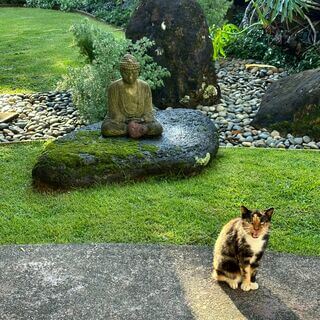
I had this beautiful sitting Buddha statue,
Cast cement.
It's like human size.
And we were moving and the mover had it on a dolly and the dolly fell forward and the head flew off.
And he looked at me like,
Oh my God,
I'm so sorry.
I'm like,
It's totally cool,
Man.
He's like,
What?
You're not mad?
I'm like,
No,
If I was mad,
I would understand nothing about the Buddhist teachings.
It's totally cool.
Like,
I can't get mad at that.
Like the Buddha would be so happy about that.
Yeah,
And then it's- It all gets destroyed.
Right,
And then you had the Buddha head like they have in India where they decapitated all the Buddhists,
The moguls came through.
So now you have the- No,
Actually I'm kind of still attached to things,
You know?
So I got rebar and I drilled and I put the head back on cement.
Now the head's back on.
There's a little crack.
For you,
Yeah.
Yeah.
Still in the garden.
Yeah,
The emptiness and fascinating journey,
Isn't it?
When nothing's happening.
But you're returning to the source,
Which does mean the end of you.
And it means the end of the seeker.
I heard this great analogy once.
Like,
You know how when you have a bonfire and you have a poker stick and you keep putting everything in the bonfire with the poker stick.
And then in the end,
You let the fire just take the poker stick.
Well,
The poker stick is the self,
Right?
And then the end,
That just goes into the fire.
So even the last stick is you.
It's really fierce,
Fierce teaching.
To release the self,
We could be so attached to it.
And even to come to that perspective of all of the creation and destruction in the universe is divinely perfect.
And it's just this process or robust,
I don't know how to say that word,
The snake eating its tail,
Right?
Nature,
Life,
And the universe.
Nature,
Life lives on life.
Though that actually life means something different to me,
But that kind of without thinking about that expresses it.
It's such a fierce teaching that creation,
Destruction,
And stories of the monk walking across the battlefield with all the dead bodies and the monks at peace.
Because the monk kind of has this deep,
It's one thing to think about it as the car getting crunched and who's worried.
But like a battlefield,
And that's the creation and destruction at work,
And be at peace with that,
That's really fierce teaching.
And it's interesting,
I've seen this with Adya and certainly Tigran Han and the Dalai Lama,
And certainly also with my teacher,
David,
And just that they really do,
Everybody points to that it ends up as love,
Like everything as love.
I don't quite get that yet,
But David,
He'll just shake his head and he'll kind of laugh and he'll go,
Ah,
You just don't get it.
It's all complete,
Absolute love.
And I'll be like,
Well,
How?
And he's just like,
It's so much more love than you could ever imagine,
Like exponential love.
When you really come to,
When you let go of the self,
It sounds like you just enter this field of exponential love that created everything.
And like I said,
I don't get that yet.
I'm just parroting what he's saying and other teachers has said this too,
That everything is like exponential,
Like a hologram of just love on love on love on love on love.
So that's where we're headed,
Like bring it on.
And that we just don't see it because we're holding the self and we're holding the dream,
Right?
We're in the dream,
But when we wake up on the dream,
We see that as he,
David will say,
Like you're quoting the Bible,
Not a hair on your head is misplaced.
Everything is perfectly organized and aligned by love.
And that you'll see,
Like you'll see the mastery of the math of the love.
Beautiful.
And you'll just be like in so much awe.
And he said,
It keeps expanding,
It doesn't stop.
Like once you see,
Like let's say we see the formula,
E equals MC squared and we go,
Oh my God.
And he said,
Then the formula just keeps expanding.
Like of course Einstein's formula did.
But it's like,
According to these teachers,
These wise teachers,
Like everything is perfectly aligned in this path of bringing us to the unconditional love that we are,
That is everything.
And it's such an incredible interactive hologram that we can't even believe it,
But we're holding on this little piece of self going,
No.
Yeah,
You know,
That's another thing,
Another piece,
Like what makes us hold on so tightly?
I've reflected to that.
And it's like,
Well,
That's the survival instinct.
At least that's been my conclusion.
Like we've been put here again,
Be human,
Right?
We've been put here,
You know,
As humans and a large part of that is keep yourself alive.
Like that's nature,
You know?
But then that spiritual yearning part is like,
Egoically die.
I'm like,
I'm confused.
But you know,
That tight holding on.
Well,
It's a lot like what we're seeing in the news now and with cults and stuff and you know,
With people that are really indoctrinated into Fox News or you know,
Or even,
You know,
I work with some people that are in cults and or were in cults and you know,
The tendency to like,
Once you get a belief system going and you're like locked into it,
You like fight like heck to,
Even when you see the teachers abusing people,
You still want to stay and you fight like heck to keep that belief system going,
Even when you have all the evidence in the world that it's not working,
Because we love our,
You know,
Our belief systems are sacred,
Right?
And so the belief system of self is the ultimate sacred cult.
Well,
It's that holding on to what's known and security,
Right?
And if you don't hold on to known and security,
But release instead into the unknown and an uncertainty,
Right,
It's like just this,
This letting go of like all ideas about how you think it should be including yourself.
Like that's for me,
Terrifying or has been.
When I was in my 20s,
I was in a group house and one of the women had been in a Zen monastery in Providence,
I guess the teacher had been physically abusing people in their one-on-one sessions and like breaking their arms kind of in the name of their Zen.
And I asked her,
I said,
Why did you stay?
Like at that point,
I didn't really understand cults so well.
And she said,
I loved the schedule.
She said the fact that every day was predictable,
We knew this was going to happen.
And then she said the schedule and the form was so pleasant,
That even when they started to see people with broken arms,
That she had a hard time letting go.
And obviously she eventually did,
Cause she had left,
But that just really struck me that what is that the rights and rituals and that sense of that we love the self,
We love the rituals,
We love the comfortability of the form and the guidelines,
Like you said,
Safety,
Right?
It's all about safety.
It reminds me of Eric Fromm wrote a book called Escape From Freedom to explain the rise to power of the Nazi Third Reich,
You know,
And like people just want to be told what to do and be,
You know,
To not have to question and just like,
Okay,
This is the way it is.
And it's hard,
Hard to be free and to rest in that uncertainty of,
Yeah.
Right,
And Todd,
What does that mean for you and I as Dharma teachers in an age where people are more and more getting that cult like clinging to avatars and virtual realities and,
You know,
These structures like with Trumpism,
You really have seen,
You know,
Wanting that security.
And what does that mean about our teaching and what,
You know,
How we can help people not blend with that illusion that blending with those illusions I think is really high right now,
More so than I've ever seen in my lifetime.
And,
You know,
We could speculate as to why that is,
Internet,
Da,
Da,
Da,
Da,
Da,
But people are blending to these false idols,
Right?
Well,
That kind of brings me back to what,
When we were talking about Adia,
Like it's,
It kind of shocked me that he doesn't have,
That he isn't like a worldwide phenomenon,
You know,
Like he has a meditation retreat and I don't know,
200 people,
Maybe 600 people,
If it's a really big retreat,
Retreat,
Right.
But like,
You know,
I mean,
There are churches of all different denominations with really bad teachings and really bad teachers that have like 20,
000 members,
You know,
And it's like,
Who's this little guy?
And he's only got like,
He's amazing.
Why does he only have 200,
600 people at his retreat?
Like,
Why isn't he like,
You know,
Tapped by the president of the United States to like,
You know,
Psychically go into people's minds and under like this person you should hire,
This person I'm fixing their psyche,
We'll get rid of that situation over the,
That corner of the world here quickly,
You know,
Like,
You know,
Like he should,
I don't know,
So that's.
He had 6,
000 people,
I mean,
On his radio shows,
He gets like 6,
000 people.
He said the first radio show,
The first he ever did 3,
000 people logged on and he got physically ill afterwards.
Cause you know,
He takes on people's energy,
But you know,
Asilomar's 500 people.
He'd have a,
If there was retreat centers that big,
I don't think he's that interested in that big a retreat,
But he could have 6,
000 people if he wanted.
Yeah,
He's that popular.
The radio shows have a lot,
A lot of people when he does those online shows.
I mean,
At least that's what I've heard him talk about how many people logged on it.
So,
But you know,
Again,
He doesn't want that.
He's not here to have followers and he's here to talk about the truth,
So that's the most important thing to him.
And you know,
With the evangelicals,
It's to create followers,
Right?
Yeah,
Tell me about your,
Have you had any kind of like experiences on the path of,
Like,
How has the path any like,
Okay,
That was like a little awakening experience or enlightenment experience.
Have you had any or synchronicities?
Like I'm pretty fascinated by synchronicities.
I love synchronicities.
Like at one point on my journey,
I found like just,
And it felt kind of like it was put there for me,
But a heart and it was just a little metal heart,
Like,
You know,
That you might have a pen and then you put it on your lapel and you push the thing on the back.
It was a heart and it said,
Love yourself.
Like I've never seen a heart like that anywhere,
Right?
And like here I'm walking along and I find it.
I'm like,
Okay,
That's a message.
I'm just gonna attribute that as a message from the universe.
Like have you,
You know,
Or like,
You know,
One time just seeing the divine perfection in nature was kind of like,
You know,
I had this awakening experience where I felt like I was seeing,
You know,
Like as if I'd been living in a two-dimensional world and it suddenly was three-dimensional.
Now,
Of course I know we're in a three-dimensional world,
But it just felt like,
Oh my gosh,
Right?
Like,
Wow,
Like,
You know,
Look at these trees and look at the perfection of nature and just this kind of sense of like amazement and awe and radiance.
So have you had any- The mentality dropped there,
Todd,
So some piece of seeing things through the mind dropped and then you were more in direct access.
That's great.
Yeah,
That's what the practice is all about.
Yeah,
And I want to hear about that.
Like if you were not,
If like meditating in Vipassana was not the right practice,
You might as well have been like meditating on a Cadillac.
But what,
So like what have been your experiences?
Have you had awakening or enlightenment experiences,
Little ones or synchronicities,
And then what is practice from your perspective if like traditional Vipassana,
Theravada meditation didn't really serve?
Like how do you see it now?
Well,
It did serve me up until a point.
I mean,
Yeah,
I think,
Well,
What's fascinating is my very first retreat,
A weekend retreat with this guy named Deera Vamsa,
He was a little Thai monk.
At one point he got set in a Jhana state.
The sit went on two hours,
He forgot to ring the bell and it was my first retreat and I was like,
Two hours.
But I walked down to the park and all of a sudden everything was just completely silent.
And I was like seeing everything from this wordless silent space,
Almost like an altered state.
Like if you were on acid or something,
It was just like,
Wow,
Nothing's happening.
And yet I was the eye watching everything.
And that was just an altered state.
But I think sometimes on people's very first retreat,
You can have a foretaste of what is sort of going to happen.
You know,
And then of course,
You know,
Then there's the wanting to get that back and all the struggles.
But the Vipassana was originally good with the noting and the strictness.
And I was super into being like the world's best retreat and following the form to a T and it really helped.
And I went on a lot of three month retreats and my second three month retreat,
My first three month retreat was just about working with depression.
But once I kind of got through the bulk of a lot of difficult emotional material,
My second three month retreat,
Kind of early on,
I was just sitting and there was a sound of the bird,
Which I guess is kind of a classic thing that can happen,
But the sound of the bird and the hearing of it and the me,
It was all just one thing.
And it was just like,
It just,
Boom,
It just blew me away that there was no separate self in it.
And then like probably 24 hours later,
Something just happened where there was like a severing of a connection to self.
It was just like something just unplugged and I just saw clearly there was no self.
And then the thoughts and the personality still came back in but I knew without a doubt,
It was very clear that there was no me.
And it was very freeing,
A lot just got lifted.
There was a lot of joy and relaxation.
And then the second experience I had,
I was in Australia and I was working with an Aboriginal elder and we were doing a very traditional ceremony with a fire and singing and it was late at night and we were walking clockwise and there were four different groups.
It was very ritualistic Aboriginal ceremony and there were four groups and each group was singing one piece of the song,
But each piece then almost like in harmony made the song.
But at one point,
The piece we were singing,
We were singing,
I was singing with my group.
I all of a sudden saw that in my one piece,
The whole song was there and it's hard to describe,
But I saw there nothing was separate and the whole totality was in that one piece and it was just like my whole world just broke open and I cried for like two days.
I don't know why I cried.
It was just,
I couldn't stop crying.
It was just like,
Oh my God,
It's all one thing.
And it was very,
Very deep and poignant.
And then you get these big openings and then your personality and yourself and your conditioning comes back in and it's kind of how to integrate it.
So,
And then just those things developing,
Those insights develop,
Right?
So they're living insights.
When you have a scene into no self or a scene into the unity,
Which was the second one,
They continue to develop and tell,
I see more and more that the thinking is just going more and more,
Like the way of self-referencing and that whole,
I mean,
You wouldn't know it by how much I'm talking,
But this- I've asked you in all fairness to you be the one who does most of the talking.
The self-referencing is being erased and more and more I just feel like everything's just being kind of erased in a good way.
So who knows what's next?
So inside yourself,
You feel like there's just some process at work that's erasing identification with the self and all the selfing and me.
Yeah,
And what I've been working on a lot with my teachers is just the narration.
And it was interesting listening to Ajay's third Wakening experience that he talks about with Tammy Simon on that interview,
Is he said what happens is your narrative and your inner world just completely stops.
And that certainly hasn't happened yet for me,
But it was cool to hear it when I heard it,
My heart just like went,
Ah,
Like my whole body lit up.
And I was like,
Wow,
Imagine when the narrative and the inner world is just gone.
He described it like looking into an empty room,
Like there's no more you that's talking to yourself.
And so that's kind of where my edge is right now,
Just watching that narrative and letting it,
My teacher just says,
Undo it,
Like turn off the radio.
He's given me a lot of different practices that we're working with to wean from the narrative.
So go ahead.
Yeah,
Ajay also said,
Ajay said that there's a lot of things that we can do to help our kids.
Ajay said that there's no internal process.
He said,
There's no process anymore.
And I was like,
Whoa,
What would that be like to have no process?
But it does get simpler as you know,
Todd,
You've probably seen it,
It gets simpler and simpler and simpler.
So help me gain some clarity on practice.
Let me see if I understand it.
But do you,
On your perspective on what your practice is like now,
Do you sit in meditation now,
Every day still?
Yeah.
For most days?
Yeah,
No.
Pretty much every day I try to do some practice.
I try to do some,
At least five minutes of something,
Of sitting,
Just being aware,
Emptying out.
I call it just emptying out.
And then I also do walking meditation.
I try to do some of that.
I sit for my work a lot,
Because I'm a therapist and now with Zoom,
You're sitting all the time with clients.
Yeah,
Holy cow,
That's so much sitting.
I try to do walking,
Because sitting I find is a little bit too much.
And then I also do all day long,
I have like inquiry questions.
I have them on a chalkboard in my kitchen.
And then I often have reminders in my car,
Wherever like these questions I kind of hold and work with.
I mean,
I know Ajahn Chantee encourages that too,
These like Ramana Maharshi type questions,
Like what is not a thought?
What's happening that's not a thought?
What's the actual right now versus my thinking about it?
These things that I'm constantly chewing on throughout the day to remind me to let go of the grip of the identity,
The thinking persona,
Right?
Because you've got this direct experience like you saw in your moment of awakeness,
Right?
You've got this direct experience of the actual,
But most of us are living from our thoughts and our commentary about it.
So I have these ways to unhook from the commentary.
Yeah.
Nice.
I also wanted to mention just for people that have emotional issues that another experience,
I guess you could,
It wasn't really an awakening type experience,
But on an emotional level it was.
I had had really severe depression,
Hereditary depression my whole life.
My mom killed herself.
My mom's sister killed herself.
My grandmother tried to kill herself and I had pretty much suicidal depression.
It was sort of what brought me to the Dharma.
And so I had struggled with that concurrently with my practice.
So I was 20 years into practice,
In therapy 20 years as well,
But still struggling with very difficult suicidal,
Almost debilitating depression.
Even after that first kind of awakening experience,
It still was there.
And one day before the second experience I described,
I was just kind of doing a self retreat and I was struggling with a depressed mind state.
And all of a sudden the depression just like,
It just unhooked.
It was like a caboose car in a freight,
Just like leaving.
It just went like,
And I saw that there was no depression and it was just causes and conditions and there was nothing there.
And it was like actually kind of funny and embarrassing.
And I was like,
Holy crap,
20 years.
I've been fighting depression and there's no depression.
The depression's an illusion.
And it was so freeing.
And from that moment on,
I've never had suicidal depression again.
And I can still have negative mind states come in and some of the conditions like low energy,
But there's no coagulation around depression anymore.
Whatever that was just went.
And at that moment,
It was cool.
This voice said,
When that happens,
It's this voice came out of the blue and it said,
This is how your sense of self is going to go to life.
And it was like,
Cool.
That's wonderful to hear.
Congratulations,
I want to say.
I'm happy for you.
It was really freeing it.
And I kept thinking,
Well,
How's it going to come back?
Because when you've lived with your,
I had suicidal depression from when I was five years old.
So I kept thinking,
Ah,
Is it going to come back?
And it never did.
It never did.
So.
That's some heavy,
Heavy genetic lineage,
However it came to you.
It shows the power of practice though,
That pretty much was through a meditative insight that that whatever unhooked,
I mean,
I didn't do it.
It just spontaneously,
Probably just the sheer amount of time and energy.
Right.
Yeah,
That's an interesting thing about meditation.
And I mean,
The spiritual practice,
Whatever form that might take for an individual,
But it happens in,
There's an aspect of it,
Which is understandable by the mind and okay,
Here are the things we're going to do.
And then we do it,
And like,
And then there's also part of the process,
Which is completely not understandable by the mind,
You know,
And stuff just happens.
Not sure,
You know,
Grace,
You know,
Like Adia will talk about it as grace,
You know.
Yeah,
Exactly.
Just happens.
And there are a few people that have had similar,
Like Ute Janie I know had anxiety or depression,
I can't remember,
And a couple other monks,
I mean,
Minger Rinpoche,
He had anxiety,
And another monk.
So people have been free of horrific,
Debilitating,
Lifelong anxiety or depression.
The practice just lifts it.
Not right away after long periods of practice.
So it's good for people to know that that is also possible as a benefit,
Right?
Almost like a grace,
Like you said,
That comes with,
Wow.
Yeah,
I mean,
That's an amazing,
Amazing thing.
You know,
Like there's enough anecdotal evidence that,
And enough correlation that,
You know,
And even scientific evidence that meditation is beneficial for one's existence,
You know,
And we don't completely understand how,
How it can do these things,
But,
You know,
It definitely has a positive influence on many people's lives,
On many accounts.
Yes.
That's why we keep doing it.
So you've worked as,
You live in Maui,
And you work as a therapist,
And you have clients,
And I want to include at some point how people can get in touch with you,
But I don't know if you have a website you want to say that real quickly right now,
People,
Are you accepting clients?
No,
Right now.
Okay,
Maybe we don't need to say the website.
You're like,
No more,
Don't contact me.
I have a website that has all my teachings on it.
Everything's free.
I just offer.
So if you want amitaschmittmyname.
Com.
Also,
I recently have downloaded a bunch of meditations and some talks on Insight Timer.
I finally kind of figured out how to make that happen with them.
So there's all this stuff on there.
I don't know if you have to pay for that or not,
But my website,
It's all free.
And if anybody wants teachings there,
There's kind of stuff on depression and anxiety teachings.
I've really like from day one,
Been a trauma informed Buddhist teacher.
I mean,
Now that's kind of the norm and very common,
But early on,
You know,
You really had to beat the drum for people that had emotional issues and you really had to educate.
And it was a very uphill battle with some of the traditional Theravadan teachers to help them understand trauma informed Buddhism.
But I've always had my work.
Right from the beginning,
When I started teaching the Dharma,
I never wanted the pressure to make a living from it.
I just felt like that would compromise my teaching if I felt pressure around the money.
Yeah,
For sure.
I always,
I mean,
I love being a therapist.
So I always,
That's always been my primary profession.
And it's been good because then I can really offer the Dharma with no expectation.
And that helps,
Yeah.
That helps a lot.
So you live in Maui and you're a therapist,
And I want to hear your thoughts on how people change.
I want to get to that in one second.
Like,
Just like,
And it could be brief,
But like tools at disposal to help people change.
And,
But first I want to hear about Maui.
Like,
That's amazing.
How's living on Maui?
And just like another place to live,
Grocery store,
Post office,
Bills to pay,
Go to work,
Come home,
Cook dinner,
Sleep,
Do the dishes.
Or like,
Is that like as paradisiacal,
I don't know if that's a word,
But is that like,
You know,
Amazing place to live?
Like,
Certainly it's better than living in some horrible places.
And living in some horrible places in the world.
It's a lot like California.
I don't know how it is where you are,
But it's warm and it's very inviting.
I think California is very inviting in the places with a lot of nature.
You got it.
What's cool about this place is you're surrounded in every direction by 3000 miles of ocean.
So for some people that drives them nuts and they get what's called rock fever,
Where they're like,
I got to get away.
But for people that don't get driven nuts by it,
There's a real sense of like an insular kind of protective quality.
And Maui is,
All the islands have a very sort of feminine energy to them.
And there's so much beauty and so many microclimates and color and there's just,
The island is like a living thing.
And what's fascinating is the Hawaiians don't say,
They identify as the land,
The original indigenous Hawaiians.
So they don't say,
I'm Hawaiian.
They say,
I am Hawaii.
It's with a W and a V.
It's I am Hawaii.
I am the ʻāina.
I am the land.
Like they are it.
And when you live here,
You really get it.
The mountains and the ocean and the breezes and the colors,
They all become like part of who you are here.
And that's the magic of living here.
But it's a small community in the middle of nowhere.
So it can get like Lord of the Flies.
You can get,
There's gonna be a lot of interesting politics and a lot of like a cauldron,
Right?
Cause it's a small community in the middle of nowhere,
Smallish.
So,
You know,
There's that,
That insular quality,
But then there's this magical awe of the islands themselves for certain people,
Not everyone experiences that.
So.
I'm loving the images that are going through my mind of just the ocean and the lush green forests and waterfalls and brother E singing,
Oh Hawaii,
You know,
But magical special place.
Yeah.
And warm,
Sandy beaches and the sunset.
It's extraordinary.
It's a fascinating place to be.
And it's like any relationship,
You actually have a relationship with Maui herself or whatever island you're on.
And,
You know,
She puts you through the paces too.
Like,
You know,
She's expensive.
Maui's an expensive partner to be in relationship with.
Very,
Very high cost of living here.
And you can't get what you want all the time.
You have to be very patient.
Everything has to be shipped here.
So.
But at least you got Costco.
Yeah,
Right.
You might want something,
But you know,
It's Costco,
It's all out because all the tourists have bought it all up.
The boat of tourists came and a cruise ship with 3000 people came and they all bought it,
Whatever item you wanted at Costco.
So it's fascinating like you have to really flow here.
So it's,
But you're in a relationship with the island as like a person.
I didn't get that living on the mainland.
I mean,
Yeah,
I think,
You know,
Certain places like in California,
You can have a relationship with a certain area.
But here you're,
It's really clear.
You're at the mercy.
I always feel that we're guests here.
We're guests.
You know,
She,
The island,
She lets you be here,
You know,
And they joke about,
She kicks people off too.
There's people that she's like,
She,
She ejects certain people from the island.
It's fascinating to watch,
You know,
Cause there's a lot of transients here.
Some people get ejected almost immediately.
It's like a James Bond ejector scene.
Nope,
You're not meant to be in Hawaii.
Everything that could go wrong will go wrong.
And other people it's like green lights the whole way.
I was lucky it was green lights for me.
But you know,
My husband,
My ex now,
And he and I right from the start when we moved here,
We said,
We're going to give.
We're not going to come to Maui to take.
We're going to,
The whole first year we're going to give.
So he's an electrician.
So he volunteered for Habitat for Humanity.
And I volunteered for this group called Feed My Sheep,
Which feeds homeless people.
And we just gave the first year we weren't here to take.
And I think that helped a lot that,
That attitude of gratitude that we brought to our first year,
Not just like,
What can Maui give me,
Right?
How can I enjoy the pleasures of tropical living?
It wasn't about that.
How can I serve?
So that helps.
Nice.
Yeah.
Probably we should do that in any community,
Right?
Yeah.
I mean,
It's belonging to any tribe is a process of mutual support.
Mm-hmm.
Right.
So tools.
Yeah.
So my perspective on therapists is that they often aren't prescriptive.
And if a client was to say to a therapist,
What do you think I should do?
The therapist would respond,
Well,
What do you think you should do?
That's like so classical.
You're like old school,
Todd.
I don't know if therapists are more prescriptive,
But that's just my- That's like from the seventies.
I mean,
The traditional psychoanalytic therapists still do that,
But no.
I got one of my Dharma friends,
Who's also a therapist in the East Coast.
He was doing this thing called Internal Family Systems,
IFS.
Amazing.
Parts were.
And I got turned onto that and oh my God,
That's just like,
That's the bomb.
Well that- And with Dharma,
It's like so perfect Dharma.
I mean,
They use the word self,
Which is a bad word in Buddhism,
But it's just fantastic for helping on the cushion.
And with therapy clients,
Like when they can start to name parts,
Then they're not judging themselves.
Oh my God,
It's so great.
It's just liberating as heck to people's inner worlds,
To be able to name a part,
Not blend with it,
See the bigger self.
And IFS brought spirituality to the therapy world,
Kind of stealth.
Like it talks about the key thing of the IFS,
I don't know if you know,
But it's resting in self 24 seven.
The parts,
Yeah,
You work with parts and stuff,
But the key is that you're vibing and embodying this self,
This wise centered self energy as the norm.
And eventually you're just living there.
And it's called internal family systems.
Is that correct?
Is that the type of therapy?
Yeah,
I have that.
I saw on Netflix,
Gwyneth Paltrow has a show called Goop.
I don't know why that name,
G-O-O-P.
And they do a episode with internal family system therapy.
And so like,
I'm not super familiar with it,
But it seemed pretty extraordinary.
And like people playing parts,
In family systems who aren't in the family system,
But then able to embody and somehow get in touch with energy they know nothing about,
And to convey to the participants,
Like,
Yeah,
That completely represented that aspect of my mother or my dad in a way that was like,
Again,
Kind of speaking to these forces,
Which are the collective unconscious,
Whatever you wanna call it beyond our understanding that at some deep level,
We all maybe have access to,
Or we do all have access to,
Depending upon where you wanna sit with that.
But do you see that with IFS?
Is that kind of,
I mean,
That might be how it's done on a retreat,
Like group therapy when there's a lot of people,
It's probably different if it's just an individual working one-on-one with a therapist,
But.
Right,
And that might be,
I'm not sure,
Cause I didn't see that episode,
But there is also a way of representing pieces in your family of origin in a systematic way of looking at parts that was,
I think,
Bowen or Satir,
Somebody did this whole structural family systems thing.
And with the IFS is really looking at internal parts.
So like right now I have a part that,
Just cause I'm being interviewed,
That is a bit of a performer.
And I can see that part that's wanting to do a good job,
Wanting to perform,
But that's being witnessed by this self energy that's just kind of back here,
That's none of that.
So I can just bring mindfulness to the performer part.
Yeah,
It's complicated.
I wouldn't know where to go with all this,
But we're all made up of different parts.
And that often happened because of some energetic clench,
Like say you were,
You know,
First time in school when you were five,
Someone criticized you.
So you got a part that became sensitive to criticism,
And then you develop other parts that protect that part.
And there's like this whole kind of system,
How our psyches work and get formed.
But what's really cool about it,
And one of my 16 year old clients,
She asked me,
What's the value of this?
And I had to really think about it.
I love when teenagers ask that.
And it was just like,
Well,
When you can identify,
Like if I was angry at you,
Say,
I could say,
Well,
I have a part that's angry at you,
And there would be no shame.
I said,
The value of IFS is that there's no shame and judgment,
It really almost erases all judgment because I can speak for a part rather than from a part.
And that's the key of the work.
You're speaking for parts rather than from.
So I can say,
Todd,
I have a part that's really upset with you.
And of course the me that's naming that isn't upset,
Right?
That's classic vipassana,
The witness itself.
And then we can just talk and you can say,
Well,
I have a part that's really mad at you too,
Right?
And then we can just look at the whole thing from self energy,
And we're speaking for our parts that are triggered or clenched.
And then the whole thing just,
There's so much space that opens up in there,
Which is really the point of practice too.
And it's so liberating even when I can say,
Yeah,
I have this part that's talking a lot,
She's performing,
And I love her,
She's okay.
It's not who I am.
I mean,
We utilize parts almost like characters in a movie and sometimes you can bring forth that part.
You can ask parts to step back.
Like if I wanted to be maybe be more quiet,
I could just ask that part to step back.
If I was mad at you,
I could talk to,
Why are you mad at Todd?
What does that part need?
It's just so liberating,
So liberating.
Yeah.
Well,
Definitely I have more follow-up questions,
But I just want to speak to that,
The background I came out of,
I was raised farm tough.
And so I think it's,
Definitely I've done a lot of healing around that,
But farm tough,
I don't know what you picture.
To me those two words kind of really capture it,
But like don't do a half-assed job and like,
Here's your dying dog,
Go bury it.
I gotta go to work,
Or like,
Okay.
Like handing your kid his dying dog and walking away,
Like farm tough,
Man.
And a lot of shame and anger.
And so the examples that you tapped into were on point for me,
Like where I come from.
So I don't know if like you are just really attuned to like facial expressions or if there's some kind of psychic knowing,
But it's just really interesting coincidence,
Maybe a synchronicity and illustration perhaps of this way that we could have intuition or collective knowing or the collective unconscious that you just exemplified,
Maybe just random chance,
Coincidence,
But the examples you brought up were completely on point for my history and where I came from.
That's really,
That's an interesting moment.
Thanks for sharing that.
Yeah.
Yeah,
And so what happens with the farm tough when you're told you can't cry,
You can't feel,
Especially as a boy,
Right,
There's that part too.
Then you do what's in IFS is called you exile those parts.
You put them in the basement,
The ones that wanted to cry when your dog was killed.
You put those in the basement and you develop this guy who's the farm tough guy who's called a protector.
But behind every protector is a little kid who's got these tinder feelings.
So in the therapy we would work through,
We know that tough guy's there and he's fine,
But eventually we help that tender little kid come out of the basement and make it okay for him to be at that round table of use.
You got the farm tough guy,
You got your spiritual guy,
You got your tender kid,
They're all at this table and they all have an equal voice.
But when you're raised in that family environment,
The sensitive parts have to be locked away and they don't get a voice.
So the therapy allows you to be a whole person and every part has an equal voice and nobody gets shamed.
And even if one part goes,
Oh man,
We can't say that,
Right?
Your self energy comes in and goes,
No,
Everybody's here.
And you're self led in that the farm tough guy isn't leading like you learned from your family that the farm tough guy is like the leader of the family.
And of your internal world.
But if the farm tough guy can just take a seat like a regular part and then you have the sensitive one,
The scared one,
The shame one,
And they're all at a round table and you're loving like Kuan Yin's self is leading the whole group,
Letting everyone speak,
No one takes over,
Then you're completely balanced.
And the centered self,
The wise self is leading all the parts versus the farm tough guy is the head of the table.
So it's almost like a regime change when you really start to work this process.
And all those parts are still there.
No one gets eliminated.
The farm tough guy is still there.
He's just not sending kids to their room and he's not charged the family,
He's just one.
And you're loving wise,
Ajay,
Your Ajay self is the one that's leading the family.
You're Ajay Shanthi's self.
And that's the healing,
Right?
No one gets eliminated.
The scared kids come out of the basement,
The farm tough guy gets just a regular seat which he really wants anyway.
Those tough kids don't really want to run the family.
They just want to be kids,
Right?
And then your wise self is the one leading and orchestrating all the interactions.
Yeah,
It's so freeing and it's so relaxing when you can know your parts.
And we don't have that many parts.
We generally have like,
I don't know,
Anywhere from five to like 20.
So you get pretty aware of what your inner world is and who's doing what.
And- Super cool.
Yeah,
It's super fun.
If you want that on the IFS website,
There's a little green book called introduction to family systems,
Introduction to IFS.
It's a little green book.
It's kind of thin,
It's really easy to read.
There's also a book,
It's a bit more simplistic and less about theory,
But it's called There's a Part of Me.
And that book kind of explains it in a simple way too.
And I love the framework,
IFS,
That internal family systems is still kind of a new phrase for me.
Kind of when I was going through my personal growth and like early stages on the journey.
And I went to a therapist and I don't know what kind of therapy that person did.
He's a psychologist,
But also did some Gestalt workshops at Esalen where you do open chair work.
And then IFS kind of came about after that,
At least into my awareness.
So it seems like it's something that's emerged in the last 10 years or something more prominently.
So I'd never practiced or was involved in doing that type of practice,
But I love the framework and the way you described it and the beauty and power of that objective awareness.
And you're the CEO or the one who's kind of like helping coordinate all these different voices within yourself.
And then I'm just reflecting back to what I heard and the beauty of it,
Where it's like,
You're not getting rid of a part.
Every part still has a voice and you listen to all the different voices,
But then you're the one who makes the decision and how freeing,
Like you said,
How freeing that is and free of shame.
And like everything gets to exist and exist for the reason you want that tough guy,
You want the warrior,
You need protection at times,
But you also wanna be able to access your heart and be tender and gentle and love and warmth and compassion.
Like you need all these different parts.
And so allowing them all and hearing them all and feeling them all.
I think that's a really beautiful framework and modality for therapy and personal growth.
And just to tie kind of those in with,
I asked like,
What is the path of transformation?
I was heading towards asking that question.
I don't know if I asked it as directly as I just articulated it,
But from our conversation today,
Like two things,
And then the third one just jumped up is like one,
Meditation.
Two,
IFS,
Right?
Like these would be like two really good steps if you're wanting to sort of like grow and overcome challenges in one's own life,
Like start integrating some meditation into your life.
If you need help from somebody else,
Definitely,
We all could use that more intensely at some times than at others.
And you and I still seek that out.
Like I've gotten help from you today.
I love doing these podcasts because I get to talk to amazing people,
And I learn and grow from them.
So like,
You know,
Meditations one,
IFS would be two.
Three,
Nutrition,
Sleep and exercise,
Right?
Just like get your sleep,
Exercise and eat well,
And that's gonna move you along.
And then four,
Trust your intuition,
Right?
But would you add anything to that list?
Yeah,
I think like creative,
Alive things,
Like whether it's making music,
We talked about early or art or dance,
Or I think we need something that is just kind of about love,
Love of life,
Right?
For me,
It's swimming in the ocean,
But we need to have something that really lights us up because that's often a place where we truly relax.
We need these places where we truly relax,
And then the transformation can happen there too,
Todd.
Because otherwise we just have this list that we're going through,
Right?
Yeah,
Let me put them out.
One,
Two,
Three,
Four,
Five.
And five,
Relax.
No,
That's definitely an area.
See,
You're on point again with your intuition.
That's definitely an area where I have some room for growth.
I think those places,
The non-doing places,
Where we can't believe or keep that belief that anything's happening,
Where we just kind of merge with the thing.
So creative,
When you're doing music or art,
You sometimes just become one with that.
And for me,
Ocean swimming,
Until I'm really in the water for hours,
I'll go along the coast by myself.
I know it's not recommended,
But I do it.
And I'll just eventually,
After about an hour and a half in the water,
You just become one with the fish.
First of all,
You're so salty.
And you're just flying.
And I just disappear at those points.
So what time- That's my thing.
My thing is the ocean and just,
Yeah.
What?
What time do you go swimming?
Morning,
Midday?
Yeah,
The rest is too windy.
Yeah.
Which shore?
West,
East,
North,
South?
I go,
There's a reserve.
There's a protected ocean reserve with black coral and you just get in and just kind of follow the coral.
Lava,
It's a lava coral area.
But I think the key,
I mean,
It doesn't matter where,
It's that ability to get lost in something.
And for me,
I can get lost in swimming.
Most people,
It would be horrifying and they'd be anxious the whole time,
But it's that sense of something bigger taking us over and just free falling into that.
And like I said,
That could be some people that's aesthetic dance,
Some people that's art,
Music,
Listening to kirtans.
Love kirtan.
I think marathon runners,
They fall into that place or runners,
Don't have to be marathon,
Where they're just one with the running.
And so things where you can,
The self can fall away and you relax into the oneness,
I'd certainly incorporate that,
But your list is great.
Yeah,
There it is.
Now just walk the trail.
Remember,
Nothing's happening.
That's my mantra every day.
Yeah,
And I think sometimes,
I mean,
Also,
We incline the mind in a skillful direction and it helps us make more skillful decisions and take more skillful actions.
Skillful being increasing happiness for oneself and others.
And so we do learn,
We do grow and we can live more skillfully.
So even if at that non-dual perspective,
It's all one and nothing's happening,
The absolute perspective and the relative perspective,
It's like,
If you're in a place in your life where you have debilitating depression,
There's a path,
It's gonna take effort,
You can walk it,
And here are the things that can help you.
Because that wasn't clear to me when I was young.
And you found your way to the path and I feel blessed that I found my way to the path.
But there's some people that this might be them finding the path,
This one talk right here.
Maybe,
Right.
And as Ajay said,
Even though,
He said,
Even though you might know it's a dream,
You still wanna have a good dream,
You wanna have the best dream you can,
Right?
There you go,
That's nice.
Yeah,
So a skillful dream,
Right?
And a dream where you help others.
Kinda like Groundhog Day,
Remember?
That movie and- Oh yeah,
Totally.
Bill Murray,
That's a great movie.
He made it a great same day over and over,
He didn't.
Once he realized that it wasn't really that great to eat all the donuts and rob the bank.
Yeah.
He decided to have a good dream.
There's a new movie that came out that had the Groundhog Day theme,
The same day repeated over and over.
It's called Palm Springs.
Okay.
2020 Palm Springs with Andy Samberg.
It's a romantic comedy on Hulu.
Check that out,
I enjoyed it.
Okay.
But yeah,
It had some good laughs in it.
Palm Springs.
When that movie came out,
I saw an interview with the director with Groundhog Day,
Not Palm Springs.
And he goes,
The Buddhists really love this movie.
I don't get why they like it so much.
He wasn't Buddhist.
He's like,
They're just fast.
The Buddhists are into this movie.
That's cool.
Yeah,
It's like a retreat.
It was the same day over and over again.
Well,
It's just that idea that like,
No,
Actually literally we're all stuck here.
Gosh,
Who's that actress whose dad is a Buddhist teacher at New York and she was in Kill Bill and Pulp Fiction.
Yeah,
And Bob Thurman.
Is that his name,
Bob Thurman?
Yeah,
Uma is her name.
Yeah.
Yeah,
But Bob talks about like,
Her dad's name's Bob,
Right?
Yeah,
He talks about,
Robert,
That's right.
He talks about,
You know,
Like,
I don't know if I'm getting this quite right,
But he sees it like we're all trapped in the same subway car.
Like,
You know,
Like what are you gonna do?
Like,
How are you gonna treat people?
Like,
These are the people you're with for the rest of eternity in this one subway car.
Like,
How does that change your perspective?
But.
Right,
Right,
But if it's all you.
We're coming up on our time limit here.
I have to take my daughter to soccer.
So we got like maybe 10 minutes left.
And I wanna hear if you have any final thoughts you'd like to share.
And I also just wanna express that I love talking with you and it's been a pleasure and very enjoyable.
And I've loved talking about audio.
Oh my God,
Like I could just keep going about that.
And if you got more to share,
I'd love to hear.
And,
But before we hear you have any final thoughts,
I looked up a few Dogen quotes,
Maybe this audio is Dogen reincarnated,
Who knows.
And so I thought these are just the Goodreads quotes.
And here's the Dogen quote,
Which,
You know,
For me is,
I don't know,
The one that came to mind when we spoke of Dogen.
To study the Buddha is to study the self.
To study the self is to forget the self.
To forget the self is to be actualized by myriad things.
So that's kind of cool.
And if you're,
And then this one sounded really like audio.
If you're unable to find truth right where you are,
Where else do you expect to find it?
There you go,
That's perfect.
This is it,
This is it.
Yeah,
I love that.
Thanks for looking those up.
That was really nice.
Yeah.
No,
It's been lovely talking to you too,
And keep finding out about your parts.
And it's really nice to have a kindred spirit,
A kalyanamitta,
Fellow traveler.
Yeah,
For sure.
Yeah,
Yeah.
And keep doing your wonderful shows.
Thanks.
Yeah,
We're all walking the path,
As Ram Dass,
Your favorite person.
One of them,
One of them.
We're all walking each other home.
Oh yeah,
That's right,
He does say that,
Huh?
So here we are,
Todd and Amita walking each other home,
And whoever's listening to the show is walking home with us,
And you guys are all welcome,
And how great,
How great.
And your daughter going to soccer is part of that.
It's just so great,
Isn't it?
The hallway,
The expandable universe.
Yeah,
It's incomprehensible and extraordinary.
Like when we really open to the mystery and the beauty,
And it can be so easy to take it for granted and forget it,
And just to be angry in Maui.
You know,
Like,
I'm not saying you are,
But like,
You know,
You know,
Like,
I mean,
Like,
Look,
Look at this extraordinary place.
You don't even have to be in Maui to see it.
I mean,
It's just like,
I mean,
The sun and the clouds and the trees and,
You know,
Rain and blue skies and the earth and things rising up out of the earth and the seasons,
It's like,
Oh my God,
It's so extraordinary and beautiful and incomprehensible,
Completely mind blowing,
You know,
Taking your daughter to soccer,
Like just to have even inhabited and experienced and witnessed this incredible existence for a day is like innumerable blessing,
You know.
I know when you're watching all the girls with this ball on this court and in the green field,
Like,
Oh my God,
How is all that?
How is all this possible?
It's just so cool.
It's just so amazing.
Thank you for joining us,
Everybody.
I hope you enjoyed this talk.
Make sure you check out Heart Mind Way,
Heart,
That's like that thing in the center of your chest,
Heartmindway.
Com to gain access to all kinds of resources and to learn how to live a more skillful life,
How to find more happiness right here,
Right now,
How to enjoy where you are more fully while you are going somewhere better,
How to enjoy where you are more fully and to love who you are more fully,
Why you are going somewhere better and why you're becoming more skillful.
So check out heartmindway.
Com.
And then please also like this wherever you receive this talk from,
Give it the thumbs up,
Comment beneath it,
Share it on social media and subscribe.
This helps other people find this talk.
This helps other people find these teachings.
This helps other people.
So help other people like this talk,
Comment beneath it,
Subscribe and share it on social media.
See you next time.