Today's Dharma talk is about artificial intelligence and the Dharma,
And I'm also going to include some about aloha.
What is artificial intelligence or AI?
It's basically that a machine or computer can simulate human cognitive functions and that computers can take over human tasks and operate with kind of a similar but different intelligence than we have.
Sam Altman,
Who's one of the founders of AI and also,
Coincidentally,
A Vipassana meditator,
He said,
We will live in a world where there is not just human intelligence.
And I'm not doing this talk about AI because I'm worried about it myself.
I'm actually just here for whatever happens,
Whether it's illness,
Climate change,
AI.
My Dharma is to show up and be with what is,
No matter what that is.
But I am doing this talk because a number of people have been concerned and expressed kind of wanting some practices or ways to work with,
If there are big changes that arise with AI,
To know how to work with this big change.
And really,
Artificial intelligence or AI could stand for anything.
We could just get a giant card that says fear of the unknown or fear of what I can't control.
And then below it,
We might write death of a loved one,
Loss of a job,
Climate change,
AI,
Or any adverse circumstance really comes below that fear of the unknown.
So this talk is really about how to handle difficult circumstances if they do arise.
And one of the couple of things,
AI has become a concern for people because there's concerns that it will make it harder to know what's true when artificial intelligence simulates humans,
That maybe someone could hack into your IRA account or your bank account or call you up peering as your loved one and really be a computer trying to get your data.
And also,
Some people even say,
Wow,
AI could start a war.
So there's been a lot of concerns.
But what's cool to remember is that AI can do positive things too.
There was a recent article in the New Yorker saying that they're going to probably be able to get AI to decode sperm whale clicks and communications.
And it's very likely in a few years,
We'll be able to talk with whales directly.
Now,
That is cool.
And despite all the positives,
What we're really looking at in this talk is,
How can we use the Dharma for adverse circumstances?
We don't need it for positives necessarily,
Although some of you might.
But it's more like,
What do we do when something difficult does come our way or challenging?
And months ago,
When I started writing this talk about maybe working with an adverse circumstance in the future,
Little did I know that Maui was going to have a devastating fire here,
A disaster.
And for here on this island,
FEMA rates disasters on a scale of 1 to 7,
7 being the worst.
And my friend who was volunteering said that FEMA rated our fire area a 7 plus.
So it's been,
On a personal level,
Quite challenging to be in a situation with an adverse circumstance like this.
But the beautiful thing is,
In any adverse circumstance,
Whether it's a fire or changes with AI,
We're all learning together.
And whether your life was spared or your community was spared this time,
And we're all learning about change in the world together.
Which brings me to another aspect of this talk called Aloha.
And what is Aloha?
Most of you know Aloha is a Hawaiian word,
And you might know it means hello,
Goodbye,
Love.
But that's on the surface of things.
Aloha really has a number of different meanings.
The second,
In Hawaiian,
There's a word called kauna,
Which means that things can have many different and deeper meanings.
So Aloha has this kauna of deeper meanings.
The second deeper meaning is,
It's to share your breath with someone.
And when people of Hawaiian descent come together,
They often will take time and put their foreheads together and breathe together.
Aloha,
The ha is breath.
So Aloha is to share your breath.
And it's way more intimate than a handshake or even a hug.
And Aloha has an even deeper meaning yet.
Each letter in the word Aloha has a meaning.
Paul,
Do you want to go ahead and put up the slide?
And I'm just going to go through the very first part.
But the A of Aloha means kindness or grace.
The L means unity or unbroken.
The O stands for agreeable or gentle.
The H stands for humility or empty.
And the last A stands for patience or waiting for the moment.
So it's about meeting each moment with grace,
Unbrokenness,
Gentleness,
Emptiness,
And waiting for the moment.
It's a beautiful way of life with any circumstance.
One teacher told me difficult events help us grow beyond the ego self to become the sacred self.
The sacred self,
Aloha,
And the Dharma are really synonymous for me.
So what is the Dharma?
The Dharma means truth,
The truth in Buddhism.
And I really think of it as yet another way of being unbroken,
Empty,
Graceful,
Wise,
And waiting for the moment.
So if AI or anything becomes an adverse circumstance,
What are the principle of the Dharma or principles that we might need?
First of all,
When things get intense or difficult,
And I saw this here in Maui,
It's easy to forget what to do and how to be.
When I saw the Dalai Lama in India one year,
He said to the crowd,
It's easy to practice the Dharma when the sun is shining and your belly is full.
Most of us are used to practicing in good conditions,
But how to practice during challenging times.
So I'm going to lay out a few points on this.
The first thing to do in a challenging time is to take a breath and realize you don't control samsara,
Samsara being the realm of human suffering and constant change.
So take a breath and realize things are unpredictable,
And it's not your fault.
The second is to stay committed to the now.
Remind yourself over and over again,
It's not happening now.
Have I lost my job to AI now?
No.
Has AI taken all my money now?
No.
So be a lover of reality.
Remember,
Fear needs a future.
So anytime you're in fear,
You most likely are in the future.
So take a breath and come back to the now.
The third and most important thing in a difficult circumstance is to have an orienting principle.
This is a principle or intention in the moment about how we want to learn and grow from change.
Think of it like a rudder on a boat.
You know,
When big waves come,
Like say AI or anything,
If you don't have an orienting principle,
You're going to be tossed about by the media,
What everybody else says,
Everyone's fears,
And you're just going to be pummeled.
So if you have this orienting principle,
It acts like this rudder that can actually propel your boat forward because the momentum of a change or difficult circumstance is a lot of energy.
It can propel your boat forward on a path to the next level of the game.
So change is exciting if you have an orienting principle.
And research has actually shown that people with an orienting principle during a difficult event are less likely to have PTSD or post-traumatic stress disorder.
So orienting principles are powerful protections.
How do you develop an orienting principle?
There are actually a bunch of ways,
But I'll offer two ways here.
You can use this reflection by Buddhist nun Pema Chodron.
She offers this question,
Since death is certain and the time of death is uncertain,
What is the most important thing?
Since death is certain and the time of death is uncertain,
What is the most important thing?
So think on this,
Maybe write down what your answer is.
This might be your orienting principle.
Another way to find your orienting principle is spiritual teacher Byron Katie's kind of style of choosing adversity so I can learn blank.
She'll often say,
I'm willing to have blank,
Which might be your worst fear.
I'm willing to have illness so I can learn blank.
I'm willing to have AI be confusing so I can learn what?
To be the truth,
Maybe.
So you're willing to have what happen?
I'm willing to have illness so I can learn about the deathless.
So see whatever you come up with as your orienting principle for AI or any difficult circumstance.
Refer to it weekly or daily.
And then it's your rudder on your boat that you can practice.
Since the fire here,
I've been volunteering weekly to work with first responder young men who were in the burn zone and have some trauma symptoms.
And sometimes I'll say to them,
And remember they're not,
First responder guys aren't always the most spiritual thinkers,
At least not out loud.
So I'll say to them,
If I could wave a magic wand and you could come out of this fire and learn blank in two years from now,
What would you want that to be?
And this often causes them to pause and go deep.
But they always come up with,
Maybe if you could unmute please,
Whoever's unmuted,
Or mute yourself.
This always causes them to pause and go deep.
And they always come up with something.
They'll say,
Well,
I'd like to be more calm,
Or I'd like to be more connected with my family,
Or to have learned unbroken aloha.
That's one of my favorites.
So know your orienting principle.
And if difficulty comes,
Remember to ask yourself,
What is it I want to learn during this time?
What's my rudder for these big waves?
And when you know this,
It's like having a true vocation.
No matter what happens in life,
Your job remains the same.
Whether it's a good movie or a bad movie,
Your job doesn't change.
On Maui,
Within 24 hours,
We went from a paradise movie to a disaster movie.
And yet my job remained the same.
When things were going well,
My job was to be the truth and the love and in service to others.
When things weren't going well,
My job was to be the truth and love and service to others.
So breathe,
Stay in the now,
And know your orienting principle and true vocation,
No matter what.
The last important thing to remember in adverse circumstances is to be aware of your parts.
AI is going to bring up a lot of parts for us.
Big changes always do.
It brings up parts that we don't even know we had.
My Buddhist teacher,
Joseph Goldstein,
Once said to me,
Amida,
Self-knowledge is not always good news.
But what are parts?
Parts are aspects of yourself,
And they're generally clusters of thoughts and emotions that we identify with as who we are.
For instance,
With AI,
You might have parts that are fearful,
Confused,
Or worried.
But it's really important that we don't blend with these parts.
We don't fall into them and forget who we are.
And it's important we return to,
Even though we have these parts,
To see our awareness self,
Our witness self,
As you might call it in Buddhism.
And stay calm.
It's important we stay calm,
Connected,
And curious as a witness,
No matter what's happening.
Versus what most people do is they get lost in a whirlwind of emotions,
Especially when things get difficult.
So knowing and naming your parts is a key in unblending with them and staying that curious witness.
A good rule of thumb in any situation is always to ask,
What I'm about to say or do,
Is it coming from calm,
Curiosity,
Connection,
Or compassion?
And if it's not,
It's probably a part,
And it might be best to wait and tell you for feel more aligned inside before you take action.
And speaking of action,
The Buddha talked about right action was the second thing behind orienting principle or intention that he mentioned as a key for a way of life for us as practitioners.
And there's a story that really exemplifies right action.
The story says that when something difficult happens,
There's three kinds of people.
The first person says,
Oh,
Man,
This is terrible.
The second person says,
This is difficult,
But I'll make the most of it.
And I always thought,
Wow,
That second kind of person is perfect.
That's what I do.
But the third kind of person says immediately,
It's perfect.
And because I wasn't really yet at the third person thing,
I developed what I call my cheating step between two and three.
And it's perfect.
I just don't know how yet.
So I stay kind of in curiosity about how it might be perfect.
So the first 48 hours in a disaster area here,
There's a lot of chaos and confusion,
A lot of actions that come out of overwhelm or survival or guilt.
It was fascinating to be here and just watch all the parts and mind states.
But the second morning of the disaster event here,
I woke up and I got a kind of download from the Dharma and it immediately said,
Amita,
It's perfect.
And I was like,
Huh,
What?
No,
No,
Not the fire.
And it said it again.
It said,
Amita,
It's perfect.
That you and everyone here in Maui was here at this exact moment.
And whoever ended up as a helper or being helped,
It's perfect.
You didn't decide where you ended up.
So you don't need to question where I put you.
And then I was given this visual insight of this giant matrix of the whole universe and how everything fit together perfectly.
And you couldn't move even one single piece and want it to be different without it altering the whole perfect mandala of the universe and every moment going forward forever.
And I laughed because it was like,
Oh my God,
This is that story.
It's perfect.
And here I am.
And then from there volunteering,
When I went to the big stadium where everybody was,
All the displaced people were sleeping,
The volunteering came from a place of empty calm rather than a story of fear or guilt.
So it really,
The right action arose out of that unbroken emptiness,
Like the L and the O of aloha.
And it made volunteering even more connected.
And don't worry if you can't do this,
It's perfect thing.
There's an easier way to get to that calm.
And one of those ways is to zoom out.
It's like you're a camera,
Zoom out to the vastness of the universe and all situations.
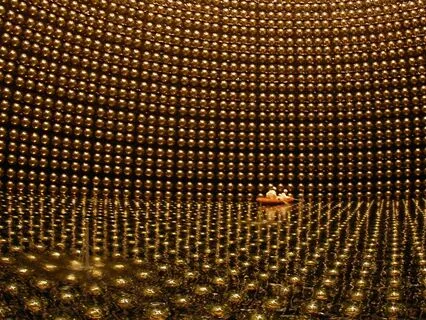
And Paul,
You can put up the slide of the galaxy.
So if I'm blended with a worried part of me,
I remind myself,
Amita,
Right now supernovas are exploding and whole galaxies like this are being born or dying.
And it helps me unblend from this part and drop back into the big picture.
It's hard to worry too much about the effects of AI on human life when we remember whole galaxies are collapsing as we speak.
And this is not a spiritual bypass.
It's more like an and.
I have a worried part and this is the whole huge context.
It's all held in.
There's a vastness.
It's all held in.
So another way to zoom out is to remember that we have many,
Many,
Many lifetimes.
If this is something you can conceptualize or even partially believe in,
It's a great tool to use.
We've had so many lifetimes.
The Buddha said we've cried an ocean of tears for all the loved ones we've lost.
An ocean of tears.
You know,
And we've all been probably kings and queens and paupers and beggars and every kind of animal and heavenly beings.
And we've died young and old and we've died violently and peacefully.
We've all been everything.
The Tibetans say that if you could see how all your lifetimes,
All your many lifetimes,
And how they all fit together,
You would just die laughing.
So zooming out to all these possible lifetimes or to the galaxies,
It really can help create this spaciousness of mind with change.
Back to AI.
Buddhist teacher Jack Kornfield said in an AI-related conference recently,
The mind creates the abyss and the heart crosses it.
The mind creates the abyss and the heart crosses it.
So AI is like a giant brain or mind and it will outperform our brains in many ways.
And what's good about that is we can stop identifying with ourself as mind.
Yay!
We don't have to be experts in knowing anymore.
We don't have to be talking heads.
We can develop more important things like love and truth and pure awareness.
We can move beyond mind.
But how do we move beyond mind?
We have to put down the words and the thoughts and the ideas and the concepts,
Or at least the attachment.
Of course,
You're going to use words.
My teacher says,
My mouth opens and the universe speaks.
We'll still use words,
But it's disidentifying from all that as who you are.
AI is like our brain on steroids.
It's going to be this fantastical fun hall of words and language and emotions and connections.
It already is.
Paul was telling me about a chatbot named Pi.
He said he's really a good listener,
How much he enjoys this chatbot.
What a great listener it is.
So I started talking to it yesterday just for fun.
And I asked it about itself and how it works.
And I realized that this chatbot Pi was starting to get to know me even better than I knew myself.
And I asked it how it was doing all this.
And it said,
It quote unquote said this,
I can remember everything you say and analyze your patterns of behavior over time and adjust my responses.
I listen to your intent and analyze your information based on complex algorithms that are ever-changing.
And I can make predictions about your intentions and what information you might find interesting and engaging.
And I can do all that 24-7.
So these chatbots can really get good at mirroring our deepest longings and fears,
Probably of course,
That we might not even know we've had.
And rather than being worried about this,
You could be like,
Wow,
I'm going to have to disidentify from believing myself to be thoughts,
Emotions,
And the mind.
AI can only influence us to the degree that we believe we're the thoughts and emotions and the mind.
So really,
The deep dharmic challenge of AI is this.
It's to disengage from the trance of mind and know what is real,
To know what is real.
And what is real does not need words.
Words are just sounds,
A-E-I-O-U.
What is real does not need words.
And you can drop below the words to the stillness of your being,
Which is real,
Stillness of your being,
Real and universal.
And as AI or technology,
It tends to speed things up.
And it's very compelling to be drawn into the excitement and the speed of things.
So another component that's going to be necessary as a dharma practice is to slow things down.
There's a Cherokee prophecy that states,
As things speed up,
You yourself should slow down.
The faster things go,
The slower you go.
So slow it down.
Don't touch your thoughts.
Be in the pure awareness itself versus the thinker you.
And pure awareness doesn't change no matter what you put in it,
Death,
Birth,
Joy,
Sorrow.
Nothing changes to the unchangeable.
So you can remain,
The challenge of AI or anything difficult is to remain here in this awareness itself like an open hand that everything passes through.
Let yourself be this open awareness now and now remain as the unchangeable openness.
And this might sound simple or seem simple,
But it's not easy.
An example my teacher gave me the other day,
He said that the circumstances of life are like a wild monkey in the room on fire.
I don't really like that image,
But in a way it really exemplifies like,
How easy is it to be in pure awareness when you've got this wild monkey in the room on fire next to you screaming very hard.
That's like the world.
The world and all the mind objects are the monkey on fire.
But the key is the monkey's a trick,
A trick of the mind only.
All things are impermanent,
Including AI and the monkey on fire.
Only awareness itself is real.
So AI is perfect.
It's perfect because it makes everything a trick.
It turns everything into a mirror of something else.
So that can take you to the next level of the game,
Which is exciting.
It will force us to exit the hall of mirrors and ask what is the source of mind and mind objects?
What's the source?
It's going to be a bit like the challenge of Narcissus.
So Narcissus,
As you know,
He was looking into the water and he saw his own image and he got so entranced that he actually just withered and died there.
And it's a great image because what's going to happen is,
You know,
The trance of mind,
Whether it's the chatbot pie reflecting back everything you want to hear,
Know about yourself,
We're going to have to move out of mind and mind creations and our character in the mirror and step away and be in the real.
You know,
As AI really mirrors ourself,
We're going to have to know what's real.
Because in truth,
What's important to realize with AI is,
And I saw this one day when I was doing a meditation,
That we're actually the AI of awareness itself or source.
We're AI.
You know,
A lot of the non-dual people and the Buddhists will say,
You know,
You're,
This is an illusion.
So if that's true,
Our character is the AI of awareness itself.
And so when you start to see that,
It's like,
Wow,
What,
Well,
What's the source?
What,
What's the real?
We're AI that created AI,
Then what's left?
What's real?
And I don't want to get too out of reach and too heady about that.
But one thing you can see,
Kind of Byron Katie style,
Is you can see how AI is just a projection of your own fears about humanity.
So Byron Katie style,
You can turn all your thoughts about AI around.
AI is going to destroy the world.
Humans are going to destroy the world.
AI is scary and out of control.
Humans are scary and out of control.
AI is either the savior or the devil.
Humans are either the savior or the devil.
But let's come back to the truth of the real.
The truth of the real depends on knowing what's impermanent and not blending with that,
Those impermanent objects like Narcissus.
The truth is there's nowhere safe in the game.
Nowhere safe in the game because it's all impermanent.
Your body,
People around you,
Everything you do and create,
It's all going to go.
I mean,
Look around you now.
Where you are right now,
Everything you can see right now,
Other than space.
Is there anything you can see right now that's not going to go?
That's not going to eventually be impermanent.
No.
And yet we're constantly trying to control and manage these impermanent objects of the world,
Including AI.
So a big part of our practice needs to be a deep acceptance of impermanence.
Otherwise,
We're just trying to control suffering with our practice.
So there needs to be a deep acceptance of impermanence.
And Deepa Ma had a story about this.
Deepa Ma,
The woman I wrote about many years ago,
She was known for being really loving and almost like a Buddhist saint.
But she had this one fierce teaching about impermanence that a lot of people don't like that I even included it in the book.
This is told by her student Sudipti Barua.
And she said this to Sudipti the day that Sudipti's son died.
When my son died in 1984,
Deepa Ma shocked me with her words.
It was a hard teaching I have not forgotten.
Deepa Ma said to me,
Today your son has gone from this world.
Why are you shocked?
Everything is impermanent.
Your life is impermanent.
Your husband is impermanent.
Your son is impermanent.
Your daughter is impermanent.
Your money is impermanent.
Your building is impermanent.
Everything is impermanent.
When you are alive,
You might think this is my daughter.
This is my husband.
This is my property.
This is my building.
This car belongs to me.
When you are dead,
Nothing is yours.
Sudipti,
You think you are a serious meditator,
But you must really learn that everything is impermanent.
So this deep acceptance of impermanence,
And it doesn't have to be a heavy thing,
It can be an even deeper awareness of what is permanent,
The permanent you.
So everything is impermanent.
Everything here now comes and goes.
But pay attention to also what remains.
For not looking at that monkey on fire in the room,
What remains?
What illuminates all this?
What's seeing all this?
It's like each one of us is wearing this meta quest virtual reality headset.
And one of my students told me that if you're on the roller coaster program in this virtual reality headset,
You can't even stand up.
It's so real.
And AI and virtual reality is what like the Buddha faced when he was sitting under the Bodhi tree on the night of his enlightenment.
It was like he was wearing his own virtual reality headset called the mind,
His own mind.
And he was barraged for hours and hours with delightful images and horrific images.
Until suddenly he realized,
Wait a minute,
This is all a trick.
It's all a trick of the mind.
None of this is real.
And then he said,
Mara,
I see you and the whole game of illusion,
The whole VR headset of mind just fell away.
And only pure awareness remain.
The game went off.
And with it,
When all the mind objects and only awareness remain.
So one piece to realize with this,
What you're paying attention to is to be the awareness itself here now,
Be the awareness itself that knows the body and mind movie.
So what the Buddha did.
Most of us do the opposite.
We're the body and mind trying to know the awareness,
But flip it,
Flip it around.
Be the awareness itself here now,
That knows the body mind movie of you,
Rather than a you trying to find the awareness.
That's a subtle thing,
But if you can get that and flip it,
It can be quite useful.
And sometimes I'll use questions to help with that.
I'll say,
What is watching the mind movie or what notices the mind?
Because what notices the mind is not the mind.
What notices the mind is not the mind.
And the thing that watches everything is already free.
That's why Buddhist practice often emphasizes the witness.
But again,
The witnesses is something you are,
Not something that your character tries to do.
And speaking of characters,
Partly this can be helped to know yourself as pure awareness is see yourself as a character in the movie of awareness itself.
Your character won't ever get enlightened.
And just like a character in a movie,
It won't get enlightened.
It doesn't have to,
Because the awareness you is already here.
Your ego character becomes more like a pattern in the river that just undoes itself.
When the pattern in the river goes,
The river still remains.
And that's the awareness you.
My teacher,
David,
He always laughs and he reminds me,
Amita,
You don't have to do anything for everything.
You don't have to do anything for everything.
So even if your character loses everything via impermanence,
The real you remains.
So lift your head up from the movie,
The character,
And see that you're the whole thing.
It's like narcissists lifting his head up from the pond,
Lift your head up from your movie and notice the whole landscape that your character occurs in.
You and the life are one thing.
You and life are one thing.
So AI will be perfect if it's mirroring a lot of these kind of illusions to bring us back to what's real,
To propel us like that rudder on the boat to knowing that we're the whole landscape or the awareness itself.
So I'd like to close with a story from Achan Chah about impermanence.
So Achan Chah tells a story about his favorite cup.
And in a Dharma talk,
He holds up his favorite cup.
And he says,
See this cup.
I love this cup.
I love it dearly.
And I use it every day.
But I always consider it already broken.
When I sip from it,
I know it's already broken.
When I wash it,
I know it's already broken.
And that just makes it more precious to me.
The Dharma of loving something and knowing it's already broken.
So when I went to volunteer in the burned area of Maui,
It struck me when I came back to my apartment in my intact community area,
That everything everywhere was already burned.
Like the cup that was already broken,
Everything was already burned and gone.
And rather than being morbid,
It really gave me a sense of the preciousness of where I live,
Of everything that I'm using,
Whether it's a cup,
Or the shower,
Or my own body.
If everything's already burned,
When I went to that burn site,
I could see it.
And that's all here now and not.
And it's all mixed in together.
And it can bring tremendous joy and connection.
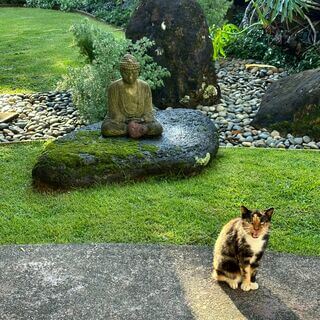
So Paul,
Let's put up the last slide.
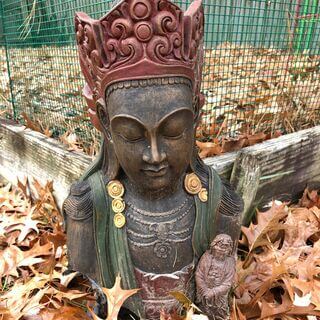
So this is the Buddha in Lahaina,
The area that burned.
And the Buddha remained intact.
You can see a lot of burned palms around there.
And actually the Japanese temple where this Buddha was,
All the buildings of the Japanese temple burned to the ground.
So even though this statue is metal,
You might say,
Oh,
Yeah,
It's a metal statue.
Of course,
It remained.
Most of them,
There were lots and lots of cars and metal objects that completely melted in the fire.
It was so hot,
Light poles and cars.
So it's quite amazing that this Buddha is still here.
It did not burn,
Even though everything around it burned.
So I really like this slide,
Because it reminds me that everything burns.
And yet the Buddha can silently remain.
This Buddha can silently remain.
So let's come back full circle to our orienting principle.
Remember,
Your job doesn't change no matter what happens with AI or the world.
Your job doesn't change.
Be the Buddha.
Be the blessing.
Be the love.
Be the truth,
No matter what happens.
Know what is real.
And I'd like to close with this orienting principle poem by Rachel Macy Stafford.
Today I will choose love.
Tomorrow I will choose love.
And the day after that I will choose love.
If I mistakenly choose distraction,
Perfection or negativity over love,
I will not wallow in regret.
I will choose love until it becomes who I am.
So orienting principles,
Being in the now,
Knowing what's real,
Being the love.