Welcome to Learn Buddhism.
I'm Alan Pedow and thank you for beginning your journey into Buddhism with me.
For our first episode Let's talk about what is Buddhism.
Buddhism is the word we use for this major worldwide religion just practiced by over half a billion people.
They are following the teachings of someone we call the Buddha.
The Buddha was born over 2,
600 years ago as a human being just like you and me known as Siddhartha Gautama.
He was born where the modern-day country of Nepal is located and eventually taught where the modern-day country of India is located.
Now Buddha is a name for an enlightened teacher.
It's not actually the name of an individual although we do use it for the Buddha we're talking about right now.
But it refers to an enlightened teacher who discovered a true nature of our reality through their own effort determination and insight.
So we are currently following the teachings,
The practice,
The sermons of the Buddha of our era and that is of Siddhartha Gautama whom we call Shakyamuni Buddha.
So there are Buddhas before Shakyamuni and they'll be Buddhas in the future.
So again a Buddha is just a title of an awakened enlightened teacher who's helping others realize what they've also realized.
His teachings allow us to also see that reality like he saw it and the reality we're talking about is Dukkha.
So there is Dukkha in our world,
Our reality,
Our existence and you've likely have heard of Dukkha translated as suffering.
But it means everything from unsatisfactoriness,
Distress,
Disease,
To something not quite right in our lives.
And this Dukkha is caused by our own actions and actions in Buddhism are called karma.
They are intentional,
Volitional actions.
So when he became enlightened and when you can become enlightened based upon his teachings and his practice you become liberated.
And when we use this word liberated we're talking about a particular term in Buddhism called nirvana and you've likely have heard of it.
It is not referencing like a heaven or some place you go to.
It's actually a mental state.
This is your true nature,
Your true reality where you don't have Dukkha in your life anymore because remember Dukkha is caused by you by your own intentional volitional actions.
So these unskillful actions,
These karma that we generate are keeping us trapped in something we call in Buddhism the cycle of birth and death or just commonly called samsara.
And samsara,
The cycle of birth and death happens moment to moment.
So when you generate karma you may feel the results of that karma either immediately or in the near future but they could also stretch into future existences.
And so karma is what keeps us trapped in this cycle of birth and death which the Buddha says is unsaspectory.
It's suffering.
It's Dukkha.
But when we become enlightened we transcend samsara.
We transcend the cycle of birth and death.
So there's going to be two parts to Buddhism is to become enlightened so that you can realize your true natural state of nirvana right here,
Right now.
But it also provides this sort of ultimate nirvana where you do not continue on in this cycle of rebirth.
The Buddha explained this,
All of this,
In what he calls his Four Noble Truths where he talks about in the first part that life entails Dukkha,
This suffering.
But in the second part he's saying,
Well this suffering is caused by our craving,
Clinging and ignorance.
And what he's talking about there is our ignorance of the truth or delusion to the truth.
And it's not something that's negative against us.
We just don't see it.
It's like a very dirty mirror or dirty window.
We can't see out of it or can't see the reflection inside it.
So we're not really sure what we're seeing but we're making perceptions,
Views,
Assumptions about what we see and actions as a result of it.
And primarily what he's talking about here is craving and clinging to things that reinforce a particular belief.
And this belief is that we,
You and me,
Have a permanent,
Unchanging,
Independent self.
And so he said that we don't have that.
We are ever-changing,
We are impermanent and we are interdependent upon other phenomena,
Other things,
Other people,
Etc.
Just to exist.
We are this temporary existence.
But because of this temporary existence,
This grouping of us right now,
We believe there's something permanent,
Unchanging and independent in ourselves.
We are not dependent upon others.
There's something ever present inside us.
And you can look at yourself right now and contemplate this.
Do you believe that you with your name and your thoughts and your belief has always been unchanging and impermanent and independent?
You likely do to some degree,
Whether that's a very deep belief or very nuanced belief.
You believe,
Yes,
There's something about me that really makes me me.
And I want to reinforce that belief.
And so this is really where the Buddha is saying we start craving and clinging to things that help us reinforce that belief.
And believe that other phenomena and other people also have a permanent,
Unchanging,
Independent self.
And when we're kind of confronted with the true reality is,
You know what?
That doesn't really exist.
And we experience that in different ways,
Such as when someone gets sick or when someone dies or when we lose something or when something unpleasant happens to us.
We realize,
Yes,
That permanent,
Unchanging,
Independent self of all phenomena,
Including us,
Doesn't really exist.
And we don't like that.
And so what we do,
We start craving and clinging to things to reinforce that.
And the Buddha says that's usually through sensual pleasures,
Through our eyes,
Ears,
Nose,
Mouth,
Etc.
And so when we start maybe having chocolate and that tastes good or we smell something and it arouses something inside,
It's like,
Oh,
I feel good now.
Or we see something that's pleasant to us.
We're reinforcing this belief and we're kind of drugging ourselves in a way to the true nature of reality,
Which is unsatisfactory,
This dukkha shouldn't be there.
But as we crave and cling to things,
We are just reinforcing that belief.
And specifically,
There's something called the three fires in Buddhism of greed,
Anger,
And delusion,
Also called the three poisons.
When we have this delusion and ignorance,
Well,
We want to essentially react or lash out or do things based upon it.
And that's where that greed and anger comes in.
It's a greed where like,
No,
I want to really support this belief in a permanent,
Unchanging,
Independent self,
Or I don't like that this loved one passed away or something happened.
And so we respond with hatred and anger in very different nuanced ways,
Whether that's verbal or action or something like that.
And so this creates all that karma that that greed and anger is creating karma,
As we mentioned earlier,
Keeps us trapped like prisoners in a cycle of rebirth.
But as not our true natural state,
Just imagine the visuals on that of the three fires or three poisons,
Whichever one you want to call it.
Would you want to be drinking poison and feel unwell?
No.
Would you want to be burned by fire or have the smoke inhalation?
No.
But we are actually so unaware of it that we may get,
For my visual here,
Very small smoke inhalation or maybe we'll get singed or burned,
Sometimes a little harder,
Sometimes a little bit less than our times.
But because we get those sensual pleasures that kind of mitigate that,
That drug us to it,
Like,
Well,
It's OK to kind of drink a little poison or it's OK to get burned sometimes.
But the Buddha said that is not right.
Having these particular events,
This dukkha,
Is not our natural state.
We want to realize our natural state of nirvana.
And so that's where he told us in the third noble truth,
Dukkha,
Suffering can be eliminated.
That's not right.
You don't have to put fuel on the fire.
You don't have to be drinking that poison.
So that greed,
Anger,
Delusion,
That is not a mandatory thing in your existence.
So what he told us and had a way to achieve getting rid of this third noble truth to ending suffering,
He tells us it's nirvana,
That that is the way when you end suffering,
You realize nirvana.
And you do that through his fourth noble truth,
Which is commonly called the Eightfold Path Inside Buddhism.
And the Eightfold Path Inside Buddhism is made up of three categories.
There's a wisdom category,
There's a morality khanda category,
There's also a discipline or meditative concentration category.
And in these,
They have these particular steps,
If you will.
There's right view,
Right thought,
Right speech,
Right livelihood,
Right action,
Right effort,
Right mindfulness,
And right concentration.
And a good visual way to think about the Eightfold Path as this practice that we have in Buddhism.
And before I go further,
There are many different schools and traditions of Buddhism that practice the Eightfold Path in many different ways and different practices.
And so when we give it a little visual representation here,
Imagine if you have a car or if you ride a bus or whatever,
Imagine the wheel there and then the road that you're traveling down.
The road that you're traveling down is your existence,
Your reality.
So is that road smooth or is it filled with potholes and rocks and everything else,
Right?
Well,
If you have a really good round,
Perfectly round tire,
Good suspension,
Everything else,
Those potholes and those bumps in a road and everything else is not going to really affect you too much.
But what the Buddha told us is our wheel is not perfectly round.
And actually the wheels that we have on our car right now,
The tires,
Are usually not perfectly round anyway.
So usually what they do when they mount your tires,
They balance it out.
So they may put what's called low weights on different parts of your rim to kind of balance out the wheel.
So as you drive down the road,
It's not shaking,
It's not bouncing around,
It's smooth.
And so the eightfold path that the Buddha gave us helps us to make essentially our reality perfectly round so we can become awakened to the truth.
We can become enlightened and realize our natural state of nirvana.
The eightfold path,
When it's practiced completely,
Fully,
It is nirvana.
And when you're in nirvana,
There's really no going back.
You're not going back to suffering like you had before.
You've escaped that because now you can understand,
Oh,
The three fires,
Three poisons,
Greed,
Anger,
Delusion.
I understand what causes that.
I don't want that anymore.
It is not OK to be burned or to take poison.
So following the eightfold path,
A very fundamental thing inside Buddhism is our path towards liberation,
Towards freedom.
And let me go through these for you.
So in the wisdom category,
And these are all interconnected to each other.
So just like how they balance your tire on your car,
You may be stronger already in one of these particular categories or different elements of it.
And so that's where you have to focus on your practice on different parts.
And that's where we have monastics inside Buddhism that can help us on this path as well.
So right view is having right concepts and ideas about the true nature of our reality as the Buddha taught it and the past leading us away from delusion and wrong views.
Because right now we do have wrong views and delusion about things.
And again,
That's not a negative thing.
We just are not aware of it.
And we have to really understand that at a fundamental level.
Then it's also bringing us into right thought.
This is our desire to realize enlightenment by keeping our thoughts in accord with the teachings of the Buddha,
Which is called Dharma.
So Dharma in Buddhism is the teachings of the Buddha at every moment.
And that allows us to eliminate the three fires or three poisons of greed,
Anger and delusion.
Then we have the conduct morality category.
We have right speech and speech produces wholesome actions and prevents unwholesome actions.
Such as,
For example,
Lying or harsh speech or idle talk,
Etc.
We also have right livelihood,
Where we should try to choose an occupation and way of life that does not hurt others or even ourselves due to unwholesomeness.
And finally,
Inside the conduct category,
We have right action.
This is behavior that is wholesome and in accord with the Dharma.
Remember,
Dharma is the teachings of the Buddha,
Such as practicing the five precepts.
So the five precepts or rules inside Buddhism are what lay persons traditionally follow.
For monastics,
They usually have hundreds more.
Then we have a discipline category of the Eightfold Path.
This is going to be composed of right effort,
Which is diligence in following this Eightfold Path,
Which leads to the creation of wholesome actions,
Karma,
And the prevention of unwholesome actions,
Which are also karma.
So you can have karma,
Which is either wholesome or unwholesome.
Obviously,
We want to have wholesome karma.
And a good way to think about karma is,
Imagine you have a glass of water.
And unwholesome karma could be like salt in the water.
As you try to drink that water,
It's probably too salty for you to drink.
But now,
If you were to pour that same glass in a much larger bucket or bigger glass full of clean water,
The salt starts to essentially not go away,
But you can't taste it anymore.
So the more wholesome karma you create,
You are going further down the right path,
The Buddhist Noble Eightfold Path,
Towards enlightenment.
Then we have right mindfulness.
This is where we need to be aware of our thoughts,
Body,
Words,
And actions.
So our mind is pure,
Aware,
And does not give rise to unwholesome thoughts.
So you've likely have heard of mindfulness in our very secular society.
Well,
It's a little bit different inside Buddhism,
Because what we're trying to do here in Buddhism with mindfulness is to become awakened to the truth,
Become an enlightened being,
And realize nirvana.
It's just not to feel good or feel better.
That's the central pleasure.
That's a result of things.
We are still going to have dukkha if we don't eliminate that.
So mindfulness is essentially us being aware of what's going on at a very fundamental level,
Because often we're not.
And when we're doing that,
Regarding the senses,
Like regarding the senses of the eyes,
Taste,
Ears,
Hearing,
Etc.
When we're doing that,
We're aware when things are going to affect us and create unwholesome actions.
Remember the greed,
Anger,
And delusion,
The three fires,
Three poisons?
We don't want to consume things that will fuel those,
Give those,
That three fires of greed,
Anger,
Delusion fuel to arise to create action to keep us trapped in a cycle of rebirth.
We don't want that.
So when we're mindful,
We prevent that from happening.
And then finally,
We have right concentration,
Which is sometimes called samadhi,
Or meditative concentration.
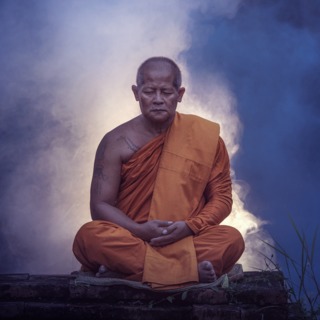
This is where your mind,
And essentially your whole being,
Is totally absorbed in a moment without distraction,
Wavering,
Anxiety,
Or drowsiness.
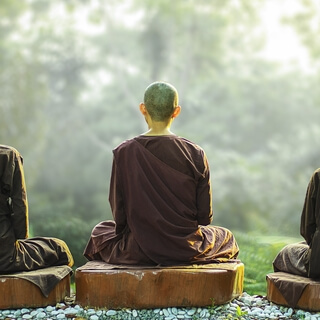
What we're doing,
And you've likely seen people doing sitting meditation inside Buddhism,
But there's many types of meditation.
There's walking meditation,
There's even chanting and contemplation,
And a variety of different things.
The ultimate goal of this concentration portion is to settle our mind,
Because our mind is always having thoughts pop in and out,
And we're clinging and craving to those particular thoughts and following them,
Even though they're transient.
And so when we do that,
We sometimes,
And often,
Take action as a result of it,
Because we're having views about them or perceptions about them.
And as you've learned,
That just keeps us in this constant cycle,
Which is just suffering.
So when we're able to calm those down,
Almost think about it like a monkey in a jungle that's going crazy and just jumping all around,
Or a bull in a china shop,
Whatever analogy or visualization you want to use,
It's just not right.
Our mind's trying to control us.
So what we're doing is like,
Calm down,
Settle the mind,
Settle the thoughts,
Because we're trying to master the mind,
Control the mind.
And when we're able to do that through that right concentration,
We're able to focus on deep insight,
As the Buddha taught us,
About the true nature of our reality,
Because right now,
It's very challenging and difficult for us to do that.
So when we're able to do that,
We can get these sparks of enlightenment,
And eventually true enlightenment,
Where we can blow out the three fires of greed,
Anger,
And delusion,
Reside in our natural mental state reality of nirvana,
And eventually,
When we pass away,
No longer continue in a cycle of rebirth.
And this is why the Buddha said,
I only teach dukkha and the transformation of dukkha.
It was very central to his practice,
Because he understood things such as what we call dependent origination in Buddhism,
That all things arise,
All phenomena,
Just like you and me,
Arise due to causes and conditions,
But because we don't understand that,
And for example,
We have arisen due to causes and conditions,
But we believe we are permanent,
Unchanging,
And independent,
That we start to create these actions,
Because we have these beliefs and everything else,
And it keeps us like these prisoners in a cycle of rebirth.
And because of that,
We have that dukkha,
We have that suffering.
So he's teaching us,
Here is the true nature of our reality,
I'm giving you this practice,
The Eightfold Path,
You can follow it in whatever tradition,
Practice you want to do,
But it's teaching you how to basically transform your life,
So that you can realize nirvana.
Suffering,
Dukkha,
Not part of your life.
And so sometimes that nirvana inside Buddhism is sometimes understood by lay persons like you and me as almost like cessation,
Like killing something or destroying something,
We're losing something.
But what the Buddha says is,
You're blowing out,
You're getting rid of greed,
Anger,
And delusion.
I know I've mentioned that a few times already,
But basically that's really fundamental.
When you get rid of that,
You realize what already exists,
You,
Your true natural state,
And you understand that,
And you can exist just like the Buddha,
Just like his enlightened followers,
Who are not affected by things happening around them,
They were able to exist in this world as we really should be.
Do you have any questions about Buddhism in general?
I would love to hear back from you.
And be aware,
I also have a YouTube channel where I go more into these topics,
And also my website at alanpedo.
Com,
Where I go in more detail about all of these topics as well,
Including an introduction to Buddhism.
I look forward to talking with you on our next episode.
Thank you.