Welcome to Learn Buddhism.
I'm Alan Pedo.
For Mother's Day I'd like to talk about two amazing women in Buddhism which are vitally important to the entire Buddhist religion.
They are the Buddha's two mothers.
You heard me right.
The Buddha actually had two mothers and I'm going to talk about that in this episode today.
But the reason they're so important is without them we wouldn't have had the Buddhist religion,
We wouldn't have had nuns in Buddhism,
And we probably wouldn't even had Siddhartha become the Buddha.
So they played a very pivotal and crucial role in the formation of Buddhism in our current era.
Now the first one I'll talk to you about is going to be Siddhartha's mom,
Maya.
I refer to her as the queen of Buddhism because without her we're not going to have Siddhartha,
Then we're not going to have the Buddha,
And we will not have Buddhism as we have it in our current realm and era.
So for every era we can have a Buddha and eventually those teachings will be lost.
There's many many Buddhas before Siddhartha and there'll be Buddhas after Siddhartha.
And we are currently in his era right now.
Now without him being born in this era and without him rediscovering the truth of Dharma and teaching to others,
We may not even have what we call Buddhism right now.
It may not even exist.
So because of Maya we had Siddhartha,
Which means we have the Buddha of our era,
Shakyamuni Buddha or Gautama Buddha.
Hers is a very interesting but also tragic story.
So at the beginning of this as far as Buddhism is concerned,
She was trying to get pregnant and she had this vision one night of a beautiful white elephant with long tusks holding a lotus flower entering her right side.
And this is obviously very supernatural and we're like,
What is going on here?
Well white elephants are symbolic of bodhisattvas or these enlightened beings inside Buddhism and they are on that path towards Buddhahood.
So what was actually happening is before he became Siddhartha the prior existence was basically just bodhisattva living in these this heavenly realm.
There's different realms of rebirth in Buddhism and this top one is this heavenly realm.
And doesn't mean that they stay there but eventually they would for example come back maybe to our realm like Siddhartha did to become a Buddha.
So he decided when and where he wanted to be reborn in order to become a Buddha,
This bodhisattva did.
And it was with Maya and 2,
600 years ago in the region where now India and Nepal is located,
This is where he was reborn.
So before he was born they wanted to know what would be the future of our future son.
And there were two possible outcomes.
Either he was going to become a great ruler or a great religious leader.
Okay so for Maya's husband who was the ruler over a clan at that time,
He also wanted his future son to follow in his footsteps because it was predicted he would be this ruler over this wide range of lands.
So even beyond what his father is going to do.
But the other outcome,
This religious leader outcome,
Religious person,
That wasn't very appealing to his father because well I want him to follow my footsteps.
So going forward to where Maya is about to give birth,
She's going back to her home,
Her original town where she grew up.
And it was very common in those days if you could you go back to where you were born to give birth.
And as she's going there she has to give birth so she's not even making it.
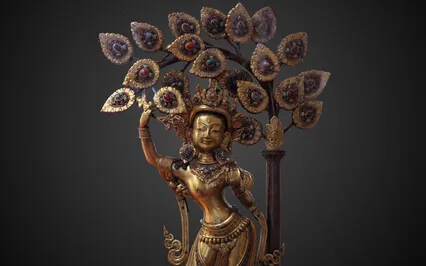
She holds on to a branch and gives birth to Siddhartha.
Now what's tragic about this is a couple days later on,
About seven days later on,
She dies.
So we're very used to in our modern high-tech medical world of childbirth being maybe painful but maybe not risk-taking.
You know you you're probably not going to die from it.
There's so much medical technology and techniques that's becoming very very unlikely.
But in the ancient world,
And still in parts of our world today,
That's very possible.
Childbirth is a very risky endeavor.
So unfortunately Maya dies.
So the Buddha,
Or the future Buddha I should say,
Siddhartha,
Sees,
Even though he's a baby,
Tragedy right there.
Dukkha,
Suffering,
Or satisfactory,
Impermanence.
He sees it right there because as he would later say impermanence is Dukkha.
And so the impermanence of Maya,
His mother,
Right in front of him.
And dependent origination and everything else.
And so whether he was fully aware or not,
He experienced it right there.
And it doesn't mean the end of Maya.
So we sometimes in Buddhism look at this as well that's it for Maya.
She gave birth to the future Buddha and that was it.
It's not actually not the case.
When he eventually became enlightened and became the Buddha,
He taught to many different people and beings.
So we usually focus so much on him teaching to people in the region of ancient India.
But we don't really sometimes focus,
If you're a Westerner,
On maybe the supernatural aspects of it.
He taught to bodhisattvas.
He taught to gods.
I mean so he taught to a range of different beings out there.
And one of them was when Maya died and her next existence was in the heavenly realm,
He was able to teach her there.
And then also when he was at his Parinirvana,
His final nirvana before he his current existence,
His physical five aggregates,
This temporary existence that he was in physically right in this world ended,
She was there for him as well.
So Maya may have been physically gone from this world but what she became in the heavenly realm still existed.
She learned from the Buddha and she was there at the Buddha's Parinirvana.
So I think that's just a wonderful thing where he lost her physically in this world but he was still able to reconnect to the next existence of Maya in his heavenly realm,
Teach her to help her eventually come maybe back to the human realm to become a Buddha as well or maybe before that progress of bodhisattva or whatever,
But also was able to be there at the time of his Parinirvana.
And I think that's just a beautiful aspect of this entire relationship between Siddhartha and Maya.
So what happened?
Seven days later she dies.
What happens to baby Siddhartha?
Well this is where his second mother comes into being.
And when we look at especially the ancient world it may be where the husband marries a relative of his wife and that's exactly what happened here.
So Gotami became the husband to Siddhartha's dad and this is where she really becomes the mother that he knew.
And what I love about this aspect of the story,
She treated him absolutely like her own child.
And we have love and compassion where she's just showing this towards Siddhartha.
And in my opinion this is helping to shape him as well when he starts progressing towards that spiritual journey even as a child,
Even when he's getting older and when he goes sets forth to become the Buddha.
I think what she was showing him during this time as he's growing up was so pivotal and important to shaping his compassion and loving kindness and just his demeanor and lifestyle.
I think was very much shaped by Gotami.
Now she is spending time with him,
Raising him.
But what happens after he gets older and he leaves and sets forth to become a monastic?
We sometimes forget about what happened in his home.
Well obviously his father did die at one point,
Right?
So he's mortal like the rest of us.
His existence is impermanence.
He's going to pass away during that lifetime and he did.
And the Buddha went back and was actually one of the pallbearers for him.
So we see that the Buddha was still engaged at different times with his old life if you want to call it that.
But what about Gotami?
Well she's no longer married so to speak.
Her husband has now passed away.
What becomes of her?
This is a very important part of the Buddhist religion and story that we all heard as Buddhists where we don't have nuns yet.
All we have so far as monastics are monks.
They are males.
That's it.
And we look at this ancient society very much male-dominated.
So if you were a female,
There wasn't really much freedom or liberation so to speak for you.
You had householder life to fulfill.
Child-buried,
Taken care of the household,
Everything else.
So to be able to just go,
You know what,
I'm gonna become a monastic,
Become a monk,
That wasn't really for the men.
You know it wasn't for the women.
And you didn't see that really throughout the region in the time.
Women didn't have these opportunities.
So Gotami is a little bit privileged because she's been living in this nice place along with her husband and has everything she needs right is due to his position.
She can go ahead and take a little bit different course than other women probably couldn't during that time.
She goes and tries to become essentially the first female monastic,
A nun,
But she keeps getting rejected by the Buddha.
Now during this time if we if we look at our modern society like what is going on here of course this makes sense but during that time the Buddha was essentially trying to get this upstart religion going.
It wasn't his goal to create what we may consider in our view a quote-unquote religion but he's trying to teach others he's trying to liberate others and during his sermons he's very clear that all sentient beings doesn't matter your your your nature your your sex or anything else like that you can become enlightened and you can realize nirvana.
So she hears this too and she's like I like to do this I like to go down this religious path more fully by becoming a monastic but he rejects her and the reason is it's multifaceted but in general as I mentioned society was very much in the culture was very much against women having any sort of these types of freedoms so he's doing this balancing act where the only way the monastic community is somehow can exist is with the essentially the blessing and support of householders everyday laypersons kings and everyone else they don't have money for themselves they don't have land for themselves they need that support so does he go yeah we're gonna do this and you know what to heck with it you just have to support us it didn't work that way so he's trying to figure out how to really get this done and he just can't see it there so we look at the Buddha sometimes well he has everything figured out now he he taught in different ways to different people he changed many different rules for monastics many different things were being formulated during his over 40 years of teaching so it's not like he's going poof I have the the answer it had to be worked out at different times because he wanted to be thoughtful and get this right if it needed to be changed it needed to be changed and that's what we see here so the Buddha's chief attendant Ananda who'd eventually become an arhat this is where gotami is going to now she's like I'm gonna go this route through a Nada cuz the Buddha listens to a Nada and Ananda went back several times to the Buddha going can't we make a Tommy a monastic you know a nun and he you know just kept rejecting that for different reasons and what was fantastic about this is gotami didn't give up she this like this was the path that she wanted to be on that's that effort that dedication determination we have inside Buddhism was the eightfold path that's part of it so she's like this is what I want to do so she goes back to Nada and then Nada goes back to the Buddha and I like this because gotami is there as well and he's basically saying okay let's talk about this so he goes and talk to him to a Nada and a nun is basically saying you said that all beings are capable of realizing or achieving enlightenment and realizing their true natural state nirvana and the Buddha has to concede that's right and so he's basically responding back to the Buddha now because he's made his point right the Buddha's conceded you're absolutely right on that so then he goes well if that's so wouldn't it be good if women could be ordained as monastics as nuns right and the Buddha goes you know what if they can accept the eight conditions they can be regarded as already ordained and as a nun so he made a very skillful way of going yeah absolutely let's do this so he had to be careful in what he had to do and this is where we see that there's additional precepts for female monastics nuns and there's still debate about that to this day but the reason he added those additional precepts was very much to go you know for the culture of the time and the conditions we have to make some concessions in order to really get this other upstart Sangha if you will of female monastics men are not gonna like these these householder layperson men aren't gonna like this but we have to find a way for them to be able to support it and to be able to be okay with it and that's where those additional precepts came into being and so it wasn't meant to punish women but it was meant to go we need to get them to become monastics this is how we have to do that for right now it's very much a political mover move if anything if you really think about it to be able to get this going so we can also look at this in a few different ways because well you know we have female monastics now right it's fantastic but won't they be upset about taking these additional precepts and some of those we look at in our modern eyes right now really that's horrible like why would they have to do this particular precept for example and you don't see that with the female monastics as we go through history we actually have some writings from them as as time progresses and it's almost like joy and liberation so even though just like male monastics they're leaving the householder life they're giving up everything and going into essentially homelessness as a monastic they are joyful they are happy they are excited about being on this path because even though they no longer have all these possessions you know they don't have this this everyday life like we do it is such a drastic change from the culture and society that they have to abide by as layperson females now they are essentially happy liberated free to go on this path so it actually was a very exciting thing for them and liberating and almost like in a way removing shackles so in Buddhism we're trying to remove these ultimate shackles of the cycle of rebirth and our karmic actions keeping us chained here these fetters here they're getting rid of one by going the monastic path so if we didn't have Gautami be so forceful and dedicated and consistent persistent in trying to become the first monastic we wouldn't have the female monastics we have today and in my tradition we have many that I see and it's wonderful I've learned so much from them and I think it's just I can't even imagine not having female monastics inside Buddhism it's just so much a part of what I'm familiar with with Buddhism and a beautiful aspect of it so we have Gautami his second mother to thank for that so as we kind of look at both of these remarkable and important woman inside Buddhism we needed them because number one we wouldn't have had the Buddha of our era Shakyamuni or Gautama Buddha however you refer to him he wouldn't exist without Maya he's not going to exist without Gautami he's not gonna have that compassion loving kindness and that right mindset as he's going forth on that path towards enlightenment in in our particular era back then 2,
600 years ago he needed that he needed that role model right there he needed that those conditions to help him and so he got that and we also far as Buddhism got female monastics nuns as a result of Gautami and his second mother so we're seeing a a person Shakyamuni Buddha who was Siddhartha when he was born facing the deaths of his mother he but we're seeing that kindness compassion loving kindness is coming with Gautami as well to help him along that path but he's still connected with his original mother Maya as well so this is probably for especially for Westerners maybe not a story that you're even familiar with to to a large degree and I'm I'm very much high-leveling a lot of this but it's beautiful what we have inside Buddhism as it relates to women and these two women right here are remarkable and I didn't even touch on Siddhartha's wife that'll be for another episode but we have these remarkable women inside Buddhism that have helped shaped what Buddhism has become do you have any questions I'd like to hear from you you can send me a message from my website alanpedo.
Com or if you're on Spotify you can leave a message to this podcast and I look forward to talking with you in our next episode thank you and happy Mother's Day