Welcome to Learn Buddhism.
I'm Alan Pito.
When we think of the Buddha,
We usually just think of him as the religious figure of the Buddhist religion and little else.
But he actually was a human being.
And with that,
He had a whole life and family that is really important to his story.
But what is the story of the man who became the Buddha and what happened after he became the Buddha?
Let's talk about that in this episode.
So we have to go back to before the man who became the Buddha,
Who was called Siddhartha Gautama,
Before he was born,
There was someone called Maya.
Maya was the wife of Suddho Hana,
Which was the elected leader of the Shakya clan in the region where the modern day country of Nepal is now located.
So he is sometimes referred to as a king inside Buddhist history and legends,
But modern historians think he was more like an elected leader of this nation state of Shakya.
One night,
Maya has this dream of this beautiful white elephant with long tusks that is holding a lotus flower and it enters her right side.
Now,
This was really a premonition because she woke up and realized she was pregnant.
Now in Buddhist cosmology,
Elephants,
White elephants are actually representations of bodhisattvas.
And to do a little backstory to kind of jump around here,
We have different realms of rebirth in Buddhism.
And one of those is a heavenly realm.
So the man who would be born as Siddhartha Gautama,
He was actually inside this heavenly realm as a bodhisattva.
And he decided when he wanted to be reborn and where and when he wanted to be reborn.
So this current era and existence that he determined right now was the time that he felt was perfect for him to rediscover the teachings here on earth and become a Buddha.
So that white elephant was very symbolic and the lotus flower in Buddhism is also very symbolic as well of of course of awakening and enlightenment.
So she woke up and she knew that something remarkable has happened and that she would be pregnant.
In fact,
She was pregnant.
Later in her pregnancy,
She traveled to her birthplace,
Which was very traditional at that time,
To give birth to Siddhartha.
As she stepped under a saltry,
She reached up to his limb and gave birth to the future Buddha Siddhartha.
And Siddhartha means he who has accomplished his goals.
Unfortunately for Siddhartha,
Around seven days after she gave birth to him,
Maya died.
So Maya had this really short time with Siddhartha,
The future Buddha.
But she was so important because she gave birth to this future Buddha.
And the love and kindness around him,
Even though he was just with him for a short amount of time,
She was obviously pregnant with him for many months.
Now that's not where our story actually ends,
But it was really indicative.
Even though he was just a baby at the time,
He has lost his mother.
So his experience with Dukkha,
Which also encompasses impermanence,
Dependent origination,
Everything else that he would go later to teach others about,
Came right to fruition just seven days after he was born.
So his experience with Dukkha,
Or suffering and unsatisfactoriness in this world,
Really came very fast for him.
Now,
What was very interesting is that Siddhartha actually had a sort of like a prophecy about him.
The very spiritual leaders at the time said that he would either become one of two things,
Either a great ruler,
Surpassing what his father had accomplished.
In fact,
Siddhartha would go on to essentially rule numerous lands.
And this was very appealing to his father,
Who wanted Siddhartha essentially to take after him and hearing that he would be this great ruler that was even more seductive to his father.
But the other prophecy was that he would become a great holy person,
A great religious leader,
And rediscover the truth.
And this greatly troubled his father.
So his father did everything he could to shield his son Siddhartha from the harsh realities of life,
Because he felt if he were to experience these harsh realities of life,
He would be more inclined to go down that path as a religious leader,
Unlike being a ruler like he was.
So very much like a Hollywood production,
He shielded him from the harsh realities of the sun.
So the sun didn't even beat down on him.
He had every luxury and want fulfilled.
So it was always something for him to eat.
He didn't see old people.
He didn't see death or dying or illness or sickness.
He lived a very sheltered life.
And he is said to have been extremely smart.
He excelled in all his studies,
Which also include martial arts and archery and everything else that a great ruler would need to accomplish.
So when we look at the Buddha in our current life,
We see this religious leader,
But his background was that he was extremely smart,
Very charismatic,
And he was also very skilled in essentially warfare and ruling and everything else.
But there was something inside him that was more than that.
There was something where you could see in many different situations during his life of that Buddha to be inside him.
That was his true destiny,
Not to be that ruler,
But to be that religious figure.
And he was able to show that in many occasions,
Which in my opinion surpassed all those things that we may take as seen as amazing,
Such as being so smart or being so athletic and skilled.
He had something inside him that surpassed all of that.
And we can also think where he went down this road to become a religious figure,
Back to where his mother maya died,
Seven days,
That could have been a seed in him that really just was growing and growing,
But at a very slow pace.
But at certain times it was watered and he was going,
There's something just not right here.
He was experiencing dukkha.
Maya had a step-sister and when she died,
Eventually his father married her and so thus she became his stepmother.
And so this is really the only mother that Siddhartha really knew as he was growing up,
Obviously,
Because he lost his mother just shortly after he was born.
But she was very supportive and foundational and inspirational to him as well.
And she was going to have a great story in the future,
Which I'll talk about in a minute.
So she made sure that he was taken care of,
Treated with love and compassion,
Which you can also see that could have also planted seeds in him for his future development into a Buddha.
Eventually Siddhartha grew up and was of the age to marry and he did find somebody to marry and they were said to connect perfectly.
This was,
If you want to use that term,
Soulmate,
This was his soulmate and they were perfect together and got married and eventually had a son and his son's name was Rahula and that actually means feather.
In Buddhism,
And fetters are something we don't want in Buddhism,
They're like almost like chains.
So it was very interesting that was a name for his son because he looked at his wife who he just absolutely adored and loved and just connected with and with his son who he also just absolutely connected with and loved.
And there was still this seed growing inside him that I can be like this forever.
This is perfect life.
But he knew deep down inside there was something still wrong.
Dukkha was still there.
He just didn't know that at the time.
So what did he do?
He started to sneak away from the compound,
This artificial Hollywood life that he was living in.
And this is known as the four sites in Buddhism.
And interestingly enough,
There's much debate academically if the Buddha actually did this or if he was recounting the tale of a prior Buddha or Bodhisattva.
And so if we look at his account as he did this,
It's very inspirational because what he did,
He left the compound four separate times,
Was his trusted attendant.
And when they went out there,
The first time he saw someone who was old and he's never really seen anybody like really old before.
He hasn't really seen this impermanence and this ever-changing nature of things.
So this was new to him because he's been surrounded by youth and everything else in his artificial life.
The next time he left,
He saw somebody who was sick and he's never seen somebody who's been sick before because remember,
His father has been carefully curating this entire fictitious life that he's been living that he doesn't get to see that at all.
So he's being shocked by somebody who's old,
Somebody who's sick.
And each time he's asking his attendant,
Who's of course of society and understands all this,
He's like,
What is this?
He's like,
Yeah,
We all get old.
This is life.
And then when someone was sick,
He's like,
Of course,
We all are going to get sick.
And so the Siddhartha is shocked by all this.
And then the third time they leave,
He sees a dead body and just truly shocks him.
And he's told,
Well,
We all die.
So basically we all get old,
We're all going to get sick,
We're all going to die.
But for someone who's been secluded and prevented from seeing the truth of our,
What we,
You and me might consider,
Well,
That's life.
It was shocking for him,
But it's also a very telling tale because we all know this as well,
But we kind of put that into the back of our head.
We understand there's impermanence,
Everything's ever changing,
But we don't truly understand that at a fundamental level.
And so it becomes very gray to us and very,
Well,
There's something permanent inside me.
I'm never going to change in this way or whatever the case might be.
And what the four sites are doing in its first three,
It's all accelerated.
It's almost like we're putting gasoline on a fire.
You're seeing all this through the eyes of Siddhartha all happening right away.
And that's how we should have been looking at our existence right now.
We are just gradually fed this drug,
So to speak,
That we are unaware of really that this is suffering.
This is Dukkha.
This is unsatisfactory.
So he goes out a fourth time.
What's he going to see now?
Well,
He sees essentially a holy figure,
A religious person,
And this also shocks him,
But in a good way.
Now there's this new seed planted in him of faith and determination that he hasn't had before.
It's like it's almost clicking.
And because of that,
This is where he makes that turning point,
Where he makes that decision.
That's what I want to do.
Now remember,
He's living the life of luxury.
He has everything that he wants.
Stuff that if we lived back in that time,
That's what we would want now.
It's almost like winning the lottery.
He has got everything he wants.
He has a beautiful wife,
Beautiful child.
He has everything.
But you know what?
It wasn't perfect.
And there's some Dukkha going on.
He just doesn't understand that yet,
But he knows there's something wrong.
So this is where he goes.
And you will hear in the Buddhist stories about this,
Where in the middle of the night later,
He leaves his wife and child.
After looking at them,
He leaves.
And a lot of times for Westerners and new Buddhists,
We look at this and we go,
He abandoned his wife and child,
And it comes up almost as selfish.
But it really isn't.
And we have to understand there's a little bit more context here than this story that we're actually being told from what we actually understand from academics,
That he was actually talking about leaving for months or a very long time.
So everyone was really aware of what he was going to do.
It wasn't like a secret that he was just going to sneak off.
This was very much on his mind.
He was always talking about it.
And in the region that he was living in,
Which is where the modern day countries of Nepal and India are located,
It was very much something where everyone was exploring all of these different types of religious quests and insights and try to attain enlightenment.
This was not something that was unusual.
This was like this Renaissance period in that region that we have never seen before,
But it was flourishing there.
All these thoughts and ideas and different things.
So it wasn't really something that was,
Oh,
Well,
He's really thinking about this.
This is shocking to me.
This was,
Yeah,
We can see how he's probably interested in this.
And his wife and child are absolutely taken care of.
He knew this as well,
That they had everything that they're going to want there.
They were protected,
Et cetera.
But ultimately,
Ultimately what we're looking at here in the Buddhist religious context,
Remember he came out of his own effort,
Out of this heavenly realm,
Reborn in this world to become a Buddha.
He just didn't know it at that time because he's born in this new existence.
He had no idea what was going on.
So,
But there was,
There was a,
There was seeds planted that was going to result in him becoming a Buddha.
Now,
He was doing it not just for himself,
Although it may have felt that way in the beginning,
He was really doing it for all of us.
Right now in our world,
We have over half a billion Buddhists,
But this has been going on for 2,
600 years and it's been the major religion of numerous countries.
So if you think about the impact that he has taken,
That's beyond just himself,
Beyond just his wife and child.
He's affected the lives of probably billions over the course of that 2,
600 years in good ways.
So that's something we have to really understand as well.
It was a very unselfish reason he did it,
But he didn't really understand everything right at that point.
And that's very much like us on the Buddhist path.
We don't really understand everything yet.
We're going with the Buddhist teachings and our faith in him and his Sangha,
His community of monastic and his teachings.
And that's very much what happened here.
So he went out into the forest and the forest of ancient India in that time was where kind of like all these religious figures were exploring different things and trying different techniques.
And well,
He found them and he was by all stories remarkable.
He would learn these techniques very quickly and master them to the point where a lot of these religious figures wanted him to take over for them after they passed away.
So he really had a succession portion in here where he could have taken over these communities and become the great religious figures of these communities.
But in each instance he was realizing there's just something not right about this.
This is not the truth I'm looking for.
This isn't really the real enlightenment.
So even though he was attaining these higher levels of enlightenment and attainment,
They weren't the real ones he was looking for.
The truth as we now know it inside Buddhism.
But during this time he was encountering people who were going,
I don't really like what Siddhartha is doing here.
So he started to gain a little bit of a following.
And he had five people follow him.
And his very last technique he was doing,
By all accounts,
He was barely eating,
Not really taking care of himself,
Nor was his followers there.
So they were basically kind of starving themselves.
And you're going to see statues of the Buddha where he looks like a skeleton.
This is that particular period that we're talking about right now.
It's very important in Buddhism because it's transformational.
I'll explain why as we go on.
So barely eating some accounts like a grain of rice a day.
I mean,
It's just ridiculous.
He had hair clumps falling out.
You could see his spine through his stomach.
I mean,
It was horrible.
Now he realized at a certain point,
Like this isn't the way,
Because he was trying to do this to attain higher levels of realization.
But this wasn't the way either.
So he's like,
I'm going to start over again.
So he goes down to the river to bathe himself.
But he essentially almost gets washed away.
He almost dies.
So there's this near death event that he barely escapes from where he realizes that's not,
This is horrible.
He was almost dead upon the shore when a maiden basically comes by a young girl and gives him some milk rice,
Almost kind of like a porridge.
And she basically thought he was like some type of forest spirit or something like that.
But he's barely alive.
He's barely getting in these nutrients to his mouth.
But as it's starting to touch his lips and go down his throat into his stomach,
He starts to feel his body react to that.
And it's nourishment.
This is what he needs.
And the reason that's so important,
It really develops something inside him known as the middle way,
Which we follow in Buddhism,
Which will also shape the Eightfold Path.
So the middle way is where you don't go to the extreme.
So we look where he was living as under his father's care,
Every desire he wanted,
Pleasures done.
That did not lead to enlightenment.
Then he went to the far extreme of,
Well,
Let's get rid of all pleasure and enjoyment and eating and everything else,
Right?
Well,
That didn't work either.
In fact,
That almost killed him.
There's this middle way.
You have to take care of your body.
You have to take care of your health.
There's no other way to attain enlightenment and realization without focusing on his body.
Even though this body is temporary in nature and ever-changing and it's essentially dukkha,
Suffering,
We still need it to get to that level.
So you must take care of your body among other things.
So he set forth to sit under what's now known as a tree of enlightenment,
What we call the Bodhi tree.
He sat forth there and he meditated for 40 days.
Not like he sat there entirely for days,
But he was in some deep meditation.
Of course,
He may have gone up in different times,
But he meditated for 40 days until he was awakened to the truth and became enlightened.
This is where he also got challenged by a century sort of like this demon called Mara.
Mara,
You can also compare it to the three fires of greed,
Anger,
Delusion inside your mind,
Your mind trying to control you.
We can look at Mara there and his actions,
But Mara did not want him to become the Buddha because Mara loves that beings like you and me are so clouded with delusion,
It can make us do different things.
So the Buddha essentially battled Mara and his army.
His army consisted of even his three beautiful,
Gorgeous daughters who tried to tempt Siddhartha.
He realized that beauty is ever fleeting,
Changing as well,
It's impermanent.
So he saw past them and his army who were flinging arrows at him and everything else,
He was able to use the rays of his hand,
Turn those arrows into flowers.
So he was unaffected by what Mara and his army was doing and is so frustrated Mara,
He gave up in defeat.
And this was remarkable,
Whether it's just the imagery,
Whether you believe this happened or not,
Just the imagery alone is inspirational.
Because if we look at Mara as someone who's inside of us,
Our mind trying to control us and make us react to things and have that clinging and craving,
The greed and the anger and hatred that results from it because of all that delusion and ignorance,
We're just reacting,
We're creating all these unwholesome karmic actions.
We can think of it that way.
He became awakened to the true nature of things and became enlightened.
So when he saw Mara,
He saw Mara for what he truly was and what his army was and his beautiful daughters,
So to speak,
Were.
And they were just things that were impermanent,
Ever-changing,
And interdependent upon other things,
Just like he was and just like everything else was.
And they had no power over him.
And it's very much like when you're experiencing certain situations or emotions,
He was not affected by them anymore.
That's what made him enlightened.
And that's when he became the Buddha.
So from there,
He arose and became the Buddha of our era because he decided that he was going to go forth and teach others.
There was a moment where he thought this might be too hard for other people to understand.
But through compassion,
He decided,
I have to teach others.
I have to do this.
And that's what made him a Buddha.
So a Buddha is an awakened enlightened teacher.
And we have one of our era.
So the teachings were lost from the prior Buddhas ages ago.
Now he has rediscovered them.
And because he's going to set forth and teach,
He became the Buddha.
We call him Shakyamuni Buddha based on Shakyamuni,
That clan,
That nation state he was.
And that's his name as a Buddha to differentiate him from the prior Buddhas and also from Buddhas we'll have in the future.
Now,
He's still a human being.
He just realizes level of attainment.
And where he went from there,
His very first people that he encountered were his five former disciples who are still following that very challenging diet where he's barely eating.
And they saw him and they see now where he's nourished.
But he still looks like the same Siddhartha that they knew before just now,
Less skin and bones.
But he told them that he has discovered the truth.
He has gained enlightenment.
He's a Buddha.
But they didn't believe him because well he looks the same like who are you?
So he sets forth with his very first sermon.
And this is where he reveals the Four Noble Truths.
And the Four Noble Truths is where he sets forth describing what we all now know as Dukkha,
Which is commonly translated as suffering or unsatisfactoriness or something not quite right in our lives.
He says our life entails that.
And that's due to in the second Noble Truth that we are clinging and craving to things and have this ignorance or delusion about the truth.
But through the third Noble Truth we can end that Dukkha.
We can reside,
Realize our true natural state of Nirvana by blowing out the three fires of greed,
Anger,
And delusion.
And we do that on his fourth Noble Truth through the Noble Eightfold Path.
And the Noble Eightfold Path is designed under three categories of wisdom,
Conduct,
And essentially meditative concentration where we are able to make our life perfectly round.
Where we are following the Buddha's path towards awakening,
Enlightenment,
And nirvana.
And so this truly shocked them because they understood that he was enlightened the way he explained it to them.
And they became his very first followers.
And from there it grew.
He was able to as time went on,
He was getting support from all over,
Especially laypersons,
But even kings and everyone else.
So he was very much the religious figure that was prophesized.
He just didn't realize it.
Of course,
He was never told about that.
So he became this religious figure.
Everyone wanted to give him stuff,
But he was very set forth on his goals.
And the religion spread from there.
Now the story doesn't end there with the Buddha or his family.
Because even when his father died,
He went back there.
He was one of the pallbearers.
So we sometimes look at the Buddha as like he left and he was gone.
No,
He came back.
He came back for that.
He was still the Buddha,
But that was still his father.
And then his stepmother,
After his father died,
Wanted to become the first female monastic of his community,
The Sangha.
Now Ananda,
Which was his most devoted and prized and chief attendant,
He was sort of like the intermediary between his stepmother and the Buddha.
And the Buddha wasn't allowing females at that time.
And we have to really think culturally how it was back then.
There was a lot of things for him to consider,
Not to say it's right or wrong,
But looking with our modern eyes back then.
He was worried about how society would see that and maybe fight back against that.
So he wanted to do things very skillfully.
But Ananda was perfect on this because his stepmother was persistent,
Really wanted to follow the Buddha.
And so Ananda kept going back to the Buddha and skillfully challenged the Buddha,
Basically going,
Didn't you say that all sentient beings can become enlightened?
And really the Buddha really understood like,
Okay,
Let's do it.
And so the first female monastics,
The first one was a stepmother.
And if we look historically,
And you talk to academics,
Looking at the writings of female monastics from that time going forward,
This was almost freedom for them being a monastic.
Remember,
A monastic is giving up the householder life.
They are giving up everything,
Essentially going homeless.
But they were so overjoyed with becoming monastics because a life of a woman back then was very challenging,
Very tough.
So this was freedom for them in many ways,
Even though they had even more precepts than male monastics.
So there's more restrictions on them,
Essentially,
But this was still freedom for them,
Which was remarkable.
And also his son,
Rahula,
Guess what?
He became a monk as well,
Starting off as a novice monk.
So his family essentially came into the fold.
They never left.
I think that's truly remarkable.
And let's not forget his wife also became a nun,
Definitely a family affair.
So we look at where he left his entire family,
But they all came back into the fold.
They all saw what he has accomplished and what he discovered and taught was so remarkable and revolutionary.
They all wanted a part of it too.
They all wanted to give up all that luxury,
All that wealth and pleasure to become monastics.
So the Buddha taught for close to 40 years and just remarkable,
Remarkable amount of teachings he gave and teachings.
But eventually with one alms round where he received with by all accounts,
It's like maybe some bad meat or something like that,
He got sick from that.
And to the point where he was dying.
So remember,
Siddhartha is a human being.
He's residing in his natural state of nirvana,
But that's not preventing him from any of the ills of his human body,
His existence right now that we're in.
So eventually he lays down and this is usually received at reclining Buddha statues.
That's a good example of what we're talking here.
This is where he's going to be entering parinirvana or final nirvana.
This is where he's ending the cycle of birth and death.
There will be no more future existences for his karma that's being created because as an enlightened being,
They are creating karma without outflows.
Outflows are almost like chains or fetters keeping you trapped in the cycle of rebirth.
He ends that.
So he's there.
He's answering questions if there's any from the monastics,
But they're so overwhelmed by what's actually happening here.
But eventually he dies and that's the end of his existence.
But not so much of the spiritual body of the Buddha that lives on in his teachings.
It lives on in his sangha.
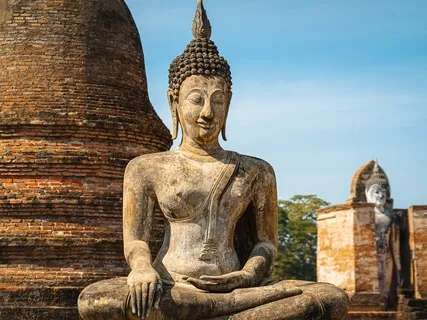
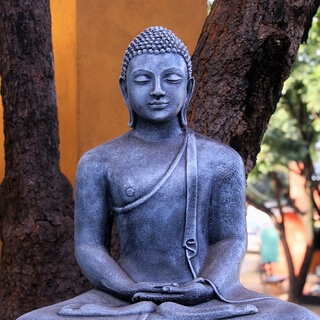
And even with the eventually came to be statues of the Buddha.
That was not something that happened right away.
That eventually happened much later on in Buddhist history.
But those are there for the spiritual body essentially of the Buddha.
So we don't have the Buddha in front of us,
But it's inspirational to us as well because it's showing us essentially the Buddha that's inside of us as well.
The Buddha said that all of us can achieve what he did.
And what he did was remarkable throughout this extremely long career if we want to think of it that way.
And we can look at his life,
One of challenges,
One of suffering and despair,
But also of the of the inspirational nature of it.
He was so devoted to this cause and what he taught was so perfect in the way we look at it in Buddhism.
He understood the true nature of things.
He was skillful in how he taught others.
He had transformed many people by his teachings.
He had a mass murderer,
For example,
Angulimala,
Who was feared throughout the land,
Become one of the most well-respected monks inside his Sangha.
And eventually Angulimala was the karma that was already with him.
He did face a death as a result of that,
But he is revered by Buddhists because of what he achieved as a monastic.
He became very inspirational that way.
You also had monastics of many different lifestyles,
Whether that's rich or poor,
Intellectual or not intellectual,
All were able to achieve enlightenment or many were close to it based upon the teachings of the Buddha.
So this is what really sparked this religion that has existed for 2600 years and is still going strong because of this remarkable individual we call the Buddha.
Do you have any questions about the Buddha?
I would like to hear back from you.
You can always send me a message from my website,
Allanpedo.
Com or apply to this podcast.
And I look forward to talking with you in our next episode.
Thank you.