Welcome to Learn Buddhism,
I'm Alan Pedoe.
On December 8th,
Western Buddhists like to celebrate a particular holiday in Buddhism called Bodhi Day.
Bodhi Day gives us the opportunity to celebrate Shakyamuni Buddha's enlightenment and to refrigerate our faith in becoming enlightened ourselves.
So what exactly is Bodhi Day,
Why is it important,
And how do you practice it?
Well we'll talk about that in this episode.
Bodhi is a word we have inside Buddhism that refers to enlightenment or enlightened.
So the Buddha being an enlightened teacher,
We are celebrating his enlightenment on this day.
So this is a Mahayana Buddhist holiday.
In Mahayana Buddhism we celebrate the Buddha's birth on a separate day,
His enlightenment Bodhi Day on a separate day,
And also when he passed into Parinirvada or final Nirvana,
His death on a separate day.
In Theravada they celebrate all of these three events on a single day.
So just difference between the different traditions here.
Why is this important?
Well when we look at the Buddhist struggle,
He was a human being just like you and me,
And so he through his own effort was able to eventually become awakened to the truth,
Become an enlightened being,
Blow out the three fires of greed,
Anger,
And delusion,
And reside in his natural state Nirvana.
And that on its own is truly remarkable.
It's very inspiring,
But it's what happened next.
It wasn't where he went,
This is fantastic,
I'm an enlightened being,
Sia,
No.
He actually knew and said all sentient beings can do exactly what I did.
He realized that all of us can become enlightened.
We all have Nirvana inside us,
We all have Buddha nature inside us,
But due to delusion and ignorance we can't see it.
So the three fires of greed,
Anger,
And delusion,
It's what's causing all this suffering,
This dukkha in our world,
And his cycle of rebirth,
And everything else that he was able to be awakened to and understand as he meditated and sat under this what we now call the tree of enlightenment or the Bodhi tree.
And when he became the Buddha he realized all this,
But more fundamentally he realized that all of us,
As I mentioned,
Can do what he did.
So instead of just going off on his own as an enlightened person,
Which he absolutely could have done,
He set forth to teach.
And that was the beginning of the Buddhist religion we have right now.
For if he didn't do that we still may be in this current era right now without the Buddha's teachings and his path to salvation,
The path towards enlightenment and to blowing out those three fires of greed,
Anger,
And delusion,
And realizing our true,
Peaceful,
Calm,
Perfect,
Natural state of nirvana.
That's where we need to be.
And he showed us how to get there.
So as he set forth he came across his five former followers who were just shocked at him because he basically left them to find the path that we were on wasn't really working,
So he went off to find a new path.
And they were a little bit repulsed by him because he looks like he's been eating and he looks totally different,
But to them he didn't look like an enlightening being.
He looked like the same Siddhartha Gautama that they knew before,
But just one who left them.
So it wasn't like he has some halo over him or anything else which really set him apart,
But when he said,
Have I ever lied to you before?
And they know he has it.
They listen to him.
And this is where he basically gave his first sermon,
Which is so foundational in Buddhism,
Known as the Four Noble Truths.
So he gave the Four Noble Truths.
And this is a very foundational teaching in Buddhism because in these four simple things he laid out the true reality of our world.
He laid out why we have it,
Then what we can actually achieve nirvana,
And how to get there.
The Eightfold Path,
The practice.
And this was so fundamentally understandable,
But also revolutionary and amazing to his former disciples.
Instantly they were again his disciples again.
So his first teaching to his former disciples,
He was able to clearly tell them what Buddhism,
What we now call Buddhism,
Is all about.
And they set forth to learn from him.
And overall what we see in the Buddhist 40 years of teaching was that he was able to help everyday human beings like you and me of all different lifestyles.
Poor,
Rich,
Not so intelligent,
Very intelligent,
People who were mass murderers.
He was able to help them in ways where his teachings allowed them to transform their karma from unwholesome to wholesome.
He was able to help many of them become enlightened beings,
Arhats.
And they were able to escape the cycle of birth and death or very close to it maybe in a future life.
So what he did was essentially start freeing people.
He was freeing people from the cycle of birth and death,
From this unsatisfactory existence caused by the this dependent origination,
This grouping of us,
To his temporary existence,
Which is Dukkha,
Suffering.
He liberated us from that.
And so 2,
600 years later we are still celebrating and inspired and awed by the Buddhist enlightenment and what he did from then on.
Not just because he became enlightened,
But because he taught and he helped others become enlightened throughout this 2,
600 years even after he passed away.
So that's a short little backstory.
But I think it's really important to mention that because we didn't understand that,
Yeah,
He's an enlightened being,
But he went and started teaching others.
He gave us this message,
This teaching,
This practice towards salvation.
And that's really what we have in Buddhism.
It's a salvation message that he gave us so that we can be free of Dukkha.
We can free ourselves from the basically this shackles,
Being prisoners of this cycle of rebirth,
Which is not where we want to be as Buddhists.
So on Bodhi day,
As we celebrate this enlightenment of the Buddha,
We can reflect on,
We can do that as well.
And we also reflect on,
Yes,
We understand that we have delusion,
Ignorance has been clouding us to this truth,
But we got the Buddha with his teachings and his sermons of that,
Almost like a light shining into this murkiness that we've never been able to see before.
And as we continue practicing Buddhism,
Sometimes we can see a little bit clearer.
We can see a little bit further down that road.
And these are those little sparks of wisdom and enlightenment that's going to help us to get to that full enlightenment.
So how do you celebrate?
It's a fantastic holiday and practice in Mahayana Buddhism because there's many different ways to practice it.
And what I like to talk about in this episode is how a Western Buddhist may be able to celebrate Bodhi day.
Now a lot of reasons why Western Buddhists like Bodhi day is because,
Well,
On the Western calendar it's on December 8th,
So it fits right into a month inside our Western calendar that we're already celebrating a bunch of other holidays,
Christmas and everything else.
So it falls very neatly and nicely into more everybody else is celebrating something too,
We can as well.
And this also is going to help you with the practicing of it because you likely have some of the equipment,
So to speak,
That you can use to celebrate Bodhi day.
One thing that I like,
Well let's say that you have a Christmas tree like a plastic or artificial Christmas tree.
You can use that.
You can use that as the tree of enlightenment,
The Bodhi tree that the Buddha had.
And so you'll see this throughout the rest of the Buddhist world.
Maybe it's gonna be like a ficus tree that they use or something like that,
But they're gonna have a tree.
Not always,
But you can have a tree.
And you can also use your Christmas lights.
And especially if you have those multi-colored lights,
Perfect!
Because what we're doing here is very,
Very symbolic.
We're helping ourselves see and reflect and participate in this Buddhist enlightenment,
This history,
This story,
So that we can also go,
You know what,
I can get there too.
Maybe I will in this lifetime.
Maybe I won't.
Maybe a future existence.
But you know what?
The Buddha said I can.
We've seen through his story and Buddhist history.
He helped many people do that as well.
So this teaching is true and I want to walk down this path to the best of my efforts.
So when you put those lights on the tree,
You're actually reflecting something inside,
Especially emphasizing Mahayana Buddhism,
Which are the many gateways or doorways towards enlightenment.
And I think that's a really beautiful and visual way to actually show it.
Because,
Well,
This is something you have already.
You're not doing something very unusual.
You probably use that Christmas tree for,
Those Christmas lights before,
And so you are repurposing them,
Obviously,
For a different religion.
But it can be very familiar to you in that way,
But you're now reflecting something a little bit different.
You're reflecting what the Buddha did in this tree that he sat under.
And these lights around there are now very symbolic,
As I mentioned,
These gateways,
Doorways,
These different ways we can become enlightened.
It's not just one particular way.
Buddhist practice,
Traditions,
Have numerous different ways you can actually become enlightened based upon the Buddha's teachings.
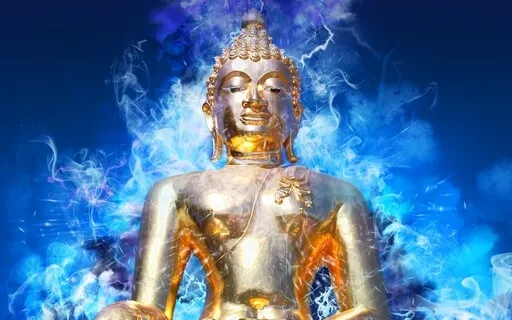
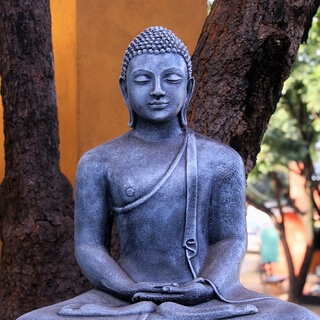
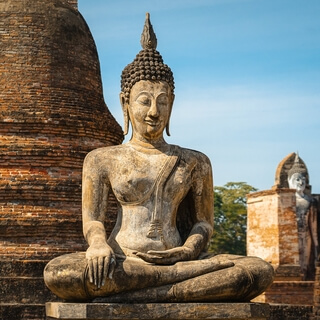
Now let's say you have a Buddha statue.
Perfect.
Traditionally,
We like to have the Buddha statue in a place of respect,
In a high-level place,
Or locked away when it's no longer being used,
Like in a cabinet.
So I would say during Bodhi day,
You still want to consider that.
Maybe your tree is not a very big Christmas tree.
Well,
Keep it in an elevated spot,
But if not,
I would say this might be a little bit exception to the rule.
You can put that statue of the Buddha under your Christmas tree that you repurposed into the Bodhi tree.
And what you're doing here,
You're kind of recreating the scene where you have him under the Bodhi tree.
But beyond this symbolic thing that you're doing here,
What can you do?
Well,
Absolutely practice.
And practicing is a really important thing in Buddhism because remember,
We're reflecting on his enlightenment.
So thus,
We want to become enlightened too,
Right?
And even if you can't become enlightened in this lifetime,
No matter how hard you try,
Let's say,
You're still making progress.
You are working ever so diligently to stop creating unwholesome karma so you can create wholesome karma.
And practicing Buddhism is absolutely a way to generate wholesome karma to help transform your mind.
So there are parts of you that are transforming in this Buddhist religion as it relates to Buddhism down that path.
Sometimes you may not even notice it,
But you are.
So things you can do?
We can follow right back to the Buddha.
So his eightfold path is grouped into three categories,
Which we call the threefold training.
So there is a wisdom category,
There's a morality conduct category,
And there's a concentration category.
So this is a great way to practice inside Buddhism.
So in the wisdom category,
Maybe this is a perfect time for you to catch up on some scripture inside Buddhism.
Maybe recite a sutra or anything else like that or even read from monastics who are talking about Buddhism or watching a YouTube video on them.
Learn,
Learn,
Gain that wisdom about Buddhism.
The morality conduct section,
A perfect time to recite the five precepts.
So precepts in Buddhism is essentially what we're doing to help us shape our morality and conduct in alignment with the Buddhist teachings and the Buddhist path.
And don't stop there just by reciting the five precepts.
Go forth into the world,
Into your daily life,
Whether that's the grocery shopping or to school or to work.
Practice those five precepts as best of you as you possibly can and then reflect on it when you come home.
And then for the concentration category,
Absolutely being mindful when you are out walking around and when people are talking to you and when you're saying things.
But also try to go ahead and do meditation during this day.
It could be sitting meditation,
It could be walking meditation,
You can even do chanting which is a form of meditation,
Recitation of perhaps the Buddha's name.
So there's many many different ways you can do that concentration category as well.
And even for going back to the morality conduct section of the Eightfold Path,
You can even take on a few additional precepts like the monastics do.
So monastics have hundreds of precepts but laypersons they sometimes on special occasions like to go past the five precepts and maybe take like the eight precepts.
And then in Mahayana maybe even the Bodhi software precepts.
So you can do these different things today just to go ahead and go,
Yes I want to do the best I can to go down this path.
And Bodhi day,
Even though we say day,
It's celebrated for quite some time.
It stretches on into January so you can keep practicing this all throughout December and going into January.
And this is a good way to go,
You know what,
I may not be completely knowledgeable about Buddhism.
I may not always be generating wholesome karma.
I know I slip up sometimes,
Right,
Maybe up to speech or thoughts or whatever.
But you know I really want to do what the Buddha guided us into doing.
Because he's not telling us to do this,
He's giving us the guidance on how to do this.
He's giving us the teachings on how to do this.
So we can go ahead and use this time,
This opportunity,
With Buddhists around the world.
There's half a billion Buddhists around the world or more.
We can all be celebrating during this time of his enlightenment to continue forcing and do it with your best effort.
You can also make different things,
You know,
So as far as like food or recipes.
And so a very traditional one is going to have a milk rice porridge essentially.
And this is what the Buddha before he was a Buddhist,
When he was Siddhartha Gautama,
And he was almost dying from this last practice he was doing,
This young maiden,
This young girl walking by,
Was able to give him this milk rice which nourished him.
And this was what really helped Siddhartha understand you don't go to extremes,
What we now call the middle way or middle path.
We don't go to extremes because,
And this is also very important for Bodhi Day in your Buddhist practice,
You don't abuse your body.
So he was abusing his body in his last practice where he was barely eating.
He was extremely sick if you were going to think about it that way because he almost died because of it.
But on the opposite end when he was living with his father he was had all the food and pleasures that he wanted.
That neither of these two extremes were the right way.
It's this middle way,
This middle path,
The eightfold path is the way towards enlightenment and nirvana.
So we can partake in that milk rice if you want to make it.
You don't have to but if you want to just to go,
Yeah I can experience a little bit of this story of the Buddha in some ways to inspire me,
To fill me up with faith in my heart and my mind to get me further down this road with Buddhism.
And then if you have children,
Well obviously we don't want to force our beliefs on children but if they're curious absolutely there's many different ways that children can obviously be part of this particular holiday tradition.
And there's plenty of things online for example there are sometimes things you can print out where they can color a picture of the Buddha,
They can participate in making some crafts,
Baking cookies,
They can even go ahead and do things like putting up the lights on your Christmas tree for the Bodhi tree.
So there's many different ways that everyone can actually participate in this.
And it's just a wonderful way that again it's all very symbolic what we're doing here because the Buddha has left us his teachings.
And in Mahayana Buddhism we have other Buddhas such as Avitabha Buddha and also Buddhi Sattvas that can help us as well.
But it still requires our effort.
We still got to practice.
We still have to have faith and determination and effort inside Buddhism just like all the traditions.
So what we're doing here is helping to fill up that reservoir inside us because you know what everyday life can be very challenging.
It can be very stressful and sometimes you know we may not be practicing as much as we should be inside Buddhism.
I always say Buddhism in Buddhist practice is just like going to the gym.
You're not going to make any gains whether it has health wise or fitness wise or building muscles.
If you don't go to the gym you don't use proper form and technique.
Don't do the right repetitions and sheens and everything else.
And you don't also ingest the right nutrients and food and everything else to achieve the goal you want.
So if we're not practicing Buddhism we're not going to make the progress.
So Bodhi day and the stretch of time we have after it is a wonderful time where you can just continue this for a number of weeks.
You can actually make this keep going for longer and longer.
Think of Bodhi day and just imagine it this way.
Bodhi day,
Have it continue for as long as you possibly can.
That would be fantastic.
But what I love most about this is when you have that Bodhi tree,
Your repurposed Christmas tree up there,
It's something that you're gonna see almost every day.
You probably have a little statue of the Buddha under there.
It's going to remind you practice enlightenment,
Nirvana.
You're getting this visual reminder,
This beautiful visual reminder that you know what?
Maybe instead of like watching this TV show or whatever I need to go do some sitting meditation or maybe I should go and recite and read that sutra,
That sermon of the Buddha or whatever else you're gonna do.
Or I'm going to do something very nice for somebody.
I'll hold a morality conduct portion.
There's different things when you get that visual representation that can definitely help you.
So are you gonna be practicing Bodhi day?
I would love to hear back from you.
You can also find up on my website an article and also a video up on YouTube about how you can use your repurposed Christmas tree for Bodhi day.
I have also another short video about Bodhi day itself all up on my website alanpedo.
Com.
Thank you and I look forward to talking with you in our next episode.