Welcome to another edition of Learn Buddhism.
I'm Alan Pedoe.
What do the half billion Buddhists around the world practice irrespective of tradition or branch of Buddhism?
It's devotional Buddhism.
Devotional Buddhism is a very effective and traditional way to practice Buddhism by providing a balanced and firm and solid foundation for all Buddhist practice,
But it's something that Westerners may not be aware of or even why it's important.
So let's go back 2,
600 years ago to when the Buddha was here on earth.
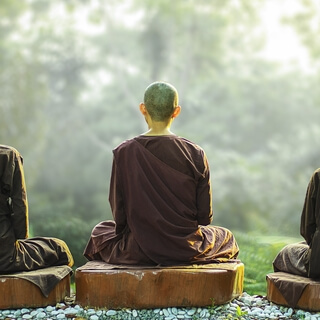
You would see monastics prostrating,
Bowing,
Listening to the Buddha.
You would see laypersons giving food during during alms rounds and listening to the Buddha and his enlightened followers.
You would see where this enlightened being,
The Buddha,
Shakyamuni Buddha,
Had this what we now may call a Buddha field or a pure land around him that affected others.
Where whether you're monastic or lay person,
You didn't want to do anything that would offend that enlightened being because you revered them as a teacher.
The truth that they were speaking the teachings were so important to you that you gave your full attention.
Your mind was clear of all defilements because you had this enlightened being,
This teacher that you honored and revered and respected,
Talking it in your presence.
This was as pure as you can get and this is really the foundation of devotional Buddhism.
When we say devotional you may have a perception or assumption or belief about what that means,
But in Buddhism it's a really good thing because we don't have blind faith in Buddhism.
Our faith is built upon the triple gem,
The Buddha as a teacher,
The Dharma as his teachings,
The liberating teachings,
And the Sangha,
His monastic community,
Which also extends in many ways to laypersons,
Insiders as well,
Which I'll talk about.
This is really important because we put our faith as Buddhists in the triple gem.
In fact when we become a Buddhist we take refuge in the triple gem.
So devotional Buddhism is based upon that refuge inside and with the triple gem in all its facets.
So when we are practicing devotional Buddhism we are opening our hearts,
Our minds,
Everything to that triple gem.
And of course that's practiced in many different ways throughout all the different traditions,
But the core of it's the same.
Because what we're trying to do is rid our minds of the three fires or three poisons of greed,
Anger,
And ignorance,
Which is really that root of our unskillful and unwholesome karmic actions which are keeping us trapped in a cycle of rebirth.
It's preventing us from seeing our true nature of Nirvana.
So thus we are unenlightened.
We want to become enlightened in Buddhism.
We want to realize our true nature of Nirvana.
We want to stop creating unskillful and unwholesome karmic actions.
And we can do that with the triple gem because that is the complete path towards enlightenment.
And of course with all different traditions,
For example even with Pure Land where we have Amitama Buddha,
That was told to us by Shakyamuni Buddha,
The Buddha of our era.
So all of this is a part of that.
So as we see 2,
600 years ago you had the Buddha there with you.
Fantastic.
You can listen to his sermons.
You can show gratitude and loving-kindness and generosity and charity and everything towards the Buddha's monastics.
And the monastics could be there listening along to laypersons to his sermons.
And this is the most conducive environment towards enlightenment.
And we saw that there.
But he is no longer on this earth.
He achieved Parinirvana.
So not having the Buddha visually in front of you,
Speaking to you right now,
That is something that makes it so much harder for us as human beings to progress.
We are very visual being and we like to hear things.
So that's something we need.
Just as a purely intellectual or conceptual look at Buddhism can't get you that far.
We need this.
So after the Buddha's Parinirvana and as we go continuing on years and years and years and generations,
We see a transition where not having the Buddha there is not something that people wanted.
They wanted to have the Buddha there with them.
So even with monastics we could see that as well.
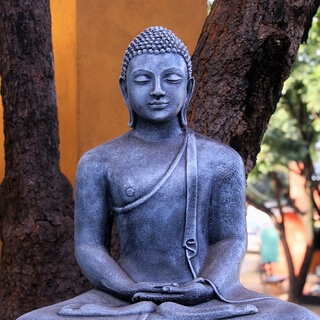
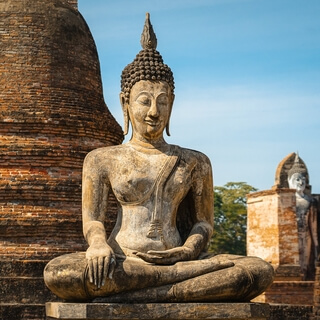
And this is where we start to see Buddha statues are coming into being.
We're seeing paintings.
We're seeing depictions of the Buddha's life.
We're seeing the Buddha come back to life through this artwork,
If you will.
And they weren't doing it to have the Buddha as some sort of God or supernatural being that they're blindly giving worship and veneration to.
No.
What they're trying to do is bring the Buddha to them in the temple or if they're lucky to have a maybe a painting or a statue inside their home,
Which we see more often nowadays.
But what we're doing is bringing that enlightened being,
That teacher with us.
Obviously it is not the living Buddha that we had 2,
600 years ago,
But that's not the point.
We're trying to bring that Buddha or a Buddha or a Bodhisattva to us right now because when we are in the presence of that enlightened teacher,
That being,
What we are trying to achieve ourselves,
We are trying to do that with that imagery because our subconscious reacts to visualization a lot better than anything else.
And so this is what we're doing because when you have that visualization here,
Just like if the Buddha was 2,
600 years ago and you're inside his presence,
You're not thinking about these unskillful,
Unwholesome thoughts,
Deeds,
Actions,
Words,
Whatever you want to do because you got that teacher right there and that's what we're trying to bring in front of us.
So having that Buddha or Bodhisattva statue or imagery physically in front of you brings them to us.
And again this isn't like they're a god or supernatural being,
But as our respective teacher we want our teacher there guiding us towards enlightenment.
And as I mentioned,
We work as human beings subconsciously very much through visualization,
Not purely through intellect or conceptual means.
And a lot of Buddhist teachings are very hard to even understand intellectually or conceptually.
So this foundation of devotional Buddhism is a devotion to this triple gem which we have taken refuge in as Buddhists.
So it's not something we are forced to do,
But because we have taken a point in our path we go,
You know what,
I'm no longer just an observer of Buddhism,
I want to be a Buddhist because I have this faith inside this triple gem.
I want to take refuge in it.
So our devotion is very much a solid and good thing because it's not based upon a blind faith.
And of course the Buddha did say,
Just don't take things you know on faith,
Right?
You need to test us out.
But if you were to only accept Buddhism when you have tested everything out,
You would never be a Buddhist.
There's no way for us to test everything out.
A lot of concepts can be very hard or challenging to understand.
It's almost like going into a particular subject in school where you've never attended before and go,
I don't want to attend this class until I understand it first.
Well you have to go to class to understand it.
It may take you a year.
In fact it may take you years to get up to the level maybe of a university or college degree to fully understand things.
And even then maybe not until you even get into the workforce and start in the real world actually doing things.
So the path could be very very long and when you get that top-level realization,
That could be years and years away just in that college or that educational aspect I was just talking about.
With Buddhism it could be lifetimes.
It could be just this lifetime.
So a lot of things could be very hard for us to understand and that's where devotional Buddhism comes into play.
Because it's given us that faith,
That trust to continue on even when we don't fully understand everything.
When we are doing devotional Buddhism you've already seen it.
In fact you might have already been doing it.
Everything from bowing,
Prostrations,
Offerings.
This is devotional Buddhism.
These are parts of devotional Buddhism because we are honoring,
Venerating and showing our devotion to that enlightened being,
That enlightened teacher who is helping us reach enlightenment.
We want to bring up inside us and inside our mind these wholesome things and the triple gem.
And especially these enlightened beings are very wholesome because it's where we want to go.
More specifically and a little side note to this,
It's what's already inside you.
The Buddha said that everyone can achieve what he did.
We just stop ourselves from doing it and that's what Buddhism is.
This is what the path is.
And so when we are bowing towards a Buddha statue or a bodhisattva,
We're doing prostrations,
When we're giving offerings,
When we're chanting,
When we're reciting,
When we're doing all these devotional things.
Yes it is to that enlightened being but it is also paying homage and respect and devotion to the Buddha nature.
The Buddha that's already inside you,
The enlightened being that's already inside you.
So would you not want to show respect and honor and love and kindness and everything else to this true nature inside you which we're trying to get out,
What we're trying to reveal.
We're trying to get rid of all these unwholesome things right and we're trying to show this compassion,
Love,
Respect,
Generosity,
Charity,
Veneration,
Devotion to the Buddha nature,
To the Nirvana,
The mental state inside you.
So when you are doing this devotional Buddhism,
It's also as I've just mentioned,
To what's inside you that we are trying to get out.
This is showing that love and respect and generosity and devotion not to your inflated ego that we all have.
We all have this ego that's really stopping us from becoming enlightened beings.
We're not doing it to that.
We're doing it to our true nature,
Nirvana.
We're doing it to the enlightened being that can be revealed through the path.
So this is a very balanced approach because if you were just going an intellectual approach where you're like,
I'm just gonna read the scriptures,
I'm going to intellectually understand that,
Maybe I'll meditate also and I don't need this other stuff,
You're missing this important part of Buddhism and there's a reason why all these Buddhists around the world are practicing in it because it's skillful in means.
This is a skillful way to practice Buddhism and as I mentioned,
Stretching all the way back 2,
600 years ago.
This is rooted inside Buddhist history and tradition not because we just wanted to venerate the Buddha or just treat him as this enlightened being.
We're doing it because he's our teacher.
He's the end goal we want to achieve and when we bring the Buddha or a Buddha or a bodhisattva in front of us,
As I've mentioned,
This is going to transform,
It's going to purify our mind,
It's going to help push out that three fires,
Three poisons of greed,
Anger,
And ignorance that we don't want inside there because that makes us create unwholesome and unskillful karmic actions.
We don't want that.
So having our teacher with us is so important or these enlightened beings with us,
It's so important.
So devotional Buddhism builds this strong foundation that's going to continue throughout your life on the Buddhist path where you also have what we call Dharma friends which are also other laypersons that are on this path with you.
You're not alone and Dharma friends are very important.
If you go to temples,
You're lucky to have a temple with you,
That's your Dharma friends there.
There are other people practicing Buddhism on this path going through very similar challenges maybe as you and we're all going on this path.
Some may be more advanced than you,
Some may be just starting off just like you,
But the purpose is in addition to this triple gem we have,
The laypersons,
Your Dharma friends,
Provide you an additional support mechanism on here.
So our devotion to our Dharma friends,
Generosity,
Loving kindness,
Compassion,
Charity,
The same things we're doing to these triple gem,
Right?
We're to use enlightened beings and monastics.
We're also doing to our Dharma friends because compassion,
Generosity,
Loving kindness,
Charity is important to other sentient beings as well.
We are trying to strip down this ego which is preventing us from being enlightened and when we are selfish,
Unkind,
Jealous,
Hatred,
Anger,
All these things,
That's not being on the path.
So when you're able to show that with Dharma friends,
It works out great and you're seeing where your Dharma friends,
These other laypersons,
Are also helping you along the path as well.
So what does this ultimately do?
You might be going,
Well this is fantastic,
You know,
You've mentioned all this,
I'm still maybe not convinced I should be doing devotional Buddhism and no one's forcing you to do devotional Buddhism at all.
If you want to purely take that intellectual path,
That's fine.
You just want to go ahead and do meditation,
That's fine.
Everyone's doing their own approach to Buddhism.
The reason everybody's doing devotional Buddhism around the world is because it works and it aligns well with what laypersons do.
So we see monastics are doing devotional Buddhism as well,
May not appear that way but they are,
But laypersons are also.
These are foundational things that help us,
But again you don't have to do it.
But if you wanted a little bit more secondary look at why this is so important,
When we have faith in a Buddha,
You gain confidence,
Right?
So if you have a trusted teacher like the Buddha or a Buddha like Amitama or a Bodhisattva,
You are able to gain this confidence because you trust them.
You see them as really the goal,
But not only as a goal but as an enlightened being where they are showing you what you can also become.
Because remember,
Buddha nature is inside you so it's really looking at what can and is already inside you.
So that allows you to have confidence because you may not have that confidence otherwise.
Because these teachings and concepts inside Buddhism,
They are very challenging to understand,
A lot of them.
And it takes a lot of time.
So having confidence that the goal is achievable is important.
So when you have confidence,
You no longer have to worry about having to understand everything right away.
Like I have mentioned,
That's not really feasible.
So you have the confidence going,
You know what,
I don't have to know everything right away.
I got the confidence in my teacher here.
My teachers respected and their teachings and their monastic community.
I got it.
This is fine.
I got confidence in them.
That's our refuge,
Right?
Now that confidence leads to something we call joy inside Buddhism because this makes perfect sense.
How can you not have joy when you are confident inside your teacher?
Because otherwise you have all these bumps in the road on this path,
Right?
And that cannot make us feel very confident at times.
They're not very joyful at times,
Right?
It can be very challenging.
But when you have confidence in the teacher and the path to teachings,
The songhood,
The community,
You are able to have that confidence and resulting joy.
Because even though it might be bumpy,
Even though you may not understand something,
It's okay.
I got my confidence inside these teachers.
So that is also important because joy leads to calm.
Because you are calm now,
Whereas you may have been uneasy,
Scared,
Or unsure about things,
Confidence is that top level.
Then you see where that results in the ability to have joy.
And joy is going to lead to calm,
Right?
Because you're not gonna be so worried about everything anymore.
That calm is ultimately going to lead to ease.
You see how they're building on each other?
So ease is the ease on the path.
And this is important.
Let's take a meditation aspect to this.
Because ease leads to samadhi or meditative concentration.
Because let's imagine you are doing sitting meditation.
You have random thoughts come in.
You may be feeling aches and pains as you meditate.
And you may have challenges.
You may not want to do it right.
But when you have confidence in a teacher and his path and the teachings and what you're doing,
And the resulting joy as it relates to that,
And the calm and the ease that relates to that,
The ease is helping you because,
Yeah,
I'm gonna have these random thoughts come in.
But I'm gonna let them go.
Because before I may have just like hung on to them and followed them to fruition.
Now I realize I don't have to worry about it so much.
The ease is coming in because you're letting go of trying to figure everything out all the time.
You're letting go of feeling discouraged.
You're letting go of all these different things.
And that cause of that confidence and the joy and the ease is so important.
That calm,
That ease is so important.
And that's gonna allow you to get to that meditative concentration.
So ultimately devotional Buddhism has a very important practice on all we do.
And meditation is part of it.
So how do you start doing devotional Buddhism?
You're probably already doing it.
As I mentioned a few things in the beginning here.
Bowing and prostrating to a Buddha or Bodhisattva.
Giving offerings such as water,
Food,
Or even the light of a candle.
These are all devotional in nature.
Maybe you're doing chanting.
Well,
Chanting has a other benefit of you're bringing the Buddha or Bodhisattva or a Buddha into your presence by reciting,
By chanting that sutra.
You're bringing this sermon to life where you're at right now.
Maybe you're reciting the name of a Buddha or Bodhisattva.
You're giving rise to them in your mind through your speech and your mindset.
And you may also have a Bodhisattva that name you're reciting.
This is bringing those enlightened beings to you right here,
Right now,
To help you get rid of those unwholesome thoughts,
Unwholesome things,
Greed,
Anger,
And ignorance.
You may have also seen Buddhists doing circumprobulation of a pagoda or stupa,
Pilgrimages to Buddhist holy places,
Observance days,
Which are very popular in Buddhism throughout the months,
Especially on a lunar calendar,
Where you take an additional precepts,
Reading scriptures,
Doing different things.
All this is devotional in Buddhism and none of it is something to be worried about or apprehensive about.
It's foundational.
It's wholesome.
And as you get involved in it,
It's something that you'll become welcome to and looking forward to.
So if you are a Westerner who's becoming a Buddhist,
You may be looking at all these different cultures and ceremonies and rituals and everything else and going,
Should I practice that or should I just be intellectual in my approach and just do meditation as well,
I would recommend give devotional Buddhism a shot.
If you have a temple that you're going to and you're not sure about what or how even to do a particular ritual or maybe prostration is a good example,
You can ask a monastic before or after to get some guidance.
They can also have classes.
You have Dharma friends there.
You can ask a volunteer or somebody else.
I really would like to try to do this,
But I'm not exactly sure what to do.
You are probably going to find that very welcoming to show you how to do it.
Don't worry if it's going to feel a little unusual at first.
Even after a couple times,
You're eventually going to get into the swing of things and then you might look forward to this as part of your practice.
We have to get through our perceptions and assumptions of what something is because we're going to put labels on things and labels are going to cloud us from what we're trying to do.
So when we start putting labels on things we do in devotional Buddhism as Westerners,
We're losing the benefit and a purpose community and foundation of it,
Which is going to be really important to us.
So again,
You don't have to practice devotional Buddhism as I mentioned,
But it's what really this half-billion Buddhists around the world are doing and it's a really good thing to do and to look at.
Now if you'd like to do this,
My last recommendation is perfect for this.
Talk to people at your temple.
They can help you get involved.
You're likely going to have things chanted or recited in different languages that are not your own.
That's okay.
It may be a little uneasy at first,
But you're going to get through that.
Maybe some rituals or holidays you're just not sure what to do.
It's okay to watch and observe and ask how to do something.
As you get into it,
It will become easier and easier for you to do.
This includes your daily practice at home.
So if you don't have a temple to go to,
Maybe you're going through a live stream of a temple and you don't really have that one-on-one right now,
You can absolutely do this at home as well and actually that's what a lot of Buddhists do.
You will see in the morning and even in the evening they may have an altar at home and they're gonna do things like bowing,
Even maybe prostrations.
They'll give like offerings,
Maybe water offerings for example,
Or food offerings and maybe a recitation or chanting.
This is very,
Very popular because it's setting that foundation for their day and also at the end of their day.
So this is a wonderful thing for us to look at as Westerners practicing Buddhism because it is foundational and it stretches all the way back to the Buddha.
I've only really touched the surface of devotional Buddhism here in this episode.
There's so much more to it but I hope it opens your eyes to this form of Buddhism that really everyone is really practicing and it's something that we should all take a look at as well.
Do you have any questions about devotional Buddhism?
I'd like to hear from you.
You can send me an email from my website alanpedo.
Com and I look forward to talking with you in our next episode.
Thank you.