Welcome to another episode of Learn Buddhism,
I'm Alan Pito.
Prayer is practiced by hundreds of millions of Buddhists around the world,
But for Westerners who are new to the religion,
They may be looking at prayer with skeptical eyes.
Why do I need to pray in Buddhism if all I need to do is meditation or study,
Or maybe looking at it as cultural or traditional and have nothing to do with quote-unquote real Buddhism?
Well,
Prayer is actually a very important component to Buddhism,
And when you practice it sincerely,
It will be a welcomed and loved and important part of your practice.
So let me take you first all the way back to the time of Shakyamuni Buddha,
The current Buddha of our era,
And if you were 2600 years ago,
You were living around Shakyamuni Buddha and he was going to give a sermon,
You would go there,
Or if you were one of his monastics,
You would be there,
And you would see prayer going on.
You would see prostrations going on before the Buddha,
And this is an important component to this entire episode because at that time,
You had a flesh and blood being right in front of you.
You got the five aggregates all together to bring you this Buddha,
Right?
And he is right there in front of you.
There is what we call a Buddha field around him.
He is teaching.
He is liberating others.
We saw that in the scriptures and the teachings where many of his followers became enlightened and he set forth the turning of the wheel,
The Dharma.
So he's reintroduced to us the teachings that had been lost so we can liberate ourselves.
So the monastics around him are obviously all in.
They are monastics and they are just so grateful to be in the presence of their teacher and to receive these liberating teachings.
They are praying and prostrating,
And laypersons also are so grateful to be around this remarkable being because a Buddha inside Buddhism is not just a regular human.
This is a special being,
If you will.
They are beyond the concepts of what we might think of.
So to be around this amazing being is important.
A Buddha.
This is immensely rare to be around a Buddha,
To even know about the Dharma and to practice the teachings.
So when they're around this living being,
They are respectful.
They are showing gratitude,
Reverence,
Respect,
Loving kindness,
Because this is something that they may have never have gotten or experienced before.
So wouldn't you be overwhelmed by the presence of such a remarkable being?
Because if you're a Buddhist,
As we now call it,
You would be.
You have taken refuge in the Dharma,
The Sangha,
And the Buddha.
The Buddha is our teacher,
The Dharma,
The liberating teachings,
And the Sangha,
The monastic community.
That is so important to you.
You have put your faith,
Your trust,
Your devotion into that.
And so being around that living being,
Very important.
Now that's all important because you can probably go,
Yeah,
Of course,
Well,
If I was around a living teacher right then,
I would show my respect,
And that's how you would do it.
Well,
After the Buddha entered final nirvana,
Or parinirvana,
He was no longer here in the physical world.
The five aggregates dispersed,
He was no longer here.
And so you even saw at that time,
There was many monastics who were overwhelmed by that.
They no longer had their physical teacher in front of them,
Right?
So you would see,
As we progress on the timeline of Buddhism,
There was no statues of the Buddha.
There was no paintings or illustrations of the Buddha.
Sometimes what you would see would be,
For example,
A illustration or carvings of a footprint and many symbols and stuff inside there.
And that was really the path of the Buddha,
The Buddha's footprints,
Right?
But you never actually see the Buddha.
But as laypersons and even monastics,
They wanted to connect with their teacher,
Right?
But as time gone on,
There would be people who have not even seen the Buddha before.
So the ability to bring this remarkable being to you was important.
This is where the statues and illustrations and everything really came to being.
Because obviously,
The Buddha is not here physically in front of you,
But we can bring him here.
We can have the teacher in front of us,
And we can focus our energy and our attention and everything else as part of our practice.
So where does that bring us with prayer?
Prayer always was there,
Even at the time of the Buddha.
As I mentioned,
You saw prayer there.
You would see prayers as it relates to many different things.
So let's jump to even nowadays.
What are we doing with prayer,
Right?
So prayer has a couple of different things.
We are praying maybe to understand the teachings.
This could be a good one.
Maybe Buddha or Bodhisattva,
I'm trying to understand emptiness or dependent origination or karma or whatever the case might be.
Or maybe this sutra,
I'm trying to really understand it,
Not intellectually,
But fundamentally.
And so I'm trying to gain some insight,
Right?
So prayer can also help us gain insight.
This is important because we need wisdom.
We need wisdom to be able to break down the false belief in a permanent,
Unchanging,
Independent self,
Which the Buddha says does not exist,
Because we're trying to get to that end state of nirvana.
We try to be enlightened to the truth,
Realize nirvana,
Our true natural state,
And be this enlightened being,
Right?
We're trying to be awakened to that truth.
But we need to be able to get there.
So being able to connect with your teacher,
A Buddha or a Bodhisattva,
Is important.
Let me back up here.
When we are connecting with them,
There's two different ways we're connecting with them.
One,
There is that innate capability inside you,
Inside yourself.
You are enlightened.
Well,
I shouldn't say you're enlightened.
You need to become enlightened,
Right?
But the capability to become enlightened is already there.
We are creating the conditions that prevent that.
So there's nothing preventing you from becoming an enlightened being.
Nothing.
There's nothing stopping you from rediscovering your true nature,
Nirvana.
We're doing that to ourselves.
And that's the whole mission of Shakyamuni Buddha,
Other Buddhas,
And Bodhisattvas,
Is to help liberate us,
To help us see the truth.
And because we can't see that,
And we're creating these karmic actions,
Which are really just keeping your mind going in this delusional,
Illusionary state,
We're not aware of the truth.
So we're not able to break free.
We're not able to see it.
So when we have these teachers helping us,
That's really important.
So inside us,
There is,
If you want to think about it this way,
There's a Buddha already inside you.
So you are praying.
You are connecting to the Buddha inside you.
And that's everything from your mind,
Your heart,
Your entire being is connected to that Buddha inside you.
There's also,
Especially in many traditions,
For example,
In the Mahayana branch,
There's also where the Buddha has never really left us either.
Yes,
He's at their party nirvana.
Yes,
He's not here physically,
But it doesn't mean we can't connect with him.
And for maybe lay practitioners like you and me,
We're not going to be able to really get more than praying,
And I'll talk more about that.
But maybe very advanced practitioners are able to connect with Buddhas and Bodhisattvas,
And Shakyamuni Buddha,
In a way that we can't right now.
And so this may not be something that maybe in the Theravada branch they believe in,
But it's something saying that there's many bodies of a Buddha.
And so it's not the same Shakyamuni Buddha that we may have associated here on earth,
But essentially his being,
His Buddha being,
Is still able to be connected to.
And this is where you might have insight that goes well beyond what we're able to do just through our own intellectual capabilities.
So there's also that capability.
But we're not talking about praying in either of these instances.
So when you pray,
You're praying sincerely,
Devotedly,
Faithfully,
Right?
But you're not going,
Dear Buddha,
Please give me a car,
Or dear Buddha,
Please give me a lot of money,
Or dear Buddha,
Or Bodhisattva,
Please take care of this person who I'm just not getting along with.
We're not doing that.
Now we may say something like that.
We go,
Buddha,
I'm having a lot of trouble.
I'm not connecting with a family member,
And we're having difficulties,
Or maybe I'm having financial trouble,
Or maybe I want to get this car,
But I'm not sure what to do.
I don't have enough money for it.
You're not asking them to do something,
Because Buddha or Bodhisattva is not going to come down with a bag of money or a car or take care of troubles for you.
They are there to help you on the Buddhist path.
So everything in Buddhism,
As we relate to Buddhas and Bodhisattvas,
Are related to the Dharma.
So it's helping us that way.
But it doesn't mean that we can't ask for help,
And that's a very human and important component.
We're asking help.
We're praying,
Right?
So I'm asking for help to understand the teachings.
I'm asking for help regarding these worldly situations,
Right?
Because they are all connected with the Dharma.
So even things that might be worldly,
In our opinion,
Are something that we can ask for because it's based on Buddhism.
Buddhism is practiced in the world.
It's related to this world that we're in,
So maybe called the Saha world.
We're in this samsaric existence,
Right?
And so because of that,
We have a lot of unsatisfactoriness,
That dukkha.
And so because of that,
We have to understand the fundamental conditions,
And it's hard for us to always see that.
So something maybe even like,
I want a car.
I want this car,
Right?
I don't have the money for it.
Maybe as we pray,
We are helped in maybe two ways.
Maybe there is a connection with a Buddha or Bodhisattva who is not directly speaking to us.
We're not going to hear voices,
Right?
But we're going to be able to understand,
Like,
Wait a minute,
Isn't there something in Buddha's teachings that can help me understand what's going on here?
Maybe it's very subconscious when it comes to us.
Or even our own Buddha nature,
Our own understanding of what's going on.
We go,
Wait a minute,
Is this related to one of the three fires,
Three poisons of greed,
Anger,
And ignorance?
Is it greed?
You know,
What's going on here?
Is it part of the ignorance?
You know,
Like,
Why do I need this car that costs this much money,
When I can afford something else that will achieve my goals,
That's going to help me get reliable transportation,
Right?
So something like that.
So we are able to connect in many different ways to help us in this world,
This existence that we're in right now.
So when we are praying in Buddhism,
Yes,
You can absolutely do that,
Relate to the conditions or needs and wants.
And you know,
Especially inside Mahayana Buddhism,
There's many different bodhisattvas that have many different capabilities that can help us here in this world.
But again,
It's not to go,
Here,
Let me take care of all this for you.
It's really skillful means,
In a way,
To help us help ourselves.
Because even a Buddhist says,
I can't do all this for you.
You have to put that effort inside her,
Which is why we practice.
But prayer becomes a very important component.
And so when we are praying,
We are able to really channel energy inside us,
Whether you want to think about it in scientific terms or religious terms,
Spiritual terms,
Many different ways we have energy that is part of prayer.
And this could be even energy that,
When we are praying,
Builds up inside us.
It changes our mind,
Our well-being,
Who we are.
And if we do this inside maybe a temple with our sangha and other monastics and lay practitioners,
That communal prayer also is very powerful.
Because we are also connecting off of each other.
So if we're all saying a prayer together,
Maybe it's a particular prayer,
Maybe to help somebody who is sick or maybe something more ambitious,
Like maybe world peace or something like that,
You are maybe not going to be,
Through that prayer,
Directly changing it.
But are you now changing the people in that room,
The people that overheard,
The energy that you give forth as you go into the world and how you interact?
Is it more wholesome along the Buddhist line that can make an impact?
It may be all small things,
But it also can add on and add up as we look at everything in total.
So one part of this,
Definitely connecting with the Buddha or Bodhisattva,
But we are also doing prayer in a very more,
Yes,
Traditional way.
So as I mentioned,
We don't have the Buddha in front of us anymore.
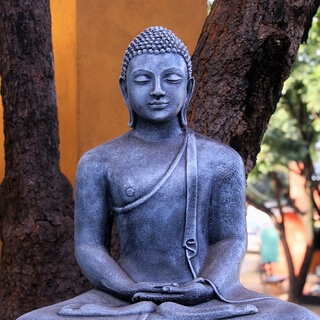
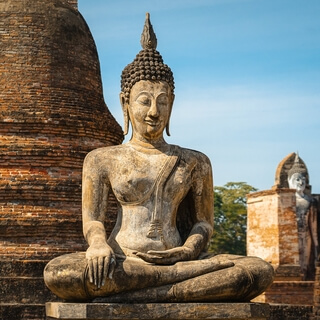
So we have statues and we have paintings and illustrations,
Right?
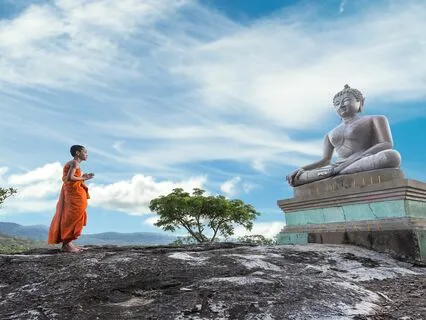
And when we are bowing to the Buddha,
We're praying to the Buddha,
When we're doing prostrations to the Buddha and Bodhisattvas,
We are showing reverence,
Respect,
Love,
Right?
These are our teachers.
These are enlightened beings.
They are aspiration.
These are our aspiration to become like them.
Whether that's maybe in Theravada,
You want to become an Arhat,
Maybe in Mahayana,
You become a Bodhisattva and eventually a Buddha.
We are looking at them as the end state.
And even,
Let's say you're in Theravada,
It's like becoming Arhat,
The way that a Buddha or Bodhisattva,
For example,
Or even an Arhat,
Is how they act and how they think and be,
That's what we want to achieve,
Right?
It's this end state.
So we are showing this respect,
This reverence,
This compassion,
This love to these teachers.
And we don't always have a flesh and blood teacher in front of us,
But we can channel it that way through those statues,
Through those objects that are in front of us to bring force to teach it to us.
So when we are showing our respect,
Reverence,
And gratitude to these teachers,
Yes,
Maybe that statue,
Right,
Is just a statue.
Let's just take it at a very physical level,
Right?
Let's take the religious part out of it,
Right?
But what's happening inside you?
You are,
Remember,
Trying to break down this false belief in a permanent,
Unchanging,
Independent self,
Which the Buddha says does not exist.
It's that ego,
Right?
And so how do you break that down?
You have to do it in many different ways.
Just reading a book is not going to get it for you.
Just reading a sutra is not going to get it for you.
Even the Buddha says intellectual pursuits,
That's not going to get you to enlightenment,
Right?
So it's part of the Eightfold Path,
But it's not everything.
So as you're doing these activities,
As I'm bowing,
As I'm prostrating,
A very full physical body activity,
Right,
I am breaking down my ego,
Because maybe my ego says,
Why should I have to bow or prostrate to a statue or to this,
Right?
I know that's not real.
Or maybe I know this,
Or maybe I know that.
That's where you have to put the faith inside Buddhism,
The determination in Buddhism,
Because that's really your mind,
If you want to think about it this way,
Preventing you from going on the path.
And it's going to be very logical,
Your mind,
In preventing you from to do that.
It'll come up with all the excuses you need not to do that.
So as we are bowing and prostrating,
Yes,
It's going to probably feel uncomfortable or unusual if you've never done it before.
But the more you go into that practice,
The mind knows it can't stop this person.
And the more you put the religious,
The Buddhist faith inside this,
It's not that blind faith,
But you put this faith inside there in this practice,
You're not letting the mind win.
You're not letting Mara win.
You are able to start slowly breaking down the idea of self,
Which is key inside Buddhism,
Because that's preventing us in a large way from becoming enlightened.
So respect and reverence to the Buddha and bodhisattvas and other Buddhas is really important for us as we do it that way.
We also pray with repentance.
So the five precepts that we have inside Buddhism,
Precepts are so important because these are what the Buddha gives us to make sure we basically have these guardrails on our path on the path towards enlightenment.
So there's a full path,
But the guardrails there are your five precepts.
Monastics have hundreds of precepts.
We got five precepts.
Sometimes we take eight precepts or maybe even bodhisattva precepts inside Mahayana Buddhism.
But we got these bare bones,
If you will,
These fundamental five precepts.
And yes,
We are going to,
What we call it,
Transgress.
We are going to violate some of these precepts.
Maybe you lied or something like that.
So as sentient beings who are not enlightened,
It's almost a guarantee you're going to transgress one of these five precepts in some way.
You know,
Maybe minor,
Maybe major,
And there's different ways that we repent inside Buddhism.
And some are major transgressions that are beyond repentance.
But I'm just talking about the ones we can repent on.
And so when we are repenting,
We are often doing this right in front of a Buddha statue or illustration,
Right?
An image of the Buddha or bodhisattva.
And why are we doing that?
You know,
Who are we praying to?
Who are we repenting to,
Right?
And is there going to be some cosmic force?
Like is the Buddha going to go,
Nope,
You're going to be punished or you're forgiven?
Neither of those.
So the Buddha or a bodhisattva is not going to go,
All your sins are forgiven,
Or that transgression is forgiven,
Or you're okay,
Or whatever.
We are doing this in a few different components.
So it's going back to that reverence,
Respect,
Right?
As a teacher,
We're going to our teacher,
Just like if we were 2,
600 years ago,
Going,
Buddha,
I've violated this precept.
Here's what I did.
You are getting it out.
You know,
Otherwise it stays in your mind,
It stays in your body,
It stays in your heart.
And so it stays in your being and transforming,
Because remember the precepts are all about the morality conduct portion of the Eightfold Path.
You have to transform that,
That is crucial.
So the Eightfold Path is grouped into three sections,
Wisdom,
Morality conduct,
And concentration.
So even if you were intellectually superior in understanding the sutras and Buddhism and teachings,
Wisdom,
All right,
But it's maybe not going to be that fundamental wisdom that really breaks through,
Right?
And then maybe even concentration,
Like you're a fantastic meditator or whatever the case might be,
Okay.
But even if you were to become enlightened with just those two components,
Who are you without the morality and conduct?
Can you even imagine any Buddha or bodhisattva who's maybe very skilled on wisdom and also meditation,
But you know,
The morality conduct,
Let's forget about that.
No.
When we look at them and we see this being,
They got the morality conduct portion down pat,
Don't they?
So when we are repenting,
We're repenting to our teacher,
We are letting it all out because we keep it in.
Number one,
We're keeping it in.
We're not letting it out.
It's a very human thing to let things out to heal,
Right?
But also to make us aware of what we're doing.
You may be going,
Well,
I'm aware of what I'm doing,
Right?
But are you?
And so we need to get out in front of our teacher,
The person who's teaching us and does the teachings we're getting from,
Right?
So I'm laying out in front of the teacher,
I'm laying out,
You know,
I talked about how,
Especially in some traditions,
Buddha is still out there,
Right?
You know,
They're at a bigger level.
And so I'm letting it out so that not only they hear it,
My teacher hears it.
And that could be sometimes a scary thing,
Like,
Wow,
My teacher can really hear this?
Let it out.
But also so you're aware of it.
So you are aware of that transgression,
How you violated that precept.
And are you now able to not transgress again?
So maybe during this session,
You're getting some insight on how to prevent that again.
Whereas you're doing this quietly or out loud,
You are able to not violate the precepts again.
And again,
The precepts are not going to be where the Buddha is going,
You are damned forever.
These are his guidelines to help us on that path.
You can violate them all you want to,
But that's not going to help you on the path,
Right?
So the Buddha is not going to keep marks up on the sky,
Right?
Or wherever,
Going good or bad.
That's up to you to follow the precepts to go down that path.
So letting it out is going to be a very important component.
We also pray to help others,
You know,
So this is a very big thing where you see a lot of prayers about helping others,
Especially when you have like a Dharma service,
There's usually,
There could be sometimes a prayer component of it,
Where there's a prayer being read,
And it's about helping others,
Or maybe we want to see something,
I give a broad example,
Maybe world peace or something like that,
Or maybe it could be something else.
And so these can be sometimes very symbolic,
If you will.
But we are praying together in that way to build that energy,
And also to keep that in our minds and transform ourselves as well.
So this is something that is showing that we are connected,
We are not inter,
We're not independent of each other,
We are interconnected.
And by doing communal prayer,
That's also a very great practice,
Whether fundamentally it can or not,
Let me just talk theoretical here,
Whether it can or not,
It is on a very physical level with us as we're doing this communal prayer,
Or even by ourselves with others around the world,
Maybe independently.
We are doing it together and building upon each other that way.
But ultimately,
All of this in prayer is something that Buddhists do.
It's going to be something,
If you're just starting out in Buddhism,
It could look very uncomfortable to you.
Well,
Maybe,
As I mentioned,
You're coming back from another religion to Buddhism,
And you're like,
Well,
I want to do everything else except that.
Or maybe I go to a Dharma service,
I say,
I'm not going to do that because I don't believe in it.
Well,
If we are not going to look at these practices that have evolved over centuries,
Or even millennia,
We got 2,
600 years from the time of the Buddha until now,
And there's a reason they exist.
And a lot of times,
It is skillful means,
Where it's helping us in many different ways.
And you may go,
You may scoff at it,
Like,
Well,
I don't really need that,
I'm a very intellectual person,
A very scientific person,
And I don't see any proof of this,
So I'm not going to do it.
Again,
There's many different ways things are going to help us that you're not going to be able to prove to yourself.
There's many concepts in Buddhism that we just can't prove.
What do we have to have faith in?
The Buddha and other enlightened beings who have told us is capable.
We saw with the historical Buddha 2,
600 years ago,
Also enlightened other of his followers as monastics.
So it's capable,
We can do it.
But if we start putting up roadblocks,
That's going to be challenging.
So all these practices that have evolved from 2,
600 years ago are helping us because we don't have the physical Buddha in front of us anymore.
We have to essentially fight more,
Struggle more with our session,
Because it is easier,
And any Buddhist leader will tell you,
Any monastic will tell you,
If we had the Buddha in front of us right now,
It would be much easier to become enlightened.
Not saying everyone would be,
But it's much easier to become enlightened in the presence of an actual teacher,
Because there is a more direct connection in many,
Many different ways.
Just not hearing sermons and asking questions,
But just being in the presence of an enlightened being,
A Buddha,
A supreme being like that,
A Buddha is rare and remarkable to have somebody at that level.
But we don't have that.
We still have the teachings,
But as we progress further and further down the time,
And we're 2,
600 years from the parinirvana of the Buddha,
We need to be able to do many different practices that help us.
And again,
We are not there at the time of the Buddha,
So we can talk as much as we want to about original Buddhism,
Or whatever,
The original teachings.
That's when he was alive.
So we are using things that many Buddhists are doing around the world,
That have evolved over the centuries,
To help with the loss of having a physical Buddha right before us.
Prayer is one of them.
It's one of those things where maybe you have to go in there slowly,
And if you want to go in there in a very,
Maybe practical approach,
Yeah,
You can definitely pray,
And go,
I want to understand teachings,
For example.
But I would say open yourself up to worldly situations as well,
Needs,
Wants.
Again,
Not saying they're going to be like a wish fulfilled thing,
But it's going to help you as part of the overall practice.
Where there's an inner Buddha nature inside you,
And that's very heavily implied inside Mahayana,
But inside Theravada,
We all have that innate capability.
That all stretches back to the original service of the Buddha.
We both believe in that,
That there is this innate capability in all of us to become enlightened.
You can do that.
Don't not see that inside yourself.
Prayer can help you there,
But it's very much when you are at a very,
Very minimum,
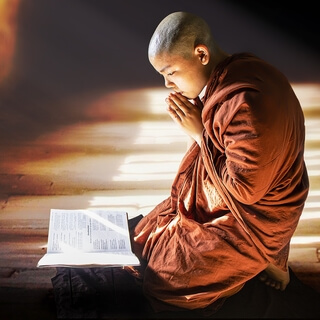
You're bowing,
You're praying,
You're prostrating before a Buddha.
That is respect,
Devotion,
Love.
This is so important,
As I mentioned several times,
Because it is transforming our morality,
Our conduct,
Our mind,
Our effort,
Our determination on the path.
Because if we can't have that teacher in front of us,
If we can't have a focus of what an enlightened being is,
And what we need to help us in our practice,
That could be an obstacle.
So,
Prayer,
A wonderful component.
I hope you,
If you need to go in there slowly,
That's fine,
But incorporate this inside your practice if you can.
It's best if you can maybe during a temple,
You know,
With your Sangha.
That's a wonderful way to incorporate prayer as well.
But start incorporating that,
And let me know how that works out for you.
Now,
Don't expect major things happening,
Like you're going to gain insight from prayer,
You know,
Right away or something like that.
This is a practice like all other Buddhist practice.
It is one of many,
Many different components that,
On its surface,
May not always have an intellectual understanding to us,
But there's definitely a Buddhist component to it,
And it's part of Buddhist practice for a reason.
The reason why we still have it 2,
600 years from the parinirvana of the Buddha is because it's part of Buddhism,
It works in Buddhism,
And it becomes a very important Buddhist practice for these half a billion Buddhists around the world.
Thank you for listening.
If you'd like to leave a comment,
You can do so on Spotify,
Or you can leave me a message on my website,
Alanpeto.
Com,
Or social media.
Thank you,
And I'll talk with you in our next episode.