Welcome to Learn Buddhism,
I'm Alan Piteau.
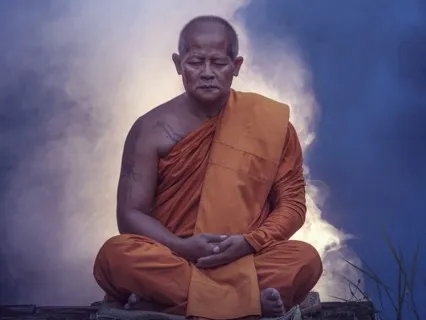
Meditation is an important and critical tool that Buddhists use as part of their daily Buddhist practice.
But what is it exactly and why is it important to you?
And how do you start practicing meditation?
We'll explore that in this episode.
First I want to introduce you to something called the threefold training.
Meditation is only one part of a complete Buddhist practice.
So meditation by itself is not a Buddhist practice.
It's just one part of it.
The threefold training is wisdom,
Morality,
And discipline.
This is also the three parts of the Buddha's Noble Eightfold Path.
So the Eightfold Path in Buddhism is the practice,
The middle way,
That the Buddha gave us so that we can strive towards becoming awakened to the truth just like he did.
So we become enlightened beings,
Meaning that we have blown out,
Ended the three fires of greed,
Anger,
And delusion,
Which have been causing us suffering,
Dukkha in our lives,
And keeping us trapped in a cycle of rebirth.
This outcome,
Where we've blown out the three fires of greed,
Anger,
And delusion,
Is known as nirvana,
Our true natural state.
So the threefold training is this whole Buddhist practice that helps us end delusion,
And meditation is part of that.
So I'd like to read you something from Venerable Master Hsing Yun,
Who gave a very good explanation of the threefold training and why it's so important.
He said that the Buddha taught the three trainings to free us from delusion.
Through morality we control our outflows.
Through meditation we learn to find peace.
And through wisdom we learned how to use our gains in the most effective way possible.
He concluded,
Generally speaking,
Meditation should be based on morality,
While wisdom should be based on meditation.
And that's important.
He's saying that the threefold training and thus the three parts of the Buddha's Noble Eightfold Path are actually interconnected or interdependent.
You can't have one without the other.
You need all three to become enlightened.
And when he's talking about outflows here,
He's talking about karma,
Essentially.
So karma in Buddhism is our intentional volitional actions.
And when we generate karma,
Typically as delusional human beings,
We are unaware of the truth that the Buddha actually taught it,
We create karma with outflows.
And they're traditionally unwholesome karma because we're not really sure and we're not really understanding what we're doing.
So these outflows keep us trapped,
As the Buddha said,
In this cycle of rebirth.
And rebirth in Buddhism essentially means we come into existence,
For example.
So this temporary,
Impermanent,
Ever-changing existence that we're in is dukkha.
It is suffering.
So thus rebirth is suffering.
This cycle is suffering.
And this is something that we want to end in Buddhism by realizing our true natural state of nirvana.
But we can only do that when we can blow out the three fires of greed,
Anger,
And delusion.
Because they are essentially tricking us or making us create karma.
And karma with outflows is what we want to stop.
Because that's basically binding us,
Trapping us in a cycle of rebirth.
To give you a contrast on that,
When we look at the Buddha or his enlightened followers,
They are generating karma without outflows.
In other words,
They can create karma just like you and me,
But as enlightened beings,
They have been awakened to the truth.
They can see clearly why things occur,
How the three fires work,
All these different things.
And because of that,
They are so mindful in every moment,
They can't be affected or tricked or tempted to do anything that would create karma without flows.
That's where we want to get because they are living in their natural mental state of nirvana.
And that is,
As I mentioned,
Our true state.
But we are so far from that right now.
And this is where number one,
The threefold training comes in and also meditation,
Which we're going to talk about in this episode.
So there are many different ways to actually meditate.
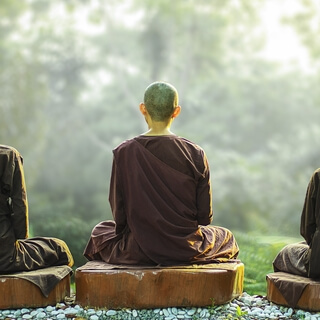
One of them is sitting meditation,
Which I'll talk about today.
But there's many different types such as walking meditation and even there's ones where there's chanting and contemplating a Buddha.
So there's different ways you can do this meditative concentration.
It is not solely just sitting meditation.
Although sitting meditation is a very foundational and historical way to actually do meditative concentration.
And so we'll talk about that today.
One thing before we begin,
This is not something that should make you sick or ill,
Hurt you in any ways,
Cause you discomfort,
Although you may have some discomfort with some new sitting positions.
But beyond that,
Meditation is not about hurting you or making you sick or anything like that.
It is about you being able to tame,
Control,
Discipline the mind so that you can gain insight into the true nature of things just like the Buddha did.
So to do that we have to have meditative concentration among everything else inside a threefold training.
And so when we're doing this,
We're starting off essentially as beginners.
And you can really think about it this way.
Imagine a window that's really dirty and you're seeing shadows and everything out there and you're making assumptions and perceptions about it.
That's our delusion or ignorance of the truth,
Which is on the other side of that window.
Or maybe a really dirty mirror and we can't really see our reflection or see what's really going on.
So we also make perceptions,
Assumptions,
Views about that.
What we're doing with meditation and the entire threefold training is cleaning that mirror or window so we can see clearly insight.
That's what we want to achieve.
Because then we can become awakened to the truth because we see it and become enlightened beings.
As I mentioned earlier,
Blow out the three fires of great anger delusion because as soon as you understand the truth,
You can see it clearly just like you would be able to see out a window and clearly see what's going out there.
You can't be tricked anymore.
You can't be tempted.
You can't do karmic actions that are without flows that are trapping you.
That ends.
You can't go back.
So that's where that's where we want to go.
Now when we're gonna do sitting meditation,
There are a lot of different components to it.
But as beginners what we focus on most is focusing on the breath.
And it's a very straightforward practice that's very difficult to do.
And the reason is we breathe naturally all the time.
Our body does it for us automatically and we have to breathe otherwise,
That'll be the end of us,
Right?
So it occurs naturally and it becomes so repetitive that we don't want to pay attention to it.
Our mind is essentially in control right now.
But it's not our mind.
Dots are arising and we cling and crave to those and try to follow them.
But they're all impermanent.
And so in Buddhist teachings and history the visualizations and teachings we get to illustrate our untamed mind are a few different things such as a wild monkey or ape just swinging around everywhere and throwing things.
It's uncontrolled.
Or I like to say like a bull in a china shop is just going through wherever.
We also see like in Zen we have the ox herding pictures whether it's an ox or a bull.
That's like our untamed mind and there's a whole series of illustrations and teachings regarding that about trying to find your mind.
Which is the really you're seeing the tracks I can see the mind then find it and tame it.
All these different steps.
So it's just not I'm gonna do sitting meditation and one day maybe a week from now I'll be enlightened.
It takes a lot of effort and practice and specifically consistent practice and effort.
I like to compare this to going to the gym.
Almost like if you want to be very healthy or maybe trained for an event or build muscle or anything like that.
You have to go and work out and not just work out but proper technique and form and also right nutrition and everything else and we can really think about that like the threefold training.
So the threefold training is like going to the gym for your Buddhist practice to become enlightened.
So now let's go into how to actually do sitting meditation.
And again,
You're not supposed to be hurt by this or feeling ill.
The best way is to actually find a Buddhist teacher which could be very challenging depending on where you live.
There are also videos online.
A lot of times teachers will actually do online video sessions,
Live sessions.
So those would be great to actually attend.
Where you should actually meditate will vary depending on your circumstances.
You should try to find a spot where you're not going to be interrupted which can be very challenging.
So sometimes you may want to have it early in the morning or late in the evening,
Especially live in a large household.
But find some place where you won't be interrupted,
Where it's not cold.
It's just the right conditions for you.
You should also be wearing some loose-fitting clothing.
So you're not be constrained by your clothing as you're into sitting meditation.
You can use a sitting cushion and there's many different Buddhist ones out there.
Now,
Despite that,
If you don't have an actual meditation cushion,
You're okay.
You can use a pillow.
You could also just sit on a chair and I've seen many Buddhists do that.
You don't have to go into some weird position that you're not ready for to begin meditation.
Next you want to sit on this cushion or this pillow or whatever you have on the forward third of that cushion so that your torso is centered.
So your position is going to be very important because what we're trying to do here is ensure that your body does not distract you from the meditation.
So we're doing a few different things here to get ourselves ready,
Almost like laying a foundation of a building.
If you don't have a good foundation,
That building is going to come down.
So we want to make sure the foundation of ourselves does not distract from what we want to do for our meditation.
We want to make sure that our knees and buttocks are in contact with the floor.
So traditionally your knees will be in one position or another in contact with the floor or your meditation mat.
And then you want to,
As far as your buttocks,
It's going to be on your meditation pillow,
Cushion,
Or even if you're on the chair,
It's going to be in contact with the ground in that particular way.
Next we're going to move to our posture and body.
So one thing you want to do now that you are sitting correctly,
And I didn't really mention these sitting positions because they're going to be very challenging to illustrate in a podcast,
Definitely look at it online.
I'm going to go through them right now.
That being said,
It's best to have a teacher help you with this,
But don't do a position that's going to hurt you.
You want to start off slowly and work your way up as you feel comfortable.
So we have generally a few different types of sitting positions.
I'm going to explain four of them to you.
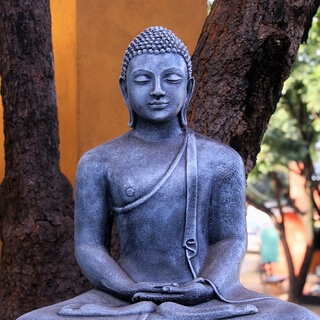
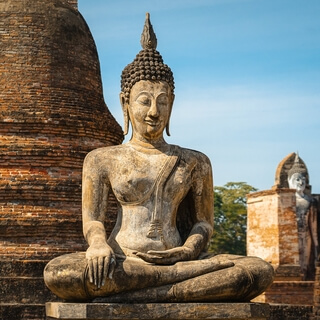
So there's the lotus position,
Which is very traditional.
This is the one where you traditionally see like a statue of the Buddha,
Where he's actually in the lotus position.
Now this is where you place each foot on the opposite thigh.
You make sure that the tip of your toes are in line with the outer edge of your thigh.
So this is a very advanced position,
But it's also a very sturdy and secure position for meditation.
One step down from that,
We have the half lotus position.
Essentially it's the same as the lowest position where we have one foot on our thigh.
In this case,
We're going to have our left foot on our outer thigh,
But we're going to have our right foot on the floor or the mat.
So it's a little bit more relaxed.
And then an even more relaxed version is the Burmese position,
Which might be a one you want to start off with.
This is basically the same as the lotus position.
However,
Both feet and calves remain on the floor or the meditation mat.
And then perhaps my favorite one is going to be a supported position.
So if you're tall or heavy,
This might be the one for you or even just starting out.
Essentially think about it like you're kneeling,
Except you're using your meditation cushion or pillow,
Or there's even actual little benches for this specifically,
Where you're sitting on that and your legs are essentially straddling that particular meditation cushion or mat.
So your knees are on the ground just like you're kneeling.
This is a great easy way to actually do it and you sometimes will see this in Japanese Buddhism as well.
So you have many different variations here,
But if you want to go ahead and just sit on a chair initially,
That's fine as well.
Especially as we get older,
It can be very challenging and difficult to do these types of sitting meditation.
So on a chair is also sitting meditation.
Okay,
Back to our posture and body.
We want to relax every muscle in our body to include our face.
And so you want to go down through your body almost like a scanning meditation.
And as we're observing each part of body,
See for tense and relax it.
And I mentioned the face because a lot of times we don't even consider our face to relax it.
But we got a lot of muscles in our face.
So as you focus on your face and your head,
Relax there as well.
This will help you with your practice.
I mentioned before you want to rest your buttocks as far forward on the cushion without falling off as possible.
So traditionally about a third is gonna be the right position,
But do what feels right to you.
So maybe you need to sit back just a little bit more depending on your body composition.
Yeah,
Go for it.
Next you want to center your spine by swaying and decreasing arcs.
And the way I illustrate this is get like a stack of coins or quarters and it's almost like your spine.
Now put your fingers around it and kind of move it all around.
And as you move it more on either side,
You can see how unstable it becomes.
So that's a great thing we're doing here.
Just imagine you're moving your fingers around and decreasing arcs till your spine or in this case a stack of quarters or coins is straight.
That's a good way to illustrate that.
Next you want to slightly tuck in your chin at a 45 degree angle.
So I'm gonna talk more about this as we continue,
But in this location that you have you might have it set up specifically for meditation.
Maybe there is going to be a Buddhist altar or table in front of you and maybe you have a picture or a statue of the Buddha.
Maybe you got some incense or something or a candle.
Something that you're gonna focus your gaze on.
I'll talk more about that at the end.
But what you're doing here,
You're not looking straight ahead or straight down.
You're kind of at a 45 degree angle looking with your head and your eyes.
So this is gonna also play a part into what you have in front of you.
Which might be as I mentioned a candle,
Incense,
Or maybe a statue of the Buddha.
Next we want to focus on our hands and eyes.
So as you see we're slowly going down and building this foundation for our sitting meditation.
We want to place our hands comfortably in our lap or on the upper foot.
So the right hand is gonna rest on the bottom of the left hand which is on top.
Now your palms are upward,
Fingers overlapped,
And your thumbs are barely touching.
This is going to be a very basic way to have your hands in your lap as we do sitting meditation.
Your eyes,
Remember how we're having our 45 degree of our chin just tucked in that way.
Your eyes are open and unfocused about three feet in front of you.
Or they can be closed.
I definitely recommend keeping your eyes open or slightly open.
Especially if you're beginning,
If you close your eyes it's gonna be very easy for you to essentially fall asleep or doze off.
And you don't want to have a very dark environment or a very light environment.
You want to have something where it's not gonna make you sleepy.
Because the purpose of meditation is not for you to have a restful night's sleep or to relax.
We're doing this as part of our practice because we want to end delusion in our lives.
We want to transcend that so we can discover the truth.
So it's very much like doing push-ups for the mind.
We are going to the gym right now.
Next we want to move into breathing.
So a very traditional practice is focusing on the breath.
Now when you're focusing on the breath this is going to be where we're trying to calm down that wild mind that we have of ours.
Because otherwise we're gonna focus on whatever it just decides to pop up.
And our mind is excellent at this.
Our mind is excellent at controlling us.
For example,
Maybe somebody says something to you or there's something just essentially on your mind,
So to speak.
And your mind knows this and so it doesn't like that you're working on controlling it and taming it.
Because remember you're in charge,
Not your mind.
But your mind is deciding to be in charge right now because you're not controlling it.
You're not taming it.
You're not disciplining it.
So it's doing whatever it wants to do and it does not like what you're doing right now.
So as we're in sitting meditation things will arise in your mind and I'll talk about this in a minute.
But what we're doing with focusing on the breath is a very time-honored way,
Very central and historical and core way,
That we try to settle the mind.
And when we're settling the mind we're settling the mind from all these random thoughts.
So that we can progress on to insight into the true nature of things.
But for a lot of us who are new we're going to be focusing on breath meditation for a while,
Maybe even years.
And this is not something to be discouraged about.
As you're working on this you're going to get more disciplined,
More stronger,
More efficient at this meditation.
Even though it may be seeming to you very basic,
It's going to come into play in many aspects of your life.
Which is essentially what Buddhism is all about.
It's about our lives and how we interact with it.
So being able to focus on this and work towards it is going to be challenging at first.
Your mind is going to try to discourage you from doing it.
And even tell you things like,
Oh this is such a waste of time,
Or you could be out doing this right now,
Or doing that.
And you might go,
Your right mind,
I'll go and do that.
And guess who won?
Your mind.
So focusing on the breaths is a great way to do this.
You want to place the tongue against the roof of your mouth and breathe through your nose.
And for more visualization just imagine the inside of your nostrils.
Like focus there.
It sounds very strange but as you're breathing in and breathing out through the nose,
That's where all the air is coming in and out.
So give your mind something to focus on.
In this case it will be the inside of your nostrils.
And so you're really aware of the breath,
The breathing in and out of your nose.
That's a good way.
Because remember we're essentially trying to distract our mind from controlling ourselves.
I kind of relate it sometimes to if you have a cat or a dog and you have like that laser pointer out.
And whatever else was going on now they're just focused on it.
They might be great on meditation this way.
So they're focused on that laser pointer.
That's what we're doing to our mind.
Just imagine your mind is a cat or a dog who's been just going crazy and bugging you and everything.
Get the laser pointer out,
It switches and you focus on it.
Focus on the inside of your nostrils and the breath going in and out.
So as we focus on the breath we are aware when we breathe in and we are aware when we breathe out.
And that sounds super simple.
But what we're going to do here,
We're going to count to 10 with each inhalation and exhalation is one count.
So this is a way to keep track of where you're at and then you recycle back to one.
So you're continuing on breathing in,
Breathing out.
It doesn't matter if your breath is irregular or uneven or it's not how you think it should be.
Because you're going to be focusing on your breath and that may also allow your mind to go,
Wait you're not breathing right.
Wait is that too shallow?
Is that too deep?
Too fast?
And so your mind is going to help you defeat the entire meditation purpose.
So that's to be expected.
You're not trying to pass judgment on what's going on here.
You're just observing and focusing on the breath.
Because this eventually as we do this more and more and more will help you calm the mind.
And this is all practice.
So obviously we're focusing on this breath.
But as we get more disciplined in this it's going to spill over into everything else in your Buddhist practice that you need.
Now we now go on to our last part,
The focus.
So as I mentioned random thoughts will occur.
You're going to have to expect this.
Do not beat yourself up or feel like you failed your meditation session.
Because so many thoughts came up and you just can continue.
Just recognize that and try again tomorrow.
These thoughts they will come up but also know they're going to fade away.
So even our thoughts are impermanent but it doesn't feel like it in the moment.
We want to cling and crave to them.
So when the thoughts occur let them drift away.
Don't analyze or pass judgment on those thoughts.
Let them arise if they come up and then just let them float off.
Just focus on the breath.
Your practice here is to settle and train the mind so eventually insight can occur.
And we can only do that when the mind stops fighting us.
And that's what we're trying to do.
Now as you are meditating and let's say you're using the lotus position or one of these other sitting positions.
They can be very taxing on your circulatory system.
So your circulation may not be great down there.
You could put a towel or a blanket over the lower portion of your body especially your knees and your legs.
To keep them a little bit warmer.
But as we end our meditation session you don't want to just jump up.
And do whatever you want to do.
Use that time to reflect on why we are meditating.
Understand that the Buddha did this.
A line of followers can use them as inspiration.
But let's focus on the end goal.
We want to end suffering in our lives.
We want to free ourselves from the cycle of rebirth.
That's generated by the three fires of greed,
Anger,
And delusion.
This is all unwholesome stuff.
We don't want it.
And so we're trying to find our true nature which is already inside us.
We already have this Buddha nature inside us.
We already have nirvana inside us.
We just need to realize.
We need to clean that dirty window.
And you know what?
Your window might be a lot dirtier than somebody else's.
You just have to work on cleaning it.
You got to start where you're at.
So focus on that maybe for a minute or two.
Or a few minutes before you actually get up.
And meditation,
Sitting meditation,
Is part of your overall Buddhist practice.
You may have other things before this and also after that you're going to do.
But you don't want to just get up and do whatever.
Use this time constructively as part of your Buddhist practice.
And then you want to rub your legs,
Rub your arms,
Your body.
Slowly stretch and get yourself where you can actually get up in a nice healthy way.
This is just very basic way to do your sitting meditation.
But I hope you learned that.
It's one part of the complete Buddhist practice but it's not the only part.
And consistency here is what's important.
So if it's going to be five or ten minutes,
So be it.
As long as you're consistent.
Don't go to extremes.
For example,
I'm going to meditate for 10 hours today.
You don't have to do that.
You want to go ahead and do it so you're consistent.
Now some things you actually can do.
You can go to for example Buddhist temple or group.
They may have an actual variety of meditation retreats that you could actually go to.
This is a wonderful way to actually do it.
So obviously just listening to a podcast and trying to do this can be very challenging.
Getting that teacher however that can be and we have a variety of ways especially online.
But if you can eventually get to an actual temple or a group that's having a retreat or even a class.
This will be great because now you have somebody watching you and seeing you and can give you some direct feedback.
So that you're doing things correctly and also give you some other guidance.
Do you have any questions about Buddhist meditation?
I'd like to hear back from you.
You can send me a message from my website alanpedo.
Com.
I look forward to talking with you in our next episode.
Thank you.