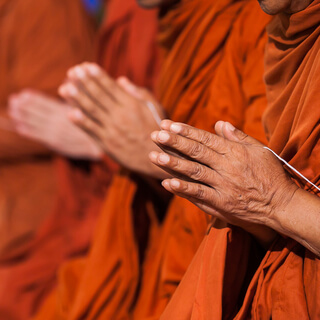
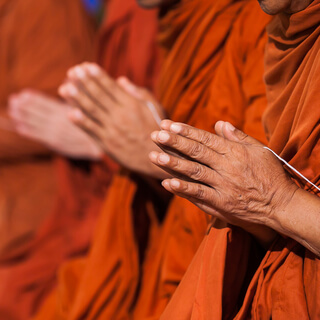
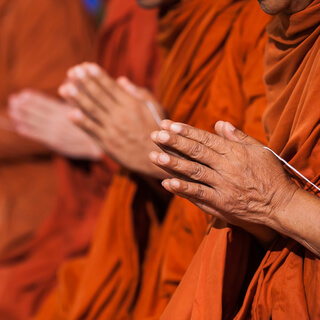
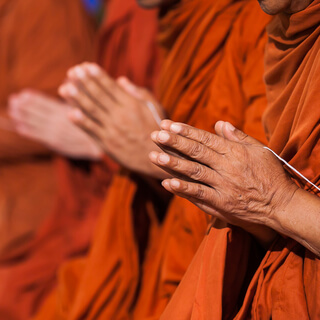
Beginning of a new day.
This is a time span just like an inhalation and an exhalation,
A daytime span in which to resolve to be mindful,
Observe,
Alert,
Pay attention during this time.
We're learning in puja reflections on the Buddha,
Dhamma,
Sangha.
We're composing ourselves as a group.
We corporate body many people together doing one thing like chanting,
Composing our bodies and minds in one posture,
One way.
The group,
The group meditation.
Then the reflections on Buddha,
Dhamma,
Sangha,
Just to keep reminding ourselves what these really are.
Yesterday I described what the qualities of the Buddha,
As the Bhagavan,
Arahant,
The Samma,
Sambuddha,
Reflecting that this is something within each one of us,
Is not an entity outside or a historical event in time,
But that very knowing alertness of being,
Being aware that all that arises,
Passes away,
And is not self.
So the meditation is a practice of being,
Being attentive in the moment,
Not believing the thoughts and memories,
Doubts and worries that cross the mind.
Aware,
Not annihilating them or rejecting,
Not being caught up into them as my problem,
As me and mine.
This is the function of the Buddha,
The knowing.
Just that knowing is enough.
The Buddha is the personification of wisdom.
When we use the word Buddha rather than say,
My wisdom,
My wisdom is,
I have this wisdom of knowing,
We call it Buddha as a way of dispersing the tendency to claim wisdom as me and mine,
Because in the ultimate truth,
Wisdom is not a,
Doesn't belong to a being or a person,
An individual.
Then in the reflections of the Dharma,
Santitiko akaliko ehipasikopanayikopajitang vetidapo vinuhi.
We chant this every morning.
Now the Dharma has no personality,
It's not personified in any way.
You can't say Dharma is male or female.
Dharma wasn't born through a woman.
Dharma wasn't conceived in any particular time.
Dharma is not a historical sage.
Dharma has no form.
The Dharma remains the formless,
The unformed,
At which we can't perceive through senses.
Buddha makes no attempt to personify it.
Personifications are done through Buddha and Sangha,
But the Dharma remains impersonal.
But they use the descriptions of Dharma,
Not as in anything like saying it's red or blue,
Wonderful and miserable,
But in terms like Santitiko here and now,
Imminent.
At this moment Dharma is not something that's separate in time or in space.
Akaliko is timeless.
Kala is time and akala is not bound by time,
Not a time-bound condition.
This is what they call the Kali-yuka in the Hindu tradition.
The Kali-yuk.
The yuka is a period of time.
Kali always represents in the Hinduism a blackness,
Dark age.
Or the attachment to the time.
Look how much of our society is attached to time,
To clocks and schedules.
The Hindu goddess Kali is a Hinduism.
I have this voracious goddess,
Mother Kali,
That she gives birth and then she consumes what she gives birth to.
And that's time,
Isn't it?
Time consumes what it gives birth to.
Anything born in time is destroyed by time.
But the Dharma is akala.
It's not that way,
It's not time-bound.
Ehipatikon is a term for come and see here and now.
Don't wait for the future to do it.
It's not something that you'll find at some future time,
Thinking that the Dharma,
Well tomorrow I'll try to find the Dharma.
I'll turn towards the Dharma tomorrow.
Today I don't have the time.
Ehipatikon,
Even a sense of urgency,
Of come,
A kind of command even.
In fact you have to go to it.
You have to make that effort of turning toward it rather than waiting for it to come and tap you on the shoulder and say,
Here I am,
I am the Dharma.
This like in Christianity,
They knock on the door and the door will be opened.
This is a kind of ehipatikon.
You have to make that effort yourself.
You have to turn toward it.
You have to be alert and really aspire toward the Dharma.
And then opanaiko,
Moving inward,
Inclining inward,
Not seeking Dharma as something out there.
Worshipping Dharma is something in outer space,
Up in the sky,
Something separate.
But inclining inward,
Be attentive to the conditions of your own mind and seeing that the nibbana is in the mind.
It's not something that you will find by looking outward and trying to find it as an object of sense or thought.
And then vajjatanga vaitidhaprovinuhi is only known through direct experience.
You cannot,
No one else can give you the Dharma,
Not even Gautama the Buddha,
Mahasi Sayadaw,
Adancha,
Any teacher,
Any other being cannot say,
Here is the Dharma.
Then you say,
Oh yes,
This is it.
Means you have to put forth the effort in your own life,
Be alert and attentive and then you will know through direct experience just like the taste of honey.
You only know its taste,
Its flavor when you actually taste it yourself.
My tasting honey doesn't really help you to understand what it is.
You don't know the flavor of it.
I might be able to write brilliant poetry about honey and give you a chemical formula,
But you still won't know what its flavor is until you taste it.
The same with the Dharma,
The tasting of the Dharma that we are doing in meditation.
Now this,
If you notice when we chant these qualities or characteristics of Dharma,
You don't really know anything about it other than you have to be alert and mindful.
You can't conceive anything that's akalika,
Can you?
What can you say?
It's not bound by time,
It's timeless.
What do we mean by time?
What could be outside of time?
Try to think of something outside of time and our thoughts are time bound conditions themselves.
Obviously thought is not the way to think the Dharma,
Is it?
We could try to write poetry about the Dharma and say write ecstatic poetry.
Oh the wonders of the Dharma,
The joy,
The bliss,
The perfect peace.
It's the supremest and the ultimateest.
You could use most superlative forms of all adjectives.
The Tibetan tradition are very good at that.
Tibetan tradition always is applying superlatives to the ordinary.
But the Chinese,
The Suttas all have these kind of supernames.
As if we get closer to the Dharma by describing it with superlatives.
And yet in the Zen tradition sometimes they bring it down to just ordinariness like gathering firewood and drawing water from a well.
So obviously language itself,
Any language,
English or any other language is not the vehicle for understanding the Dharma.
Something we have to turn towards in our way,
In our direct turning.
An alertness,
An attentiveness,
A humility of giving up our own personal interests and desires,
Inclinations and habits to open,
To be open rather than to try to condition ourselves into beings becoming something else.
So that sometimes people consider religious experience a kind of conditioning process where you kind of make yourself into a saint through being very moral and thinking very high thoughts and doing good action.
But even though we might do all these things,
And they are certainly good to do that,
If we do not really open and let go of our desires and our views and opinions,
And even to let go of goodness itself,
Saintliness itself,
Then we will never know the Dharma.
We might know about it,
And heard of it obviously,
But knowing is something,
Direct experience,
It is not a knowing about.
Like one can know about somebody,
We know about certain people,
We have heard about them,
But we do not know them.
During the meditation when we take refuge in Namo Yisra,
Opening to the ultimate truth,
Not trying to find it or think about it or conceive it or have it,
Or get Ajahn Sermetho's view of the Dharma and then get Venable Sijita's view of the Dharma,
Go around trying to get different people's opinions and views about the Dharma.
Or waiting for some powerful sage to come along and zap you so you can have a Dharma experience.
Or take a drug,
LSD or something like that,
Maybe you can have a real Dharmic,
Cosmic experience.
And you say,
Well what is a Dharmic,
Cosmic experience?
It is where you feel the absolute oneness with the ultimate supreme.
You still don't know what it is.
That is all silly expressions people describe in ecstasy,
Thinking that use of superlatives and exotic words is relating to a real experience in the Dharma.
We need not say what it is.
It is bhajatanga,
It is something we know only through our experience of it.
And that experience is not anything,
It is not really an experience,
It is an insightful way of letting go of self in which there is no longer anything to understand or know,
An emptiness,
A freedom.
There is even the most superlative adjectives,
Exotic expressions,
Only like filigree around the spirit,
You can have nothing more than just function other than ornamentation.
Now what this does is putting the mind into a state of,
Instead of reaching out and trying to find something,
We have to learn to be very,
Very patient and wait,
Just wait,
Learn to sit,
Stand,
Walk,
Lie down,
Just waiting patiently,
Listening silently.
Nothing to do,
Nothing,
You don't have to go and look for it.
If you sit here and you think,
Where is it?
You start trying to find something,
It would be like chasing shadows.
So in practice we take the attitude of just the gentle opening,
Silent listening,
Waiting patiently,
Humbly.
And that's enough,
That posture of just silent waiting.
Noting any expectations,
Hopes,
Aspirations,
Noting these but not being caught up into them,
Not believing them.
But say for this day,
Today,
Being able to just sit,
Stand,
Walk,
Lie down,
Work,
Waiting,
Silently listening,
Watching,
Being alert from one moment to the next.
Now thinking,
Well first I have to do this,
And after the mind is quiet,
Then I will do that.
Then I have to make it into some kind of exercise.
First I have to do my yoga practice,
Get my body into proper condition,
Then I'll do the panayama,
Then get all the chakras going,
And then from that into the panopana sati to get the calm,
And then the letting go,
And just the kind of bare awareness practice.
So something that's very simple and undemanding becomes a whole system of mental,
Physical exercises,
Views and opinions,
Various assortments of clinging,
Attachments,
Hopes,
Expectations,
All kinds of mental conditions arise and we aren't even aware of it,
We just believe.
First I've got to do this,
And then I've got to do that.
So patient waiting and listening means we listen to this,
We're not there,
You shouldn't even think that you shouldn't think that,
Don't even think that.
But be aware of the thinking process,
Of the kind of habitual tendencies of your mind,
The obsessions,
Fears,
Doubts and worries,
Listening to them as changing conditions.
Like in this kind of practice,
We're not concerned with the quality of the conditions anymore.
So it's like counting the sand grains on the Ganges River,
As they say.
If you saw me on the Ganges River counting each sand grain,
Picking up one and thinking,
Oh look at this beauty,
Isn't it lovely,
Its color,
Its shape,
It's so gorgeous.
I go into ecstasy and then I get to the next sand grain and think,
Oh what a disgusting ugly sand grain this one is.
And I go on to the next one,
This one is alright,
It's neither very beautiful nor is it ugly,
It doesn't really disgust me.
I go on like that,
How many eons of time would it take to count all the sand grains in the Ganges River?
You just get too lost looking at each sand grain and admiring it or analyzing it,
Reacting to its beauty or its ugliness.
But all we have to know is that the sand grainness of sand grains,
We don't have to know that is there a particular color pattern,
Just knowing that all sand grains are just that.
Therefore we don't have to bother to count them all,
We don't have to go one,
Two,
Three,
We don't have to analyze them.
We're just looking at that which is common,
That characteristic which is common to all sand grains.
The Ganges River is at their sand grain.
The same with condition of the five khandhas,
The body and mind,
They're all just conditions.
Some are beautiful conditions,
Some are ugly,
Some are neither beautiful nor ugly,
But they're all just conditions.
We're no longer trying to analyze each condition,
Figure it out,
Where did it come from,
Become entranced by its beauty or repelled by its beauty.
We're just looking at the condition,
Conditionness of condition.
Sankaras as they say in Pali.
And noting that the characteristic of all conditions is change in nitya,
Duka,
And khandha.
So that we're not spending our time trying to figure out which conditions we should keep and which conditions we should throw away,
But just patiently listening in watthi,
That any condition that arises passes away and is not self.
This is a different kind of,
Looking things in a different perspective than say the kind of way you've trained your mind before,
Where you become entranced by the qualities of conditions or fascinated or repelled or bored by the quality of the thoughts you have or the memories that move through your mind.
When you're in university training and all the kind of mental training that you've experienced in your life so far,
Been the kind where you become fascinated or repelled,
You're caught up in the quality of the conditions of body and mind,
Of the world around you.
But this practice is no longer concentrating on quality,
But on the characteristic of change.
A condition in this word,
When I use condition,
The English word condition,
It means anything that arises and passes away,
Anything that has that characteristic of change.
And in this the Buddha described the five khandhas or the five aggregates,
Like in this morning we chanted Rupanganitam Vedananitam Sanyanitam Sankaranitam Vijnananganitam.
These five khandhas,
Rupa,
Vedana,
Sanya,
Sankara,
Vijnana,
Are impermanent.
Now all these five aggregates or five categories include everything that we perceive,
Conceive and know through the senses,
The body and all the conditions of the mind.
And we reflect on the impermanence characteristic of these conditions.
And the same with Rupanganitam,
Vedananatam,
Sanyanatam,
Sankaranatam,
Vijnananganatam,
Not self,
Not me,
Not mine.
The body,
The form is not me,
Not mine.
The feelings are not me,
Not mine.
The memories and perceptions of the mind are not me,
Not mine.
Conceptions,
Thoughts are not me,
Not mine.
And Vijnana,
Consciousness is not me,
Not mine.
Then we chant Svapayi Sankara Nitya.
All conditions,
All compounded conditions are impermanent.
Svapayi Tamanatati.
All dharmas are not self.
So in this Svapayi Tamanatati is a way of letting go of claiming even the ultimate realization as a personal attainment.
In other words,
Practice is a constant silent listening,
Alertness,
Attentiveness in the moment.
It's not something that you'll get an insight and suddenly you claim,
Oh I'm an enlightened being.
I have attained nibbana.
That kind of thought itself is just another condition,
Changing.
Just the patient knowing that even thoughts of that nature are impermanent and not self,
Not to believe even or grasp any kind of ecstatic experience or even grasp any kind of insight.
This is another problem with meditators is that they grasp their insights.
You do begin to have insight into the truths and then you start grasping it.
Because through memory you remember some brilliant moment,
Some great insight,
Some realization and then your desire is to claim it as me and mine.
I have insight and I saw this,
I understood at that time.
I felt the absolute oneness of the ultimate truths.
Remember that.
But that's only a memory,
Isn't it?
The point is not in remembering insight,
But living insightfully in this moment,
The next moment,
The next moment,
Being alert,
Into the moment of Promise to you.