In the morning,
Pudya,
It's time to reflect on the Buddha and Hammasvanga,
The three refuges of the Buddhists.
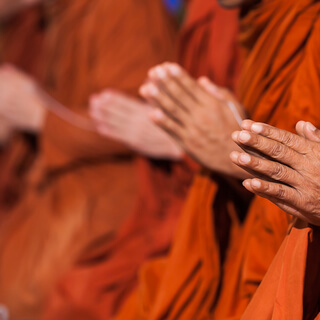
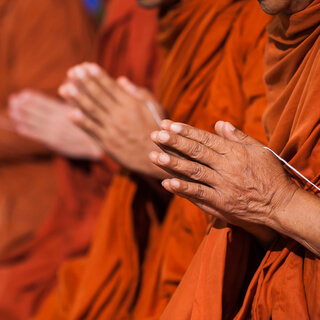
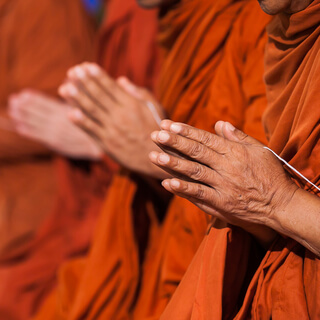
Their traditional introduction of offering candles,
Incense and flowers is offerings made at a Buddhist shrine in any Buddhist temple,
At least in Theravadaan countries.
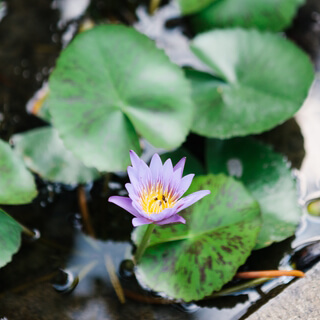
Flowers always represent only a symbol for a sila or morality.
You notice on Buddha images that Buddha is always sitting on,
Ah,
Sometimes lotus petals,
Which means symbolically a foundation of moral purity.
And then the incense,
Symbolic of samadhi,
Or the kind of balance of emotions and the equanimous heart in which the fire of wisdom is supported,
So that the candles represent symbolically wisdom or light.
Then the offering of these is an act of giving,
These three kinds of things that most anyone can afford to offer at some time or another.
Then they reflect on the qualities of the Buddha,
Characteristics of the Buddha.
And of course these are like the arahant,
The perfected one,
The bhagavan,
The perfect one,
The the perfect one,
The perfect one,
The perfect one,
The purified one,
The samma,
Sambuddha,
The self-enlightened one.
So these are particular descriptions of purity and perfection,
And samma,
Sambuddha,
Meaning through one's own efforts,
Not depending upon some outside force for enlightenment.
But this Buddha is,
Even though people seem to regard this as the qualities of a sage of the past,
The Gautama the Buddha,
We have to see that all these symbols,
Concepts,
Historical sages included,
All these conventional forms are just pointing at the immediacy at the moment now.
We're not just reciting some historical record qualities of somebody who's dead and worshipping or paying respect to someone who died 2,
500 years ago in India.
We don't even,
Who is never known,
Who seems to be someone remote in time and in place in civilization.
But these very qualities,
These very characteristics of purity,
Perfection and self-knowledge are the,
What we say,
Taking refuge in the Buddha at this moment.
The other,
Vichajrana sampanno,
Means perfect in knowledge and conduct.
Now this means that Buddha's,
There's not any discrepancy between what they say and what they do.
They're not saying one thing and then doing another.
Now this is very common,
Seemingly wise people will give off wise wisdom,
Advice,
And yet they themselves,
Their lives are not vichajrana sampanno,
They're not impeccable in their own lives.
They still,
Their conduct is not up to the standard of what they're saying.
And the quality of lokamitu means the know of the world,
The seer.
Lokamitu is a characteristic of a Buddha.
And as I was saying yesterday,
What is it that Buddhists know that enlightened beings don't know?
Buddhists know that anything that arises passes away.
Now the loka or the world is something that we tend to conceive as,
In very coarse terms probably,
From having taken geography lessons and looked at maps and globes.
So that to us oftentimes the world is a globe or continents,
Oceans,
Mountains,
And so forth.
But is that really the world?
I mean you think about it and you conceive the world as an idea and your mind,
You go out and look at the world,
What do you see?
You see an object of your eye consciousness,
Like this room here.
This is the real solid world here.
I can touch it,
I can hit it.
But that in itself is in the mind,
Isn't it?
That perception of solidity,
That actually touching the form,
The sense of solidity,
Through touch is a perception in the mind.
All your views and opinions about the world as being round and a globe and with continents and so forth,
These have come from the minds of human beings.
In other words,
The world is the mind rather than a lump of earth,
Matter spinning around the sun.
So the Lokawidoo is the knower of the mind rather than a Buddha,
Nothing in the sutras,
In the polycanon where the Buddha even mentioned the United States of America,
Or North America,
Or Australia.
They say he's Lokawidoo.
Didn't even mention China,
Japan.
So the Buddha being the seer or the knower of the world means knowing the mind.
Now the conditions of the mind,
All that is common to the,
Or the characteristic that is common to all those conditions is that they arise and pass away.
Even the sense of solidity,
The ideas of a round,
Of a spherical earth,
Ideas of space and time,
These are in the mind.
They come and go.
So Buddhas know this,
Not deluded by the quality of the conditions of perception,
No longer fascinated nor averse,
But knowing the simple truth that all that arises passes away.
Then the characteristic,
The quality of Anuttarobhuri Sattham Masarathi,
Santhantewa Manusanam,
This is the Buddha is that which is capable of training gods and men.
And in this way of speaking,
Gods and men represent intelligent beings.
In the Buddhist cosmology,
Devas are like highly intelligent beings.
Now they could be,
Or even kings and noble sages were called devas in Pali,
But also it refers to the invisible celestial beings,
Which are virtuous and good and it has intelligence.
And to manusya,
Which are human beings,
Which have the animal form,
The animal senses,
But the intelligence.
Now this human intelligence is,
Or this intelligence of a human being,
Is the ability to reflect on,
To observe,
Like even though your body is an animal's body,
Your body,
We share the animal world,
We share our consciousness very much with animals,
The sensory consciousness.
We can see them,
They can see us,
And we have the same kind of body,
A physical body that experiences pain and pleasure,
Heat and cold,
Just as all animals have this in common.
But the animal world can't reflect on itself at all.
It can't take,
If you teach,
Try to teach a cat about morality,
About not killing anything.
No results yet,
I have this cat,
A chittorist.
I've been teaching morality too now for four years.
Even though she's met great teachers like Mahasi Sayadaw and Ajahn Thar,
Living in with virtuous monks,
Lay people,
They still insist on killing rabbits and mice,
Inability to reflect on.
But a human being can do this.
We can look at these things,
What is right,
What is wrong.
So the Buddha is the trainer of gods and men.
This means that this is Buddha wisdom,
That which knows that all that arises part of the way,
That very knowing wisdom,
Is the way that we're trained to break through the illusions of the human form,
Of even the intelligence,
The human intelligence,
Or the deva intelligence.
Because human beings have the animal form but the intelligence of the gods.
So our particular dilemma in birth as a human being is,
How do we relate the coarse body with the refinement of our consciousness?
Mentally we'd like to soar up into space.
We're trying to do it physically now.
We just can soar up into outer space.
We always want to go up,
Nobody wants to go down.
Going up to heaven,
You never go down to heaven.
You go down to the earth.
Going up to heaven,
You never go down to heaven.
You go down to hell.
Hell is supposed to be under the ground.
And so we have this desire to soar out.
The mental faculty is seeking to be liberated from the coarse physical limitations.
And if you notice how much we resist the body itself,
Its heaviness,
Its limitations,
We really resent.
We don't like to be bound,
Earthbound,
Stuck on the ground with an animal's body.
But this particular problem of human birth also has its advantages.
The fact that the gods or the devas,
They experience so much happiness that they can never really,
Really understand the full meaning of the Four Noble Truths,
Suffering,
Origin,
Cessation and power.
Whereas a human being,
The amount that we experience a goodly amount of suffering,
This physical pain,
Aging,
Physical aging,
Sickness and death of the body,
Discontentment in the mind.
Now because of that,
The Buddha is a teacher of men and he established this teaching of the Four Noble Truths as a way of teaching human beings.
So that those who were willing to say,
Observe,
Wake up,
Be mindful,
Would see the way of liberation,
The path out of the cycle of birth and death.
Now in taking refuge in the Buddha in the morning,
It's a way of remembering this.
We forget all the time.
We have very good memories and we also are very good at forgetting.
And so we get carried away with our enthusiasm or ideas or depressions and doubts.
So we need kind of symbols,
Ceremonies,
Conventional forms in which we can recollect.
And so the beginning of a day like this is a way of recollecting,
Starting at the beginning of a new day.
What happened yesterday is over.
It's only a memory.
The rest of this day is the unknown,
The future.
Here and now it's the early morning and we're sitting here with this opportunity to recollect the Buddha.
Now also the recollection of the Buddha,
We can also reflect on the Gautama the Buddha,
Who was indeed a very wise and admirable being.
Because this sage in India broke through the illusions of the body and mind and then spent the rest of his life establishing a teaching and a tradition which would be carried through a span of time.
Now there's also Buddhas before Gautama who didn't establish their teachings but who were enlightened Buddhas.
And so their teachings never lasted very long.
They were forgotten after the sage himself,
The master,
Died.
There was nothing to carry it on through span of time.
And the Shakyamuni Buddha was noted as the Buddha that established the Four Noble Truths,
Eightfold Paths,
And the Sangha that would be carried through a five thousand year span.
Now that's a pretty clever thing to do actually.
Seeing that it's still going,
It's even more amazing.
I mean,
Imagine someone could say that 2,
500 years ago.
You could say,
Oh this teaching will be carried through five thousand years.
Then at this halfway mark now we are still able to use this particular teaching in a country as remote in time and in place as this one.
And yet the teaching itself is as clear and as precise and as useful to us as it no doubt was to those in India at that time.
Now the Buddhist cosmology,
Buddhist cosmology,
This particular teaching is the way that a human being can,
Say,
Break through the delusions of the sensual world,
Can transcend the conditions of birth and death and attain the Nibbāna or the deathless in this life,
In this moment.
Now this is also a very special kind of teaching because of that,
Because in religious experience usually most religions only take you into the state of purity,
But not liberation.
So that,
And this is what we mean by sambha,
Sambuddha,
Because this means that through putting forth this very effort to see clearly that anything that arises passes away and through that,
Just that kind of understanding,
We are no longer bound by the conditions of the body even though the body is still alive.
It doesn't mean we throw the body away,
But we understand that the body is not self.
We understand that it's a condition in nature that has been born that will get old and die.
And the conditions of the mind that come and go and change,
We realise like emotions,
Thoughts and memories,
Feelings,
All these are just natural conditions changing,
They're not self.
So when you fully comprehend that through insight,
Then there's no more fear,
No more desire.
One no longer attaches or follows desire.
Now because this is a path of knowing rather than believing,
You see the important thing is the practice of it rather than believing anything.
Like in Buddhism we never ask people to believe.
They say,
What do Buddhists believe in?
There's no belief,
There's nothing that one needs to believe in.
It's a direct pointing at the way things are.
Direct pointing means to look and see for yourself.
But I know most of you believe in all kinds of things.
As your comic habits are to always believe or disbelieve things.
Now in this knowing,
What can we know for sure without belief,
Believing in anything,
Without believing anybody's theory,
Without believing any doctrines by wise sages,
By great prophets.
What can you as just an ordinary human being,
Man or woman,
Know without believing?
That's important isn't it?
Have you ever thought about that?
What can be known directly without believing in a theory?
Even a very good theory,
A very wise theory is still a belief if we don't know the reality.
And what we can know without believing is now at this moment the impermanent nature of this sensory consciousness.
Whatever it is,
Whatever you're feeling now,
Whatever mental condition is traversing your mind,
That is a changing condition and is not self.
So this is where the Buddha's path is,
This is what the Buddha was pointing to very directly.
To just know that much is enough.
If you really understand,
If you really know that,
Then there's no more problems in life.
But the knowing is not a believing knowing,
It's not a conceptual understanding either.
You understand the concepts easily enough.
But a constant knowing,
In other words a constant knowing mindfulness,
When at the time in the sutras,
When the sages,
The brahmans and the philosophers of that age would go to the Buddha and ask,
What is your teaching?
You are the Buddha,
The All-Enlightened One,
You must know everything.
And they would ask him about God and does God exist?
Do you believe in an eternal soul?
Do you believe in this or that?
The Buddha would never answer these questions.
He said,
All I teach is suffering,
It's arising,
Passing away and the path,
Transcendent path.
Now that also is a very wise way of teaching.
To not talk about that which is inconceivable.
Not try to conceive the inconceivable or limit the unlimited.
But a direct pointing is a way of seeing now limitations,
The conceived,
That which is arising and passing,
The born,
The originated,
The created.
Now that knowing whatever those conditions are,
Whatever arises,
Passes away no matter how important or how unimportant it is.
That very knowing is enough.
But to be able to know in that way,
You have to let go of our desire to know and our desire to annihilate and get rid of.
We have to learn to be very patient,
Very humble.
Being content with knowing that at this moment whatever is arising,
Whatever arises passes away.
In other words,
Like just sitting here during the day standing or walking,
Your intention for doing it,
Your feelings,
Your attachments,
Your opinions and views,
The most sacred concepts and ideas,
All these things are just conditions arising and passing away.
And as we constantly reflect on this,
In this week a real opportunity to intensely observe this,
Reminding ourselves constantly,
And just say the ordinary daily routine.
Being that Buddha,
Being that very knowing,
Rather than sitting here for hours on end trying to become Buddhas.
A lot of these ideas of modern times are we have to perfect the body,
We have to make this body perfectly healthy,
We have to have this perfect intelligence and emotional balance.
Emphasis on trying to perfect that which is imperfect.
The level of the body and the conditions of the mind,
They are all unsatisfactory in the sense of dukkha.
This is one of the characteristics of existence.
You'll not ever find perfection in any condition of the sensual world because that is not where perfection is.
So spending our lives just trying to perfect an environment or a body or a mentality is really a waste of time,
Only lead to despair.
So knowing is knowing where perfection is,
What it is,
Rather than trying to find perfection in that which is imperfect.
Trying to find the unlimited in the limited,
Trying to find the inconceivable in the conceived,
Trying to find the unborn in the born and the uncreated in the created is futile.
So instead we place our attention on that which is unknowing,
On the knowing now of the created,
The born,
The originated.
And through that observing that what is created is destroyed,
What is born died,
What has an origin will cease.
And in that knowing then there is the liberation from any delusions in regards to any mortal condition whatsoever.
Now the next reflection that we do is in Buddhist countries when we say we offer what is called punya,
Or in the English translation it is a very inspiring word but they usually refer to it as merit or grace or any good results,
Anything that is good,
Beneficial,
Good wishes,
Good thoughts,
Results from our practice,
Any kind of good results we get.
This sharing of punya is a way of opening out,
Of not just practicing meditation here just for our own self,
But also a reminder of any goodness,
Any success that we might achieve or attain or accumulate in our lives to be shared with all sentient beings.
Now this kind of reflection also will allow us to feel more responsible for how we live during the day here when you realize that you are not just some alienated,
Disconnected being that has no effect on the universe.
Many people now they think how I live is nobody else's business because I can do what I want.
In the US where we stress individualism of doing what we want,
Living our lives to perfect ourselves,
To fulfill our desires,
To do what we want to do,
And no matter how it affects anyone else,
Our parents or friends or husband,
Wife,
Society we live in,
We think I want to fulfill myself,
I don't care what happens to you.
But the Buddhist always reflects the fact that our actions,
The way we live,
Has its effect on the universe we live in,
Not only on the immediate beings around us but on the whole universe.
So that if we live a selfish,
Cruel,
Stupid life it adds to the misery of all sentient beings.
If we live a good,
Moral,
Virtuous life it's for the welfare of all sentient beings,
It has its good effect on the universe.
So this sharing of punya is a Buddhist way of praying,
Like for those we know who are ill or unhappy,
Those that are suffering,
A way of praying for those that we don't know who are suffering.
But it's not just a prayer asking for God to help all those who are miserable and unhappy,
But it's an actual offering of our own goodness and merit and grace,
Offering outward to develop that in our daily lives of good action,
Virtuous living as an offering for the welfare of sentient beings.
For those we know,
Such as our parents,
Friends and so forth,
Like in Buddhist countries they'll often times when somebody is ill,
Some mother,
Her child is ill,
She'll come to the temple and offer food to the monks in order to share the merit with her sick child.
That's why I say it's kind of a Buddhist prayer.
But it's more of an active prayer than a passive one of asking for an outside source to do something.
We take that opportunity ourselves to do something kind,
Good,
Generous in the world at that moment,
Offering that for the welfare of that sick person or for all sentient beings.
Now this is an important kind of reflection from Tithurst last year.
We dedicated a whole year,
A whole merit of our life as monks and meditators for the welfare of all sentient beings.
So all of you were included in that.
I hope you noticed the improvement.
Like Master Hua in San Francisco said,
San Francisco won't sink into the ocean as long as he's there.
Hasn't sunk into the ocean yet either.
So at this time,
This attitude of sharing,
When we live a good life and practice the Dharma,
That which is good in the universe accumulates around us.
Grace,
In Christianity they call it grace.
When we open ourselves up to the truth,
Then grace operates through us.
So,
Merit,
That which is good and wise seeks to surround us.
So rather than say,
Developing the attitude of accumulating any of this for oneself,
We always offer it for the welfare of all sentient beings.
So our good actions and our mindful living is a benefit to all sentient beings.
This is a devotional practice obviously.
So we reflect first on the monks.
We always remember our preceptor or the monk that ordained us.
To share any merit,
Any grace from our life with our preceptor,
With our teachers.
For all of you to reflect this moment,
To share the grace,
The goodness,
The good results or the happiness that you get from this with your teachers,
Those who have taught you the Dharma.
And with our parents,
A way of remembering our parents,
Offering this goodness to help or to bring happiness or zenith.
Or liberation to our parents.
In our relatives,
Husband,
Wife,
Brothers,
Sisters,
Children,
Good friends.
All those that we feel positive about or we feel love or some kind of relationship with,
Some kind of positive relationship.
How we can reflect on using their names.
And for the leaders of this country to offer the merit,
The grace from our life,
From our practice,
For their welfare.
Leaders of the country have to make important decisions that affect the lives of many millions of people.
Our own virtuous action in wise living has its effect also on those who have to make those decisions.
Better than what happens in America these days when they try to kill them.
But the Buddhist refrains from that kind of action and offers the merit of his life,
Her life to their welfare.
Whether we agree with their political points of view,
What they're doing is not the point.
We're not here taking political sides.
But just that kind of compassion and love on bias in which we,
Say,
Offer this merit to help them to make the right decisions and do the right thing.
And offering this punya for the welfare of those that we don't like,
Those that we know personally who hurt us,
Humiliated us or caused us pain.
.
.
.
For all those beings who are all animals,
Those animals that we like are pets,
Cats and dogs,
Horses,
All the animals that we like to eat,
Cows and pigs,
Chickens,
All sentient beings,
All animals,
Birds and fish,
Wild and tame,
Insects.
Then for the welfare of all miserable beings that live in the states of constant fear and obsessive desire.
They like those drug addicts,
Alcoholics,
People obsessed with desires of a low kind and have to spend their lives constantly seeking for gratification.
They all those in prison,
In prison camps,
Mental hospitals,
So forth,
Offering this merit for their happiness,
The way of at least remembering,
Reflecting on the suffering of other beings at this time,
At this moment in time.
And then all the malevolent evil forces in the universe,
All those caught in hatred,
Desire to destroy,
To share this merit with them.
So in this practice of sharing of punya,
It's like a Buddhist prayer,
So we're recognizing that we're all in this world together,
From the most ethereal to the most coarse,
Most angelic forms,
The most evil forms.
But how we,
This person here,
How I can live my life,
Has its effect on all these beings.
So when we really understand this,
Then we must,
At least I personally feel more responsible for my own life,
How I must live in this world.