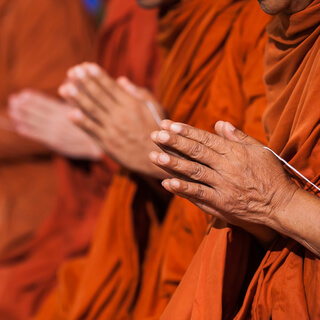
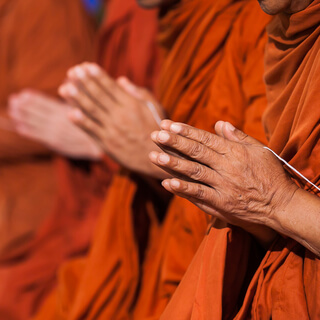
This morning we had another chance for reflection on the Dharma.
And so you've seen during this past week here,
I had a chance to reflect on the,
Say,
The ordinary and the mundane,
All the worldly tamas of greed,
Hatred and delusion,
As well as reflect on the grand kind of visions that have been presented to the mind through the talks.
And so this is important for you to consider how to use the conditions we find ourselves with.
Like yesterday I talked on devotional practice and didn't get really very far into it,
But the practice of metta as a way of learning to be mindful of the unpleasant,
That which we find ugly and repulsive that we experience through the mind,
The senses.
Another practice that is very much a part of the Theravadan tradition is what we call the sharing of merit.
And this is greatly misunderstood by Western people because the idea,
The word merit itself,
Somehow is not a very inspiring word.
We think of girl guides and boy scouts.
But in Thailand or in Buddhist countries,
Merit is something that is greatly sought after and considered something quite worth pursuing,
To do good actions for gaining merit.
Or for what we mean by this,
By doing that which is good in the world.
Not for one thing,
Because if you contemplate it calmly,
You see that to do good you receive good,
To do bad you receive bad,
But also for the welfare of all sentient beings.
So in the act of sharing of merit,
It's a skillful means which Buddhists use in order to let go of the idea of one gaining through meritorious action.
In other words,
One does a good action and any merit or grace or goodness or good result or reward or happiness or joy or anything positive that one receives from this good action is to be shared and given back for the welfare of all sentient beings.
Now this conceptual way of talking is a way of letting go of the idea of accumulating merit for oneself in a selfish way.
The attitude of doing good for the welfare of others rather than for personal gain.
Because the tendency even in Thailand is sometimes to think of that you yourself are accumulating great storehouses of merit by doing this and by even sharing the merit with other beings,
You're somehow gaining more merit by sharing.
Now this is an act of devotion which becomes quite significant in your life when you realize that you personally,
You as an individual,
Your body and your mind has its profound effect on the universe where we tend to think of ourselves as what I do it doesn't matter,
I can do what I want,
It's none of your business and if I do evil things it's my business not your business and I'm and if I'm not hurting you why should you care?
This tendency in the West to be very strongly identified to a sense of being a unique and individual that has no connection with anything else and somehow is outside the whole and so what I do is my own business not yours.
And this has reached in the West I think its peak of selfish development in the recent years to where our identities are so limited to this body and our desires that we have with sometimes a very very insensitive and irresponsible to the people we're living with and the society that we're in and to the world because you think none of your business and we think of our parents,
Our mothers,
Fathers say that's not a very nice thing if you've done something very insensitive and cruel to your mother and father and you say shut up none of your business,
My life,
I can do what I want I'm over 21,
How dare you interfere with my life trying to possess,
Hold on,
Keep the strings and so forth and we think it's my life and I can do what I want with it.
Well I say in a previous time in the West or as many Asian countries now the tendency to identification is tends to be broader rather than so specifically directed towards one's own body like in Thailand,
Thai people tend to identify more with a family unit than with a stronger identity in sense of being a person is very much a part of a family where I can see in my own life I'm speaking from my own experience is that one identity with a family is very little nowadays at least in my life I don't feel any great strong identity with my parents or with a class or with even a nation these things are very weak in my mind they're not very strong and so therefore that identification tends to be very strong with the individual self with me with this body and the abilities and inabilities my strengths and weaknesses which tend to cause an increasing amount of anguish and despair as you grow older you become you feel so isolated and alone and so unable to communicate or understand or have communion with another being because your conditioning is one of which you you tend to cut off and separate and live in your own world which doesn't include anyone else really so in the sharing of merit they we began to understand that what we do how we live has its profound effect on the on the universe we live in now this was quite an awakening for myself because before I had very much of this sense of none of your business I can do what I want and through say meditation and beginning to understand what the universe really is I began to see that I had to be responsible for how I live because not being a mean and nasty and evil person by nature I never have really wanted to be responsible for causing unnecessary misery and suffering to other beings and I could see that if I live foolishly and stupidly and selfishly that this has its effect on the universe on the on the people I live with on the on the society I mean and on the country and on the world so all sentient beings suffer because of my stupidity and selfishness now I reflect on this in the monastery we reflect on this every morning and the attitude of sharing our the merit of our lives living our lives during the day in a way that is trying to be as skillful and as sensitive as possible any our actions to be done not for say our own desire to be enlightened but for the welfare and concern for all sentient beings and people ask me what are you doing for the third world say I share my merit with with all beings in the third world second first making no preferences and when we think if we reflect that if we live foolishly and stupidly we're adding that much more momentum and power to all it is heedless and stupid and foolish in the world and there's already so much of that anyway we don't need to feel obligated to add to that what is there seems to be a lack particularly now is concentrated effort in doing good and living mindfully there and then the merit any merit to be shared to do this not for one's own sake but for the welfare of all sentient beings then in the practice of sharing of merit we we reflect on it's like a Buddhist way of praying for somebody like somebody's ill Christians will come and they'll say my my wife has cancer and she she's not expected to live much longer do you Buddhist pray and I know yes we do and will you pray for my wife so I read we we say in our morning chanting in there the merit of our lives any grace or goodness that we might gain is to be shared or good actions done particularly for say and the merit of that good action to be shared with that particular person who's ill so in Buddhist countries like people will come and they'll say we'll give a donner they'll give food to the monks and I say with the can this merit be shared with so and so who's ill or with some with parents who have departed or whoever one wants to share it with so you particularly say specify the name of that person and then add and all sentient beings so that even though you're you're this particular face food might be offered for the welfare of and in growth in enlightenment of one's mother it's not only for one's mother but for all sentient beings so this is this is the Buddhist way of developing the devotional side of religious practice it's an expanding of the heart in in this way to include all without preference without distinction from the finest they to the to ones say them the month they to the upper child the preceptor that ordained us to all the teachers who have taught us to parents and husband wife brothers sisters are good friends the king and queen the rulers of the country we we share our merit every day to hers with the prime minister the members of Parliament with with all say all the animal realms all the animal world and all those in various stages of anguish and despair such as criminals and and people locked away in mental institutions all those who are sick and weak or drug addicts and so forth down to the most malevolent and brutal beings that exist in the world the merit offered equally to all sentient beings and this way you you you began to include within your heart in a very conscious way all possibilities of existence of sentient beings that could possibly exist from the highest like the day bar kind of ethereal refined beings to the courses in most evil and all gradations in between now this act of devotion is is is a way of developing the heart you say it's not that it's not to be a rational sensible kind of thing in which you have to be guaranteed that you get so much food you'll get so much so much of a reward or to see vivid evidence that your meritorious life has really had its profound effect on the third world or that you know ordering merit every day for criminals and prisons and rather drug addicts is really solving their problems this is not a rational kind of thing where you're you're weighing on a scale the amount of goodness you're doing by the effects that you can see with the eye or hear with the ear it's an act of faith and so this devotion is is faith is and faith is action in the world it's how we live and relate within the human form to the other human or sentient beings that surround us and that we are part of and this is what we mean by devotion now we find within Buddhism itself and in Britain a sense of not understanding the value of devotional practice because it's connected with kind of blind faith you know kind of smarmy sweet sentiments that seem that only foolish people tend to to reiterate and if we consider ourselves one who doesn't fall for all those silly kind of sentimental things we tend to feel an aversion arising in our mind toward devotional practices like bowing or lighting of candles and incense chanting offering of merit spreading meta and all this kind of thing we can we can all lump together and say superstition or foolishness I want the pure teaching of the Dharma the Four Noble Truth the Eightfold Path and give me a practical kind of meditation practice that makes sense and that I can accept and then I'll do it but I don't want any of that other stuff now in practice of meditation you you say they're like the compassion and joy now these arise are developed in one's life as we tend to say learn to give out rather than to take so many so much of the time your people they what did you get out of that meditation retreat when you heard his talk did you get anything from it did you went to this Buddhist Center somewhere did you what did you get out of it this sense of what what are we getting from all this what this Buddhist society summer school what are we getting out of it this is this is the attitude is the attitude of one who still does not understand karma or rebirth and who still goes at things with the idea of getting something and so when we change that to say giving rather than then taking like when we went when we come here to the Buddhist Society summer school what are we giving to it can we give anything can what how can we help it how can we give to it rather than what am I getting out of it you see now this now this attitude of giving is takes a lot of humility and patience and yet this very attitude is the attitude which is the path to enlightenment what what can I give how can I help and if we can just give ourselves to the summer school to to be one who's content with with the things as they are rather than then complaining about this or that reflecting on what's being said without demanding that that things be said that we agree with but being able to to accept even that those things that Bacchus or that we don't agree with with a patient patience and humility being grateful for the things offered for the talks given rather than being critical and saying no I didn't like that no I don't agree with that attitude of feeling gratitude for people who have taken the time to come in and offer some kind of experience or knowledge or information or help that they have have experience or that they can give us then we accept with gratitude say thank you very much whether we agree or not whether it's been absolutely fantastic or very minimal we don't care anymore we're not concerned about the amounts or how much we get and if we get just a little bit or even if nothing we'll be grateful for that because then you're approaching more what was talked about last evening so this is a compassion and joy Karuna Modita and who pay car void it discussed meta meta is who pay car is the equanimity and this is being able to remain balanced in one self no matter what life presents to us in other words if we lacking in a pay car in our lives we tend to be carried away all the time by the qualities we're experiencing through the senses if you have no pay card or somebody says to you you're absolutely wonderful you're divine and you jump for joy who ran you get very high that's a really wonderfully sensitive person then someone else comes along and says you're so stupid in discussing and you become terribly depressed you want to kill yourself or kill the person and this is a lack genuine lack of equanimity in other words what other people say has seems to overwhelm you if it's positive and good you're very happy if it's insulting and unpleasant you'll become depressed same applies to say good fortune and bad fortune you inherit a million pounds you jump for joy and you lose a million pounds and you start thinking of ways of killing yourself no who pay car no no equanimity you succeed or you fail you become a great worldly success the claim the greatest human being since since somebody and you feel joyful and happy and wonderful and then you're humiliated and despised by the world and you feel depressed no who pay car no equanimity there in developing equanimity it's in seeing the equal value of both praise and blame success and very good fortune and bad fortune these happiness and suffering by seeing that both praise and blame they come and they go they change one feels good one doesn't but you begin to see that it's not sale you begin to say examine the the reactions you have the impulses you have in your own mind like in your lives your daily lives if you start looking at your own mind rather than trying to say transform yourself into the ideal or feeling that you more or less have been given a bad kind of deal in life and you have to more or less just live in a miserable state of what you think you are you begin to penetrate the very feelings of happiness and suffering success and failure good fortune and bad fortune praise and blame you see that even depression even though it has an eternal appearance of eternality is only a moment in time same with happiness in the meditation wisdom arises through this kind of investigation which is not a judgmental investigation such as analyzing the conditions by saying one kind of happiness is better than another or you're not trying to figure yourselves out according to theories that you have about what you should be or shouldn't be but you just observe be content with the moment as it is meaning whatever it is you're aware of it as as it is and see how long it lasts be one who has courage to investigate things even the most unpleasant and painful situations are filled with every possibility for enlightenment if you if you make the effort to do so so in wisdom you see wisdom is is where there is no thing and in compassion we have compassion for everything so in these two seemingly opposed things where everything and nothing we find our balance because we're not making preferences anymore we're not seeking annihilation or an idea of emptiness as a place that we should be identified with nor are we seeking our identity among all the myriad manifestations that we experience through the mind but we begin to be at peace with the arising and passing of conditions and with the emptiness in other words there's no attachment to either extreme no effort to identify with greed hatred and delusion nor with no greed hatred and delusion in this practice of meditation the Buddha was I think people it's very hard for for Western people to realize that the Buddha was not in any way philosophizing about the nature of existence or theorizing or creating any doctrines about the nature of things but pointing away only that is very practical it's not a denial nor an affirmation but a pointer and so therefore when we talk about the Four Noble Truths the Eightfold Path three characteristics of existence so what we're not saying to be a Buddhist you have to believe in anata or you have to believe in karma and rebirth or you have to believe in the Buddha it's not a matter of belief at all it's not saying to believe or disbelieve but to find out to through your own direct experience of it in the Theravada tradition the it's a very simple kind of Buddhist teaching it nothing much is taught other than then the Four Noble Truths and the Eightfold Path and then people tend to criticize Theravadans for because they have these ideas about there's something more than that and so that you start thinking well you know you you want something like one would like to read Shakespeare rather than start learning the ABCs if you think of it there's Hamlet and Macbeth and that's much more interesting than then ABCDESG but you can't very well start out unless you have incredible bar meters from previous lives reading Hamlet we have to start out with a simple ABCD now once you learn the basic skills what you do with them is up to you isn't it once you learn how to read this is a book I am a man you can find out you can begin to read more complicated literature than that but that's up to you what how much how far you want to go what you want to do in there let's say in in teaching meditation it's just a way of teaching basic skills developing some skill in a way of seeing things clearly and then the rest becomes quite clear about the shunyata or things about me that becomes quite obviously real if you if you already have penetrated the fact that the things that we think you'll see experience through the senses are not cells are just the impermanent conditions arising in party all that begins and all that arises part of the way and as I said once before in the in the very first sutta of the samajaka sutta that the Buddha gave in in the deer park in Benares to the five disciples was just this basic exposition of the four noble truths in the eightfold path then the end of it the the the disciple condania understands and the Buddha prays to him he says oh condania understand he's he's though he knows and yeah condania and what does condania understand all that arises part of the way that this is why in our practice rather than trying to have the godlike vision from the heavenly realm the celestial view and understand everything in all its complexity we content ourselves with understanding the mundane the ordinary and penetrating the ordinary just like the breath the inhalation the exhalation just walking sitting standing lying down just the most ordinary conditions of our daily lives there's the dharma the profound dharma in all these actions that we experience in in our lives to be enlightened with if you're trying to seek to understand on the ground on the ground view because that's not the lesson we're to that's not our that's not what we need to do in this lifetime as human beings because we can only understand the ground understanding the most humble the most ordinary that's why meditation is always here and now with whatever is as it is no matter what its quality might be high or low good or bad and the act of giving out rather than of getting how much can we give let's make our lives one of giving rather than of taking because in this outward giving in that very motion of going out like this is an act of openness like your body is opening up isn't it where get grasping or taking this is closing off shutting ourselves off the act of giving this like opening the palm giving out is it physically it's even an opening out to others doctor could you tell me is it possible to say a little more about the cultivation of Upekkha like like the in the bar me in the Theravada school and they're 10 bar mitas the last two listed are metta and upekha and those are also the the first and the last of the problem of the heart if you've noticed the two Karuna and Mudita are not considered bar mitas these bar mitas are perfections that one develops and therefore Karuna Mudita tend to arise quite spontaneously when when there is mindfulness when there is when the when the other bar mitas have been established in one's life now upekha is is people tend to translate that as kind of indifference or or equanimity sometimes they'll they'll use the word indifference which means not being concerned with anything and many people feel upekha is just kind of shutting oneself off and saying and as you see some maniac comes into this room and starts slashing away at everybody I just say in permanent condition not so I'd be some kind of monster myself wouldn't I not being totally indifferent to what's going on but the the upekha is is that in in our cell is a way of not being overwhelmed by the qualities of success or failure good fortune or bad fortune happiness or suffering praise or blame that we experience now that doesn't mean we're indifferent in the sense of insensitive to praise and blame you're not you're not just say repressing any any kind of feeling that arises and saying oh I shouldn't feel happy if I'm praised and I shouldn't feel depressed if I'm criticized it's not that because then you one tends to repress and and ignore or look away from but by upekha means to maintain a cool calm centeredness or praise and blame so that we can be aware of the habits we already have like it's natural and I personally from speaking from my own knowledge of my own character is that when somebody says you're absolutely wonderful I like that when somebody says you're rotten and disgusting I don't like to hear that either now it's not that I should like to hear the truth the true facts of existence that I'm rotten and disgusting and that I should despise hearing the untrue fact that I'm absolutely wonderful is not not playing games with your mind at all that but if awareness of the feelings of liking and disliking that arise and knowing them just as they are knowing feeling is feeling and in that you become equanimous with it you can accept praise and listen to blame without repression or indulgence there because sometimes in praise there's a lot of truth sometimes we are absolutely wonderful all of it and at other times we're absolutely rotten and sometimes people are just being nasty they're just saying you're absolutely rotten because they're angry with you and they want to hurt you and sometimes people are being obsequious trying to get something from us by saying you're absolutely wonderful but we can listen you know and in that awareness is the ability to respond appropriately because we've not been we're not blaming others we're not reacting to what's being said in a foolish and heedless way so in Ajahn Chah he was always his one of his great points of stress stressing in teaching when he was in England last year was see all conditions of equal value success or failure now say like like we all like to feel that we're what we're doing is successful it was a successful summer school oh yeah and if somebody says it was a failure it was really the worst summer school I've ever seen and they'll oh I don't think I'll even go next year you see we're reacting but when we hear you know what it was a really successful summer school we can accept that we're trying to deny it because we are you know maybe it is maybe it isn't as a matter of opinion or the most miserable one that once ever been to that's a matter of opinion but one can can accept and learn from from both success and failure from good fortune and bad fortune good health and bad health from whatever conditions we experience in our lives we see they all take us to the same place into the deathless if they are if you if there's a in in the suit of they say what is the essence of all conditions the Buddhist said deliverance is their essence they're all conditions no matter what those conditions might be good or bad if you're aware of them take you deliver you from delusion and where do all conditions merge into the deathless in when we are patient and humble and equanimous then we can be we can allow everything to to teach us and merge in the into the deathless does that answer your question