Recollecting here and now the way it is,
This reference always,
And then being the knower,
The puto,
The knower rather than the person trying to know or get or get rid of.
So in this sense,
Like the puto is not personal,
It's just a word in itself,
But it's for remembering,
For reminding.
In the Thai first tradition,
As I learned it with Lungpocha,
They use this puto as a kind of mantra,
But it's also something used both for samatha meditation and for vipassana.
So samatha is,
You know,
They usually divide Buddhist meditation into samatha,
Vipassana.
Samatha is,
You know,
Are the skillful means of concentrating the mind on an object.
So you're kind of excluding everything but the object that you're focused on.
And then vipassana is opening to everything.
It's non-exclusive.
So then there's a lot of opinions about samatha,
Vipassana,
Jhanas,
And techniques of meditation in the Theravada and Buddhist world.
And of course this is,
Opinions are like this,
You know,
But it's more important to see an opinion as an opinion rather than,
You know,
Seeing that as something you've got to defend and believe in and or reject.
So contemplate that in yourself,
You know,
That what I think or what,
You know,
The scriptures say or this teacher,
This ajan.
And,
You know,
Even if it's a right opinion or view,
It is what it is in the present moment,
The sense of clinging to a condition of some sort that you've acquired or your own particular take or viewpoint is like this.
So in my own experiments with my mind observing my own opinions,
When I,
You know,
When I get fixed on my opinion,
Then I can see it in the result when I attach to,
Even though my opinions are always right,
It's still an attachment to being right.
And then I,
You know,
I see then the result of that attachment,
If out of ignorance and blindness,
Then I see any of you who don't agree with me is wrong.
That's the way the thinking mind is,
The dualistic use of language and thought and memory.
So in Vipassana meditation where,
You know,
You can quote scriptures,
You know,
About jhanas and things like this,
And it's kind of views,
Strong views about attaining jhanas first and then doing Vipassana.
And that is not that it's wrong,
But we can be very,
You know,
Blindly attached to a view that we interpret and have scriptural authority for.
So that's where this awakened consciousness,
Putho here and now,
Isn't about interpreting Pali scriptures or seeing it only in maybe a very literal or particular way of thinking,
But observing.
This was Lungpa Chah's whole emphasis in his conundrum,
True but not right,
Right but not true.
You know,
I had the insight years ago before I ever came to England,
And I have a tendency as a personality to want to be very liberal and all accepting and coming from positions like all religions are pointing at the same thing and we must respect each other's beliefs and the kind of high-minded liberal generous attitudes about religion.
And then also the other tendency to see that somehow Theravada is better than the rest.
So this is one this kind of grand magnanimous tendency,
And then there's this other one that somehow,
Even though they're all pointing to ultimate freedom and liberation,
Somehow Theravada is a much better way of doing it.
And then just listening to myself,
The kind of magnanimous side and the opinionated,
My own personal preference,
And then that which listens.
And suddenly,
I think I was in Bangkok at the time,
Suddenly I just saw what I was doing,
Because I listened to myself.
I could listen to both.
The magnanimous one is,
You know,
How you will like to present yourself to the world is magnanimous,
Majestic,
Grand,
Not narrow-minded.
And then the other,
The feeling,
You know,
Personal feeling of Buddhism is better.
And these are opinions,
Isn't it?
The one's kind of very grand and idealistic,
The other is personal preference.
And that which is aware of that,
That is the Bhutto,
You know,
In terms of this tradition.
It's not comparing and saying one thing's better than the other.
It's just knowing that if I think Theravada is better than the rest,
It's like this.
So this knowing is,
You know,
This knowing connected to the way it is.
It's,
And then this word,
Paññā,
Discernment.
And then you,
You know,
You,
Discerning is not comparing,
It's not critical,
Not evaluating anything,
It's just knowing,
Pure knowing,
Dhamma,
The way things are,
The way it is.
Now this is like listening.
I've used this sense of listening because it's like paying attention.
You say,
Now listen to me,
You say,
I'll ask you to pay attention.
Listening is,
You know,
You can,
When you're in a dark cave in a room without any light and you can't see anything,
You still listen.
You can listen externally,
You know,
To the sounds external,
Or you listen to your self-thinking,
Or a sense of being aware of what you're feeling.
So in the dark,
You know,
If you ever meditated in a totally dark room,
You know,
With no light,
Then I'd open my eyes and I'd look at darkness.
Then I can't see anything,
I can't,
You know,
There's no light,
So I don't know what's in this room,
It's just,
But I'm seeing darkness.
I'm saying just by using this sense of vision,
Opening my eyes and looking at darkness,
At blackness,
It's like this.
And then listening to this,
The conditioning of the mind to think of,
You know,
I can't see,
It's dark,
Because the personality is based on seeing things through light,
Through having an external light,
Electric light,
Or candle flame,
Something,
Or daylight coming through the window.
But then reflecting on that,
That which sees darkness in a dark room,
That which is aware,
They even have looking,
Because the eyes are open,
You're looking at what's in front of your eyes and it's black,
Is like this.
And then contemplating,
And that is consciousness,
Isn't it?
Consciousness,
It's knowing in consciousness then,
Is the light,
Isn't it?
But now it's not external light coming from candle flame or electric light,
But it's,
Or lamp,
It's,
And this is what we're getting to,
Getting to this pure conscious,
Impersonal light that isn't colored or distorted with qualities.
But which,
You know,
Even though we're conscious beings,
We don't,
We've never investigated what consciousness really is,
The experience of our conscious existence within a form.
So we operate always from views,
Scientific views,
Religious views,
Cultural views,
And see ourselves accordingly,
Always through the distortions of what,
Of memory,
Of value judgments,
Comparisons,
Identities with the physical body,
With cultural attitudes.
But pointing out just how,
You know,
How conditioned we are to see things in this mundane,
Kind of banal way of conditioning.
You know,
Many people don't want to reflect on their lives,
They're in risk,
They just want to be told,
Tell me what to do,
Tell me what's right,
You tell me what's wrong.
What does the Buddha think is right and the Buddha think is wrong?
What is,
You know,
This is the Buddha's right.
So we,
You know,
We give this authority to maybe something in a scripture or a teacher,
Who we think is an enlightened master or whatever.
Because on a personal level,
You know,
Personality is like this,
You know,
Your personality is like this,
You know,
You're not going to be able to see yourself around,
You know,
Through the conditioning process.
So you see yourself as an enlightened,
Limited person,
Maybe you don't have very positive grand view of yourself,
So you're very much aware of weaknesses and fears and inadequacies,
You know,
You get intimidated or get punished and so forth.
So we see ourselves through these memories,
And the personality is conditioned.
So,
You know,
Your personality can never get enlightened.
Personality is just habit,
Evaluating yourself as a human person,
As a human form.
So in the kind of conceit of Western,
And sometimes,
You know,
They go to Thailand and they ask who's an enlightened Arahant,
Who's an Arahant,
And they form opinions about,
You know,
What they hear of this monk or that monk,
Or they go and visit various monks and see things they don't think Arahants would be doing,
Like smoking cigarettes or chewing betel nut,
Nor,
You know,
They're not floating up in the air,
They may be laughing or showing their teeth,
And according to scriptures,
Arahants,
When they smile,
It's a teeth that smile,
Their teeth,
They're never visible.
So one person I know in Thailand,
He thinks,
Says,
You couldn't,
You know,
I couldn't be an Arahant because I smile,
My teeth are visible.
And so,
That's fine with me,
But I mean,
It's,
You know,
This is not reflective,
Isn't it?
It might be,
You know,
Views you pick up from reading scriptures.
Not that they're wrong,
You know,
It's not that scripture is wrong,
But it is limited in its condition,
Isn't it?
In itself.
Then,
Of course,
You know,
In a Buddhist society,
You know,
You have in the scriptures,
They talk about Then,
Of course,
In a Buddhist society,
You have in the scriptures they talk about devadas and the Buddha teaching the Brahma God and the devas of different levels of refinement and going to Sita heaven to teach his mother Abhidham after his enlightenment.
And of course,
The kind of Western mind thinks this,
Sees this in a particular cultural way.
And the more kind of rational and scientific you like to see yourself,
Then you kind of see it as just kind of accumulated ornaments on Buddhist teaching.
Real Buddhist teaching is Four Noble Truths.
A lot of this stuff is just cultural collections around it.
And we can put it down.
We can form opinions about there aren't any devadas or anything like that.
There's no ghosts,
Pee,
Or anything like this.
It's all just superstition.
What is that?
The thing I know is that it's a cultural conceit that I know that my view is right.
There's no ghosts,
No pee,
No hungry ghosts,
Or there's no heaven or hell.
And devas,
There's nothing,
It's just ornaments coming from maybe the religion previous to Buddhism.
So we can,
We're quite conceited in clinging to these views.
And then maybe the Buddhists,
Part of Buddhist culture like in Thailand or Sri Lanka,
They'll say,
Well,
Let's see in the scriptures,
There's Indra,
And there's Brahma,
And there's all these other,
You know,
Devadas coming to listen to the Buddha.
What does that mean?
And we say,
Well,
It's usually,
You know,
They talk about,
You know,
Kings are called devas and so on.
We want to bring it down to a material,
You know,
Something we can accept on a material level like a physical king.
And notice this conceit that's so prominent in the Western scientific,
Rational addiction that we,
You know,
That's very much ingrained in us in the,
Through the cultural preferences of say,
The Western world.
So in just observing this,
You know,
In myself,
Seeing how conceited I can be as a person,
Personality,
A way that my,
You know,
My personality operates.
And listening to it,
But not criticizing it,
It's just observing what conceit is.
Or views,
Strong views I have about there aren't any ghosts at all,
It's just rubbish,
Superstition is like this.
You know,
If I'm clinging to that view,
Then I'm,
There's awareness of what I think and I believe and so forth is like this.
Now getting that perspective of awareness of clinging to a view,
You know,
This is an intuitive awareness.
You're aware,
You know what a view is,
A viewpoint or an opinion,
And an uberdonic clinging to it.
Now as you,
As you trust in the awareness of it,
You can see the dukkha of that attachment.
You can discern it.
You know,
I'm right,
You're wrong,
Yours is just religious superstition,
Mine is the true Buddhist teaching.
What is this?
You know,
Is conceit,
Isn't it,
Is that,
You know,
The sense of my view is the right one.
And is that,
Does that lead toward peace or calm or,
You know,
Freedom or does it put me back into the samsaric world of I'm right,
You're wrong?
And so this is like discerning the result of clinging to a doctrine or ideal or religious teaching or rational views,
Modern scientific attitudes.
It's not that,
It's not a judgment against them,
But in this intuitive awareness,
You're coming from a different place than personal conditioning or cultural or religious conditions.
So this leaves you with this,
You begin to recognize that really inner peace and stillness come from non-attachment,
Which is like to the conditioned mind,
To the worldly mind,
Is like very uncertain.
It's my nan,
Thay,
You know,
Lungpa Cha's reflection on life,
Uncertain,
Insecure.
But there's this knowing,
This sense of knowing,
Not having opinions or judging,
But pure knowing,
Consciousness itself and discernment.
And then you're aware of the limitation that each one of us is under being a physical form.
So we see,
We can only see from this limited perspective of this conscious form.
But then you also are letting go of identity with form.
So it isn't that you know everything about everything,
But you know,
You can discern all can,
You know,
Just by the physical body you have and the emotions,
The views,
Opinions,
The sensory experience,
You've reflected on it and you see all conditions are impermanent.
From this perspective,
We learn from this humbling perspective of a very limited physical form in this vast universe.
And so the Buddha,
You know,
We're not God,
So we don't know everything about everything.
And all the whole universe,
What,
You know,
The more we try to understand the universe as something out there,
You know,
We're trying to figure it out through,
You know,
Modern science.
You know,
What's out there,
Are there other planets where there are beings like us,
Are there kind of human forms or are they little green Martians or are they like maybe,
Where do the Davidas live?
Do they live on Venus or Mars?
And all we can is we don't know.
So that's the discernment,
Not knowing,
Because we can only see this far.
And we judge things from the cultural conditioning,
You know,
The personality,
The Sita Bhattabhara Maas,
All this.
So we can project onto Mars kind of fantastic forms of Martian consciousness,
Little green men with eyes that stick out of their heads or something,
You know,
Kind of the fantasy world of comic books,
Science fiction.
We can imagine anything.
But the reality at this moment is not knowing and knowing not knowing is humbling because conceit means that I know and I know better than you do.
So in my own experience,
The more insight one has in this way,
This sense of me knowing a lot begins to fade out.
Don't know hardly anything.
Just knowing is like this.
But there's an awareness that is universal.
You know,
The consciousness is no longer seen in such a limited form as identity with my body and me.
And so this sense of mystery,
Openness to the mystery,
To not trying to figure everything out in forms,
Strong views about who's right and who's wrong and who's stupid and who's intelligent.
But letting go of all that to this simplicity,
The humility of being the knowing within the limitations we find ourselves with the physical forms we have and the personalities that manifest is the knowing they are.
We learn about the nature of all conditioned phenomena just through observing the breath.
Just by anapanasati you can see,
You know,
All conditions arising,
Ceasing,
Inhaling,
Exhaling.
That's the pattern of conditioned phenomena.
You don't need to know every condition,
Whether it's on the macrocosmic level or microcosmic,
But just in the kind of ordinariness of your breathing at this moment,
Inhaling,
Exhaling,
Arising,
Ceasing,
Birth and death,
Beginning and ending.
And then if all conditions are,
It's a pay sankaranita,
All conditions are impermanent.
Is the clue,
Isn't it?
It's not a doctrine one grasps.
It's taking that and then investigating,
Seeing,
Hearing,
Smelling,
Tasting,
Touching,
Thinking,
Feeling.
The whole sensory experience through consciousness is about anicca duca nata,
Whether it's,
You know,
Universal systems,
Billions of years,
Or just the days and nights are relentlessly passing.
This is the equinox now,
Spring equinox,
So the days and nights are equal.
And at this time,
Day and night have the,
You're supposed to have the same length of time.
And then from now on,
The days get longer,
The nights get shorter.
You know,
So we've been through a winter where the nights are longer and the days shorter and now the equinox and then this is just a reflection on just seasonal changes here in England.
It's quite obvious,
Isn't it?
You know,
It's very quite obvious the winter,
The effect of winter on consciousness or mid summer,
Where you have long days and short nights.
So you know,
In terms of day and night,
There are unseen things that we can't visually see or have it experience.
But you know,
There's infinite possibility and potential in the conditioned realm.
You know,
You think our puny little brain can,
You know,
This is the ultimate hubris,
Isn't it,
Where we think we're God.
What I think is what God,
You know,
Is what God thinks.
And so then we,
You know,
This is what leads us to disaster in our lives where we overestimate ourselves or promote ourselves into a position of being the God that knows everything.
Or just seeing ourselves always as a hopeless,
Limited,
Flawed person that doesn't know anything and is not worthy of anything.
And those are the two extremes.
Seeing ourselves always as not good enough and weak and ugly and unlovable and stupid and so forth.
The other extreme of I'm the almighty God and I know everything is,
You know,
Going from one extreme to the other.
But the knowing isn't about extremity.
It's here and now.
Any path to go,
Come and see.
Well,
You know,
One thing we can investigate in our own experience within the limited forms we're in.
You know,
Like karma,
If you attach to hatred and desire to annihilate,
Kill,
Punish,
Revenge.
You know,
If you're attached to these kind of emotions,
Well,
That's what hell is,
Isn't it?
Hell must be like this,
You know,
Full of anger,
Hatred,
Revenge,
Resentments,
Bitterness,
Despair.
So in our own consciousness,
We experience hell because we have periods in our life where we have these,
You know,
We're angry,
Full of hatred and resentment,
Wanting to kill somebody or annihilate,
Destroy.
Things like this,
Or we can,
You know,
Use the power of positive thinking of all is love and everything's good and life is wonderful and I'm so grateful and happy and where we just think in very positive perceptions and that inspiring and we feel high and happy.
Well,
That's just,
You know,
That's what we can learn from is how,
You know,
If we,
From these rather humbling kind of banal investigations of our own consciousness,
We can live in a realm of anxiety and worry,
Just by worrying about what's going to happen to the Sangha.
You know,
What's going to happen to Amravati when Ajahn Samedho goes?
What will happen to Theravada Buddhism?
Or,
You know,
Unless we do something,
You know,
Maybe we've got to,
You know,
Make a bigger presentation or perpetuate it throughout the world or whatever,
You know,
We can be caught up with good intentions and or just feeling of helplessness.
But this butho awareness and is aware of these,
These are maybe personal idiosyncrasies or tendencies and,
You know,
It's not,
It's no longer judging but observing,
Discerning conditioned phenomena like this,
The self,
Sakkaya-diti,
Thilabhatambaram,
Asawitthi,
Keca.
They're fetters,
Fetters then are,
You know,
Things that limit you,
They kind of tie you up like straight jacket or manacles,
Chain to the wall,
Bind you to something that obstructs you and you can't see,
You can't learn because of the obstruction.
And then to discern what freedom is,
Is,
You know,
It's like where there is pure awareness and non-attachment and no self.
Because even the holding the idea I'm free person is still a condition that is another kind of manacle,
Isn't it?
Another fetter.
Even considering yourself a free person is a limitation,
It's a condition.
You see,
So this discerning,
The wisdom,
Banyā,
The Buddha is the essence of the Buddha.
Open outrasin not from the été,
But from Pu 예�,
The znajalai,
The Because I remember,
You know,
I used to think,
Oh,
It couldn't be David Oz.
I can't even see them,
You know.
And then some people would see David Oz,
And then I think they're just having hallucinations or making it up.
And,
You know,
The way,
You know,
I consider because I can't see them that they don't exist.
Or my cultural conditioning would tend to disparage that superstition.
It being brought up as a Christian,
You have angels and this kind of thing.
And then it's easy to criticize that because you've never seen an angel.
I never have.
But then as your intuitive sense develops more,
You know,
There isn't,
You aren't so limited in your conceits,
Your cultural conceits or personal biases.
You know,
You're no longer bound or tied to such limitation.
So then it's more of a sense of wonder,
Awe,
Or mystery.
And it's humbling to realize how little one can know and that we learn from little things rather than from knowing everything.
So the Buddha in his very,
You know,
Handful of leaves teaching what he's offering,
Just a handful of leaves,
Because he's not interested in what each leaf in the forest looks like or how many there are.
But if you have a handful and you get the general idea leaves are like this,
And they're,
You know,
Whatever species of tree they are,
It's not really the issue.
All conditions are impermanent.
You don't need to know all the conditions to know,
To extrapolate from just the way you're breathing.
And the reality of change that we experience through seeing,
Hearing,
Smelling,
Tasting,
And thinking.
So awakened consciousness is humbling.
It's not,
It doesn't make us into super,
Superman or fantastic figures.
So the appearance,
You know,
Of the Buddha parent,
I mean,
We make,
We have these icons which do make them look fantastic.
But,
You know,
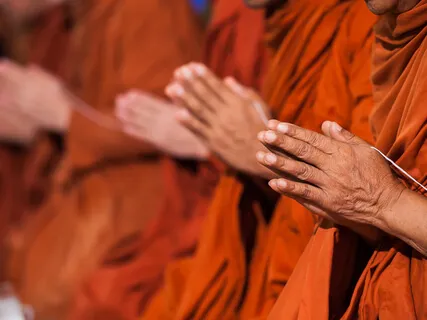
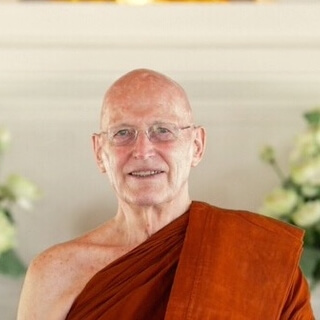
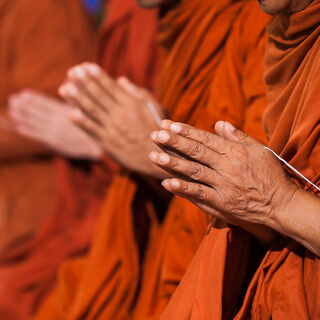
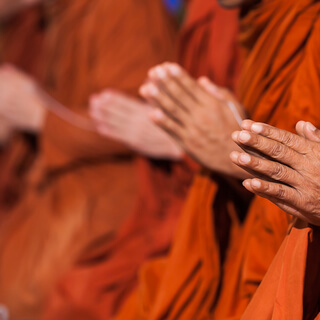
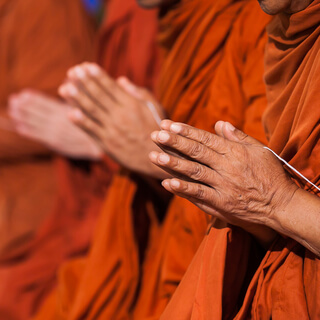
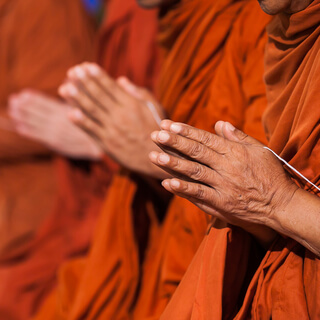
The Buddhist monk,
The bhikkhu,
You see,
Shaven head,
Robe,
Kind of ochre,
Gun colored robe,
Barefoot,
Bareheaded,
You know,
Not a,
No crown,
No kind of jewels ornamenting the body,
Nothing dazzling or sparkling or glitzy.
No velvet robes,
Ermine trimmed collars.
So I mean,
It's,
You know,
It's kind of a,
You know,
It is a kind of iconic form in its way of non-person,
Non-person.
Non So that's why,
You know,
In our tradition,
How we pick up this tradition,
Like consider what the word bhikkhu implies,
You know,
How does that affect you?
If you're a Theradhar and you think bhikkhu,
What is that?
What kind of emotional reaction do you have to the word bhikkhu?
Not that there's any way you should feel,
But observe.
It can be seen in highly personal reactions,
Emotional being threatened by bhikkhus.
Bhikkhusanga can even sound pejorative,
You know,
The bhikkhus,
What do the bhikkhus think?
We've got to get the approval of the bhikkhus,
And the bhikkhus are senior to us.
I mean,
Just to,
You know,
Observe how a word that's meant to convey impersonality,
Just an expedient means,
Can form some kind of,
You know,
Personal reaction,
Threat.
We should love the bhikkhus,
Admire them,
And at the same time,
There's only shoulds,
And then there's also maybe a personal reaction.
Then the same applies to bhikkhuni or sila dhara or things like this.
It's just how these,
You know,
Words,
Religious conventions,
How they can,
You know,
Just to see how they,
What kind of emotion arises when you think of these words.
Now the aim then is to,
You know,
The polystructures,
The words,
Is towards anata,
Non-self,
Non-identity.
And so the forms are not,
You know,
To be seen as persons.
So like the most junior bhikkhu in the tradition is,
We're not saying that he's only a junior bhikkhu,
But he represents bhikkhu sangha,
Which is the force that carried the tradition up to this present time.
It's not about being a junior bhikkhu who just ordained yesterday,
And so he doesn't really count.
You know,
Even the most junior bhikkhu is bhikkhu sangha representing that,
Not as a personality,
Impersonality,
As well as the most senior.
So that's the Vinaya structure.
The form is not about,
You know,
I'm not like this.
I don't want to bow to that newly ordained bhikkhu.
He's just off the streets.
And I knew him when he was a lay person.
I thought it was pain in the neck.
Not going to bow to him.
It's humiliating because,
And that's understandable on a personal emotional reaction,
But that's what we want to see,
You know,
To use the forms for reflecting on our own personal emotional reactions to structure,
To seniority,
To the words that we use,
To the way we form views and opinions about Buddhism through attaching to our own particular feeling about the language,
The Pali language,
Or the tradition we're in.
You see,
So it's getting to the source of attachment,
Ignorance and attachment,
Ignorance,
Avijjhā dhanhā ubatāna.
And as long as that sequence is never penetrated,
Then,
You know,
No matter how many years and diligently you practice,
If you can't get outside those three fetters,
Then you're stuck there,
You know,
With your own limitation of the conditioning that you've acquired and blindly attached to.
So,
You know,
And then we do,
In the community,
We do affect each other emotionally and personal reactions,
You know,
Liking,
Disliking,
Loving,
Hating,
And so forth.
That's just human nature,
Isn't it?
We can't,
You know,
We don't,
Because you're a summoner doesn't mean you don't have any personality or you just become kind of like a Buddha Rupa or some kind of totally impersonal person.
We still have our comic tendencies and irritating habits that follow us through life.
So,
Don't expect your personalities to have great transformations into being saints.
But we're no longer binding ourselves to personality.
You know,
We're liberating ourselves from birth and death,
From the conditioning that we have acquired in this life.
Not through destroying it,
But no longer believing,
Operating,
Being blinded by Sakkaya Ditti cultural conditioning and thinking and the thinking conditioning.
So,
It is a lot to ask,
Isn't it?
Because,
You know,
We are very much involved with our feelings and views and opinions,
And the society we live in encourages that.
Modern psychology is all about trying to find your true self and,
You know,
Solve all your problems and so forth.
So,
It's trying to be a happy,
Well-adjusted,
Normal person,
Personality,
To kind of see if you can get rid of things that are,
You know,
Unacceptable in society or two.
That you should be happy.
You should be a happy person and ideals that we have in society of how things should be.
So,
The sum in our life is not about trying to make ourselves happy or to try to,
You know,
Convince ourselves that monastic life is just one experience of happiness,
One fantastic happy moment after another,
Or it should be.
But it's a vehicle for reflecting on the karma that arises during this lifetime as it changes and manifests in various ways.
I remember when I went to,
First went to live with Ajahn Chah,
You know,
In Wat Pa Phong.
I was the most junior bhikkhu,
Just ordained at the end of the line.
And then,
Of course,
But the only farang bhikkhu there.
First time they'd ever had a prop farang or a western monk.
So,
Thai people would come and they'd bow,
They'd go and bow papers back to the panchayat.
And then they'd come over,
Passing all the other monks,
And bow to me.
And I found this embarrassing,
You know.
So,
You know,
I didn't like being bowed to at all.
And I,
You know,
Personally didn't feel worthy of it.
So,
You know,
I just felt very uncomfortable.
And then I think they should,
You know,
They should be bowed to the other monks.
I'm the newest,
The least trained.
And so I asked Ajahn Chah about it and he was just,
You know,
His view was no matter how junior are you representing bhikkhu sangha.
You know,
That's not,
You know,
It can be,
In that case,
It was because I was an unusual one,
The only non-Thai bhikkhu in the lot.
So that did attract attention.
And what I want to make of that in some personal way is,
You know,
My problem,
How suffering of I'm so,
You know,
Special that you should bow to me or I'm not worthy.
Both are sakkayaditi,
Isn't it?
I'm not good enough.
So,
Like in,
You know,
When you're a junior monk,
Sometimes you do find it incredibly difficult when people bow to you because you,
You know,
On a personal level,
You don't feel,
You can feel very unworthy of and feel embarrassed by it.
But this is to see that also,
To see that that's your sakkayaditi manifesting.
Or the way we can think,
You know,
I'm not going to bow to that.
You know,
I'm not,
He's not worthy of my bow is a form of conceit.
So the form,
The structure,
You know,
Form and the seniority structure of it is getting to the root of conceit in whatever way,
You know,
It manifests as arrogance or as feeling unworthy,
Whether you feel personally worthy or feel unworthy or get very convinced that I'm senior,
You bow to me or that even though I'm senior,
I don't really care if people bow to me or not.
One can be,
I don't really care.
I don't need your bows.
I'm perfectly all right.
Or you better bow to me because I'm head monk of this monastery.
I mean,
Both it's putting in extreme terms of sakkayaditi.
Sakkayaditi covers that whole gamut of,
You know,
I'm so important or I'm not important at all,
Whether it's arrogant,
Conceit of superiority or feeling of total unworthiness and impurity.
And awareness of that is what?
Awareness isn't about judging,
But knowing all conditions that any form of personal conceit,
Whether whatever extreme it takes is what it is.
It's a nica du canata.
And now those three characteristics are the,
You know,
The suggestion,
The way of looking at conceit,
Not judging it.
It's not saying because all conditions are impermanent,
They're bad,
Because conditions change.
They're good,
Bad,
Neutral,
Whatever,
According to other conditions.
This is,
You know,
This is an invitation to really appreciate the teaching of the Buddha,
Not as some kind of personal,
You know,
Attitude about it,
But because it is,
It's an invitation to awaken and see and know in a direct way with wisdom and to really let go of the causes that create all our personal suffering and fears and anxieties and worries.
So in,
You know,
In I found,
You know,
In sometimes,
You know,
Like you have,
There's all kinds of Buddhist monks,
You know,
So in the Bhikkhu Sangha,
You know,
In Thailand or wherever,
There's very good monks,
Arahants,
Very wonderful,
Pure monks,
And then they go to just being rascals,
Corrupt,
Impure monks.
So in Thailand,
You've got,
You know,
Got so many monks,
200,
000 Bhikkhus,
And so they've got,
You know,
The best to the worst range,
You know,
In such a,
In so many Bhikkhus in one society,
You know,
They're not all going to be the best,
So they range from the very best to the very worst.
But in terms of Vinaya,
You know,
You're not judging in that way about how high,
How good or how bad they are.
Because sometimes,
You know,
You know,
About two monks that I personally don't like or don't respect as a person,
But that has nothing to do with it,
Isn't it?
Because of the relationship of Vinaya,
Then whether their Vinaya is good or bad or is no longer my concern.
And then it does bring up conceit,
Like I'm more pure than that monk,
Is Akhiyaditi.
That's what I want to see,
You know,
How,
You know,
I can feel that I am,
You know,
I'm my Vinaya and my practice is superior to his.
Why should I bow to him?
Is that what I want to be,
You know,
A conceited monk thinking that,
You know,
That I'm better than somebody else,
Or seeing it as opportunity to pay respect to the Sangha,
Bhikkhu Sangha,
Whether that individual purity or impurity is no longer the issue,
It's the appropriate response to the form,
You know.
So it's not about judging,
Comparing or personal views.
So it's not about judging,
Comparing or personal views.
So it's not about judging,
Comparing or personal views.