Wise Acceptance and Loving-kindness A collection of short Dharma teachings by Venerable Ajahn Anand Getting to Know the Mind When we first come to meditate,
We'll notice quite quickly that even sitting for a minute seems almost impossible.
All we get is restlessness and agitation.
With practice,
Though,
We'll soon be able to sit for longer periods – five minutes,
Ten minutes,
Fifteen minutes.
Eventually,
We'll be able to sit for half an hour with ease.
Sometimes meditation is peaceful,
Other times not,
But in the beginning stages the key element is patience.
It's important to see that the five hindrances to peace in the mind – sensual desire,
Ill will,
Dullness,
Restlessness,
Doubt – are not created by meditation.
It's just what's there already.
In daily life,
We're used to thinking a lot,
And often not in a very skillful or controlled way.
This type of thinking tends to agitate the mind and create different types of mental stress.
So when we sit down to concentrate on the breath or another meditation object,
What we notice first is what's already there.
Suddenly we see,
Hmm,
There's a lot of thinking going on.
So to begin with,
Just accept that it's normal for the untrained mind to be like that.
And the way to deal with it skillfully is to develop this quality of mindfulness.
We meditate to get to know our mind,
But that doesn't mean we think,
I've got to be peaceful.
If we think and attach in this way,
Then we'll tend to get irritated with ourselves when we're not peaceful.
Our aim is just to know the mind.
And when we're working on developing constant awareness,
This will include times when we're not very peaceful,
When there are thoughts and distractions coming up.
So we just know,
Hmm,
The mind is distracted.
There will also be times when our mindfulness and concentration are strong,
And the hindrances disappear.
At those times,
We're aware that now the mind is peaceful,
Now the mind is calm and concentrated.
Whatever the experience,
We know it for what it is.
That's our aim.
Building Momentum Mindfully If we put forth effort on a daily basis,
The meditation will start to gain a momentum of its own.
When we wake up,
We'll want to practice meditation.
Whenever we have spare time,
We'll want to practice meditation.
And if the opportunity arises,
We'll want to practice all day.
If we practice consistently with mindfulness,
Whatever time of the day we go to meditate,
Be it in the morning or evening,
The mind will move into a state of peace quite easily.
This is what we call continuously developing the mind.
Whenever we have mindfulness established is a time when we're developing the mind.
However,
Even if we sit all day with our eyes closed,
If there's no mindfulness,
My efforts will bring little benefit.
If we do walking meditation all day,
But our mindfulness isn't firmly established,
This would not be putting forth effort in meditation.
To be truly putting forth effort,
We should be endeavoring to abandon any unwholesome mental states that have arisen,
And to bring up wholesome states and maintain them in the mind.
The unwholesome states that we've already abandoned,
We should be trying our utmost to not let them arise anew.
If we're working in this way with mindfulness,
Then whether we're standing,
Sitting,
Walking,
Or lying down,
We'll truly be developing the mind.
Wise Reflection There will be times when the mind is too restless to simply watch the breath or stay with the meditation word.
At these times,
We may need to use wise reflection.
Wise reflection is when we consciously use thought to bring the mind to peace.
We can use the recollection of the qualities of the Buddha,
The force of mime abidance,
Recollection of death,
Chanting,
Or other modes of contemplating the Dhamma.
Some people find their temperament is more suited to using this reflective and contemplative style of meditation,
While others may find that staying with a single meditation object,
Such as the breath,
Will bring their minds to peace quite easily.
Many practitioners,
However,
Find benefit in using these two aspects interchangeably as a means of calming the mind.
In the Thai forest tradition,
It's quite common for practitioners to use the recollection of the Buddha as their main object of meditation.
In addition to reciting buddho along with the breath,
We can also recollect the qualities of the Buddha to bring the mind to calm.
The Buddha was one who was perfectly awakened.
His mind was pure,
Free from mental defilements,
Free from suffering,
Experiencing constant peace.
Not only did he purify his own mind,
Finding the way to free it from delusion and attachment,
But he also developed the wisdom to teach others to follow the same path.
Because of our faith in the Buddha and his teachings,
When we enter or leave a hall,
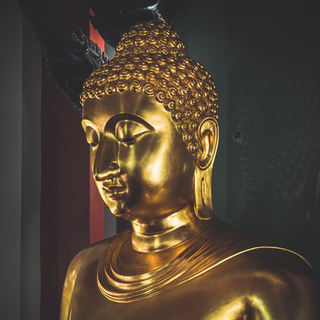
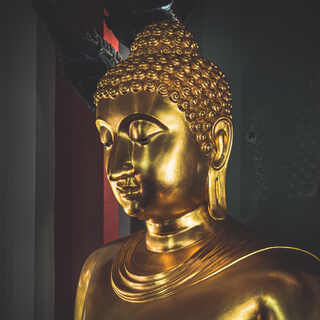
It's customary to pay respects by bowing three times to the Buddha statue.
When we do this,
We're recollecting the enlightenment of the Buddha and what that signifies.
We recollect the qualities of mind that he perfected,
Namely,
His great compassion,
Great purity,
And great wisdom.
He developed these virtues and other aspects of his spiritual practice over countless lifetimes,
All the while holding the vow to become a Buddha.
His vow was finally realized as he experienced the happiness of liberation,
Sitting under the Bodhi tree in India 2,
500 years ago.
He then began.
.
.