So now is the opportunity for us to sit in meditation.
This is something that's very important for us to do.
It becomes a foundation for our hearts.
It's samma samadhi.
It's the right form of samadhi,
Establishing our hearts,
Collecting them in the correct way.
And this is important to develop this correctness,
A rightness in our samadhi,
Because there are many kinds of samadhi.
And those people,
Soldiers who go to fight in battle,
They have a kind of samadhi and a kind of mindfulness.
The same with animals,
A tiger for instance,
That has a collectiveness of mind and awareness,
Mindfulness when it's catching a deer.
The same for a cat that's about to pounce on a mouse.
It also has this firmness,
Collectiveness of mind,
Samadhi,
And mindfulness as well.
So everyone and every animal needs mindfulness and samadhi to be able to survive.
And just like a thief as well,
They see the danger in their occupation,
And they also have to endure with many difficulties so that they don't get caught by the owners of what they're trying to steal.
What's this mindfulness and samadhi that they have?
It's micha samadhi,
Wrong samadhi.
But we need to develop right samadhi,
Whether it's the samadhi we have in our work or whether during practice we developed correct samadhi,
That which doesn't harm ourselves or others.
And so this is all to do with mindfulness and collectiveness of mind.
So we can train this by paying attention to our breath as it comes in and goes out,
And do this until we become proficient in that,
So that our hearts meet with peace and stability.
They gather together into the state of samadhi.
In the beginning,
We can recollect the goodness that we have created.
And what might that be?
All the things that we've done in the past,
Whether it's throughout our entire lives,
Just in this year or this month,
The things that when we think about,
They bring a fullness,
A joy to our hearts.
We recollect the merits that we've done,
All the skillful actions we've created.
So like the people who help to build stupas,
When they think about that,
There's a fullness that comes into the heart.
So it should become an object of recollection that we should bring up frequently.
As we do this,
It's a form of the recollection of the Buddha,
Of the Dhamma and the Sangha,
Because these are the ways that we have paid homage to the triple gem.
So we recollect the goodness that we have created,
The good things that we've done in our lives,
And this brings a fullness,
A joy to our hearts.
And this relies upon our sense faculties as well.
So we have an eye that works and that can see forms.
We use our eyes to see wholesome things,
Maybe disciples of the Buddha,
Awakened beings.
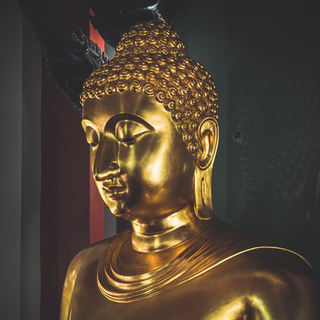
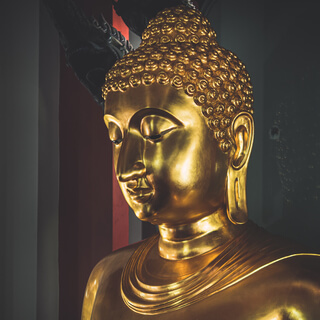
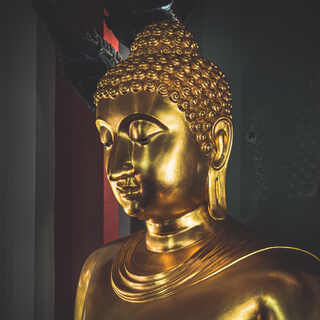
And we can also look at images that have been created,
Molded in the image.
And through gazing at these images,
There can be a fullness,
A joy,
A brightness that pervades our heart to the degree that tears may flow down our cheeks.
It pulls our mind towards peacefulness,
Towards samadhi,
And that comes from all this merit that we have created.
So when we recollect these good things,
Our hearts feel at ease and calm.
And perhaps some people have helped to create Buddha images or have sculpted Buddha images.
And that this can come about is from the great goodness of the Buddha through all of the Bhāramis that he had to perfect throughout countless lifetimes.
So when we meet with difficulties in our practice,
We can recollect the Buddha and consider that the challenges that we face are just like a tiny speck of dust in comparison to all of the difficulties that the Buddha had to go through.
We see that the Buddha is limitless,
But the difficulties that we experience are just tiny things.
We recollect the Buddha,
The Dhamma,
The Sangha,
All of the Arahants,
And consider that in order for them to gain the Dhamma that they've come to teach us,
They had to pass through many,
Many obstacles.
Perhaps we chant a certain verse and our hearts feel very still and peaceful with that chant,
Then we should bring up that particular verse very often,
Carry on doing it until our hearts gain substantial peace.
And then from that,
We can come to look at our breath as it comes and leaves.
Why is it that we need to train our minds?
It's because having come to be born again and again in the cycle of saṃsāra,
Our minds become very confused,
So confused to the point that we've forgotten what our original state is,
What the original mind is like.
It shows that we've lost our wisdom.
So there is this purity to our hearts,
But it's just that we don't see it.
Our hearts flick between liking and disliking so quickly that we don't see the space in between those.
There is a gap,
However,
It's just we don't perceive it.
But that gap between liking and disliking,
Between being caught in the sense impressions,
Is a space of purity.
So we're not perceiving that and just being caught in all of the objects of the mind.
We fail to see the mind's original bright nature.
All we see are these objects that are caught up in self,
In me,
And in others,
And we don't see the danger of that.
So having been born,
It's like we're all stuck in one boat,
Or we're all trapped in a house,
And that house has caught fire.
It's just that we don't feel the flames yet,
Because it's a cool fire.
But this old age sickness and death,
It's creeping in steadily upon us.
It's just we don't have the wisdom to understand that,
To see that clearly.
But it comes in closer and closer.
And it's only when it gets really close that we actually understand it,
That we see it.
It's only when death is right near us that we understand death.
But it's not in time.
We have waited too long.
We haven't seen it in time.
But those who have wisdom will perceive this.
They'll see that the house is on fire and that they just can't stay in it.
They'll see old age sickness and death steadily closing in.
And it's not that in seeing that we have to run away and ordain.
We can practice,
Both as lay people and as monks.
Just for monks,
They should practice even harder,
Seeing that this house is on fire.
Or another comparison is like a fish that is in water,
Swimming around,
Whether it's in the river or in the sea.
But if that fish is taken onto land,
Then it will try and struggle to get back into the water with all of its effort.
Because that's its natural place.
The water is its home.
And it knows that if it stays on land,
It's going to die.
So it thinks about the ocean.
It never stops thinking about that.
And it wants to go back into the water.
That sea is always on its mind.
Or it's like a bird that's trapped in a cage.
And having wings and once having freedom to fly about wherever it wanted,
That bird wants to regain its freedom.
It doesn't want to be stuck in that cage.
No bird wants to be trapped in the small space.
So it tries to get out.
It tries to flap around and escape from that cage so it can fly like it once could.
It sees the danger of being stuck in that small space.
And just like the fish sees the harm in being out of the water and wants to get back to the water,
Both the fish and the birds,
They miss their freedom.
But for us people who have been born,
Do we see this?
Do we see that we've lost our freedom?
We've forgotten it.
That we have this pure nature,
The original pure mind,
But we've forgotten about that because we've been away from it for so long.
We haven't met with our original nature for such a long time.
Having been born many times in the cycle of birth and death,
We're just stuck with the impressions that we perceive.
We are stuck with greed,
Hatred and delusion from birth till death.
And then we get born again into another life.
And the cycle goes on and on without end.
It's happened for such a long time that we've forgotten about our original nature.
We just become engulfed in suffering.
We don't think about the freedom that we could have.
And so if beings create bad kamma,
Then that comes back to them in the form of stress.
And they just aren't able to find a way out until that kamma becomes all used up.
Or those beings who have created good kamma,
They become deluded in that happiness as well.
So therefore we need to find our way back to our original mind.
And the way we do that is through developing samadhi and sati,
A collectiveness of mind and mindfulness.
It's difficult because when we come to train in this way,
All we can see is the results of the proliferation that we've engaged in for such a long time.
That ever since we were young,
We've been using our brains to think about various things,
Whether it's in our education or through our work.
There's been all of these thoughts going on and it becomes so habitual.
And so when we're older,
We come to meditate,
To practice and train our minds.
And what comes up when we sit down is a lot of memories.
All of these old habits just come flooding in.
And that prevents our minds from becoming peaceful.
Well some people want to gain peace very quickly and they're confused or in doubt about how to do that,
Which meditation object to use.
Some have read the scriptures very frequently and they know the theory that if we have the nature to have an inclination towards lust,
Then we contemplate the body,
The 32 parts of the body.
Or if our characteristic is one of faith,
We have a faith character,
Then we can recollect the Buddha,
The Dharma and the Sangha.
Or if our mind inclines more towards wisdom,
Then we contemplate the four elements or recollect emptiness.
Those who like to think a lot,
They can use the breath and watch the breath as it comes in and goes out.
But even though we know these things,
The mind can still doubt about them,
That we want to get results quickly.
So all people who come to practice and ordain,
They all have faith.
So the object of the Buddha,
The Dharma and the Sangha is appropriate for all of us.
If we don't experience much peace,
Then we can chant.
And then after that chanting,
We use the meditation words of Buddha,
Dharma and Sangha.
And just do this a lot,
Do it frequently.
The reason that we are uncertain about how to practice is because our minds haven't experienced much peace yet.
And even for some people when they do gain joy in their hearts,
When there is calmness and stillness,
They can doubt because they want to get results even quicker than they have gotten them.
But whatever works to bring about peace,
Then that's all right,
We use that.
We do it often,
We meditate a lot.
When our minds are calm,
We won't have any doubts.
That doubt will disappear from our mind all by little.
The mind is in a very stable and calm state.
Even if we wanted to doubt about something,
It just couldn't doubt.
It's not able to do that.
But in the beginning,
If we study the scriptures a lot,
Then we'll also have a lot of doubts.
So we shouldn't do too much reading,
But rather practice a lot.
Recite the meditation words of Buddha,
Dharma and Sangha.
And then as the mind calms down,
We can reduce that to just Buddha.
Just keeping it with one single object,
Keeping it on one point.
One of the great teachers recommended to use the phrase,
Buddha Saranagachami,
And recite this over and over again.
Until our hearts are peaceful and this meditation word just disappears all by itself.
When we do this and the mind becomes calm in this way,
Then we'll start to gain an inkling of our mind's original pure nature.
This comes about through right mindfulness and right samadhi.
So we use this samadhi to contemplate so that wisdom arises.
So that we're able to see clearly and in time with the truth.
Able to perceive things as they arise and see.
Seeing the body as just being a collection of elements,
Leading to wisdom.
Or seeing the body as just being empty.
When we do that,
Our minds will turn empty as well.
And we'll see their original pure nature.
But if our minds don't have wisdom,
Then we'll be stuck in the cycle of samsara.
Simply pushed around and chasing after all of the sense impressions that we experience.
Until we forget what our original nature is like.
If we don't have mindfulness,
Samadhi and wisdom,
Then we'll be stuck in delusion.
And our minds will be lost and get deluded by all of the things that we find pleasurable in this world.
Whether it's sights that we like or sounds that we enjoy.
These become the objects and the source of delusion.
And our minds just getting stuck in this world.
Stuck in sense objects.
But for the fish,
It doesn't get deluded by any of these things.
When it's on land,
It will think about the water until the very moment that it dies.
Or like the bird that's stuck in a cage,
It will try to get free constantly until it's able to get out and fly again.
But there aren't some birds who get used to being in cages.
They start enjoying the food that they're fed.
And they get lost in that food.
They get attached to it.
Drunk on it.
And they start being content with that,
Not wanting to leave,
Not wanting to go back to their natural place.
And even if they're let out,
They don't want to fly away.
So for us,
We should try to bring up wisdom so that we can see the value of a peaceful mind.
And we don't get drunk upon the things of this world,
Get lost and deluded in this world.
But rather,
We see the danger in the cycle of samsara.
Deceiving old age,
Sickness,
And death as they close in on us.
Knowing that we don't stay in this world for a long time.
That every passing moment,
Our bodies are degenerating.
So we shouldn't be heedless.
But rather,
We should try to see the Dhamma.
And those who are endowed with mindfulness and wisdom will see truth.
Slowly as we practice,
Our minds become empty.
They let go of their attachments to the things they've been clinging on to for so long.
When they do this,
We gain a taste of Nibbāna.
And we don't forget that.
We don't forget what it's like.
And at this point,
There'll be great energy to go back to Nibbāna.
And just like the fish that wants to go back into the water,
The bird that wants to go and fly in the open air again.
If our mindfulness and wisdom is good,
Then we'll be able to contemplate into the body and see it as being empty.
And at this point,
Our heart gains freedom.
There's great joy and happiness in this free heart.
However,
The heart will come back and start attaching to a sense of self again.
But we'll have tasted that freedom already.
So we'll know what it's like and we want to go back.
We want to regain our freedom,
To not be attached anymore.
And in this way,
We will slowly destroy sakāyaditti,
The self-view,
Little by little.
Even though it can be very difficult,
We should try to continually persist with it.
Try and bring up effort so that we can free ourselves from this attachment.
So that we can change our wrong views into right views.
So that our mind just settles with one single object,
The object of Nibbāna.
And that will be what we are after,
What we go for.
This is what the practice is like.
In the beginning,
However,
There'll just be constant doubting into what meditation object we should be using.
How to get results quickly.
Whether we're able to attain to noble fruits in this life or not.
Maybe we want deep samadhi or jhanas.
Maybe we want to get wisdom quickly.
And this can,
All these desires can bring up great doubts.
So what should we do in that case?
Well,
It's not necessary for us to ask many questions,
But rather we should just try and bring up confidence in this practice and put in as much effort as we can.
The great teachers,
They can give us encouragement,
Telling us that it's possible that we can do it,
That we can attain.
But it's not enough for us to just listen to that.
We need to put in effort ourselves.
We need to sit in meditation,
Walking meditation.
We need to put down our doubts and be firm in walking this path of sila,
Samadhi and panya until it all gathers together into one thing.
Until we see and know the Dhamma for ourselves.
So may all of you be intense on this path.