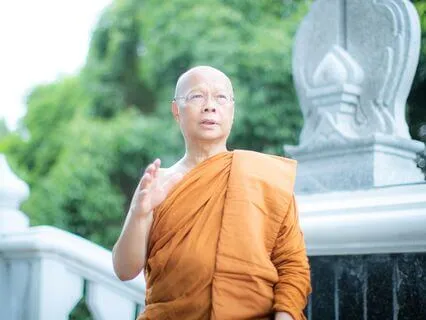
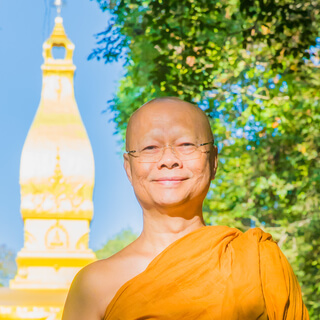
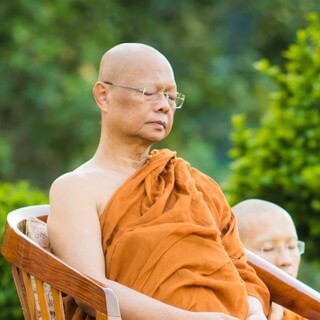
Today it's the ninth day of us coming to practice together in this retreat that's online and we've reached the closure of this retreat.
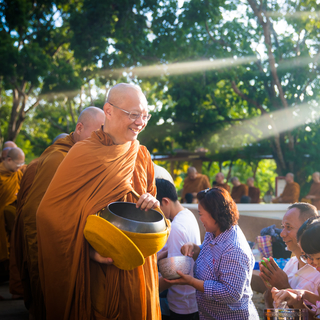
So myself and the monastic sangha here wish to express the joy that we find in all of you coming together to practice the Dhamma online like you have been during this retreat.
Those who have come to practice here at Wat Mabchen and those joining us through this online system as well.
And perhaps some of you have joined this retreat every session and perhaps some have joined when you have the time available to do so.
But you will have this sincerity in coming to study,
To seek out knowledge and understanding in the Dhamma of the fully self-awakened Buddha.
So the studying of the Dhamma is important because in our lives each day that passes we meet with so many different sensory objects,
Experiences.
And it's normal for the mind which has taken birth already,
That when it meets with us it gives rise to a feeling of me and mine.
And so there's some happiness sometimes,
There's suffering sometimes.
And all people have wishes,
Desires.
And in the beginning those desires are just worldly desires.
And so out of these eight worldly winds we desire the pleasurable side of them.
And so there's gain and there's praise and there's gaining status and there's pleasure.
And the undesirable side,
We don't like those.
And so there's loss,
There's criticism,
There's loss of status and there's pain.
But the reality is that this body of ours,
It's constantly deteriorating with each and every in-and-out breath.
And this is something which we should be constantly contemplating as well,
Into the decaying and the ending of this conditioned body.
So when we are born,
We have a mother and a father,
But we're really born alone.
The mind enters into this mixture of earth,
Water,
Fire and air.
And then it grows up until it reaches a point where it starts to deteriorate.
And then eventually we meet with the end,
The ending of all things in this life.
And so every time that we are born into each existence that we wish for happiness and suffering we don't want.
But in this world no one experiences just happiness.
And the happiness that we do experience becomes the cause for suffering to arise.
And that's what it's like every life if we don't practice.
If we don't practice then we won't be able to find freedom from suffering.
And so the Buddha taught that each life is just dukkha,
Life after life.
It's constant discontent and suffering.
If we're going to talk about that in a refined,
Subtle way,
It's this feeling of self which arises.
That each time the mind concocts,
Proliferates,
There's a self that has arisen already.
We meet with sense objects,
These come into the heart.
There's the external sense objects that of form and sounds and tastes and odors,
Tactile sensations.
And these meet with the sense organs of the eyes and the ears,
The nose,
The tongue,
The body,
The mind.
And then there's this contact passer which arises.
And this too is a Dhamma.
And if we have mindfulness then we'll be able to know that,
That there's this contact coming together and we can let go and our minds will then be free from suffering.
But if the mindfulness is not in time,
Then we cling and that's the cause for suffering to come up.
So each birth that we take,
It's just constant dukkha.
But this is dukkha,
The birth within the mind that we're talking about.
The birth of the body,
This takes a long time.
But that which happens in the minds,
We see that each day that passes,
Many times throughout the day.
So when anger comes up,
Then we suffer.
We feel hatred,
We feel jealousy,
We feel annoyance,
Worry.
Then that's all dukkha.
This is all stressful suffering.
So therefore we need to try to train our minds,
To teach our minds.
Whenever the kilesas are pushing up this conditioning of the mind and making it proliferate,
We need to very quickly teach ourselves,
Who is it who is feeling greedy or angry or deluded?
Is it,
Is the mind really me?
And why,
When I teach it,
Does it not follow,
Does it not believe what I'm saying?
So we're always constantly trying to teach our minds,
Getting them to see how all things,
Everything which is physical,
Everything which is mental,
Is empty.
So when the Buddha taught the Anattalakana Sutta,
His teaching on anatta,
On not-self,
To the five ascetics,
That all of them attained to Arahantship,
Full awakening.
Because they saw how all physicality and mentality is empty.
So the Buddha taught as well that all of this is anicca,
It's always changing,
It's inconstant,
That it's dukkha,
That it can't endure,
And we can't control it.
And so when it's like this,
Then how could it be me?
Do our minds want for these things to be this way?
And it shows that it's not me.
And so there's this arising and ceasing of things.
You can see then that that's,
It's not a me,
There's not a me in that process.
See all the feelings that we have had,
The pleasurable ones,
The ones of pain,
That have come within our hearts since we were born,
Where are they now?
They have arisen already and they've ceased already.
The things which we feel pleased by,
The things which we're displeased by,
That they have come and they've gone.
And this is happening in the present moment,
This arising and ceasing.
In the future,
They will arise and cease in the future as well.
And so if we understand just this clearly,
Then we see the Dhamma.
And if we have great wisdom,
Then we attain to the Dhamma.
But currently our wisdom is not a lot,
So we need to try training,
Try teaching our mind like this.
And at the very least,
Through this wisdom,
We'll be able to develop our Samadhi.
The Samadhi grows and when that grows,
Then our wisdom grows as well.
And this turns into Bhavana Mayapanya,
So the wisdom that arises through the cultivation of the mind.
And with that,
Then we know this Dhamma or attain to the Dhamma.
So this is a good opportunity that we all have to come to know about this,
To study the principles of the teachings and the practice.
So may you take these and carry on practicing,
Don't just throw them away.
But carry on doing it continuously so that it all connects up.
Carry on with your practice until the next retreat.
And in this way,
Your mind will always be growing,
Be developing.
Be intent and try to be reminding yourself about the inconstant nature of Sankharas.
And the Buddha taught us to not be heedless,
That those who are heedless are dead already.
And so it's not just the case that when one stops breathing,
Then one dies.
And Ajahn Chah,
He asked,
Have you seen a dead breathing person before?
And if we aren't mindful,
Then right then we are dead already.
And so throughout the day we can observe ourselves,
How much mindfulness or little mindfulness do we have.
And if we don't,
Or whenever we're not mindful,
Then we're dead at that point,
Even though we're still breathing.
And the people in the world who aren't developing their mindfulness,
All of them are dead already.
They're deluded,
Deluded in this world.
Therefore,
We need to be sincere,
Sorry,
Deluded in the world and dead from goodness and from merit.
So therefore,
For us,
We need to put in our efforts to be cultivating goodness and merit.
These are things which we should be doing constantly,
To be growing in generosity and virtue in meditation.
Until the end,
We can know the Dhamma and see the truth of the Dhammas that we should know and see.
We view this world as being empty.
It's like how the Buddha taught to Moggaraja.
He said,
Moggaraja,
If you view the world as empty,
Then the Lord of Death won't be able to find you.
And what this means is suffering.
That if we view the world as empty,
Then the heart won't suffer.
And so may all of you set your hearts on this.
So may all of you have good fortune and have good strength,
Good health.
And we'll meet all of you again next time.
See you next time.
See you next time.
Bye-bye.