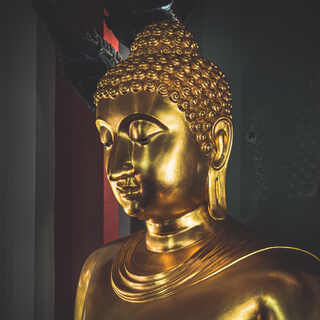
We venerate the Sama Sambuddha,
The perfectly self-awakened Buddha,
As the Sasadha,
Our great teacher.
We give the highest respect and homage to him.
He is the Ratana,
Supreme jewel,
The jewel of the Buddha.
He taught the Dhamma,
Which is the jewel of the Dhamma.
And having the enlightened Sangha disciples arise is the jewel of the Sangha.
We go to the Buddha,
Dhamma,
Sangha as the precious jewel,
More supreme than any other jewel in the human and deva divine realms.
Because when we have the jewel of the Buddha,
Jewel of the Dhamma,
Jewel of the Sangha as our refuge,
Then the suffering in our heart will reduce.
When it comes to the commemoration of the day the Buddha was born,
Enlightened and attained final Nibbana,
We learn about the Dhamma,
The teachings of the Buddha,
So that we can understand more clearly and deeper into them.
Sometimes we may have doubts in our life or in the teachings,
And then by hearing Dhamma we will understand things that we have never heard or known about,
And hear and know about them more.
And it makes our hearts have views that are correct.
The Dhamma is amazing.
When we receive the Dhamma,
The heart is brightened and joyous,
And the doubts disappear.
The Sammasambuddha was born as Prince Siddhartha,
And he walked seven steps forward and exclaimed that he was the most excellent,
The most supreme,
The most developed in the world.
And we may have the doubt of how a baby just born could walk.
If we have lots of faith,
We will believe it and not doubt it.
Faith leads us,
And if we have wisdom we may think many things.
But we may have some experiences which science may not be able to explain.
There's a material object,
A pulley,
Weighing a few kilograms,
That is inside a layperson's house,
And this pulley can disappear and was found on the roof of the house.
And a person who is around the house all the time didn't see anyone who would take that pulley,
Which weighed a few kilograms,
And move its location.
So something like this is possible.
And the Sammasambuddha had great barami,
Spiritual perfections.
He was born and could walk.
This was his mind that had full and complete sati,
Mindfulness.
All of the states of mental absorptions and psychic abilities he had built a lot of already.
He could just make a mental determination and could raise his body up and walk,
Like a miracle.
And the meaning is that he would spread the buddhasasana,
The dispensation,
All over the Indian subcontinent.
And he could speak.
We may think how come a baby born can speak.
In this world if we go back a hundred years before,
And at that time we saw an AI that created a human that can have a face like us,
And speak and sound like us,
Then we wouldn't be able to understand how it is possible.
So we can't think that the Buddha as a baby speaking is something impossible.
It was through the merit and barami of the Buddha.
The Sama Sambuddha wanted us to give more interest in the Dhamma.
The Bodhisattva,
The Buddha-to-be,
Grew up and at just seven years old could enter samadhi,
Meditative concentration,
And enter jhana,
Mental absorption.
He had coolness of heart and had rapture and inner bliss.
And with the barami of the Bodhisattva,
His samadhi and great coolness of heart would spread out very far.
It made his father,
King Suddhodana,
And the royal relatives pay their homage to him.
They venerated the merit and barami.
So even just as a child,
But because of having barami like that,
He was venerated and given homage.
This is important to remember.
The Bodhisattva learnt the arts and knowledges,
But he had wisdom.
Why do we have to have aging,
Sickness and death?
There should be that which does not age,
Does not sicken,
Does not die.
There is darkness and light as a pair.
There is hot and cold.
There is birth and death.
So there must be that which is not born and does not die.
So the Bodhisattva went in search of it.
He trained in samadhi because he was trying to escape from death.
He didn't want to die.
He didn't want to be born.
If we have to be born,
Then we have to die.
So he looked for a place of no death.
And this is not easy.
It must be one who has full barami.
He went searching for it with a high level of samadhi,
Of the level of rupajana and arupajana,
The form and formless absorptions,
Which he had attained already.
But he still did not succeed.
He then tortured his body for six years,
Of which no other could do it to that level.
He fainted three times and still had not succeeded.
Then he came back to take food,
Which Lady Sujata offered 49 spoonfuls of milk rice porridge.
He had strength now.
And he made a mental determination,
Floating the golden tray in the river,
Which went against the current and then sank to the bottom.
And from this determination he had made,
He was then certain that he would succeed.
The bodhisattva crossed the Naranjara river till getting to the mahabodhi tree,
The banyan tree.
He sat meditation,
Facing east,
And he made a vow that if he did not succeed in gaining enlightenment,
Then he would accept death.
This seat was called the diamond throne,
Or one who has the heart of a diamond.
He had developed the high levels of jhana a lot already.
Then he remembered when he was a child and had entered samadhi through using anapanasati,
Mindfulness of the breath.
He entered first jhana,
To fourth jhana,
Up to eighth jhana,
Then stepped it down.
And here he had insight arising of the knowledge of recollecting past lives.
He could remember being born in each lifetime.
On the second watch of the night,
About 10pm to 2am,
He gained the knowledge that beings are born from their karma.
That one is heir to one's karma,
Supported by one's karma.
One will receive whatever karma one does,
Whether good or bad.
Being born as a human,
An animal,
A deva,
He knew from what karma it was from.
He knew clearly into it.
He knew of each citta,
Heart,
That was born cycling around death and rebirth.
He knew it clearly.
Doing kusala,
Goodness,
One is born well.
Doing akusala,
Bad deeds,
One is born badly.
And in the last watch of the night,
The bodhisattva contemplated paticca-samuppada,
The dependent co-arising of phenomena.
He saw that there is no real self.
Dikyalases,
Mental defilements,
Arise because of causes and conditions.
Avicca,
Ignorance,
Is a cause for sankhara,
Karmic formations.
Sankhara is the cause for vinyana,
Consciousness.
Then tanha,
Craving,
Arises.
Upadana,
Clinging.
Then dukkha,
Suffering,
Arises.
This is the process that people are deluded in.
It leads the heart to be born and die in the cycle of sankhara.
The heart without wisdom is led on by ignorance like this.
So beings make different karma.
Having greed,
Anger,
Delusion.
This is them being controlled by the defilements.
So don't get angry and have ill will towards them.
Don't look down and be harsh to them.
Sometimes the result of karma come up as suffering.
So don't make it worse for them.
Have metta,
Goodwill and compassion.
Because all beings' hearts have been tricked by the defilements like this for a long time already,
And being deceived until losing out on everything.
The Buddha contemplated and had knowledge and insight of the ending of the asavas,
The mental effluents.
He could destroy the defilements and have purity of heart,
Becoming the Sama Sambuddha.
Before he was Prince Siddhartha,
Then attained enlightenment and became the Sama Sambuddha by way of the heart.
Before this,
The Bodhisattva,
For many lives and existences,
Had built his Barami,
Having the virtue of great compassion.
Then being enlightened,
He had the virtue of great wisdom.
And his heart,
Becoming purified,
He had the virtue of great purity.
These are the three virtues that we keep recollecting.
When we recollect these three virtues,
Our heart is joyous.
Rapture arises easily.
In the time we have various suffering and dangers,
We think of the Buddha.
And then we will be safe.
Wherever we go,
If we have fear,
Then we think Buddho.
We think of the Buddha.
And then fear can disappear.
This is a true thing.
There are Dhamma practitioners who go to a place to go against fear.
When fear comes up,
They think only of Buddho,
Think of the Buddha,
And fear disappears.
But we have to firmly believe that the Buddha will really protect us,
Protect us by way of our hearts.
We may have the karma that the body must break apart,
But the Buddha will protect our hearts.
The heart will be joyous,
Have happiness,
And not waver,
Going with outer things.
We remember the virtue of the Buddha as an object of our mind.
In a day,
We recollect the Buddha a lot,
Until our mind is firm in samadhi.
Seeing anicca,
Impermanence,
Dukkha,
Unsatisfactoriness,
Anatta,
Not-self,
Is seeing the Dhamma.
This is seeing the Buddha in our heart.
Here we will be a noble sangha disciple of the Sama Sambuddha.
And being a monk or a layperson,
They will be a noble sangha disciple.
There is no difference,
Because it's in the heart.
So we must try to learn the Dhamma of the Buddha,
And practice following it.
We give our homage to the Buddha through our practice.
This is truly respecting him.
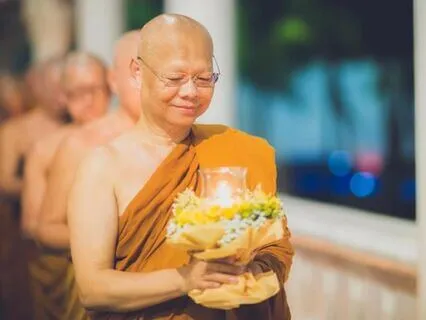
So today,
There are those coming to do a circumambulation in homage,
With flowers,
Incense,
And candles.
And those at home give their homage as well.
We take our hearts and recollect the virtues of the Sama Sambuddha.
This is an outer expression of body and speech.
As for the mind,
We can recollect the Buddha constantly,
Through each day.
Each hour,
We recollect the Buddha often,
And he makes us have fullness of heart,
And samadhi arises.
We're able to control over the defilements.
Rapture and bliss arises.
And we learn the Dhamma,
Especially the last teaching of the Buddha,
Where he taught us to not be heedless.
Three months before that,
The Buddha had announced that he would relinquish his sankhara,
Bodily form.
He looked upon the city of Vesali for the last time,
And relinquished the lifespan of his mortal form.
And the Buddha left with metta and compassion to the town of Kushinara,
To attain final nibbana.
He went to a small town,
To avoid a war in the future.
If the Buddha attained final nibbana in a large city,
Then the people would start a war.
And so the Buddha went to this small town,
And in the long past it had been a large city of a wheel-turning monarch.
And even in the end,
The Buddha had perseverance,
Determination,
And endurance,
To go teach the layman Chunda and his wife,
So they could attain to becoming sotapannas,
Stream-enterers.
And to teach the ascetic Subbada,
Who would be the last arahant monk in the life of the Buddha.
So can we see how excellent the heart of the Buddha is?
And the Buddha taught the final teaching that,
Bhikkhus,
May you all bring heedfulness to completion.
Bhikkhus here means those who see the dangers in the cycle of saṃsāra.
So laypeople who see the danger in saṃsāra can have minds that are a bhikkhu as well.
So may you be established in heedfulness,
Because life is not certain.
The Buddha was the sammasambuddha,
And there was no one who could argue against the Buddha.
But his bodily form had to decay like this.
For eighty years,
The Buddha used up his body to have the most value.
It couldn't sustain itself anymore,
The cells had to decay.
So we should not be heedless.
We can't be heedless anymore.
If we are seventy years old,
Then in ten years we will be eighty.
If we are sixty,
Then we have twenty years left.
And time passes quickly.
For young monks,
Young laypeople,
Don't say it's still a long way away.
It's not a sure thing.
We need to train in the practice and develop the mind.
Because we don't stay in this world forever,
We stay in it temporarily.
We will have to let go of everything,
We must throw it all away.
And no one wants to leave.
Having been born,
We don't want to go,
We want to stay forever.
But we look and see that no one has ever stayed forever.
Even the sammasambuddha is not here anymore.
He couldn't.
His body had to break apart.
And so he reminded us.
Mostly our hearts are deluded.
Ignorance takes us to be deluded.
It takes us to enjoy.
What makes us deluded is enjoyment and pleasure.
The enjoyment takes us to be lost,
To not think and contemplate.
And then we forget for a short time.
And then we're thirty years old already,
Forty,
Fifty,
Sixty,
Seventy,
Eighty years old already.
It's close to time being up already.
Or many die before that.
Or those who die after.
So don't be heedless.
So it is a commemoration of the full moon of vissaka,
Of the sammasambuddha's birth,
Enlightenment and final nibbana.
In one way,
It is according to time.
But in the heart,
The Buddha was born when he was enlightened.
Enlightened,
The Buddha was born.
And the defilements were also nibbana,
Extinguished then.
So may you be established in heedfulness,
Following the Buddha's teachings.
Then you will develop your minds to be higher and better.
Give up bad deeds,
Cultivate meritorious deeds and purify the heart.
Then you will meet and see the Buddha truly in your hearts.
May you grow in blessings.