Today is the 11th of October,
2023.
In terms of Dhamma practice,
When we contemplate this body,
We contemplate it as impermanent,
Ever-changing,
Suffering,
Dukkha,
Not self,
Not me,
Not mine,
Which means we can't control it.
It arises based on causes and conditions.
So we have these causes,
It arises,
Then it changes,
It's not lasting,
Then it degrades,
And the cause for degradation is there,
Then it degrades,
And it's suffering as well.
This suffering arises based on causes as well.
So when we have ignorance,
Craving,
And attachment,
These are the causes for suffering to arise.
And when there's no ignorance,
Craving,
Or attachment,
Then suffering ceases.
And ignorance,
Craving,
And attachment,
They're able to be abandoned by walking the path of virtue,
Collectedness,
And wisdom,
The Noble Eightfold Path.
This is able to cut off the attachment so that suffering doesn't arise,
So that nirodha,
Or cessation,
Arises.
So we abandon this attachment,
This upadana,
And we abandon suffering.
Cessation arises.
So we abandon this attachment,
This upadana.
This is the mind that sees.
If mindfulness and wisdom aren't there,
If they're not enough,
Then there's no wisdom.
This is the path,
The magga,
Having weak energy and not being strong.
And when the path is weak and the defilements,
The kilesas,
Have more energy,
Then suffering arises.
So there's a fight here between the path and the kilesas.
And if we don't train the mind,
The kilesas are already strong enough to succeed,
Because the mind has ignorance,
Craving,
And attachment all the time.
So we need to train,
To train the mind to be smarter,
More intelligent,
To give rise to knowing,
To wisdom.
There is no brightness,
No illumination that's comparable to wisdom.
This brightness on the outer level we've seen before.
The sun arises in the morning and sets in the evening,
But it doesn't make our minds bright.
This is an outer brightness,
It's not an inner brightness.
So we need to train to give rise to inner brightness.
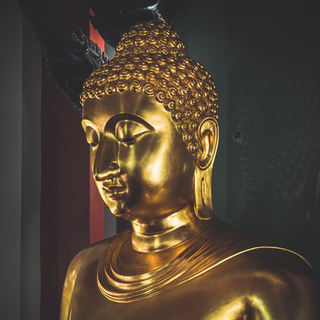
So the Buddha is bright already,
Is the awakened one,
The Buddha.
So what do we need to do to realize being a Buddha,
To be a Savaka Buddha,
A disciple,
An awakened disciple?
So to bring the mind to be an awakened disciple,
We need to understand and know,
Following the fully self-awakened Buddha,
We need to train.
So we have this faith and belief in the Buddha,
That he did awaken,
Did realize purity,
Is free of kilesa,
Free of defilement.
Some people believe this,
Some people don't.
But for Buddhists,
They believe this and feel very sure about it.
But one hasn't yet seen it in truth.
But there's this quality of faith,
There's this mind of faith.
Having this faith already,
Then one needs to practice following the teachings.
This is important to give rise to value and benefit for us.
Because the Buddha didn't want anything or wish for anything any longer.
People pay homage to the Buddha with flowers all over,
And pay respects,
Pay homage,
Bow,
Praise.
And only doing that,
The Buddha didn't wish for that.
The Buddha wished for us to practice following his teachings for our own welfare and benefit.
This is the patipata puja,
Or the homage through practice.
So we walk and sit in meditation,
Contemplate the Dhamma,
To give rise to the Dhamma in our own mind.
So we use this quality of faith that we have.
We see the Sangha,
The monastic Sangha.
We bow,
Pay respects,
Say satu.
We see that the members of the Sangha are intent to practice as an offering to the Buddha,
Intent to follow the precepts,
Follow the celibate life,
The holy life.
So we respect that,
Have faith for that,
Say satu.
Then we see that our minds are lost in the world,
Lost in wanting,
Wanting to become,
Wanting to have,
Wanting to gain,
Wanting to have various types of material wealth,
Wanting to become this or that.
This is normal and natural,
Because we think that when we get those things,
Then we'll get happiness.
So we see that all minds want happiness,
No minds want suffering.
But then when we don't get what we want,
Then we suffer.
There's no end to that suffering,
Doesn't end,
Doesn't stop.
If we have the wealth that we wished for,
We still suffer.
We have worry,
Busyness,
Distractedness of mind,
Annoyance,
Anger,
Ill will,
Agitation,
Just the same as before,
The exact same as before.
So when it's like this,
We see dukkha,
We see this quality of suffering,
The noble truth of suffering.
We see separation as well,
Separation from that which we love,
Meeting with things that we don't love,
Or associating with people that we don't like.
Or we see our bodies,
Our condition,
Formations change.
This is suffering as well.
We see suffering.
We think that it's suffering like this,
And then we think,
How can we escape from it?
What's the way out?
So people read the texts and see,
As a way to try to understand how to seek the end of suffering,
To see what did the Buddha teach.
He taught generosity,
Virtue,
And meditation,
Or you could say virtue,
Collectedness,
And wisdom.
Just like the Venerable Yassa,
Before he realized awakening,
He felt very agitated,
Very bothered.
He walked into the forest,
And his mind felt very troubled,
Very agitated.
The Buddha taught,
Here is untroubled,
Here is unagitated.
So Venerable Yassa came to listen to the teaching of the Buddha,
And the Buddha taught about generosity and virtue,
The benefits of generosity and virtue,
Which is happiness.
It's happiness of heart,
Being relaxed,
But it's not yet peaceful.
We see that one must separate from that happiness,
And so there's drawbacks to it.
So therefore one must train the mind to have samadhi,
To have peace and collectedness,
To practice nekama,
Practice renunciation,
On the outer level,
Like the eight precepts,
Or the 227 precepts.
Then there's the renunciation of the mind,
Just to bring the mind to peace,
Collectedness,
And stillness,
To renounce all the moods and sense impressions that we like.
We can compare it to a log in water.
We take that log out of the water.
It's difficult to burn it,
Because it's wet,
Thoroughly wet.
So we have to put it in the sun for a long time,
Let it dry out.
Then we're able to light it on fire.
This is like the mind that's liking all the time,
It's not peaceful,
It's not seeing the Dhamma.
So we need to train the mind in samadhi,
So the mind has liking,
Disliking,
Feeling hurt,
Upset,
Having anger,
Ill will,
A mind that's troubled and agitated.
So we need to contemplate that this body is a heap of suffering.
It's a heap of that which is not beautiful,
A heap of change and impermanence,
A heap of not-self.
So we contemplate the body to see that it's covered in hair,
Skin,
Nails,
Teeth,
Hair of the head,
Hair of the body,
And it's filled with all these organs,
All these organs packed together,
Piled together.
So we contemplate these 32 parts,
Like the stomach,
The intestines,
The liver,
The lungs,
The brain,
The blood,
The lymph,
The oil of the joints,
The phlegm,
Saliva,
The mucus,
The bones,
All the different organs,
All these different parts,
And on the outside,
The hair of the head,
Hair of the body,
Nails,
Teeth,
And skin.
Then the inside is completely full of different organs and parts.
But we don't see this.
We see it in the way that we're used to.
We see it in our old way,
Seeing it as something beautiful,
Something that's self,
Something permanent,
Something that's a source of happiness.
So to see it thinking itself like this,
That's normal.
It's a cause for suffering.
So we bring the mind to be peaceful and still in order to give rise to wisdom,
To see it in another way.
And this is able to change the mind,
To abruptly change the mind.
This is seeing the truth.
This is seeing the Dhamma,
Which is seeing the truth of the way things are.
And this truth is something amazing and miraculous.
We see that all these bodies of ours,
Covered in skin,
Covered in cloth and so on,
We take all of that away.
We see that it's not self.
There's not anyone there.
There's no being,
No me or mine there to be found.
Bring the mind to stillness.
We see that life is uncertain.
All lives must end in death.
We don't see a being or a person.
We don't see someone of this nationality or that nationality,
This or that race.
This is a mind that's still.
The mind starts to proliferate,
And then we see that in truth there's nothing there.
It's not like that.
We see that it's not self.
There's no one who dies.
There's no person there.
This is something we've heard before,
That it's not self.
But then we wonder to ourselves,
Well,
This is not self.
Well,
How is it really?
What is that really like?
We've heard that the body is like a robot or automaton,
And we can think that,
But it's on the level of perception.
Sometimes,
For instance,
There was one senior monk who would see people walk by,
And he would see them just as a skeleton walking by.
He wouldn't see a person there.
This was his mind that was peaceful.
But if we see a person,
That means our mind isn't peaceful.
So we need to contemplate a lot to bring the mind to samadhi,
To give rise to wisdom,
And see it's not a person,
Not a self,
And see it just as a skeleton.
Before we see it as a person,
Then we see that that's not true.
There's no one there.
This body isn't anything.
It's not permanent,
Not lasting.
So therefore,
There's no one who dies.
There's no one who's born,
So there's no one who dies.
This is nature.
This is dhamma.
It's a robot that arises.
This body arises,
Stays for a little while,
And ceases.
So we contemplate this to see with wisdom.
So the Buddha wanted us to see this,
To follow the dhamma.
And then we see that all the flavors of food,
They can't compare with the flavor of dhamma.
The flavor of dhamma is supreme amongst all flavors.
It's this flavor of fullness,
Contentedness,
Rapture in the mind.
So we have that flavor,
The flavor of dhamma.
So may all of you make effort in this practice to see the dhamma.
Sometimes the mind is agitated and troubled,
Filled with doubt.
This is normal for the mind to be busy or troubled or annoyed.
So have mindfulness to watch over this,
To see that there's nothing there.
It's the mind with attachment.
There's nothing to it.
There's nothing there.
Sometimes we feel we have a problem or issue.
We go to consult someone else about it,
And that other person tells us that it arises from this cause or that cause.
So we have to be careful about that.
We shouldn't or don't listen to people who are deluded.
This just makes the mind more troubled and busy.
Because all of our suffering,
It's arising because of our wrong views,
Just that much.
The suffering arises due to our own wrong view.
So if someone tells us that someone else sent us our suffering or gave us our suffering,
Sent the suffering to us,
Makes our mind agitated and troubled,
This is wrong view.
It arises in our own minds.
And this is normal as well.
So we need to train and see that it's like this.
Sometimes the mind is troubled.
Sometimes it's peaceful.
If our mind is peaceful every day,
That means we're proficient,
That we have a lot of parami,
Spiritual virtues.
So may you do this practice,
Practice as homage to the Buddha.
This is a great blessing in our life to know and see and understand the Dhamma.
And once you see the Dhamma,
Then you keep practicing in order to let go completely,
In order to know all moods and sense impressions in time as they arise,
To separate the mind out from the sense impressions in order to let go,
In order to not suffer.
So may you all set your hearts on this.