We have sati,
Recollection and awareness of the breath,
Together with the meditation word bhutto,
Or we can use wisdom to contemplate,
Or meditate mentally repeating empty,
Empty.
The aim is for our minds to be with the one mental object.
When we can do it continually,
Then the mind and the mind object will be one.
The mind will be peaceful.
Bhutto,
Empty,
Or any of the meditation words will cease.
Getting to this point,
Then the meditation word ceases without us intending it to.
The mind is more peaceful.
There is bhitti,
Rapture,
Fullness of heart arising.
And it's not just when we sit in meditation.
When we are walking and we recollect our goodness,
We recollect our making of bharami,
Spiritual perfections,
Of giving dhana,
Keeping sila,
The moral precepts,
And a feeling of fullness of heart arises.
We recollect the merit that we will be doing later on,
And our hearts feel full already.
This arises in the heart first.
It is all bharami.
The goodness that we do today,
Then after today passes,
It is our bharami that we have built.
If we build and grow it a lot,
Doing it today,
Every day,
In this lifetime,
Then in future lives,
This merit and bharami will support us to meet with happiness.
One who gives dhana and makes merit regularly will have abundance in all the four basic requisites of life.
Those who like to listen to dhamma,
Who develop mindfulness and cultivate their minds,
Will gain wisdom.
By having sila,
One will have wisdom,
Have all one's limbs complete,
And have a long life.
By not harming all living beings,
Harming people,
Then our body will have few sicknesses.
In a past era,
Of a past Buddha's dispensation,
There was one novice who was sweeping leaves and rubbish.
But being a young novice,
He was a little stubborn and didn't want to throw the rubbish.
And one senior monk told the novice to take the rubbish to throw out.
The novice begrudgingly had to do it.
When the novice had swept and cleaned the vihara and courtyard of the kshetiya and threw out the rubbish,
Having made merit and bharami,
The novice made an aspiration,
May I have a lot of wisdom,
Just like the waves of the great ocean.
And he made another aspiration,
May I be a great king that has power and glory like the midday sun.
As for the senior monk who had special knowledges and a high level of samadhi concentration,
He knew of the novice's mind.
And as he was the one who made the novice to do the work of cleaning and taking the rubbish out,
He made the aspiration,
May my wisdom be able to receive the waves of the great ocean.
And in the future,
After the time of our Buddha,
The novice was born as King Malinda.
The senior monk was born as Venerable Nagasena.
King Malinda had wisdom,
Who would question all the monks,
And there was no one who could overcome him.
As for the arahants,
Who didn't want to argue with the king,
They evaded him.
King Malinda thought he was very smart.
There wasn't anyone who could answer his questions.
But when the king met Venerable Nagasena,
He felt excited and afraid.
King Malinda asked many questions.
But Nagasena had an incredible skill of answering,
Because he had a lot of wisdom.
At seven years old,
Nagasena had learnt the three Vedas of the Brahman belief.
He completed it all.
And it was the Venerable Arahant Rohana who took in and ordained Nagasena as a novice.
Venerable Nagasena learnt the Abhidhamma and was sent to go learn the Vinaya and Suttas.
He learnt it all very quickly.
He had mindfulness and wisdom and could teach the Dhamma.
Hearing it,
One elderly woman could attain to Sotapanna,
Stream entry.
And there was a wagon merchant who received the Dhamma from him and attained to Sotapanna as well.
When Venerable Nagasena had finished his learning,
He ordained as a monk.
Later,
He developed Vipassana,
Insight and became an Arahant with all the special knowledges.
And he could win over and convert King Malinda.
King Malinda asked Venerable Nagasena,
Was the Buddha real?
If the Buddha was real,
Have you ever seen him?
Venerable Nagasena said he had never met the Buddha.
But he was convinced that the Buddha had been enlightened,
Becoming an Arahant.
The Buddha was real for sure.
One who practices following the Buddha's teaching is one who sees the Dhamma.
And one who sees the Dhamma sees the Tathagata,
The Buddha.
One who attains to Dhamma attains to the awakening of the Buddha.
So the Buddha is here.
Venerable Nagasena asked back,
Is there the first king of your lineage?
There is.
And have you ever seen him?
King Malinda could then accept it.
And the king asked many other questions of which Venerable Nagasena could answer them all.
This was from the merit and barami that had been built before.
And from having built mindfulness and wisdom.
Built the spiritual quality of jhana,
Mental absorptions.
And then coming to be born as Venerable Nagasena.
And King Malinda had built barami and became a great king.
So we that have built barami,
Being born in this life,
Some have a lot of wisdom.
And they will learn in their studies and fields quickly.
They are intelligent.
They learn the knowledge of a doctor,
A nurse,
An engineer,
An architect.
Various fields of law or different vocations.
They are very skilled in their profession.
And they develop and cultivate their minds and do it well.
This is because of having determination and their merit and barami.
It is pupepunyata,
Merit done in the past.
So this is important.
And it is also the merit and barami done in the present.
If in the past life we did only a little,
Then in the present we have to do a lot.
We listen to the teachings from the Krupa Ajahns,
The great teachers,
And we follow and practice them.
Then we will see and know the Dhamma.
And the path of practice to bring us to wisdom is not hard at all.
We have faith and confidence already,
And we have a determination to learn.
We learn in pariyatti,
The theory of the practice.
We understand it to a reasonable level,
And we take it to practice.
We develop our sati,
Mindfulness,
A lot.
We give dana and have sila as our foundation.
We practice it regularly.
And sila is especially important.
The dana and sila we have done,
It is a merit and barami of a very high level.
Because those who are determined to keep the five precepts for their whole life,
It is not easy.
If we can do it,
Then it will bring us great benefit.
And the higher benefit of sila is for the purpose of gaining samadhi and wisdom.
So having dana and sila makes us be born in heaven easily.
Why?
Because of goodness.
Our mind is uplifted.
And although cultivating bhavana,
Training our mind to be peaceful and tranquil is a bit hard,
But when we have faith,
Our mind is at ease already.
Sometimes we may just walk and enter the hall,
And we have rapture arise already.
There is a feeling of fullness in the heart already.
We haven't yet bowed to the Buddha,
And we already feel content and full in the heart.
The mind is peaceful and tranquil.
Here we don't need to chant if we want.
We make the mind peaceful and in samadhi.
Because all the chanting we do is developing recollection of the Buddha,
Dhamma,
Sangha.
It is for our minds to be peaceful and tranquil.
And when the mind is peaceful already,
Then rapture arises.
Our hairs stand on end.
Not coming from fear,
But coming from a feeling of fullness in the heart.
This is what we call the five forms of rapture.
And some Dhamma practitioners may meet or experience with rapture.
Or for some they may not have much rapture,
But have equanimity.
And the mind is peaceful and tranquil.
So this is us having made our mindfulness and samadhi firmly established.
It's being within the Noble Eightfold Path.
So sitting here we have sila,
Samadhi and bhajna,
Wisdom.
It is walking the Noble Path to the end of suffering.
And that we are doing this is because of having seen the drawbacks of suffering.
Of the cycle of birth and death.
Of parting from loved and pleasing things.
This is all suffering,
As we understand it.
The cause of suffering is attachment and clinging.
From having a sense of self,
A me and mine.
Because of the ignorance of our mind.
So because we have avicca,
Ignorance in our mind,
Then there arises attachment and clinging.
So it's like this.
But when we learn and listen to the Dhamma,
Then the teacher will teach and point it out to us.
Like Venerable Ajahn Chah would talk of conventions.
We need to know conventions according to the truth.
There are conventional truths that are correct by way of the world,
As we know and learn about.
So Ajahn Chah said in this world,
In English,
They call a chicken and a duck.
But suppose we understand a chicken was called a duck,
And a duck was called a chicken.
Then in the present,
We would know that a duck makes the sound,
Cluck,
Cluck,
Cluck,
Cluck.
And as for the chicken,
It makes the sound,
Quack,
Quack,
Quack,
Quack.
So that's a chicken.
If the convention was like this,
Then we would call it as so.
Both the duck and chicken are living beings.
They don't really have names.
We could call them anything we want.
So Ajahn Chah would talk about understanding and truly knowing conventions.
Sometimes he may change the name of a spittoon and would say,
To bring over the glass,
Pick up the glass,
Which he would be referring to that spittoon that he called a glass.
And if we don't know conventions,
Then we would be unsettled by this,
That Ajahn Chah had spoken wrongly.
He has no mindfulness and had forgotten himself.
But it's not like that.
He changed the conventions for us to understand that in reality there is no spittoon.
We could call it a glass,
Or we could call a glass a spittoon.
It's like this.
If we understand this,
It's normal then.
We can pick it up fine.
It's the four elements.
The heap of earth,
Water,
Fire and air.
If we are male,
It is a convention.
A female is a convention.
But it makes us understand each other.
A monk is a convention.
So we understand conventions properly.
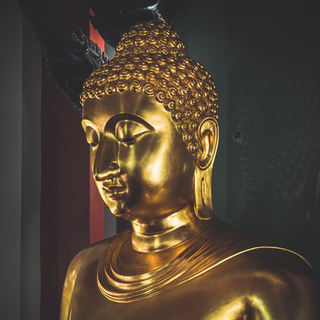
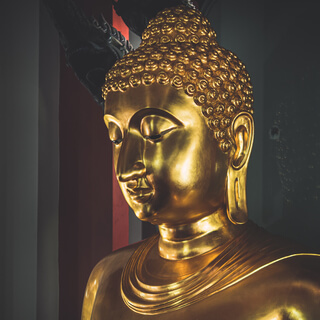
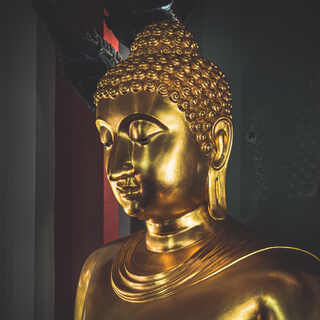
Like we have the faith to create a Buddha statue.
It may be made from different materials.
It can be made from wood,
Moulded from clay,
From cement.
Or a Buddha that is specially finished within one day.
We could make it from bronze or copper.
Or having a lot of faith,
We could make it from gold.
So because of faith,
We build an image in the likeness of the Sama Sambuddha,
The perfectly self-awakened Buddha.
We call it a representation of the Buddha.
If we are a child,
We may think that it really is the Buddha.
When we become adults,
Then we understand that those wise ones had built it so that we can come to bow and give homage and think of the Buddha's virtues.
So we understand about conventions.
But seeing conventions,
We think of the Buddha and we gain merit and skillfulness arises.
Those who build it think of the virtues of the Sama Sambuddha and merit and skillfulness arises.
This is the building of goodness.
So we know in terms of conventions that in reality,
A glass is the name of a convention.
Be it small,
Middle or large,
Or all the colors,
They are all conventions.
Our mind gathers together.
It sees the truth that this is a convention.
Then liberation arises.
Can we see that they are together?
So we have wisdom.
Wisdom coming from listening,
Studying,
From thinking and contemplating.
And then there is the knowing that arises in the present,
Right here.
And those who have a lot of wisdom may attain to becoming an Arahant.
It comes from contemplation and with a spiritual foundation of mind imbued with mindfulness and samadhi.
So we are developing samadhi.
May you make it complete.
Practice it often and make your merit and barami to be more ready.
Make all skillful qualities be more complete.
As long as you still have a breath,
May you all be determined and put forth effort to build merit and barami,
To cultivate your minds a lot.
Until you gain the arising of knowing and wisdom,
May you grow in blessings.