Part 2.
When the Mind Finds Strength Throughout my first,
Second,
And third rains retreat,
The level of calm in the mind progressed steadily.
As each year ended,
I was able to look back on it and notice that the level of calm had increased.
My mind was at ease,
Totally cool,
Like being in air conditioning.
So cool and so wonderful.
This gradually progressed year by year,
And by my fourth rains retreat,
The practice really came together.
The mind and body felt so cool that I would shiver.
If I met with cold weather,
I would feel even colder.
My bodily elements couldn't adjust to this change.
There would just be this continuous feeling of coolness.
Some people instead experience heat that pervades the body,
But the calm is there.
It depends on our own bodily elements.
The experience of calm and peace in the heart will manifest accordingly with whatever element is predominant.
But this peace can still deteriorate and disappear because it is subject to anicca,
Dukkha,
Anatta.
When this happens,
We have to keep investigating and meditating anew until the heart becomes calm again.
After we re-attain calm within the heart,
The practice starts to get even better.
It's like the mind is more strength and meditation starts to get more fun.
However,
When there are sensory impingements coming in,
If we can't contemplate them clearly,
Then it becomes too much suffering to bear,
Severe suffering in the heart.
Although we want to overcome these moods,
We just can't.
Doubts and uncertainty spin back and forth.
We want to be back on the right path,
Regaining clarity.
Lungpu chow would stress not to worry about it.
Leave the doubts alone.
They are just a hindrance.
When there is no calm,
Everything seems a mess.
The doubts spin round and round,
And we feel way off the path and can't seem to get back on.
We wonder where to go,
But every direction seems to lead only to dead ends.
Everything seems dark and hopeless,
And we can't get around it.
We just paralyze ourselves,
And the mind spins around and around,
In and out,
And the doubts drag us down and then come all again anew,
Again liking,
Again disliking.
But if we keep at the practice without stopping,
It must progress.
The practice will move us forward.
Later,
When we have come to the point where the power of the mind,
The power of samadhi,
And the power of investigation are strong and effective,
This is where the practice becomes smooth.
Whenever we investigate,
There is calm.
We don't have to tell the mind what to do.
At this stage,
It knows the path to proceed.
At this point,
Investigation will proceed smoothly by itself and proceed in the correct way as well.
The practice has momentum,
And there is no doubting,
So we start to understand the Dhamma clearly.
So to get to this,
How do we practice?
What do we do?
In the start,
We have to watch the fundamental things.
If we're eating too much,
Know that this is kilesa,
A basic one.
Then watch the mind.
This thinking,
Proliferating in restlessness,
We can't make it stop instantly.
So we need to keep trying and keeping at it,
Performing whatever duties we need to perform while keeping up our investigation.
As monks,
Investigation of Dhamma is our primary duty.
Kesa,
Or hair of the head,
Loma,
Hair of the body,
Nakka,
Nails,
Tanta,
Teeth,
Tacho,
Skin,
These are the five kamatthana which we need to develop,
Investigating and contemplating them backwards and forwards.
Munku ca would usually teach the way to abandon attachment to the body during the ordination ceremony for new monks.
He wouldn't talk about body contemplation so much in his general teachings,
But when talking about his personal practice,
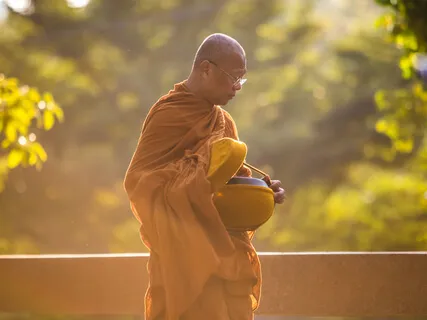
He recounted how he would visualize other monks and novices as corpses and ghosts as they walked ahead of him on alms round,
Or else he would visualize himself as a decomposed corpse.
His own strength of mind had already developed to the point where he could contemplate the body fluently in this way.
The work of investigation is just like this.
If the mind is calm and still,
We can understand many things with a greater clarity and understanding.
But if this calm isn't yet there,
We will just be flooded with doubts and uncertainty.
In the beginning,
We must investigate anew,
Bit by bit,
Developing this strength within the mind.
The way of practice.
Go against your heart's desires.
When I was staying and learning from Munku ca,
All his ways of instructing and training were aimed at grinding down our defilements,
Going against our wants.
This is a really important aspect of the practice,
Not just always following our desires.
In the past at Wat Nongpaphong,
When it was time for the rains retreat,
Sometimes monks and novices would volunteer to go off to a branch monastery,
But sometimes no one would volunteer to go.
So Munku ca would just send people away.
Sometimes it suited them,
Other times not.
Some monks,
After they had been sent off,
Would come back later saying,
Oh,
Why did he send us to this place?
It was terrible.
Why has he put me through this?
We have to rely on using kanti,
Patient endurance,
As a foundation of the practice.
With patient endurance,
We can consider and investigate until we can resolve the negative feelings that arise.
This is an important quality in the training and practice,
Together with having respect and reverence for each other.
This is where the practice starts to grow from.
In Munku ca's way of teaching and instructions,
He would also emphasize indriya-samvara-sila,
Restraint of the senses,
Jagarya-nu-yoga,
Devotion to wakefulness,
Bhojani-mata-nuta,
Moderation in eating,
And contentment with the four requisites.
This is the foundation of the practice.
Keep right with these.
Whether our progress is fast or slow,
It's up to our spiritual maturity and accumulated merit.
It isn't certain.
Some meditators come along later but progress quicker.
How does this work?
It's because of the cycle of samsara.
Some are around for a long time but still haven't achieved many results.
Whether someone succeeds sooner or later is dependent on their accumulated level of Parami.
The ones who find success quickly put forth effort and accumulated a lot of Parami in a previous life.
Maybe someone had enough Parami to be ordained in the time of the Buddha,
But only enough to ordain at an old age,
Which was too late to allow them to see the Dhamma.
It really depends on the merit we have accumulated.
Some monks have been practicing ever since they were a novice and still haven't got any results.
They may even reach old age and still not see any results.
This doesn't just apply to one individual monk.
It affects everyone.
Different places,
Various methods,
Same teachings.
Though we might have ordained in previous lives,
Maybe we still haven't seen any results.
This will depend on our accumulated merit,
Our Parami.
It follows us.
But whatever our situation is,
We have the opportunity now to practice the Dhamma in the way of our teachers,
The Kṛbha-ājāns.
We have to stick to these principles.
Don't deviate from them or let them go.
If we have let these principles go,
We are off the path.
If we have let them go,
We have let go of the very thing that will help our progress.
Many different monasteries teach this correct path,
The way of contemplation.
Certain meicci meditation centers also teach the same path,
Keeping sati,
Watching over the body,
Watching over feelings,
The mind and mind objects,
Right within the sati-bhātana.
If we watch right here,
Probe at this,
We can understand and see the Dhamma.
Keep practicing along the principles of the vinaya,
Or monastic disciplinary code.
These principles give us a means for correctness,
Uprightness and grandeur.
It is the way to make our conduct beautiful.
This is the way that will lead us to further progress.
In a certain lineage,
The teacher will teach the way to develop things like manoma-yiddhi,
Or creating mind-made bodies,
With the power of mind and other psychic powers.
They are real but exist within the field of abhinyas.
Practicing for psychic powers requires the development of abhinya,
For which we need a high level of parami.
But these teras,
Or elders,
Only use these psychic powers to attract people to the Buddhist teachings,
To pull them in by getting them interested.
Because we all like psychic powers,
Special kinds of mental tricks.
They really pull us in and attract us.
First they get people's attention with their psychic powers.
Then they explain that if we practice the way they teach,
That we can develop these powers too.
That's it,
Hooked.
I want to practice this way.
They explain that if we want these powers,
First we have to develop sila,
Then we will see them.
But when we try it,
They still don't come.
These powers still haven't come about.
So the teacher says it's because we don't have vipassana.
We need to develop vipassana.
Then we quickly notice,
Hey I still haven't developed these psychic powers.
So the teacher tells us that we have no samadhi.
Then if we still haven't developed them,
They tell us it's because our sila isn't pure enough.
So it's back to the start.
It all comes back to the basic principles of sila,
Samadhi,
And panya,
Just like that.
The way of attracting people through psychic powers is just a different way to teach the same principles by using a means of getting people interested first in developing faith.
Some monks,
Though they may have abhinayas themselves,
Don't speak of it because they are inclined to teach by way of reason and investigation using panya.
Lunkpucha exemplified this style,
Teaching and advising with his own knowledge and experience of the practice,
Knowing the ways of progress and the ways of decline.
There was once a monk who started the sun as his kasina meditation object until he gained supernormal psychic powers,
Like being able to read others' minds.
But later he fell into delusion.
He just lost the way.
He could sit all night without nodding off,
But he still fell into delusion.
He later disrobed and went crazy.
Lunkpucha wouldn't allow his monks to get into this sort of playing with kasinas.
Though there were a few monks who still did use the sun as their kasina meditation object,
Despite Lunkpucha's objection,
In general he wouldn't have any of this.
Because he knew the correct and important aspects of the practice,
Lunkpucha would try to pull them back onto the right path.
He knew that most of the monks that get into kasinas fall into the same trap.
They stray from the path.
With the training of the mind,
Sometimes we find it really difficult.
We find that it's too hard and burdensome.
If we haven't got enough parami,
Yes,
It is difficult and burdensome.
If we have enough parami,
Though,
It isn't hard at all.
Whichever way it is,
We need to patiently keep at it,
Following the principles of practice laid out by our elders,
Such as Lunkpuman and Lunkpucha.
These great monks and many others traveled on the path that leads all the way to arahantship.
This path is based on making the mind peaceful,
Then moving into investigation within the framework of the body,
Or else using the investigation of the body to make the mind peaceful.
Some monks go straight to looking at the mind.
They skip over and don't investigate the body at all.
They just watch mental feelings and thoughts.
If we really watch over the mind with sati,
It has to stop thinking.
We need to be able to stop it.
If we really focus and watch right at the mind,
The thinking has to stop.
Watching with unwavering attention,
Focused on the mind,
We see the thoughts arise and pass,
Arise and pass.
Eventually they will stop.
This is the sati that watches over the mind.
We see that this mind is only the mind.
The thinking ceases.
We have to follow it.
Follow it with knowing.
If we try this and the thinking doesn't stop,
This means that our sati is weak.
If we try to keep using this weak sati to investigate in this way,
Sooner or later we are going to run out of energy.
All of our strength will be depleted,
And we may become lost in our thinking.
There are so many monks who have encountered and experienced this.
They haven't entered upon a path which lays out the principles of practice in their essence.
The correct way to develop the mind in meditation is to not let it get attached to liking or disliking.
To do this,
Lumpu ca had us contemplate the body.
This is important because it is the way to bring the mind to peace.
When we talk about fixing attention on the breath,
This means being mindful of the body and the body.
Once the mind finds peace,
It becomes radiant and luminous,
And our contemplation will be able to separate the mind and the body.
The knowing,
Or the knower,
Will become prominent in our awareness at that point.
The knower will see any hindrances that are arising in the mind,
And will know where they are and on what level they are arising.
It will also know the level of radiance of the mind.
This is something we can observe.
Once the state of radiant awareness has manifested clearly in the mind that knows,
Then we will know that we are following the correct path of practice and the right way to proceed.
Our own experience will match that of all the teachers,
As we have heard and studied.
We will know at what level the mind is at and what stage our practice has reached,
Because the teachers have pointed out each stage as we are experiencing it.
The experience of apana samadhi.
If we are going to gain expertise in investigation,
We have to do it often,
Really develop it a lot,
Do it a lot.
At the start,
We will probably experience fatigue,
Exhaustion,
And difficulty exhaustion,
And difficulties,
Because we have to poke at and look right into all our moods,
Into all the feelings and thoughts that come up,
The manifestations of liking and disliking.
But we have to keep investigating continuously and consistently,
So that the mind doesn't go chasing after all these moods.
When we start to be able to follow and guard the mind,
We are in the present and our samadhi begins to progress a lot more smoothly.
The mind will be able to move to the level of kānaka samadhi.
But whenever we walk jangama or sit in meditation,
This samadhi will go deeper.
Fixing attention on the kamatthana that we are using and are skilled in,
The mind can move to upajarā samadhi.
Whether we are walking or sitting,
Whichever we find the most effective,
By taking up the method we have gained proficiency in,
Entering upajarā samadhi will be quick and easy because we are already skilled.
But when we come out of upajarā samadhi and encounter the various emotions and moods,
The mind will still get involved in them.
So we have to keep our sati up with them.
If we continually investigate the body,
Feelings,
Mind and mind objects,
Our sati will become firmer and our samadhi will become stronger.
Being able to develop the mind to enter apana samadhi depends on our accumulated merit.
Some monks don't experience it until after many years.
Some experience it after five or six years,
And some in only one year.
Apana samadhi.
This is where samadhi is at its most calm and cool.
Wītaka,
Vīcāra,
Vṛti,
Rapture,
Sukha,
Or joy,
And eka gatā all converge into one.
It's like the pendulum of a grandfather clock that usually swings from right to left,
But it stops still in the middle.
At this point,
Even if we want to think,
We can't.
The mind is so still that there is no movement of thought whatsoever,
No proliferation.
There is only the knowing.
After the mind has been calm and still for a duration depending on its own strength,
It will withdraw from that state.
We then have to move into investigation.
We take up this body,
Our physical form,
And investigate to see it with total clarity in the light of anicca,
Dukkha,
Anatta.
From here our investigation will move along by itself,
As if on automatic.
It has a momentum of its own.
We investigate to see ourselves as merely elements.
We can investigate our own hair.
Suppose our hair falls out.
We will realize that it isn't ours or a self.
This will give rise to the understanding that there isn't a permanent entity or a self.
Wisdom will arise.
The mind and body will separate and be seen clearly as different from each other.
The mind and feelings will also separate.
We will see clearly,
True understanding.
But if we don't yet have the ability to enter apana samadhi and our investigation isn't at the point where we can see this separation clearly,
Then we must rely on continually developing whatever level of samadhi we have.
This whole process will lead to the maturing of the practice and the understanding of dhamma.
We maintain kānaka samadhi when in a normal state,
Going about our daily activity.
And then when we sit,
The mind will go straight into upajjara samadhi.
In time,
We will be able to remain in upajjara samadhi in all postures.
When the mind proceeds deeper into its investigation of the body,
Feelings,
Mind and mind objects,
It will incline towards apana samadhi.
The mind's strength progresses around itself like this.
Now the mind will be able to see sharply and clearly.
Before we were fully skilled in entering apana samadhi,
It is possible to have some periods of the mind staying in upajara samadhi for a whole month.
The body and mind are light and at ease.
There are still external sense impressions,
But they don't affect the heart because samadhi has separated them out due to its power.
Effort and diligence in the practice now has a momentum of its own.
The heart will always be wakeful and alert,
Equipped with the bhojangas.
There is pithi,
Sati,
And samadhi.
If we make the effort to maintain sati continuously,
Mindfully keeping up with all the moods and emotions we experience,
And seeing the body as it truly is,
Our samadhi will gain stability and be kept smooth and even.
Without having to do or control anything,
Our meditation moves along smoothly by itself.
The mind remains in the state of upajara samadhi.
This is the result of the continuous development of our practice,
Investigating until we understand and see clearly into the dhamma,
Until there are no more doubts.
This samadhi is firm within us.
We don't need to try and control it or be overly cautious.
It's at a good level,
But not quite to the full extent.
We have to keep proceeding down the Noble Eightfold Path.
We have to keep investigating,
Investigating just like we have been,
Practicing like we have been.
Step by step,
It will take the strength of the mind to a new level.
Some monks are skilled at making their minds peaceful by using the parikamas utto,
Dhammo,
Sango,
Or watching the breath until their mind reaches stillness.
We have to keep up with our kamatthana that we are experienced with in order to pass beyond our moods and emotions,
Overcoming all the hindrances.
When we have various mental states of desire,
Aversion,
Drowsiness,
Restlessness,
Irritation,
And doubt,
We have to train and adapt our samadhi to cross over and beyond those mental states.
This is called focusing the mind.
This is bhavana.
This is samadhi.
This will give us the foundation that supports the practice,
The practice of panya.
When we are proficient in all these levels of samadhi,
Kānika,
Upajjhāra,
And apana,
Our investigation comes about quite easily.
Whether we direct our contemplation to the body,
To feelings,
Mind or mind objects,
Within no long time,
Maybe even in three or seven days,
We will be able to see the Dhamma in all its clarity.
However,
If we follow the path of panya developing samadhi,
We must keep investigating and letting go of the kalesas one by one,
Bit by bit,
Little by little.
Because our samadhi isn't yet firm and stable,
We have to rely on using panya to develop these states of samadhi.
This samadhi might not be as deep as in the way of samadhi developing panya,
But we still need it to support the contemplation.
Whoever follows the path of wisdom and contemplation will need to keep investigating with panya until the strength of samadhi is gradually developed up through the levels of kānika upajjhāra and apana.
The understanding of Dhamma will then arrive at full clarity.
Ultimately,
Whoever develops samadhi needs to get to the level of apana.
If samadhi hasn't yet reached maturation,
It will be impossible to see the Dhamma clearly.
Here panya and samadhi should be operating in balance and harmony with one another.
We can use either of the two ways of practice,
Panya developing samadhi or samadhi developing panya.
Whichever way works,
This is the way to progress along.
The maga or path of sila,
Samadhi,
And panya.
If we have a lot of work and duties,
Practicing samadhi and making the heart at one by using a meditation word or using the breath may be difficult.
Knowing that it is hard,
We need to firmly set sati to the task of guarding over the heart and bringing it to calm.
If we are going to practice samadhi in this way,
We need to keep bhuto constantly with us.
Whether we are standing,
Sitting,
Walking,
Lying down,
Or whatever else we might be doing,
We have to keep the meditation word bhuto always in the heart.
If we are eating,
We have to be thinking of bhuto so that the heart is at one with it.
If the heart is always with bhuto until it is the only object within,
We can then prevent all the impressions from outside from entering and disturbing it.
But if we are keeping an eye on the mind,
That is to say,
Recognizing our thinking,
Proliferation,
And restlessness,
Though there is some level of knowing,
The sati is too weak to be able to keep the mind in check,
So we must bring up bhuto.
Every time that there are thoughts arising,
We mentally repeat bhuto until all our thinking is reduced and bhuto is there in its place.