Today is the commemoration of the important day in the Buddha's dispensation that we know as Magha Puja,
The full moon day of the third lunar month.
Magha is the name for the third lunar month,
And so what is the importance of this day?
In the dispensation of our Sama Sambuddha,
The perfectly self-awakened Buddha,
There is just one time that the Buddha teaches this Dhamma on the foundation and heart of his teachings.
And the Sangha of the Buddha of 1,
250 monks,
Who were in different places in all directions,
Gathered together having recollected the Sama Sambuddha.
And they came together without any prior arrangement.
Here each of the Buddhas would gather in this way,
And though may have different numbers of Sangha,
They come together to hold an uposada,
A fully pure meeting of the Sangha.
And the Buddha gave a teaching laying down the foundations,
The important principles,
Which are the non-doing of any evil,
The cultivating of merit,
And purifying the mind.
And these are principles we can use in leading our life.
For children,
They need to have a foundation in learning.
Adults need a foundation in doing work.
Then they can succeed in their lives.
So the foundation of Buddhism is to abandon all evil,
Unskillfulness.
There is unskillful actions and speech,
And of the mind.
We have to try to abandon it.
The whole world is in chaos because people of the world don't abandon evil.
There are various mental states of greed,
Anger,
And delusion,
And they are the root of all evil.
The Buddha knew that bhāpo,
Unskillfulness,
Evil,
Is hot.
So he taught us to give up evil.
And to get to the coolness of the mind,
Then we need to practice merit and goodness.
Like today,
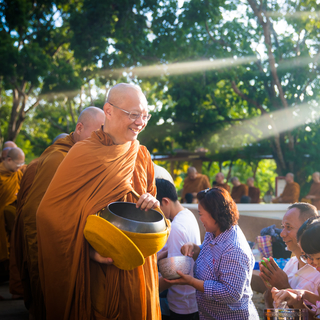
You have given alms,
Taken up the moral precepts,
And have given homage to the virtues of the Buddha,
Dhamma,
Sangha.
We commemorate Magha Puja Day from our faith in the Buddha.
We puja,
Give him homage.
We give homage to the Dhamma that the Buddha gave on the day of Magha.
We give homage to the purity of the Sangha of 1,
250 Arahant monks,
Which is something not easy at all to find.
For just one Arahant to arise in the world is hard,
And there were many of them.
So we give homage to their virtues,
Through building goodness,
By giving dana and giving alms,
By keeping sila,
Offering sangha-dana,
And listening to Dhamma.
And listening to the Dhamma is important.
They are the teachings of the Buddha,
And then we take it to practice,
To make all our merit to be the most complete.
We do it through our strength,
Doing it as much as we can.
We practice developing merit and goodness.
And bhavana,
Meditation,
Is kusala,
It is a great goodness.
Because our mind can give dana,
And can keep sila,
Moral conduct,
Virtue,
But the mind is not still yet.
It thinks of things which are unskillful,
And also thinks of many other meritorious things.
So we need to come to meditate.
We have sati,
Mindfulness,
To look over the mind,
Until our minds are peaceful.
And then we will see even more of the benefits of the practice.
In this discourse,
The Buddha further talked on cleansing one's mind to be purified,
Making the mind pure,
Which means that before it is pure,
It is not white,
It is black.
We need to try to make the mind clean,
In each revolution,
Each round,
Until the mind is all pure and bright.
Then it will be a venerable arahant.
But if we can make it 75% bright,
It is a venerable anagami,
50% and it is a venerable sakadagami,
25% brightness and it's a venerable sotapanna.
But we have to try to have brightness bit by bit.
And we can do it.
That is,
If we are determined,
And we have ideals for our life.
And in the beginning,
We have dana and sila,
Which requires us to have kanti,
Forbearance,
Patience.
This is an ideal that the Buddha taught.
All good things need us to have forbearance.
For laypeople,
For students,
For adults doing work,
In doing bhavana meditation,
For all the sangha,
It all requires forbearance.
We need to patiently endure all things.
And we know this already.
We have to endure the painful feelings of this body.
This body is dukkhang,
Difficult to bear.
But we need to bear with it,
Too.
Because we don't yet have the wisdom to understand that rupa and nama,
Material and mental phenomena,
Are aniccang,
Dukkhang and atta,
Impermanent,
Unsatisfactory and not-self.
So we need to endure with it.
Because the body changes.
Then the teaching comes to where the Buddha says,
Nibbanam paramam vadanti buddha.
All the awakened ones say that nibbana is the supreme dhamma.
So it is not an ordinary and normal dhamma.
Giving dana and keeping sila is dhamma,
But it is normal.
It is not yet supreme.
Using samadhi concentration,
Making the mind peaceful,
It is not yet supreme.
It is not the supreme dhamma.
But the coolness of the mind,
Or the wisdom that knows and understands into the four noble truths,
Is the supreme dhamma.
That is nibbana arising.
All the awakened ones are the sammasambuddhas,
That have enlightened already and have enlightened in this Buddha's era,
And the Buddhas that will be enlightened in the future.
They are the knowing ones,
The awakened ones,
The radiant ones in the dhamma.
They will all teach that nibbana is the supreme dhamma.
But laypeople can see it as well.
Or at the highest level,
They can attain to it as well.
In the time of the Buddha,
There were many who saw and attained to dhamma,
Who were laypeople.
And then they ordained as monastics and novices.
So to be able to see nibbana as a supreme dhamma,
We look at what did the Buddha have us learn about.
It is about dukkha,
Suffering,
Samudaya,
Its cause,
Nirodha,
Its cessation,
And magga,
The path.
Which we have often heard about.
Dukkha,
The suffering of the body,
The suffering of the mind.
What is it like?
Have we seen it?
Hunger and thirst is suffering.
Not resting enough is suffering.
The heart's not beating the right rhythm is suffering.
In the past,
We could walk easily.
But now we may have problems with our feet,
Or there is something wrong with the joints.
Then it's suffering.
Tooth pain is suffering.
There is aging,
Sickness,
And death,
Separation from loved ones and loved things.
We meet with things we don't like.
We are with people we don't like,
And then we suffer.
In brief,
Upadana,
Attachment to the five khandhas,
The aggregates of body and mind,
Are suffering.
So suffering arises.
The Sama Sambuddha teaches us further that this suffering,
The Buddha has known into it.
So what is suffering,
And what should be done with suffering,
Is that it is to be known.
And how do we know it?
We know that this suffering is a state that cannot endure.
There is nothing that can be stable forever onwards.
There must be change according to causes and conditions.
This is dukkhang.
It all changes.
The Buddha understood it clearly.
The state of suffering,
It must be like this.
The Buddha had known it,
That suffering has change constantly.
It has causes and conditions for this suffering to arise.
And when the cause of suffering ceases,
Then the suffering itself ceases.
It is not that suffering arises without any cause.
It has a cause.
And the Buddha had found the cause.
He found that it is just this tanha,
Craving.
See,
Tanha is the craving and pleasure in forms,
Sounds,
Tastes,
Odors,
Physical sensations and mental objects.
There is sensual indulgence,
Wanting to have and wanting to be.
And when we don't get something we like,
Then we don't want to have it,
Or for it to be like that.
So there are these three types of craving.
They are the cause for suffering to arise.
And the Buddha has known it.
Oh,
Suffering arises because of this master.
If craving does not arise,
Then suffering does not arise.
And what to do with tanha,
Craving?
We need to deal with it.
And we know the method.
Whatever it is that we suffer over,
We don't want it.
So we need to deal with the cause of it.
Of all the causes.
If we are lazy,
Then we need to deal with that cause.
We need to be diligent and hard-working.
If we are someone who uses money extravagantly,
Then we need to deal with it by being thrifty and saving.
We know this.
If the body is weak and not strong,
We need to build a stronger body by exercising.
And so on.
The Buddha knew that we have to deal with this craving.
We should abandon it.
If we can abandon it,
Then suffering does not arise.
Because we don't like suffering.
But it must arise if we have the cause.
So we have to abandon the cause.
The Buddha had contemplated it and could abandon the cause.
Craving should be abandoned.
The Buddha had abandoned it and so attained to becoming the Sammasambuddha.
And if one can abandon craving,
Then how is that?
Nirodha,
Cessation,
Arises.
The abandoning of that craving.
Letting go.
The liberation from all clinging.
This is called nibbana,
Coolness.
If craving arises,
There is suffering.
It is hot.
If there is no craving,
It has ceased.
Then coolness arises.
When coolness arises,
It is called nibbana.
So what to do to attain nibbana?
We need to make it clear and apparent.
This shows that the mind is dark initially.
So we need to make it clear,
Apparent,
And to be bright.
When it is bright,
Then we let go of the craving by itself.
We have wisdom.
Suffering does not arise.
And the Buddha could do this already.
So how to make the heart clear and apparent?
We need to walk magga,
The path.
What is the path?
It is sila,
Samadhi,
Panna,
Morality,
Concentration,
Wisdom.
And how to develop it?
The Buddha had developed the path fully,
And the four noble truths in completion.
It is separated into two pairs.
The first pair is,
Craving is the cause of suffering.
And the second pair is,
Walking the path,
Which makes nibbana arise.
It is two pairs.
If the strength of the path is weak in our heart,
Then it can't fight against craving and the defilements.
So then suffering arises.
And we don't want this.
Nibbana is coolness.
Our hearts will be white and pure.
How much ever it is purified,
Then our mind is cool to that level.
There is that level of nibbana in the heart.
So we need to learn how to walk the path to the utmost.
So chanting and meditation,
And today we have given dana and kept sila,
It is all walking the path.
It is the supreme path.
Magga is the path.
Ariya magga is the supreme path.
In this world there are many paths.
There are roads,
Flight paths,
Boat paths,
Or even a path underwater.
Wherever there is a path,
One can travel.
But it is a path within this world.
It is not supreme.
The supreme path is the noble path.
So we are fortunate that we have learnt about the supreme path,
The teachings of the Buddha.
We are fortunate to have heard and have faith in the Buddha.
So we need to try to really walk the noble path in this life,
Before our body,
Which is dukkhang,
It decays and breaks apart.
So learn about it.
We have gotten a body,
So take the mind to learn about the body,
That it is like this.
It decays like this.
Our hearts be able to accept it with wisdom,
That it is a heap of impermanence like this.
It's a heap of suffering like this.
We can't control it,
Both the body and the mind.
And then we will then see the Dhamma.
In the beginning we will see the Dhamma,
By accepting the truth of sankhara,
Conditioned phenomena,
That all Dhammas,
All phenomena,
Come from causes and conditions.
When the causes cease,
Then suffering ceases.
All suffering comes from causes,
That is craving.
If there is no craving,
If craving ceases,
Then suffering ceases.
Then the Dhamma,
Which is nirodha,
Cessation,
Can arise,
Because the causes have been built,
Which is to walk the noble path.
If the path is present,
It comes up,
Then nibbana arises.
If the path is weak,
Then nibbana can't arise.
The heart is not purified.
The Buddha taught of the supreme Dhamma,
That is making our heart purified,
To be nibbana.
And it is the local,
Original language saying nibbana,
Which means cooled.
The rice pot that has finished cooking the rice has been put out.
It is nibbana already.
It is finished.
It is cooked.
Our heart is the same.
We need to cleanse the mind to be purified.
Because the defilements that attack us makes the mind polluted.
So we need to have mindfulness,
Seeing arising and ceasing,
Being able to see that material and mental phenomena are impermanent,
Unsatisfactory,
And not-self.
By seeing it to whatever level we can,
We need to train in it,
By having patience and forbearance,
Which is the quality that is the highest incinerator of the mental defilements.
So may you try to maintain your goodness,
Abandon evil,
Cultivate goodness,
And purify the mind.
Have forbearance and patience in your life,
In your studies,
In your work and duties,
And in your Dhamma practice and meditation.
Build merit and your spiritual qualities.
And when being with others,
Don't speak ill,
Don't physically harm,
Don't criticize,
Don't put others down,
And give your forgiveness to others a lot.
Forgiveness is dhana.
It is abhaya dhana,
Giving fearlessness.
So may you practice this,
And then one day the mind will be peaceful,
And you will then see all things as being of the nature to change.
It is not our self,
Not us.
Then you will see the Dhamma at the beginning stage,
And you grow in blessings.