After the Buddha had taught the Pancavagya the five ascetics,
He spent the first vasa,
Rains retreat,
In Isipatana Deer Park for the entire three months.
The beginning of this tradition,
Or the cause of having to enter the rains retreat,
Was because usually this period coincides with the time of agriculture,
The season when the rice seedlings were germinating and about to sprout.
So travelling in the time of the Buddha,
One would travel through the fields,
Or tracks for carts.
As the tracks for carts were sparse,
It was mostly through fields,
And so if those ordained would walk,
They would cause damage to the crops and rice seedlings of the villages.
So this was the cause that the Sangha had to stop travelling and stay in one place,
So as not to step and trample on the crops that the villagers had planted and damage them.
And this would bring risk of being criticised and getting blamed,
That the Sangha should not travel during this season.
So there were the rules about spending the rains retreat coming up.
Yet the Sangha still may travel in a way that would not break the rains retreat for a period not more than seven days,
Like for the purpose for the monk's medical treatment,
Or their mother and father is ill,
Or a monk has an ordained disciple who has thoughts to disrobe,
So they go to teach Dhamma to that individual ordained in the Buddhasasana,
The dispensation,
For them to lessen those types of thoughts.
Or sometimes there is a large merit-making ceremony,
And they invite the monks to lead the ceremony so that they can make merit.
But there are some occasions when one has entered the rains retreat already,
And like for example there's a big flood,
And the monks can flee to escape it to another place.
Or if there is disaster and danger arising,
Or the people supporting them in that area,
Or the villagers leave,
Then the monks aren't able to survive there.
Like if there is a fire or flood,
Or incidents including bad people causing to harm them,
Or dangerous animals causing harm,
Here when we have the chance to spend the rains retreat,
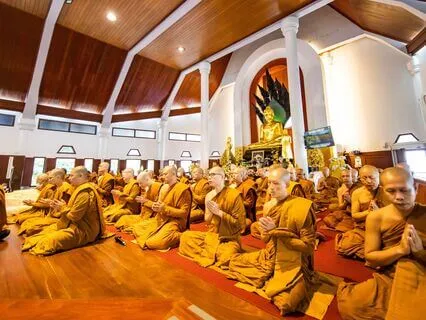
The monks will revise the Vinaya,
The monk's discipline,
And about Dhamma practice.
As for laypeople,
They may enter the rains retreat being determined to keep the five precepts and the eight precepts,
Or to establish such a vow to sit meditation in one day,
One hour or two hours.
They can try to offer alms every day,
And try to develop mindfulness a lot.
At the minimum,
Have the five precepts always,
And try to keep the eight precepts on the weekly lunar observance day.
In some places,
Laity will keep the eight precepts,
Staying in the monastery,
And may not sleep for one night following the monk's way of practice.
Be determined to chant and bhavana,
Meditate.
Some will chant Ittipiso 108 times,
Some may chant the Jinapanjara gatha 9 or 18 times,
And so on.
This is up to one's determination to try to develop the mind to be better.
And so for the monks entering the rains retreat,
There is the tradition of the practice of giving respect,
And a practice of humility.
Like by giving respect to the elders,
The place where we are at.
Like in the monastery,
Then the monks will give respects to the head of that monastery,
Or being in that village,
A district,
Province or city,
They give respect to each other according to seniority.
These days,
There are the monks who are in a position of administration,
And the monks will give respect to the administrative leaders,
Who will lead the group in the correct way.
When I was at Wat Nong Pa Pong,
It was on the 16th of June,
When it would be the opportunity to gather and formally give respects to Venerable Ajahn Chah,
And then after,
The monks would go off to spend the rains retreat.
And Venerable Ajahn Chah would lead the monks to go pay respects to the monks who had duties of administration in that province.
Whichever province we are in,
The forest monks will have the tradition to respect the monks who are heads of that province.
This is a good conduct and a practice of humility,
And humility is contained within the Buddha's teachings on the 38 highest blessings.
When the mind has humility and respect,
Even though we may have knowledge in our heart,
But we keep it in and put it down,
We don't attach to it so that it becomes views and conceit.
When we are humble and give respect in this way,
Then it will become a social group that when witnessed,
Is praiseworthy,
Organized and in harmony.
When entering the rains retreat,
There is the establishing of a vow,
Determining to spend the rains retreat in that place.
And for monks who have a mind with a strong power of sati,
Mindfulness,
Then they will make a determination to not think outside of the monastery,
To only think of things in the monastery.
Some monks are even more firm-minded and will establish their mindfulness only in their kuti,
Hath.
This requires a lot of barami,
Spiritual virtues,
Likely on the level of an arahant,
A fully enlightened being.
Those who have the strongest barami will have mindfulness only in their bodies.
To be able to do this,
They must have extremely well-established samadhi concentration.
These are examples for us to think and reflect on that we need to bring our mindfulness in closer range.
Because these days,
Our mindfulness,
Our recollection,
Goes all over the place.
We receive lots of information and news.
When we receive a lot,
Then we know about every subject.
But that knowledge damages our mindfulness and bhanya,
Wisdom.
So we reduce what we receive,
That which is received by our eye,
Ear,
Nose,
Tongue,
Body.
We reduce it.
We reduce what the mind receives.
Then we'll be able to bhavana,
Meditate a lot.
Like for our thoughts to reduce,
We use the meditation words buttho,
Dhammo,
Sankho,
And then the mind is peaceful.
If we talk a lot,
Then the mind is not peaceful.
So we have to be determined to talk only a little.
Like in the monastery,
There are monks who determine to not talk all through the rains retreat.
Because if they talk a lot,
Then the mind is all scattered.
It becomes a lot of the sense of self.
All the forms,
Sounds,
Odours,
Tastes,
Sensations and mind objects.
And thoughts are mind objects.
When there are mind objects,
We think,
Then we say it out.
It's all about us and our self.
When we can restrain the senses,
We talk little,
Then we see the mind.
We see the thoughts arise,
So that we can see that it's not us or ours.
Good thoughts,
These thoughts arise from delusion that causes the mind to proliferate.
It's a sankhara,
A karmic formation.
Both good thoughts and bad thoughts,
They are karmic formations on the side of merit and demerit.
So for demerit,
We throw it away.
What is merit?
We do it.
But we do it with letting go too.
Even if we can't do it yet,
We will try to practice it this way.
And in the rains retreat,
We have time,
So we practice fully.
After the rains retreat,
We have work and lots of duties in the name of Buddhism.
Lay people have lots of business they need to do.
So we need to train.
We train like this,
And this is cultivating a good mind to arise.
When we do this often,
Do it every day,
Every month,
Every year,
Then the mind gets better.
The mind will have more knowing,
Have more understanding about leading our life.
We will have wisdom.
Wisdom is knowing,
An all-rounded knowing.
The highest wisdom is the all-rounded knowing of the heap of Sankhara,
Compounded phenomena,
According to the truth,
The knowledge of rupa and nama,
Material and mental phenomena.
So there is wisdom from hearing and listening.
There is wisdom from thinking and reflecting.
And there is the wisdom from Dhamma practice.
And in all our worldly learning,
It all uses mindfulness and wisdom.
It is used in education,
In doing work,
And in our job.
Having knowledge in various fields,
We use that knowledge to give benefit to society.
Like we discover and understand various fields,
In medicine,
In education,
And it can make people have more sila,
Dhamma,
Morality and goodness.
And it's also imbued with knowledge.
Then that's even better.
So Entering the Rain's Retreat is about the ultimate learning of the teachings of the Sama Sambuddha,
The perfectly self-awakened one,
Of what is samadhi like.
We revise over the five precepts,
Eight precepts,
Ten precepts,
227 precepts.
For the laity,
They revise over the five and eight precepts.
The novices revise the ten precepts.
The monks revise over the 227 precepts,
So they have more understanding in it.
Because this sila,
Moral conduct,
Leads to having happiness and peace arise.
And it applies even for young children,
An eight-year-old and a twelve-year-old being together.
An eight-year-old child doesn't really know anything yet,
But a twelve-year-old will know things already.
But society these days has developed a lot.
In the past,
Children who are at the age of playing and enjoyment would play with toys,
But the toys were easy to obtain and cheap.
There was no need to compete to get them,
Because we could easily get them.
But now the world is developed,
And children have mobile phones to play with,
And they may contend each other for them.
Those who have more strength may harm those who are weaker,
To the point that a twelve-year-old harmed and killed an eight-year-old.
This is very scary,
Because of not having sila,
And because of not sharing.
So in this rains retreat,
We share.
We have external sharing of material things,
Of things we need to use.
The laypeople share food,
And the monks share what they have.
They can share the four requisites that the laity have offered,
While those with dhamma share to those who don't yet have dhamma.
Teachers teach disciples in various fields.
When the disciples receive this,
They have respect for education and in learning.
We have respect for the owner of the Buddha sasana,
Which is the Buddha.
We respect the dhamma,
The teachings of the Sama Sambuddha.
We respect the Sangha Sawaka,
The true noble disciples of the Sama Sambuddha,
And we try to learn the training rules,
Which is having respect for the Vinaya.
And what is important is that we respect heedfulness.
Heedfulness is the path to the deathless.
Heedlessness is the path to death.
So this refers to the last teaching of the Sama Sambuddha.
When we are heedful,
We learn about sila,
Learn about samadhi,
Learn about wisdom.
Being a child,
Truly learn your subjects.
An adult still needs to learn.
They learn in their work and duties.
Learning doesn't stop.
They need to use it to lead their lives,
Whether for the laity or monastics.
So keep being determined.
Have effort to practice to gain understanding.
Have wisdom to lead you in your work and duties.
Then you will walk the right way.
And some people in this world have no path to walk because they receive the result of their karma.
Many can't choose their path to walk.
But some people have many ways to walk.
They can be a human,
Be a deva,
A divine being,
Can train samadhi to be a Brahma god.
But because of delusion,
It leads them to walk in the wrong way.
They can be rich,
But getting rich in the wrong way,
By having no sila,
Having no dhamma.
Then they have happiness,
But in no time they will receive the fault of not having sila dhamma.
But one who walks the right way,
They walk on the path to have their heart be in peace with sila,
Having generosity,
Morality and meditation.
Just like we have determined and vowed to do.
This is correct and undiluted.
This is not being led by the defilements going to the lower path.
So the monks should be firm and determined to practice and meditate in the right way.
Sit and walk meditation and go to morning and evening chanting.
Some monks won't sleep at night or through the rains retreat.
We can eat food only from the alms bowl,
Eating only food gained from alms round.
So restrain and care for the mind.
The more refined practice is to restrain the mind to be peaceful.
So these are the monastic practices of the Sangha of monks in this year.
May all the laity be determined in your dhamma practice.
May you grow in blessings.