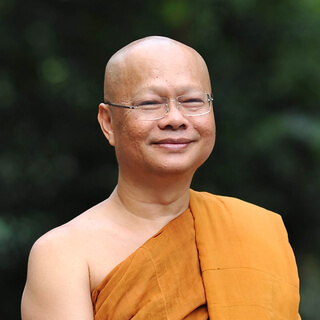
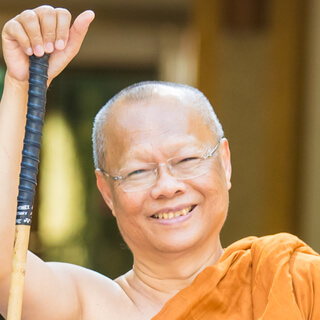
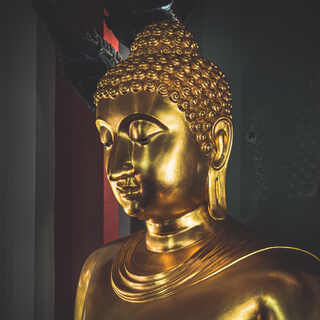
So this is a Dharma talk given the morning of July 27th,
2019 by Mungphor Nenam.
So sit comfortably.
You can sit cross-legged or you can sit with your legs to the side or sit in a chair.
So in terms of posture,
We have the sitting posture,
The lying posture,
The walking posture,
And the standing posture.
But the important thing is to have mindfulness,
Whatever posture you're in.
So right now as we're sitting,
We can be intent to know the in-breath and know the out-breath.
Just knowing the breath as it goes in and as it goes out.
And as we're aware of the breath in this way,
We can recollect the qualities of the Buddha,
The awakened one.
He was known as the Arha,
Far from the mental afflictions,
Known as the Kivasas.
He was able to save his own heart from suffering.
No one had the wisdom to know the truth before him.
But he was able to know for himself and free his heart from suffering.
Being free from ignorance,
Craving,
And attachment.
And in order to know this truth for himself,
The Buddha built his Parami,
Or spiritual perfections,
Spiritual virtues,
In order to know the truth for himself.
So when we recollect the Buddha,
We can recollect the qualities of purity,
The qualities of his loving kindness and compassion.
And this is this Parami,
Or spiritual qualities that the Buddha built.
He built these in order to help others,
In order to help us to be free from all suffering as well.
To have our hearts be free and to make this wandering on of samsara,
To make it shorter.
So in this life we can try to make samsara as short as possible.
And to do this,
You can see the path that the Buddha laid out.
The samsara wandering on is very long.
We don't know when it will end,
Which lifetime it will end.
If we still have ignorance,
Craving,
And attachment,
This ignorance,
Craving,
And attachment will follow us.
And keep following us without end.
Until we cut it off.
So the Buddha,
He gave the teachings,
Gave the dharma to his disciples.
And the disciples were able to know the truth correctly and become noble disciples after the Buddha.
They were known as noble disciples.
So if we do mindfulness,
Concentration,
Wisdom,
Then also we ourselves in the present,
We can see the truth as well.
Because this dharma,
Or truth,
Is a state or condition that is here already.
Whether the Buddha arises and teaches about the dharma or not,
The dharma is here already.
It's like these human bodies of ours.
They're born and they're here already,
But the mind does not know the nature of the body clearly due to delusion.
So the Buddha taught us to develop these qualities of mindfulness,
Collectedness,
And wisdom.
We can recollect his qualities and practice following him by developing mindfulness.
For instance,
Through chanting the chant,
Iti-piso,
Three times or nine times in order to make the heart peaceful.
We can do this while also knowing the in and out breath.
And if we have mindfulness continuous with the in and out breath,
We can recite on the in breath,
Bhut,
And on the out breath,
Do,
To recite bhuto,
Awakened,
Or awakening.
And then as our mind gets more peaceful,
Bhuto disappears by itself.
We don't need to intend for the mantra to disappear,
It just disappears on its own.
Then the breath becomes more subtle,
The body feels lighter.
We can even feel like we're sitting in the middle of the air.
So feeling like we're sitting in the air,
This is the heaviness of the mind attaching to the body,
Getting less and less.
The heaviness is not at 100 percent.
So the body feels lighter,
The mind feels lighter,
Concentration arises.
And another kind of happiness arises that is not from outside things.
It's a happiness that comes from inner peace.
A peace of the heart which is very important and something that no one can give to us.
Whereas the happiness from outside things,
This happiness cannot last at all.
But if we do concentration,
Our mind and body can feel light and we can see the qualities of anicca,
The changing nature of things,
Dukkha,
The stressful or unsatisfying nature,
And anatta,
The quality of ownerlessness,
Or things being not-self.
But we have to have a peaceful mind first and develop that in order to develop wisdom that knowing can arise,
Such as knowing the five aggregates,
Knowing our body and mind as they are.
So develop mindfulness and concentration.
This is important.
So for us sitting here already,
We already have the qualities of dana,
Or giving,
Siva,
Or virtue.
In this giving,
It's not just the four requisites of food,
Clothing,
Shelter,
And medicine.
It's also the giving of forgiveness to others.
For instance,
People who might think bad thoughts or do bad things to us.
We can give them the gift of forgiveness.
And these qualities of anger and vengefulness,
We can put them aside because they make our minds not peaceful.
They're known as hindrances,
Things that cover over our heart and obscure our vision.
But if we have concentration,
Then we can have rapture,
And then wisdom can arise.
And it can be enough wisdom to cut off anger and vengefulness temporarily.
So we use mindfulness and wisdom to contemplate even deeper.
And we see that these feelings of anger and vengefulness,
They exist.
But there's no owner there,
There's no self there.
It's just a phenomenon of the mind.
A phenomenon of the mind coming from ignorance,
Attachment,
And craving.
And these phenomena that cover over the mind have covered over our minds for a long time already.
And they give rise to these moods and mental phenomena that arise and then pass away constantly.
If you try to look for a me or a mine,
A you or an other,
You cannot find that.
Really there is no self there at all.
So the Buddha taught that everything arises from causes.
When you see this,
Then emptiness can arise in the heart.
This is what we call nirvana,
Or nirvana,
A coolness,
A freedom from the mental afflictions,
A freedom that's temporary.
So we see the truth,
We see the dharma,
We understand it.
We can see that all phenomena are changing,
Stressful and not self.
And the heart becomes more and more free and spacious,
More and more empty.
We can also see,
This is called seeing convention,
And when we see convention clearly,
Then freedom arises in the heart.
So we can take the example of asking ourselves,
Are apples and guavas different?
Well we call them different fruits,
But this is just a convention.
If we see clearly,
They're just the four elements of earth,
Air,
Fire and water coming together.
If we separate these elements out,
Then we'll see that there's nothing actually there,
Just emptiness.
We can also look at other religions.
Other religions might teach that there is a life that's eternal,
Where there's no change at all,
A life we can have with God.
We can contemplate what is that which is eternal in Buddhism.
We call that what is eternal in Buddhism,
We call nirvana.
It's something that doesn't change,
Something that the mind can experience,
Where there's no change at all.
But if there is form,
If there is materiality,
Then whatever that is cannot be eternal.
Because whether it's form,
Whether it's materiality or mentality,
It has the nature of change,
Stress and onerousness.
But this dhamma,
This state or condition that's here already,
This is what we call nirvana,
And it's here already.
We can ask,
Nirvana,
Is it real?
It is real.
We say heaven exists,
Hell exists,
The great high gods exist,
And nirvana also exists.
And where is nirvana?
If a human heart achieves nirvana,
Then where does it go?
Does it have a location?
If nirvana has a location,
Or has a place,
Then that place would not be the real nirvana,
Because nirvana cannot be a place.
If it was a place,
Then that would mean it would be an experience or a birth.
We can compare it to a traveler,
A traveler who goes to different countries,
Like to the USA,
To England,
To Europe,
To Australia.
And then when you arrive in each place,
There arises a new experience,
A birth,
A meeting.
So traveling,
Going to a place,
It's like being born at that place when we arrive.
Experience gives rise to birth.
So if nirvana is a place like that,
Then the mind would be born into that place.
And wherever there is birth,
There is also death.
But nirvana has no birth and has no death.
So how is this?
We have to look at the phenomena of the mind.
We can look when our mind is peaceful,
And we have rapture and deep happiness,
And the mind is with utto,
With the breath,
Is peaceful and quiet.
Maybe we have felt this sometimes.
When we see this,
We can see that this practice gives very real results.
And then we contemplate this body.
This body,
Is it ourself?
Is it ours?
We contemplate and start to understand clearly that it is not us,
Not ours.
It's just a container for the four elements of earth,
Or solidity,
Water,
Fluidity,
Fire,
Heat,
And air,
Or movement in space.
There is no man there,
No woman,
No person,
No being.
We just see it's empty,
It's open.
This is possible to see.
So start with understanding and teaching the heart that this body is not us,
It's just elements,
There is no self.
And our mind can start to accept this,
And start to cut off attachments and craving for things as me and none.
The mind gives rise to more emptiness and openness.
In this mind that's empty in this way,
We see that greed,
Hatred,
And delusion are not there.
And when the mind is empty like this more and more,
And we're able to be in that emptiness longer,
How do we feel?
When we have knowing and understanding clearly into the truth,
And more emptiness arises,
And we understand the Dhamma,
We can see the Dhamma,
Then our heart becomes empty and free,
And goes to a state where there is no change at all.
We call this the heart that is in the Ivana.
So the Ivana is not any particular place or point,
It's right here in our own hearts.
So Buddhism teaches that our hearts can go to a place that is deathless,
And it is a deathless element,
A deathless realm.
This is possible.
There is no need to die or to be born,
But what is born,
Or what does arise,
Is a perpetual happiness.
A happiness and coolness of the heart.
But for ourselves every day,
We have suffering,
And this suffering arises out of our hearts that have greed,
Aversion,
And delusion.
We feel discontent,
And we feel greed or wanting,
And the more we feel this wanting,
The more discontent we feel.
And we feel we need more and more,
Without any end to it.
Or in terms of anger or aversion,
We feel very disturbed and agitated,
And we just don't want to let go.
And then in terms of delusion or ignorance,
This is like a fire that makes our hearts hot.
So we can practice to see the drawbacks,
To see the aspect of suffering of the Four Normal Truths that the Buddha taught.
Then we can extinguish suffering.
So the suffering has a cause,
Which is craving.
Craving arises,
Then suffering arises.
If there is no craving,
Then there is no suffering.
To extinguish craving we do practice,
Which is virtue,
Concentration,
And wisdom.
Because craving has the feeling that we have a me or a mine here.
So we have to keep trying to do virtue,
Concentration,
And wisdom to give rise to wisdom in the beginning.
But when we give rise to wisdom in the beginning,
It's not real wisdom.
We just use wisdom from thoughts.
But wisdom from thoughts,
It's not yet crystal clear,
Because there's no concentration behind it.
We might think the thought,
There is no self.
But really,
We do have a sense of self still there in our hearts.
Because the things that we think,
Our thoughts have clinging along with them.
The thoughts are not coming from wisdom and peacefulness.
So we keep practicing and training ourselves.
And not just when we're in the monastery,
Whatever kind of work we do,
We can keep chanting internally,
Keeping our mindfulness.
We can do the chant,
It could be so.
We can even do it 108 times per day.
If we have faith,
Then we can even do this 108 times a day by 9 times a day.
And then a busy mind can become more and more peaceful.
If we're really intent and determined,
And we decide we need to have this peace of heart,
We have faith,
We have effort,
We have persistence,
And we keep working at it.
This is just like when we study in school,
Or do our work in our careers.
We have experience with this type of effort already in our lives.
And one uses all of one's energy to accomplish the task at hand.
Then we come to now.
Now what we're doing is we're practicing developing our minds.
And this is something we have to do for ourselves,
To make our mind peaceful and concentrated.
Until we can understand the truth that the Buddha taught.
We can know in our own hearts the teachings of the Buddha.
That the Buddha taught that whatever arises,
It passes away as its nature.
And we can see this clearly.
So actually in our lives already we've seen this.
That we all are born,
We all age,
We all sicken,
And we all die.
This happens a lot.
So we see this,
But we don't yet understand clearly in our hearts.
Because we see in terms of self and other.
We see this person has birth and death.
But we don't yet see this state of truth,
That nature is just like this.
In truth there is no one who is born,
There is no one who ages,
No one who sickens,
No one who dies.
This is just the nature of reality playing out.
So this body that arises from the four elements,
Where is the self in it?
The body comes from earth,
The solidity,
Fire,
Heat,
Water,
Liquid,
Air,
And space.
So if we sit here and our breaths don't come in for five minutes,
Then the body just falls apart.
Death and heart failure occur right there.
So if we look at it,
We are able to be here because of our breaths.
So why do our hearts think that it is possible for this body to be a self?
The body is here because of this breath.
And also because of these four requisites,
Food,
Clothing,
Shelter,
And medicine.
Just like this.
So these four elements,
Just like this,
Are able to be here due to causes and conditions.
And if we look at these four elements,
If they are not in harmony,
Then they get sick,
Become painful.
Like in the rainy season right now in Thailand,
With the fire element,
The element of heat is too weak.
Then we get cold and get sick.
This is natural.
Bacterium viruses arise and give us a runny nose,
Or give us a cold.
This just arises from causes and conditions.
Just that much.
We contemplate.
This is not us who is in sick or in pain.
This is just the four elements.
The elements are like this.
This is natural.
We do our best to take care of them.
And in our minds we have mindfulness and wisdom.
We see the truth of this body and mind.
Then we contemplate the truth.
We contemplate,
Use our concentration,
Let our minds be peaceful and still.
We practice this quality of collectedness,
Our concentration in meditation.
This is something that has great benefit in merit.
A vast amount of merit.
Even more than giving or practicing virtue.
Giving and virtue are very good and important.
And they actually develop our hearts to be able to have collectedness and concentration.
To be able to not have anything that makes our hearts hot or upset.
We can be at ease.
So virtue is the basis for concentration.
So may we all make effort every day to chant and meditate.
Like to chant Samma,
Sambuddho,
Or Sambuddho,
Or just Buddho.
Then our minds can become peaceful and still.
Our doubts vanish.
Buddho can disappear and the mind is at peace.
We see the body walking here to and fro.
Sitting,
Standing,
Lying down.
We see it's not self.
This won't take long to see if our mind is really peaceful and mindful.
So this virtue of concentration and wisdom,
They come together and we understand clearly that it's really not a self here.
Doubts vanish.
We destroy wrong and deluded views in our hearts.
So I ask all of you to determine your minds and hearts to develop your minds.
We will chant now.
So determine to cultivate your minds in the process of chanting.
Have good mindfulness and awareness.
Don't get distracted and lost in thoughts.
And make effort in this.
Do this often,
More and more often.
This will have the benefit of being able to see the truth in this lifetime.
May the law be well.