Samadhi for Liberation,
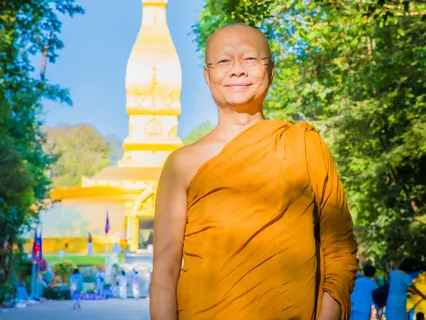
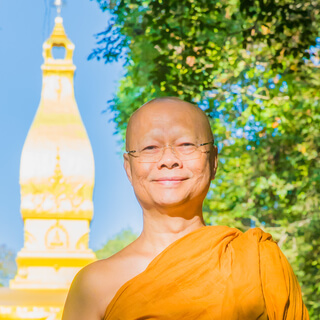
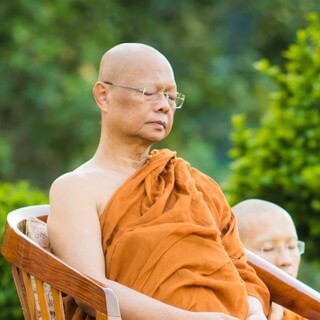
A Dhammadesana by Venerable Ajahn Anand Akinceno,
Explaining the complementary roles of Samadhi and wisdom in the practice of freeing the heart.
When the heart has been brought to peace through repetition of the mantra Bhutto in conjunction with the in-and-out breathing,
Then we no longer need to maintain this mantra in mind.
With the heart at ease,
Peaceful and still,
We can just simply be aware of the breath coming in and the breath going out.
When the heart is peaceful and still,
Various physical sensations will manifest within.
Sometimes we may feel that the body is expanding as we sit,
Filling the whole room or meditation hall.
The body can seem to enlarge so much that we feel it is touching the ceiling.
We might also feel tingling sensations or waves of rapturous energy thrilling throughout the body,
Causing the hair to stand on end.
If this rapture or pity is strong,
The body can seem light or weightless,
As if it were floating in space.
With this experience of pity,
The body feels light and tranquil,
The mind peaceful and still.
This experience of momentary peacefulness,
Where the mind has entered a slightly concentrated state,
Is called Kanaka Samadhi or momentary Samadhi.
If this state of tranquility lasts longer,
For example,
5,
10,
15,
Or even 30 minutes,
Then the heart enters a deeper state of peace called Upajara Samadhi.
This is a state of concentration that is neighboring or on the verge of entering the total stillness and serenity of jhana.
When the heart settles into the peace of Upajara Samadhi through practicing mindfulness of breathing,
There is an awareness of inner calm and stillness.
At this level of concentration,
The mind is not yet completely still.
It can be compared to the pendulum of a clock swinging slightly to the left and right.
There is a slight amount of mental activity and a modicum of thinking,
But mostly the mind is peaceful.
This movement of the mind is the activity of Vaitaka and Vichara towards the meditation object.
Vaitaka is the initial application of the mind that takes up or focuses upon the sensation of breathing,
And Vichara is the sustained activity of keeping the breath in mind.
Feelings of pity and sukkha,
Rapture and bliss,
Also arise in Upajara Samadhi.
In Upajara Samadhi,
One is saturated in sukkha,
Characterized by feelings of internal strength and stability.
Sukkha can be distinguished from pity by the deep contentment it generates.
However profound pity may be,
Unlike the experience of sukkha,
It doesn't induce feelings of inner contentment.
When this experience of sukkha becomes very powerful,
There is no longer any movement of the mind.
It rests within,
Peaceful and still,
No longer swinging left and right.
Even if we want the mind to think,
It doesn't.
There is no longer any interest in external things.
The mind no longer registers sense impressions,
It has no concern for external experience.
The mind will not go out,
And impressions from the outside won't reach in.
No thoughts arise at this stage.
The activity of vittaka and vichara is not on the level of thinking.
Only a little pity remains.
As pity and sukkha become more distinct,
The mind becomes more peaceful.
With this attainment of inner stillness,
The mind enters a state of unification or one-pointedness called Eka Gata,
The five conditioning factors for the realization of full absorption,
Vittaka,
Vichara,
Pity,
Sukkha,
And Eka Gata,
Have now been brought to completion and the mind enters first jhana.
I will only explain up to here for now.
Vittaka is usually understood to mean thinking,
But this is not the case.
Vittaka is the initial activity of taking up or focusing on the meditation object,
Such as the breath.
Outside the context of meditation practice,
Vichara also implies thinking and mental proliferation.
In the practice of mindfulness of breathing,
However,
Vichara is the activity of staying single-mindedly with the breath,
Maintaining a constant awareness as it comes in and out without straying to other matters.
Vichara keeps up this constant,
Unwavering focus until the mind becomes peaceful and possessed of pity,
Sukkha,
And Eka Gata.
When we are skilled and proficient in the practice of mindfulness of breathing,
Then the four foundations of mindfulness will naturally be brought to perfection.
Mindfulness of breathing is the king of all meditation methods,
And its frequent practice and cultivation brings great fruit and benefit.
Sometimes we may use other methods of meditation,
And these bring results in the same way—pity arises,
Leading to kanaka samadhi,
And so on.
For example,
We can recollect the virtues of the Buddha as our theme of meditation.
We can recite the verses from the daily devotional chanting,
Recollecting that the Buddha is the supremely enlightened one,
Who is pure and free from defilement,
Self-attained,
And possessing the boundless virtues of purity,
Loving-kindness,
And great compassion.
If we devote our hearts to these reflections,
Then pity will arise.
The state where pity arises in momentary flashes can be called kanaka samadhi,
And if pity is sustained for longer periods of time,
The experience can be called upajara samadhi.
The ten recollections are themes of reflective meditation that include the recollection of the Buddha,
Dhamma,
And Sangha,
And the contemplation of death.
These reflective meditations are capable of bringing results to the level of upajara samadhi.
However,
As they imply thinking,
These contemplations cannot lead the mind into jhana,
Although they do provide a good foundation for it.
If we practice these reflective meditations,
Then the power of concentration will grow by itself.
However,
By practicing mindfulness of breathing or the contemplation of the elements,
It is possible for the mind to become peacefully unified.
Having realized the state of unified awareness,
The mind then withdraws from this deep concentration back to the level of upajara samadhi.
We should then take up the practice of body contemplation.
We can contemplate the hair,
Nails,
Teeth,
And skin of the body according to our preceptor's instructions during the ordination ceremony.
Laypeople can also take up any of the thirty-two parts of the body for contemplation.
We investigate the body to realize its nature as mere elements shifting and changing according to causes and conditions.
The body is neither a self nor a soul,
Neither a person nor a being,
Neither me nor you.
Reflecting in this way,
We are developing kaya-gata satipatana,
Body contemplation,
That is,
The first foundation of mindfulness.
The practice of mindfulness of breathing is also included within the first foundation of mindfulness,
Which is the meditation on the thirty-two parts of the body,
The ten cemetery contemplations,
The investigation of the elements,
And mindfulness of body postures and activities such as coming and going,
Sitting and standing,
Walking and talking,
Drinking and thinking,
Looking behind and looking ahead,
Working and lying down.
When developing the first foundation,
Mindfulness must always be focused within the body and must not be allowed to wander in other directions.
As we become more skilled in keeping awareness within the body through the practice of mindfulness of breathing,
Then we will gain the strength of mind to focus on other aspects of body contemplation,
Such as those given in the summary of the first foundation of mindfulness just mentioned.
We will realize that the body is merely a body,
Neither a self nor soul nor person nor being nor me nor you.
Usually we relate to the physical body as a person or being,
As our self or their self.
Contemplating this matter,
However,
We might suddenly realize,
If I breathe in but don't breathe out,
Or breathe out but don't breathe in,
Then the body will die in accordance with its nature.
If our mind is peaceful and concentrated,
We will clearly see the truth that this body really isn't a self or soul or person or being or me or you.
With this insight,
The heart becomes disentangled from the sense of self.
The body is seen as one thing and the mind as another,
Both completely different from each other,
Different aspects of nature.
At that moment,
Through clarity of insight,
Wisdom arises and Upadana is abandoned.
The attachment to the body as self is uprooted.
This realization arises through meditation and is the highest manifestation of wisdom.
Wisdom initially comes from listening to and studying the teachings regarding not-self.
After thinking and reflecting further,
We accept not-self as theory but have not yet realized this truth directly for ourselves.
However,
As we practice samadhi and then contemplate the truth with a serene and silent mind,
Clear insight arises.
We previously took this body to be our self,
But through insight we clearly see that this is not the case.
The heart lets go of attachment to the body and uproots greed,
Hatred and delusion.
It is the mind that is still and peaceful to the level of one-pointedness that sees deeply into not-self.
If our contemplation of not-self is based on other levels of samadhi without the empowerment of jhana,
Then although we also gain insight,
The realization of not-self and the experience of letting go is not as deep or profound as the level of upajara samadhi.
In other words,
Although we can also use the power of kanaka or upajara samadhi to let go of our attachment to conscious experience by seeing it as impermanent,
Stressful and not-self,
This letting go will only be on the level of kanaka or upajara samadhi.
Therefore,
The deeper the samadhi,
The deeper the insight will be.
If we then contemplate the body based on this upajara samadhi that has been empowered by the attainment of jhana,
We will clearly see the truth and let go of attachment.
The Buddha stated that those possessing the inner strength to reach the stage through much meditation and spiritual development will certainly see the Dhamma and receive the fruits of practice within seven years or seven months or seven days.
If our mind has reached the state of one-pointedness and we practice body contemplation,
We are sure to see the Dhamma and be transformed from just ordinary good people to noble ones.
In the beginning it is essential to develop samadhi because it provides our heart with inner strength.
If our practice bears little fruit,
It is because our mind lacks this inner strength and stability these qualities have not yet arisen within the heart.
In addition to this,
Our sense of restraint is not yet fully developed.
We need restraint and heedfulness to guard the mind and keep it focused within.
If we practice in this way,
The mind starts to experience the stillness of samadhi.
This is the method of the Insight Meditator.
They develop just enough samadhi for the mind to be peaceful and then,
Through contemplation,
Abandoned clinging and attachment,
Realization of enlightenment together with the three knowledges requires a more advanced method of practice with much deeper samadhi,
Twice as deep as before.
With the increased power of second jhana,
After withdrawing back through first jhana to upajara samadhi,
The depth of contemplation is far more profound than previously.
But let's leave this aside for the time being.
In the beginning,
Let us work on developing the inner strength needed to realize one-pointedness,
Starting with Kanaka Samadhi,
Then Upajara Samadhi,
And finally Apana or Jhana Samadhi.
Sometimes we might wonder why it is that although the mind has reached the level of Upajara Samadhi,
It doesn't go deeper into oneness.
The reason is that Upajara Samadhi itself has various levels of increasing refinement.
When the mind is brought to the peace of Upajara Samadhi through the power of contemplation,
This peacefulness is on a relatively coarse level at first.
After dwelling in this coarser level of Upajara Samadhi to its fullest extent,
The mind's internal strength weakens and seems to return to normal,
Just as if we hadn't been meditating at all.
We then have to begin practicing anew,
Contemplating,
Meditating,
Watching the breath,
And focusing inwards again.
We continue practicing in this way until the foundation of the mind becomes stronger,
And it enters an Upajara Samadhi of intermediate refinement.
At this stage,
The nature of the body is seen clearly,
To the point where it seems as if we can abandon all our defilements,
Cutting them off completely.
However,
The mind still doesn't become unified,
But weakens and withdraws once more.
Therefore,
We have to practice still further,
Until the mind enters the most subtle and refined level of Upajara Samadhi.
The mind that dwells in this fully refined state of Samadhi sees very deeply indeed.
Upajara Samadhi of intermediate refinement can make the heart serene for months at a time.
When skilled at this level,
The mind only requires a little focusing before entering Samadhi,
And sometimes remains there for the whole day.
The mind may slip away from Samadhi at times,
Such as before falling asleep,
But on awakening,
The mind still holds the perception of inner stillness,
And with a moment's focus,
Re-enters this intermediate level of Upajara Samadhi.
The lower level of Upajara Samadhi can arise through listening to and investigating our experience,
Both its conventional reality and its ultimate reality,
Which when seen,
Leads the heart to liberation.
For example,
We can contemplate the mind and the objects of mind.
If we abide with the sense of bare knowing,
Seeing the mind as one thing and the objects of mind as another,
Then letting go is possible.
Through insight into the conventional reality of body and mind objects,
The heart is liberated from attachment to these things.
How we perceive this meditation hall can also be the basis for investigation into conventional and ultimate reality.
Is this hall big or small?
On a day when few people come,
It appears very spacious,
And yet on festival days with many visitors,
It can seem too crowded.
However,
The hall itself doesn't claim to be either large or small.
These adjectives are merely conventions of speech,
To which the deluded mind attaches and creates its subject-object world.
In reality,
The hall is just exactly the way it is,
Nothing more and nothing less.
Through reflections such as this,
We come to see the conventional world according to reality,
Which leads the heart to liberation from clinging and attachment.
This kind of contemplation,
Where we gain deep insight into external phenomena,
Can,
At that moment,
Cause the mind to converge in samadhi.
The nine insight-knowledges may manifest also at that instant,
And the mind will see into the true nature of reality for as long as three days.
The arising and ceasing of conditioned phenomena is seen as it actually occurs.
Looking externally,
Conditions can be seen as decaying and disintegrating,
And focusing internally,
The full horror of this truth is realized.
All conditions,
Whether internal or external,
Are a cause of attachment and suffering,
And therefore should be viewed as fearful in nature,
And worthy only of disgust and dispassion.
If we see this deeply,
Then we experience great joy and contentment.
The material world is unable to give us this type of happiness.
If we have seen the Dhamma,
Then we no longer seek satisfaction in the world.
The heart is no longer attached to worldly things,
As it sees greater value in the experience of Upajara Samadhi,
And in a mind developed through meditation.
With the experience of such insight,
Our faith and confidence in the teachings of the Buddha become firmer and we start looking for the way out of this world.
These feelings of disgust and dispassion free the heart from the tendency to seek delight in the world.
In seeking the path that leads away from worldly happiness,
We increase our efforts in meditation.
When the mind withdraws from the lower or intermediate levels of Upajara Samadhi,
Where concentration was sustained for an entire day or month,
This experience cannot always be repeated.
It is the nature of meditation practice that sometimes the heart enters Upajara Samadhi,
But at other times enters only Kanaka Samadhi.
However,
The foundation in Upajara Samadhi and the insight already gained is the real driving force of the mind,
Just like the first stage of a rocket that although now out of energy,
Has already succeeded in bringing us this far,
The second stage of the rocket can now propel us to greater and greater heights.
Whatever our method of meditation,
Be it body contemplation,
Mindfulness of breathing,
Or the contemplation of death,
We have to practice and develop it a lot.
At this stage in our practice,
The heart becomes increasingly more peaceful and serene.
This state of serenity completely fills the heart and can last for many years.
With stable mindfulness,
The heart is easy to control and enters the intermediate level of Upajara Samadhi with more consistency.
At first we might not recognize this,
Thinking that we are about to enter Jhana.
Once again,
However,
This does not happen.
To continue the analogy,
We have cast off the second stage of the rocket and are now being propelled along by the third.
Nevertheless,
Our meditation deepens and we increase our effort to find ways of making the mind more peaceful.
At this stage,
Our practice of meditation is strong and stable.
The five powers of faith,
Effort,
Mindfulness,
Concentration,
And wisdom come together in the mind.
This means that the seven factors of enlightenment start to arise.
In fact,
They already began to arise from the first experiences of Upajara Samadhi,
And along with the four foundations of mindfulness,
They continue to develop more and more.
The heart becomes freer little by little up to this level of Upajara Samadhi.
At this stage,
Sometimes the mere act of recollecting Dhamma,
The uncertainty of life,
And the inevitability of death,
For example,
Is enough to make the heart peaceful.
Umpur Chah taught that if the power of greed,
Hatred,
And delusion is so strong that we cannot hold any other meditation object in mind,
Then we should contemplate the subject of death.
When newly ordained,
Mindfulness of breathing and the contemplation of death were my main methods of meditation.
This was because I still used to think and fantasize a lot about the future.
When young and youthful,
We tend to think only in terms of gain and progress,
Never of decline and loss.
For this reason,
I took up the theme of death for contemplation,
Seeing the danger in the endless round of birth and demise,
Where the fortunes of life are unpredictable and where the only certainty is that of passing away.
Through such reflections,
The heart is moved by a sense of profound sadness towards the universality of suffering and by a deep urgency to transcend it,
Like the desire to flee from a burning house.
When I was practicing at Wat Nongpapong,
Umpur Chah instructed us to develop these themes of meditation in order to prevent the mind from just following its likes and dislikes.
He taught us many skillful means by which to gain an understanding of the Dhamma,
And we strove to practice accordingly.
This meant that we had to be willing to make sacrifices,
Giving up our old habits through the cultivation of generosity,
Moral discipline,
And the practice of meditation.
When newly ordained,
Mindfulness of breathing and the contemplation of death were my main methods of meditation.
This was because I still used to think and fantasize a lot about the future.
When young and youthful,
We tend to think only in terms of gain and progress,
Never of decline and loss.
For this reason,
I took up the theme of death for contemplation,
Seeing the danger in the endless round of birth and demise,
Where the fortunes of life are unpredictable and where the only certainty is that of passing away.
Through such reflections,
The heart is moved by a sense of profound sadness towards the universality of suffering and by a deep urgency to transcend it,
Like the desire to flee from a burning house.
When I was practicing at Wat Nongpapong,
Umpurcha instructed us to develop these themes of meditation in order to prevent the mind from just following its likes and dislikes.
He taught us many skillful means by which to gain an understanding of the Dhamma,
And we strove to practice accordingly.
This meant that we had to be willing to make sacrifices,
Giving up our old habits through the cultivation of generosity,
Moral discipline,
And the practice of meditation.
Before my ordination as a monk,
I had already gained deep insight into conventional reality and that which lies beyond such conventions.
On that occasion,
The insight into conventional reality was so profound,
It seemed as though the heart had been transported to another world,
Evoking such deep feelings of joy and rapture that they lasted for three days.
The feeling of inner contentment was so great that I had no desire to eat.
I only wanted to enter the forest and meditate.
The inspiration generated by this experience was so profound,
It compelled me to renounce the world and,
Ordaining as a monk,
Begin the search for liberation from suffering.
I viewed all worldly wealth as meaningless,
A cause of attachment,
Worry,
And stress,
Mental states which,
In turn,
Condition further suffering and lead away from peace.
The heart that is peaceful and inwardly joyful clearly comprehends the truth.
At this stage,
The nine insight-knowledges arise,
And the heart seeks the way to liberation from suffering.
In this way of practice,
The mind must always be focused on its meditation object.
Wherever we go,
Sometimes we will have to deal with crowds of people,
Causing feelings of attraction or aversion to arise.
In this case,
We can incline the mind towards the contemplation of death.
Whatever our theme of meditation,
We should always keep it in mind.
We will then be at peace and free from such moods of like and dislike.
However,
This type of peacefulness arises through the practice of tranquility meditation,
Not through liberating wisdom.
Even the contemplation of death is still a method of tranquility meditation,
Although it can also be used as a basis for insight,
Enabling the heart to let go of attachment and become radiant and pure.
When we have made the mind more peaceful through contemplating death,
Or through practicing some other method of meditation,
Then it enters Upadhara Samadhi with ease.
In this state of stillness and serenity,
There is only the slightest amount of mental activity.
During my fifth-range retreat,
I began the practice of Asuba Kamatana.
I had previously determined not to seriously take up this type of meditation until after I had been a monk for five years.
I have no idea why I made this resolution,
But the upshot was that I never practiced Asuba before this time.
During my fifth-range retreat,
Therefore,
I was determined to focus on Asuba meditation.
Through the power of imagination and visualization,
I created images in the mind of the ugly and unattractive aspects of the body.
The clarity of these visualizations increased to the point where they became what are called nimitta,
Or fixed mental images.
Sometimes I experienced nauseating visions of blood dribbling from my mouth down to my belly.
These nimitta were so real that I almost vomited.
Seeing the repulsiveness of the body through the cultivation of these nimitta causes pity or rapture to arise.
The clearer the insight into the loathsome nature of the body,
Both internally and externally,
Then the greater these feelings of pity will be.
If the contemplation deepens even further than this,
Then sukkha,
Or bliss,
Arises,
And eventually the mind becomes still and serene.
Nimitta are of two different types.
At first these nimitta are merely lucid visions that arise during meditation for short periods of time.
However,
With practice,
They later become fixed mental images that are as vivid and easy to hold in the mind as if one were seeing the real thing with open eyes.
When these nimitta are fixed in the mind,
If we desire it,
They can be expanded or enlarged.
Initially,
When contemplating the body,
We can visualize any of its parts.
These visualizations can then be transformed into fixed mental images,
Which can be enlarged or expanded for deeper contemplation.
This ability is essential.
If the mind has reached this stage,
It will be able to analyze physical phenomena in terms of datu,
Or fundamental elements.
Contemplating fallen leaves,
For example,
Whether green,
Brown,
Or yellow,
We can see that they revert to the state of soil.
If we then turn towards the body,
We can see that its nature is also one of decline and fall.
Like fallen leaves,
The physical body also returns to the earth.
If the body can be seen as a mere composition of earth,
Then the heart will be peaceful and at ease.
At this point,
Although the mind may enter upajara samadhi or even jhana at times,
The state of emptiness has not yet been realized.
However,
If we analyze this earth element by reducing it to its most refined state,
Seeing it break apart into dust and then disperse as mere atoms,
The heart will realize the state of emptiness,
That is,
Not self.
When the mind is refined,
Still and serene,
The empty nature of the body is seen.
With this realization of emptiness,
The heart abandons attachment to the view that the body is oneself.
This clear insight into emptiness arises through wisdom.
This experience is called tadanga-wimuti,
Temporary liberation of the heart through wisdom.
Samadhi can also bring about the state of emptiness,
But through the power of suppression.
Here the mind is empty only of mind objects,
Not of defilements.
There is still attachment in the heart,
Along with greed,
Hatred,
And delusion.
But when the mind is peaceful,
These defilements are suppressed.
The same is true for the contemplation of the elements at its basic level.
Greed,
Hatred,
And delusion are subdued but not destroyed.
However,
When we contemplate these elements according to reality,
Seeing them as nica-duhkha-anatta,
The heart realizes emptiness.
This realization of emptiness is where we gain insight into the truth of the material world because the mind disengages from the body and is seen as a separate reality.
It feels as though the heart has been transported to another world.
This is a world of neither conventions nor appearances,
A world of neither greed nor hatred.
This is not a world of beings and people,
Nor a world of self and others.
This is the realm of liberation.
At this stage,
However,
Although the heart gains a glimpse of freedom,
It cannot yet reach the state and must return to the world of conventional reality.
Nevertheless,
We realize that if we keep contemplating and gaining insight into not-self,
We will see the Dhamma.
This knowledge of the inevitability of crossing over into freedom is called gotrabhujana.
The third stage of the rocket has propelled us beyond the earth's gravity and on into outer space.
At this stage,
We are greatly inspired.
With the heart constantly abiding in kanaka or upajara samadhi,
We don't have to admonish ourselves to put forth effort practicing sitting and walking meditation.
The heart is naturally inclined this way.
At this point,
We clearly see the path and so strive in meditation,
Regardless of what we think we might attain.
We just put forth effort practicing meditation until the mind is peaceful.
Usually the mind abides in upajara samadhi,
But with the deepening of this tranquility,
It enters the stillness and serenity of apana samadhi,
Full absorption.
Here the heart has profound inner strength,
Which when directed towards investigation,
Can clearly distinguish between the mind and mind objects.
With repetition of this insight,
The power generated through the practice of the Noble Eightfold Path is brought to completion,
And this path converges in the heart.
This experience of magha-samangi can last for three days,
Seven days,
Or even for a month.
The dharma is clearly seen.
There is no longer any uncertainty.
The Buddha,
Dharma,
And sangha are seen in the heart with no room for doubt.
The heart dwells in this state of freedom for three to seven days or even longer,
Depending on the power generated by the unified path.
Everything is seen in the light of liberation.
Whatever the world may claim,
The liberated heart now says differently.
When the power of this attainment comes to an end,
The mind returns to a mundane state.
However,
There are no longer any doubts about the path to peace,
Because the heart has realized and experienced emptiness.
Alternatively,
We can say that nibbana has been seen,
Or that the mind has entered the stream of dharma.
In conventional language,
There are many ways to describe this experience.
One who has reached this stage will no longer have any doubts about the path of practice.
In the beginning,
What concerns us is how to develop the faith that will get us practicing meditation.
Once we start meditating,
The results will come by themselves.
Mipurca compared this process to entering inside a temple.
Describing the contents of the temple is solely for the purpose of arousing the interest of others and persuading them to enter,
At which point they will see for themselves.
In the same way,
We can ask ourselves what we need to do to get us practicing mindfulness of breathing and body contemplation,
Because once we start practicing,
The results will come by themselves.
This is my advice in developing the practice of samadhi.
Please understand,
Therefore,
That there are two different experiences of emptiness.
One experience of emptiness arises from the peace of samadhi,
Realized by focusing on the breath,
Contemplating the body,
Or by practicing some other method of meditation.
However,
A much more exalted experience of emptiness is that which comes from abandoning attachment.
This realization of emptiness arises through wisdom and is the experience of wamuti,
Or liberation.
This experience of emptiness comes when grasping has been uprooted in the heart.
With this realization of emptiness,
The heart abides effortlessly in the lower level of upajara samadhi.
One no longer needs to do anything.
If the experience of liberation has advanced to a more profound stage where the power of the unified path is stronger,
Then the mind will dwell in the intermediate level of upajara samadhi and eventually in the third and most refined level of all.
This is the way the power of the liberated mind works.
This level of upajara samadhi is freed from defilement and is different from the type of samadhi that is first experienced.
The initial type of samadhi brings about a state of emptiness by merely suppressing the defilements.
After the mind has become one-pointed through suppression of the hindrances,
It turns to body contemplation.
This contemplation,
Empowered through jhana,
Leads to the abandoning of the defilements and causes another,
Deeper experience of emptiness to arise in the heart.
This is a state of purity.
It is a state where samadhi arises automatically through purity of mind and where the body and mind are light and tranquil.
In the beginning,
Practicing samadhi is difficult.
We have to deal with all kinds of negative moods and our samadhi is unstable.
We enter samadhi but it soon vanishes.
So we contemplate making the mind peaceful,
But again this samadhi disappears.
The mind's inner strength is not sufficient.
This is the way it is in the beginning.
Focusing the mind and contemplating dhamma is mentally exhausting,
But we must patiently endure.
At first we have to be restrained in every way.
This is a difficult,
Arduous practice,
But we have to be patient.
The results will come later on.
If we experience this type of suffering in the present,
Then happiness will come as a result.
Therefore,
As yogis,
Or seekers of liberation,
Who have gained a human birth and encountered the Buddhist teaching,
Let us strive in this practice of meditation for the sake of further encountering the dhamma in our hearts.