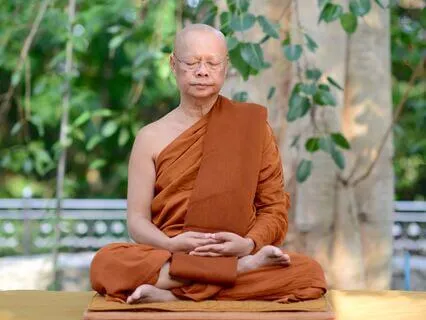
Sitting meditation in samadhi is important.
Samadhi is firm concentration,
But if it is the type that is developing firm concentration solely to find happiness in jhana,
Mental absorptions,
Of the form and formless jhanas,
Then this existed before the Buddha's time.
There were those who wanted freedom from suffering,
And they thought that this samadhi would lead the mind to not suffer.
Because samadhi is evading and escaping from sense objects.
When we have the sense organs of the eye,
Ear,
Nose,
Tongue,
Body and mind,
Then we receive sense impressions of forms,
Sounds,
Odours,
Tastes,
Tactile sensations in mind objects,
And we take it as a self,
The sense of self arises instantly in this experience,
And we have happiness and suffering following.
And so if the power of sati,
Mindfulness,
And panja,
Wisdom,
Is small,
Then the mind runs with those sense objects.
And the more and more this happens,
Then there can be sicknesses arising in the mind,
Like we see more of the mental illness of depression,
Or if it gets worse,
There are thoughts of wanting to leave this world,
So this is wrong view.
But the nature of feelings,
Of liking and disliking,
Is that it arises and ceases.
If we have enough rest,
We can overcome the moods.
But this is one whose wisdom is still small.
It is following the world.
The mind goes along with the current of the world.
So here we are training in samadhi,
Which is samma samadhi,
Right concentration.
It is not samadhi of the type where we are trying to escape from sense objects.
Samma samadhi is imbued with benefit so that wisdom arises.
The Buddha,
Before he became the Buddha,
He first trained in samadhi.
But it was a samadhi to go deeper into jhana.
He thought that to take jhana to the highest,
That he would be able to become free from suffering.
But he found that however high it got,
The avijja,
Ignorance,
Was still in the heart.
There was still a sense of self.
So the Buddha knew this.
He then practiced by torturing his body.
And when he tortured the body,
He didn't enter jhana,
But he was imbued with the strength of jhana.
He looked at the painful feelings.
They thought that by seeing into painful feelings,
Then one could attain true happiness.
But it couldn't be known like that.
So he developed samadhi by being aware of the in and out breath which he had done when he was seven years old when his father was leading the plowing festival.
And practicing this samadhi was amazing,
That it could have jhana,
Knowledge arise.
He could remember past lives.
He had the knowledge that could know the karma of living beings that go around the cycle of birth and death.
And when that was full,
Then he had vipassana,
Insight arise.
This is wisdom arising.
This was sama samadhi.
Mindfulness contemplated about the dependent arising of phenomena.
So he knew that the cause that makes a person be born and die is from ignorance,
Craving and clinging.
And so he attained enlightenment and became the sama sambuddha,
The perfectly self-awakened one.
It was just here that he had destroyed the defilements.
So we need to be careful of passa,
Sense contact.
During the day,
Sense contact leads to feeling.
Then from feeling there is craving and clinging.
So we need to be careful after we have practiced meditation.
If the mind is established well,
Then the body will be light and the mind is light.
In the beginning of the practice it is a bit difficult.
When I was a lay person like you,
I trained in samadhi and the mind was cool and peaceful.
The body felt light.
It felt at ease.
Then later it started again.
The mind went following sense objects.
Then later I saw this as suffering.
So I trained again.
I saw the suffering of why is the mind all over the place.
Why is it not peaceful,
With agitation and worry?
It wasn't peaceful.
I closed my eyes and thought,
Why is the mind hot like this?
I sat in meditation for about 2 minutes and opened my eyes and I thought I had sat for a long time already.
Why was the mind so hot?
It was like fire.
This was the mind that was not on an ordinary level.
The mind was hot.
It was the result of karma.
Before I had been able to sit meditation and so I thought back to when I had been able to train in samadhi and the mind was cool.
That was a good method.
So I tried to train anew.
Then the mind became more cool and peacefulness arose.
Now I was determined.
I kept the 5 moral precepts and on one prabha observance days I kept the 8 precepts.
I would go to the monastery and practice like you all.
I listened to Dhamma and had wisdom arise.
I heard the Dhamma talk of Venerable Ajahn Chah and the wisdom arose that material and mental phenomena is not us.
All material things are simply conventions.
Simply labels.
Our bodies are named male and female,
Those are just simply labels.
It was like the mind entering the current of the Dhamma.
It brightened.
Rapture arose for 3 days and 3 nights.
The Dhamma is amazing.
I didn't think that it would come up like that because I was still just training in mindfulness and samadhi.
On some days I could do it and some days I couldn't.
The days that I couldn't my mind would be all over the place but I could bear with it.
So I kept trying to train myself and I saw the truth called knowledge arising.
The 9 insights of knowledge.
It was knowledge arising.
I saw all people as going towards old age,
Sickness and death.
It was revolving around,
Like if we had the feeling that we're all running towards death.
It would happen soon to everyone,
Then we will bring that contemplation within.
Life is just this much left.
I saw all the things,
Material things,
Are not lasting,
Not permanent.
They arise and cease,
Arise and cease,
Arise and cease.
This body is not us.
And seeing like this,
The mind changes.
The mind changes over.
All that we aim for,
Wanting wealth and whatever it is we want in this world,
We understand that we have to die.
So none of that has any value.
So we need to find that which has value and substance,
Which is Dhamma practice.
If we have no duties and responsibilities,
Then we can go forth and ordain and practice.
If we still have duties and responsibilities,
Then we practice as a lay person.
You can do this.
You can have patient endurance and train yourself.
You can develop your mindfulness and samadhi.
So try to do it.
The Buddha developed himself first and then taught us.
For us to walk in sila,
Samadhi,
Bhajna,
Morality,
Concentration and wisdom.
And if our barami,
Spiritual accumulations are full,
Then when we hear the Dhamma of the Buddha or from a noble disciple,
Then we can see the Dhamma.
In the time of the Buddha,
The Buddha taught the layman Chunda,
The son of the goldsmith.
He had trained in samadhi until his mind was peaceful and then when he listened to the Dhamma of the Buddha,
Then both him and his wife attained to sotapanna,
Stream entry.
This was because he had made barami before and he had made a mental aspiration from his barami to meet the Buddha and be able to hear his Dhamma.
So they were the last pair of lay male and female disciples of the Buddha who saw the Dhamma.
And for the last monk,
It was the ascetic Subbada.
He had practiced a lot and done a lot of merit in barami.
And he made the mental aspiration to be the last noble disciple of the Buddha's life.
So all things have causes and conditions.
So we have been born and have a good opportunity.
Our country has the Buddha sasana,
The dispensation.
So we're able to train our minds to be light and the body to be light,
To have bliss.
It is really possible.
And the more we can understand the Dhamma,
Then the mind is bright and we have a refuge in our hearts.
Travelling near or far,
Then we have mindfulness to look over the mind a lot.
When we hear anything,
Have mindfulness with it.
Because there will be a sense of self arising.
We feel that we are hearing and a sense of self arises.
There is them and me.
The eye sees a form and we feel that there is me and them.
Like we see the hall and we feel that there is a hall.
This hall is small or big.
When there is a hall,
Then it shows there is a person who sees the hall.
That is our self already arising.
We contemplate that it's not there.
There is no hall.
The one who feels they see it is not there.
The knower of experience is not there.
It is anatta,
Not self.
We let go.
Whatever we hear,
It's not there.
There is simply hearing.
If we can let go,
Then it's simply seeing as seeing.
Simply hearing as hearing.
So we need to train to the end of the path to this level and then we will be able to let go.
But in the start,
When we listen or hear anything,
It is a self,
It is I,
It is me and them.
Then we come back to reflect that there is no me and them.
And this needs to be supported by mindfulness and samadhi which we are trying to train in.
The Sama Sambuddha had trained in it already and then he taught us.
Sometimes when we don't like to practice and we are lazy,
Then think of the Buddha.
Before he could attain enlightenment,
It wasn't easy.
Before he found this path of enlightenment,
It was not easy.
We may think it's easy to meet his teachings.
But how much the Buddha had to build his Barami,
Spiritual perfections.
He had to be born and die,
Born and die,
Born and die for us countless times.
He was born and died,
Born and died so much that each speck of land would have the bones of the Buddha full like the mountains and seas from his building of Barami.
We ourselves have been born and died a lot too.
But it's being born and dying with delusion.
The Buddha was born and died before from delusion.
Then later it was being born and dying for us.
So we have a good opportunity.
So learn Dhamma and try to practice.
In the beginning we may have doubts.
There are many different meditation objects,
So it's confusing.
We have to understand that all the meditation objects,
They all lead to peace.
There's no need to doubt.
Just do it.
Make the mind peaceful.
We can butto,
Butto,
Butto very quickly.
Just this one thing and you can get peaceful already.
If we don't doubt,
That is.
You can chant itipiso,
Bhagava,
Arahamsama,
The long repetition until the end of the chant.
This is so that we have mindfulness established.
Then later it can shorten to just butto,
Dhammo,
Sankho.
Then later just the one word,
Butto.
The mind is one-pointed.
The mind is one.
It is Apanasamadhi,
Full concentration.
There is rapture and bliss arising.
Then we enter contemplation to have wisdom arise.
So anapanasati,
The mindfulness of the in and out breath,
And samasamadhi is for wisdom to arise.
If it is to absorb into jhana,
To gain higher and higher jhanas,
It is just going deeper into samadhi only.
It does not attain to magha,
Phala,
Nibbana,
The paths and fruits of nibbana.
It is close to nibbana but doesn't get there.
So we have to step it down to contemplate with samasamadhi until it can attain nibbana.
Yesterday a Swiss layperson asked me,
When the Buddha was able to do anapanasati and then could gain the higher jhanas,
So why did he not use that higher jhana?
Why did he need to go back to anapanasati again?
So I answered,
That higher jhana that he had got was absorbing deeper.
The samadhi was too heavy.
It wasn't balanced.
Mindfulness is not balanced with samadhi.
It has to be sila,
Samadhi,
Panya,
Being magha,
Samadhi,
The path factors in harmony together.
When it's not balanced because the mind has gone too deep,
Then it's heavy on samadhi.
There's no mindfulness.
So they have to step it back.
Anapanasati is bringing mindfulness up.
And if samadhi is well established and just right,
Then they will have the wisdom to know the Dhamma.
They can see the Dhamma.
Before the Buddha had found this,
He needed to learn from other teachers.
If he didn't learn like that,
And he used anapanasati,
Contemplated and attained enlightenment straight away,
Then those who had higher jhanas would think that the Buddha had no higher jhanas like them.
And when the Buddha says that he is an arahant,
A sammasambuddha,
People would not easily believe it.
So he learned with those big teachers and succeeded in all that.
And he had passed through it all.
So he knew it wasn't it.
Because he had learned it already.
For those who practiced torturing the body,
They wouldn't have faith.
Because if one had not passed self-torture,
Then they couldn't be a sammasambuddha.
The Buddha had tortured himself till no one could do it to that level,
And he still didn't succeed.
So he searched and found by himself,
Becoming a sammasambuddha.
He was rightly self-awakened,
All through his own efforts.
No one else could know it like this.
Samma samadhi and mindfulness was perfect.
It was complete with sila,
Samadhi,
Bhajna.
It was the harmony of the path factors arising.
And then he knew.
Like we are practicing,
And then one day the path factors will be in harmony,
We will see and know that material and mental phenomena are not self.
We know it and we can be a stream-enterer.
May you all be determined.
May you grow in blessings.