So we have the opportunity now to sit in a relaxed way,
To sit in meditation.
If it's not suitable for you to sit on the floor,
You can sit in a chair or whatever posture you find suitable in your respective dwellings.
On this first day of retreat,
Our online gamma practice retreat,
So we have this first day of our retreat that we're beginning today,
We call entering the kamatthana in Thai.
And so what that means is to have mindfulness.
We have time during the day,
Or some of us may have to go to work.
But in either case,
The important thing is that we bring our meditation object with us wherever we go,
Whether we're able to be at home on retreat all day,
Or whether we go to work,
Bring your meditation object with you.
This word,
What we call meditation object,
Kamatthana,
The word kama is work and thana is a place.
So it's a place of work.
So we have our worldly work,
Which is to seek out money,
To care for our livelihood,
To care for our lives in the world.
That's something necessary.
In this kamatthana,
This meditation object is necessary to care for our minds,
Because we have to care for our minds.
If we don't have a meditation object,
That our minds are not beautiful,
The mind becomes dry and barren,
And filled with doubt,
And suffering,
Whether a lot of suffering or a little suffering all the time.
So even if we have everything materially,
Everything in the world that we would need for our bodies,
Could be,
We have plenty of food,
A lot of food.
If we have too much food,
Or we intake too much,
Then we get sick.
We have this food for the heart.
That is something we need to practice.
We train in it,
And we cultivate it,
And we store it up,
The food for the heart.
Because our lives are passing by continuously,
Every day,
Every month,
Every year,
And many years pass by,
In our dhamma practice together,
Whether online retreats or in-person retreats,
We began doing this about 10 years ago.
And so whether you've been doing this since the beginning 10 years ago,
Or just starting today,
That's something very good,
That you're intending to develop your heart and mind with your meditation object,
To use wisdom to train the mind to bring about peacefulness.
As training the mind to bring about samadhi,
Collectedness,
Or peacefulness,
There are many different techniques.
Here are the 10 recollection meditations.
For instance,
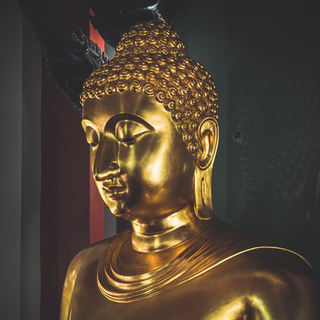
Buddha Nusati,
Recollecting the Buddha.
Dhamma Nusati,
Recollecting the Dhamma.
Sangha Nusati,
Recollecting the Sangha.
So this is to recollect the qualities of the Buddha,
Dhamma,
Sangha.
And we need to plant the seed of faith.
It's like planting a tree.
We plant out something very small,
We give it fertilizer,
Protect it from insects,
Give it light,
Give it water,
And the tree grows bit by bit.
Because growing a tree is just like growing faith.
The faith in the Buddha,
Dhamma,
Sangha grows gradually,
A little bit at a time.
And so it's my belief that all of you have this faith in the fully self-awakened Buddha already.
And having started with that from the beginning,
Then you practice to cultivate it,
To make it increase through your Dhamma practice.
So we practice to know and see clearly,
To understand the Dhamma bit by bit,
Ever more.
However much we understand the Dhamma,
That's how much our faith increases.
So may you set your hearts on this,
Because we have a very good opportunity here.
We have our physical bodies that are complete and ready in all aspects to study the Dhamma.
We have time,
We have faith.
And so we recollect the qualities of the fully self-awakened Buddha.
In the beginning,
We recite the verses and we incline our hearts with Namo Tassa Bhagavato Arhato Samma Sambuddhassa,
Homage to the blessed,
Noble,
And fully self-awakened one.
And so the Buddha is one who is an arahant,
Fully self-awakened,
A pure one,
The blessed one.
And in Thai,
It's translated as being far from the kilesas,
Far from the defilements,
One of the qualities of the Buddha.
So we see that the Buddha has wisdom to succeed and achieve victory over the defilements,
These defilements which make the heart sad and low,
That are in the hearts of all of us.
Whether a human,
An animal,
A deva,
Or a Brahma god,
They all have kilesa,
All have defilement,
Whether coarse or subtle.
Brahma gods have them,
Devas,
The heavenly beings have them,
Humans have kilesas to a middling degree,
Animals have kilesas to an even heavier or more intense degree,
And lower than animals,
Then the defilements are so strong that the experience of painful feeling of dukkha vedana is so much that they can't practice.
Even higher than that is the Brahma worlds,
Where they're not interested in dharma practice because they have happiness already.
Humans have a balance of pleasure and pain,
And so it's easy to see that.
And for devas,
They don't have bodily suffering,
So it's difficult for them to see suffering,
To see dukkha,
They need to have a lot of wisdom.
But if the devas cultivate vipassana,
Clear seeing,
Then they are able to see the dharma.
For instance,
When the Buddha gave the first discourse,
The discourse on turning the wheel of dharma on a salaha puja,
Which we commemorate in just a short time from now,
We see that a great many devas attain to the dharma,
Attain to the quality of being noble beings.
There's a great number.
In terms of the human realm,
It was just one individual,
Anya Kondanya,
Who saw the dharma during that discourse.
So for ourselves,
We have these very good and suitable bodies,
Have a mixture of pleasure and pain.
So we come to practice and train,
To train the mind.
And we,
With our physical bodies,
We sit,
We walk,
We listen to the dharma,
We recollect the qualities of the Buddha,
The Buddha who is far from the kilesas.
And we ourselves are also able to become far from the kilesas.
And we're already far from the kilesas with our body and speech,
Because we've undertaken the five precepts or the eight precepts.
Today I gave the eight precepts.
But if you want to undertake the five precepts,
Then you simply change the third precept to kamiso micchacara,
And you change a couple of the other precepts,
The wording of them as seen in the chanting book.
And if you do the eight precepts,
You simply do all of them as was recited earlier.
And this quality of virtue is that which brings our behavior of body and speech to be orderly and proper.
The benefits of virtue are truly great.
It gives rise to peacefulness and samadhi,
To happiness,
The composure and peace of our body and speech,
Not to be troubled or chaotic.
This helps our mind to grow in samadhi and collectedness,
To bring about true peace in the mind.
This is a great benefit.
So virtue has many benefits.
The highest benefit is to practice virtue for the sake of samadhi.
We see that samadhi that's well established has many benefits in itself.
Well established samadhi can care for physical illnesses.
It can be used to investigate various worldly matters.
One can also use samadhi for the sake of ending suffering.
This is what makes samadhi have truly great value,
That it gives rise to wisdom following the teachings of the Buddha.
As the Buddha taught wisdom,
The wisdom to know clearly,
To see and know clearly the four noble truths of suffering,
Its cause,
Its end,
And the path to its end.
So in order to realize wisdom,
We need to cultivate this quality of samadhi,
Of peacefulness and collectedness.
And we do that through recollecting the qualities of the Buddha and taking that as the object of our mind.
To recollect that the Buddha is one who is able to have sufficient wisdom to achieve victory over the defilements,
We recollect this.
When we recollect this,
The mind can give rise to peace and rapture easily,
Give rise to samadhi easily.
That's because we have faith in our hearts.
This is the first quality.
And what's the second quality?
We recollect the purity of the Buddha.
We see that all of our individual ancittas,
All our individual minds,
Whether humans or devas or all beings,
Are full of defilement.
The minds are not pure.
But the fully self-awakened Buddha was able to have the wisdom to achieve victory over the defilements,
To give rise to purity in the mind,
To become free from the cycle of birth and death.
As we see this cycle of birth and death continually cycling on,
How long is it?
How far does it go?
If we recollect it,
We see we have the last life,
The life before that,
The life before that,
And it just keeps going on and on.
And when was the first life?
When was our first life?
We don't know.
Because it keeps going on and on like this.
In terms of the future,
There's the next life,
The next life,
And it keeps going on and on.
This is because the kilesas,
The defilements arise,
And based on defilement,
Beings make kama,
And there's the result of that kama.
And so these lives just keep on going,
Going on and on,
And it's very,
Very long.
So the Buddha has this great knowledge to know clearly.
He had insight and insight knowledge.
He contemplated the individual minds of beings being born and dying,
And saw that this process of birth and death went on for a very long time into the past.
And the Buddha was able to know the future as well,
And see that these minds,
They're under the influence of kilesa for a long time,
Being born and dying.
And even within an individual lifetime,
Each lifetime is full to the brim with suffering.
We see even in this very life of ours,
What suffering have we met with since we were born?
So we can recollect that,
All the different types of suffering that we can remember in this life.
So we have birth,
And that's with the sense of self,
And then this quality of dukkha,
Of suffering,
Keeps going without end.
And there's a lot of suffering.
And the Buddha taught that the number of,
Or the amount of tears that we've shed in this course of birth and death,
And all the difficulties and suffering,
All the sadness one has met with in this long course of samsara,
It's more than the water in all the oceans.
So we see in this life when we're sad,
We cry,
We're separated from the loved,
We cry,
Or we meet with something that we don't love,
Or we try to get something,
And we don't get what we want.
We can see this with children,
When they don't get what they want,
They cry right there.
And adults are the same way.
And so therefore we see that this has gone on for a very long time,
This experience of suffering,
Tears being shed.
So the quality of dukkha is a lot in that way,
Something very difficult,
A lot of suffering,
And we see the Buddha having this kilesa.
But the Buddha realizing purity of mind,
Abandoned all kilesa,
Had no more kilesa,
Not even a little bit of defilement left.
This is the purity of the Buddha.
We see that the Buddha had no equal in the three worlds,
The world of the humans,
Devas,
Or brahmas,
The sensual plane,
The plane of form,
Or the formless plane.
There was no one equal to the Buddha in this way.
It was only the Buddha who was able to know and see for himself,
To realize purity in his own mind.
And we recollect the Buddha has this quality of great and noble compassion,
This incredible vast compassion without bound,
Without limit.
And the Buddha thought that there are beings in the world who have sufficient wisdom to know and see clearly the dhamma.
And so the Buddha therefore spent 45 years teaching,
And we gather together all the teachings that the Buddha gave.
And we see it comes down to material form,
Feeling,
Perception,
Formations,
Consciousness,
Or unstable,
Impermanent suffering and not self.
When we cling to this form and mentality as self,
This is the cause for suffering to arise.
The Buddha had the wisdom to see the origin of all suffering,
To see where this quality of lack of ease or dis-ease,
Or where did it arise from,
Where did suffering arise from.
What arises because of craving and attachment,
This is the cause.
So the Buddha knew this and saw and investigated how to end this suffering,
Saw that one must abandon craving and attachment to realize cessation,
Which is the end of suffering,
Nirodha.
The Buddha was able to know deeply that beings must cultivate the Noble Eightfold Path,
Which begins with right view.
So the Buddha knew all these four noble truths and taught beings who are able to receive such teachings,
Anya Khandanya being the first to understand them,
Followed by Venerables Mahanama,
Asaji,
Vadiya,
And Wappa,
The group of five ascetics,
Who were all able to know the Dhamma and realize arahantship.
And what they were able to know is that everything that is of the nature to arise is of the nature to cease.
They saw that everything arises,
Stays for a little while,
And ceases.
This is a characteristic of all things,
All mentality,
All materiality.
This is the realization of stream entry.
Every day,
Our eyes meet with visual forms,
Our ears meet with sounds,
Nose with smells,
Tongue with tastes,
Body with bodily sensations,
Mind with mind objects.
And whenever this experience of contact happens,
Then weight and a feeling tone arises,
And there's liking or disliking for those feelings that arise.
And so at being like this,
There's liking,
There's disliking,
There's craving,
There's attachment,
And there's suffering that just keeps going on and on like this.
And the suffering is the cause for birth,
And then death,
Craving and attachment to arise again,
Delusion to arise again.
This just cycles on and on,
Cycles on and on.
Birth and death,
Birth and death,
Just in this way.
So therefore we need to develop our meditation object,
Our kamatana.
In the beginning,
We start with recollecting the Buddha,
Recollecting the Dhamma,
Recollecting the Sangha,
To bring the mind to feel at ease,
To feel joyful,
To feel collected and peaceful in samadhi.
It starts with Kanaka Samadhi,
Momentary collectedness,
Upajara Samadhi,
Neighborhood and collectedness,
The mind that's firm,
Has rapture.
This is a mind that can know,
Or we practice to know the breath going in,
Going out.
One can recite BUDDHA with the in-breath,
DO with the out-breath.
One practices like this continuously.
This is able to bring the mind to peace,
Collectedness and stillness,
To the point where one doesn't want to think at all.
One doesn't want to look at the breath anymore as well.
The mind and body feel light and rapturous.
There's mindfulness that knows that right now the mind is peaceful and collected.
The mind is firmly established.
And after the mind is in this state for a period of time,
The mind starts to gradually exit that state.
And it's at that point that we can study and learn.
We see that this quality of samadhi brought about through thinking of the Buddha.
Samatha,
Kamatana,
The meditation object for the sake of tranquility.
And exiting from that,
We study to learn about all materiality and mentality,
That the breath as well arises and ceases.
For instance,
This in-breath,
It arises,
Stays for a little while and ceases.
Arises,
Stays for a little while and ceases.
This is vipassana.
This is clear seeing,
Just this.
Before I ordained,
I went to ask a question of Lungpu Indtachak Laksa.
He was an arahant,
A fully awakened being.
And I asked,
How does one practice vipassana?
And he answered that one sees the in-breath arise,
Stay for a little while and cease.
One sees the impermanence of the breath.
Seeing the impermanence of the breath,
One sees that the air element is of the nature to degrade.
So it's the same for the fire element,
The water element,
The earth element.
They're of the nature to pass away and degrade.
And so one sees them as not-self.
This is vipassana.
It's able to cut off the clinging in the heart to give rise to wisdom.
So all of you start with this recollection of the Buddha,
The kamatthana of Buddha Nusati,
To bring the mind to firm establishment.
And so you have this opportunity,
So try to recollect this daily,
To bring the mind to peace and stillness,
Whether you're at home or at work.
If you're at work,
You can do a short meditation word like bhutto,
You can recite bhutto.
Try to recollect this often,
Try to do it a lot.
In the end,
Your mind will be able to collect and gather in samadhi.
So may you all be well and may you all grow in blessings.