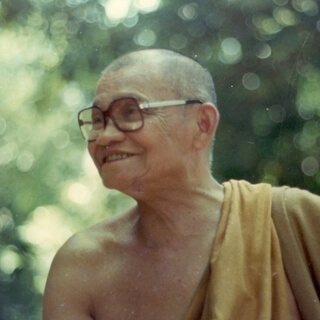
So in our practice of meditation or of cultivating our minds,
Something that's very important is for us to have kanti,
This patient endurance with all of the emotions and the sense objects that we come across.
So in keeping virtue,
This is also true,
This kanti is very important.
And for us practitioners,
While we're practicing,
For the most part what we want is to develop our mindfulness and bring about samadhi,
Bring the mind to a firm and stable state.
So perhaps we can do that when we're sitting and when we're doing walking meditation,
But when we receive one of these sense objects,
A sensory experience,
In the beginning we know that,
But all the same greed,
Hatred and delusion arise,
And we're not able to catch them in time.
So when the samadhi is just a small amount,
We need to really forbear with that.
And we know that now the mind is becoming averse,
Now it's becoming irritated towards this sensory experience.
And perhaps we're not yet angry,
But there's this irritation that's come up,
We don't like what's happening,
And the mind becomes stirred up and chaotic.
So we have this mindfulness there,
Knowing.
We may ask,
Well,
Can we contemplate those things,
But at that point we're not able to contemplate.
So we have that mindfulness there,
Knowing what's going on,
Knowing the feelings that have come up.
And then there's a feeling of self that arises as well,
This feeling of me and mine that comes up with it.
So when we receive one of these things,
One of these sensory experiences,
The mind is deluded by them and it attaches to them,
Attaches to them as being me,
Belonging to me.
And when there's this me and mine,
Then there's suffering.
So we need to forbear,
Endure.
With a standing,
Walking,
Sitting,
Lying down,
We observe our minds.
We observe the proliferation that happens within them,
All of these thoughts,
All the stories that it tells us.
That if there's a feeling of hatred,
Then the mind tells stories along those lines.
It gets us to try to fight,
Or it comes up with cruelty and ill will,
Because we don't like something.
So we just follow that,
Observing it,
Knowing it,
Teaching our mind this is something that's not sure,
It's unstable,
It's inconstant.
And then eventually that will just run out of energy and it will cease,
All of its own accord.
But we don't see that arising and ceasing.
So if there's a sensory experience that we come across that's a stimulus for aversion,
And then the mind becomes averse.
If it's a stimulus for liking,
Then the mind starts to like it.
So we need to endure with this liking as well.
And sometimes there's a great amount of attraction,
Desire.
And sometimes the sensory experience is a stimulus for disliking.
And so this is just how it is.
We know it's this way.
And right at this point,
Where the mind gets involved in that,
Is the point that we study in order for Dhamma to arise.
The Dhamma comes up right here.
If our mindfulness is good,
And we see that the mind is one thing,
And its objects are something else,
It's not one and the same thing,
We're able to separate them out.
So it's like oil and just plain water,
Water we may find in a well or a river,
That those two are separate,
That the oil floats on top of the water,
They're not mixed together.
But if the mind is lacking in mindfulness,
Then its objects and the mind itself become mixed up as one thing.
So as practitioners,
We need to train ourselves,
We need to train these minds,
So they can separate out from the sensory experiences,
No matter what they are.
But in order to do that,
We also need good samadhi as well.
And if the samadhi is good,
Then we can separate them out,
And see that they're not me,
They're not who I am.
But normally what happens is that when these come up,
We take them to be me.
When there's samadhi there,
We see that all of these modes,
All of these objects of the mind,
They're not a being,
They're not an individual,
They're not me,
They're not you,
They're not anyone.
So the mind that experiences them is just a knowing element that knows these objects,
But then it becomes deluded in them,
It becomes lost.
And when we receive one of these objects,
There's also a knower that's there as well.
And this knower looks after the mind.
If the knower is not present,
Then the mind becomes lost and deluded,
And then suffering arises.
So therefore we need to try to prevent the mind from going into liking and disliking.
But in the beginning,
We really need to put up a fight.
And sometimes these modes,
They go on for days and nights.
And if we're lacking in samadhi,
Then we really have to put up a good fight as well.
And sometimes even if that samadhi is there,
Then we still have to really fight with it,
That these emotions are present.
And even though the mind doesn't cling onto them with its full strength,
Still there is that attachment,
There's not liking that's present.
And sometimes it can be like this for many days,
Maybe three days or five days,
That there's great strength to that aversion.
But with the presence of samadhi,
Even though it's very strong,
It's still able to hold that at bay to some degree.
And then when the mind gathers together,
Then there's a clarity of its seeing,
Can know that the body is just a body,
And then here the mind becomes empty.
So it's possible to become deluded in these moods and sense objects for many,
Many days at a time,
But they don't defeat us,
That we still stand our ground.
And then eventually the mind can separate out from them,
And when it gathers together,
Then there's that separation that occurs,
And here we see the Dhamma.
So we shouldn't be afraid of these moods.
We should endure with them and put up a good fight.
Even though it's very difficult,
We carry on,
We still train ourselves,
We still train.
So perhaps we can make a comparison.
It's like just an average person that takes up running or starts playing football or some other sport,
And they've just taken the sport up,
But they're immediately competing against the world champion.
But this other person,
They're just the average person,
They're just someone who's new to the sport.
So who's going to win then?
And of course it's the champion.
But if that person endures,
And if they stick with it,
Carry on training,
One year,
Then two,
Then three,
Then four,
Then five,
And they become more and more skilled,
And then they're able to really put up a decent fight,
They're able to really compete,
Then their mindfulness samadhi becomes better.
And so this is what it's like for the arahants,
For all of them,
That before they became arahants they were just average people,
Just your average person.
And they had to train themselves,
They had to train to give rise to the spiritual qualities,
To train their minds,
Until eventually they're able to defeat the defilements.
So therefore for us,
If we're sincere,
If we set our hearts on this,
And we endure,
Then we're following what the Buddha taught,
That he taught us to put up a good fight,
He taught us to endure.
That if we have greed come up,
We endure with that,
If there's aversion,
We endure with that,
If there's delusion,
We endure.
We set our hearts and fight,
We set our hearts and practice,
And in a long time we'll be able to win out.
So as monks we really need to forbear,
And to do this a lot.
Perhaps we eat,
Take up these ascetic practices of eating just at one time,
Or eating everything in the one bowl,
To only use the triple robes,
Or to spend time at the foot of a tree,
Or in a cremation ground.
And we really need to endure with that.
We have this feeling,
Well if I die,
Then I die,
That the Dhamma is on the shore of death,
And so in our practice we put up a good fight,
If we die then we die.
Maybe we're afraid,
Until there's so much fear that we don't know what else we could possibly be afraid of.
And Ajahn Chah,
When he was staying in the chana ground,
He was so afraid that he took his bowl to be his friend.
And he was with that fear until eventually he asked himself,
Well what is it that I'm afraid of?
And the answer came up,
I'm afraid to die.
And so then he asked,
Well where is it that I'm not going to die?
And he found that there was no place.
And so this wisdom came up right here,
This wisdom that there is no place,
That we're not going to die.
And so sometimes it's like that,
That this fear can be so intense,
Or the strength of the liking or the hatred can be incredibly intense.
And if that wisdom comes up,
Then there's brightness that appears.
But before that,
It's really something,
It's really an issue that we're dealing with.
And so that's before we reach that point of knowing the Dhamma,
Seeing the Dhamma,
That it can really be a fight,
That we may think that we're going to go crazy.
So for myself it was like this as well,
That there was so much fear.
And when I was in this state of terror I asked myself,
Well what is it that I'm afraid of?
And then the mind gathered together,
Samadhi gathered together,
Wisdom arose,
And then emptiness appeared,
And all of this fear disappeared.
So it's all there within the mind.
If the mind is deluded,
Then it will proliferate in a way that gives rise to fear.
If it has knowing,
Then it will proliferate in a way that gives rise to wisdom.
And so when that happened and I was in this cremation ground,
Initially there was so much fear but then this wisdom arose.
And then I cleared away the soil and the foliage on the ground,
And there were bones that were there,
And they were lit up by the light of the moon.
And I saw these bones,
The flowers of the noble beings,
That my mind was so bright at that time.
When the mind's in that state,
Then everything that one sees is Dhamma.
Initially there was so much fear that was there,
But I stayed with that,
I relied upon this strength of endurance.
So one must have this satcha,
This truthfulness,
Because if we don't have that,
And we don't have endurance,
Then we won't be able to stick these things out.
And for myself,
If I didn't have that,
If I didn't make this determination of truth to stay there,
Then I would have just left without getting any Dhamma.
But I set my mind on staying there,
I really made this determination of truth that I would stay there.
And so I didn't leave,
I determined to be there throughout the night,
Really staying with that,
Putting in effort,
Fighting.
So therefore in our practice we shouldn't become discouraged.
Actually it's normal at times to be discouraged,
But even if we are,
We shouldn't retreat,
We shouldn't flee.
It's normal to have these feelings sometimes.
We may get the feeling,
Am I really able to take this anymore?
We may feel that we've been at it for so long and we haven't got any peace yet.
That there's this feeling of being discouraged,
Disheartened,
But we need to stand our ground and not retreat.
That we set ourselves anew and then carry on proceeding,
Carry on walking forward,
Persevering,
Putting in our efforts.
For some practitioners who are quite old already,
Then they're really sincere like this,
That they're not careless,
Because they see that death is close.
And who knows,
Perhaps they may see the Dhamma,
Know the Dhamma before the young practitioners,
Because they see that death is very close to them.
And so they're not careless,
And this is something that's really important.
So may all of you set your hearts on this.