So on this opportunity,
You've been determined to come to practice Dhamma,
To practice on this meditation retreat,
And you've come and traveled from far away,
Many thousands of kilometers to come and to learn Dhamma of the Sammasambuddha,
The fully,
Perfectly self-awakened Buddha.
And the practice starts from the restraint of our actions and speech,
Which is having sila,
And then we make the mind firmly concentrated in samadhi so that wisdom can arise.
This practice of developing samadhi,
This well-established,
Firmly concentrated mind,
It's not just when we sit meditation,
But in whatever posture that we are in,
Whether walking,
Sitting,
Standing,
Or lying down,
We try to have mindfulness,
Have sati with that,
Being aware of all of our movements.
So we start by giving meditation instructions.
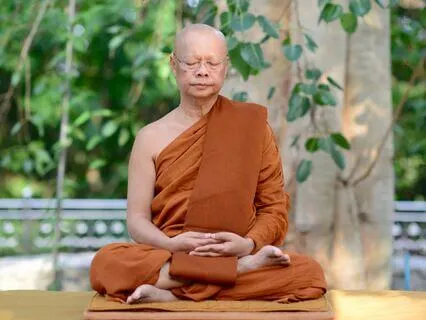
So when you're sitting meditation,
You can establish your posture.
You sit with the right leg on top of the left,
Your right hand in your left palm,
And try to sit upright,
But don't overly control or force the body.
Try to have the body's posture to be just right and relaxed,
But upright,
And then bring attention to know the breath.
So you know the in-breath,
Along with the meditation word buddha,
And then the out-breath,
Along with the meditation word tol,
With the in-breath buddha,
And then the out-breath tol.
So simply,
We are trying to have mindfulness with the breath.
And you can notice that from the time that you wake up,
That the mind's already proliferating and thinking of all sorts of things,
Thoughts of the past,
Thoughts of the future,
Thoughts of many different things.
And so the mind's not peaceful.
And so we're trying to bring up mindfulness and gather it into one meditation object or one object.
And we do this through bringing up mindfulness with our meditation repetition or word.
So the in-breath buddha,
The out-breath tol,
Or you may be more used to using another phrase or meditation word or repetition.
And you can use that as well.
On the in-breath,
You can use om mani,
The out-breath,
Padme hum,
If you're used to that.
And so the idea is that we're not trying to have the mind to think of other things,
To come back and be with this meditation word or repetition as much as we can.
And when we do this,
Then the proliferation,
The amount that the mind is restless will reduce and the mind will become peaceful.
So when we meditating,
Don't control the breath to be shorter or longer than it is,
Whether the breath is short or long,
Just know that,
Just be aware of that.
If you control the breath too much,
Then you may have pain or headaches or the body or the mind just doesn't feel at ease.
And so just try to have this more feeling of being at ease along with having mindfulness with the in-breath and out-breath,
In-breath buddha,
Out-breath tol,
And try to put down the thoughts of the past,
The thoughts of the future.
You're not interested in them and bring the mind to the present moment.
And when you develop mindfulness like this,
Then you start to have more peace and feelings of bhitti or rapture may arise,
This sort of sense of fullness of mind.
And this is like the strength of samadhi is increasing.
Maybe there's manifestations like the body feels very light,
But whatever it is,
We're not interested in these.
And we just knowing the meditation word along with the breath.
And as the peace grows,
Then this meditation word may disappear on its own.
And we know just the breath in and out.
And as our peace grows more,
Then even the breath may disappear altogether.
And there may be just stillness and emptiness there.
And here we just have mindfulness to know that this is present.
And when the mind becomes peaceful and still like this,
Then we may let go of all conventions.
And so the conventions of being a monk or a nun or a lay man or woman,
Being Theravada or Mahayana,
They don't arise.
None of these conventions are present.
And there's just stillness and peace.
And our mind is in samadhi concentration.
And all these things become one.
The dhamma is all.
This is the oneness of the dhamma.
And we have this knowing or wisdom that all things are impermanent,
Unsatisfactory,
Not self.
They're all inherently empty.
So this is developing mindfulness when you're sitting meditation.
But outside of meditation,
Wherever you're,
Sorry,
You can meditate as well when you're in the walking posture.
And when you're walking,
Then with the right foot,
Put the left foot toe,
Repeating the keeping the meditation repetition word there.
And whatever activities that you're engaged in,
Whether you're eating,
You're doing any duties,
Then keep your mind,
Mindfulness with the meditation word as much as you can.
And also try to speak very little,
As little as possible,
But instead develop lots of mindfulness.
So before we practice sitting meditation,
I'll pause opening questions,
Give an opportunity for any questions that any may have in regards to this,
To meditation.
I read the biography of the Krubarjan,
Great meditation masters of Thailand.
And they talk about becoming enlightened,
Attaining Nibbana,
About the mind that is liberated and that becomes free from suffering.
And they don't understand what about this in the Pali texts.
They don't tend to talk about this.
So the mind is in a normal state,
Usually.
And then when there's the entering or experience of a sense object,
And this is when the defilements of greed,
Anger,
Delusion arise.
And when these defilements arise,
This is when the hot state of mind arises or heat arises.
And Nibbana is coolness.
And so if we can reduce or lessen these defilements of greed,
Anger,
Delusion a bit,
Then to that extent,
Then the coolness of mind arises.
And the fullness is the mind that is pure or a purity of mind.
And this is the state that is free or liberated from suffering.
And so if one is able to overcome completely all the greed,
Anger,
Delusion,
Then the coolness of mind completely arises,
Or we say that is the liberation from all suffering.
And she read the biography of Venerable Ajahn Man and in the talks of the original mind or citta,
Which is pure,
Purified and doesn't understand this.
So the mind that is clear can be compared to like the clear or clean water inside a vessel.
And this is the mind,
The clear water is like the mind.
And this is the state that before there is proliferation coming up,
The state of the mind is like that clear water.
And then proliferation then arises coming from ignorance,
And then a sense of self arises,
And then there's the defiled states of mind arising.
And so in this practice,
We're developing mindfulness,
Trying to know in time this proliferation as it happens or as we experience it.
And then the radiance of the mind arises,
The purity of the mind arises.
And so we can see like a baby and baby doesn't really know anything,
But we can ask,
Does that baby have a sense of self?
Yes,
They do.
But it's not yet clearly seen or clearly evident.
Their faculties aren't developed yet.
The brain's not developed yet.
They haven't really used it.
The memory is still small.
And so they don't attach to things or have clinging in the same way like an adult does.
And so this is why we think that a baby looks very pure.
And this is then the state of the mind that is still and empty.
But then later on,
The defilements enter,
And then the mind attaches,
Clings,
And then this is the cause of suffering to arise.
So then the practice,
In the Dhamma practice,
We're trying to then develop mindfulness in order to know in time this as it happens,
As we experience it,
So that we can let go of it.
The question is then,
Is this original mind or citta the same as Nibbāna or how are they related?
So the original citta or the mind is not the same as Nibbāna.
It's not purified,
But it is clear,
But it isn't pure.
There's not yet wisdom there.
And so when the sense objects enter or we experience them,
Then clinging arises and there's all proliferation following that.
And this is because there isn't wisdom.
But its basis,
Fundamental of it is clear.
The same as like water that's not clear is because maybe there's pollutants inside it,
A lot of particles or something that we've shaken up this vessel of water,
And so it doesn't look clear.
And in this way,
Then we can't make it clear like that.
But we can compare it to like water that has colored dye put into it,
Maybe blue,
And then it turns blue,
Or red,
It turns red,
Green,
And it changes color again.
But we're taking out that color and bringing it back to its normal clear state.
And we do this through having developing wisdom.
And we are practicing then to develop mindfulness so that we can know all the sense objects as we experience them,
Have the understanding or knowing that all things are impermanent,
Unsatisfactory,
And not to be taken as a self.
Then this is when the purity arises,
And it arises bit by bit.
And when it's completely full,
Then we can say then that is nibbana.
Then this is when there's no more birth in saṃsāra or in future and renewed existences.
So develop mindfulness in the present moment a lot,
And then peace will arise,
And then you'll gain clear understanding in this.
Question about that she's practicing following the teachings of Venerable Ajahn Mun,
Venerable Lungta Maha Bua,
And she practices with the breath,
In and out breath,
Along with butto,
And trying to develop mindfulness in all of the postures,
And finding that her meditation is not that good.
And so should she use more just butto only as the meditation word only,
Or with the breath as well,
What's more appropriate for her?
So you can use either the breath along with butto,
Or only butto with the repetition of the word,
But just see that if that method that you choose to do,
That if it brings up a good level of peacefulness,
Then you should use that method a lot.
I think she asked that if she tends to like to escape from difficulties and problems when they arise,
So if when facing a problem or experiencing one,
Then if you don't think about it,
That problem,
Then is that okay or not?
So there's two ways is that one way is that you flee or escape from the problem or try to avoid it.
And the second way is that you understand that problem and you understand it with wisdom.
And so the first way you try to flee and escape and evade it,
And you don't contemplate and investigate it as well.
And that's because when you experience it,
Then it brings a mind a lot of anxiety and disturbance there.
The second way is having the wisdom in order to understand that thing that you're experiencing and you're able to let it go.
And so you know that all things arise from a sense of self or they come from a sense of self.
And so if you know,
Then all things are not self,
Are not self,
Then you're able to separate then the mind from the object,
From the experience there.
And then when problems arise and you know it with wisdom and you're able to let go.
Continuing on then is,
Can't really understand about not attaching to it and letting go of it.
Then how can you solve the problems if you don't attach to it or not interested in it?
We have to understand and there's two ways is that firstly running away from that problem.
And the second way is actually having wisdom in regards to it.
And so maybe we people,
We experience things in the world,
Sense impressions,
Experiences.
For instance,
Maybe someone says something bad to us or harshly to us and we don't want to hear that.
So we have to run away.
But then when we run away to the other place and another person says something bad to us,
We don't want to the other place and another person says something bad to us again and then we try to run away again.
And so this is like also the case for all types of things as well.
And then we try to not be interested in that.
We don't want to experience anything like that or know about it.
And then this is that we're trying to run away from problems.
The second way is that we're able to see them,
The sense experiences,
The problems,
And we're able to overcome it with wisdom and we're able to let go.
And so in the beginning,
The mind will experience sense objects,
The external world,
And it won't have wisdom.
And so we do try to run away from it in the way that we're developing samadhi concentration.
This is like we're trying to escape or run away from the sense objects.
This type of samadhi isn't yet a true wisdom,
But it's a peaceful mind or the mind brought to calm and it's brought to calm from all the proliferations and thoughts and hindrances.
But later on,
When we have developed this mind that is in a good state,
Then we're able to come back and contemplate the sense object,
The problem,
The issue,
And we're able to let go.
And then this is when wisdom arises.