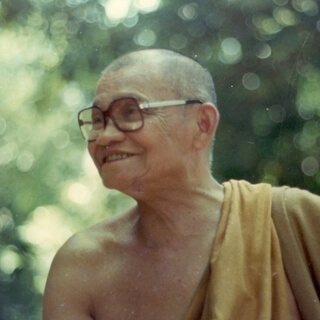
At the times we are staying in a dangerous place,
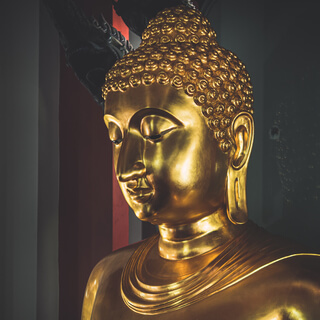
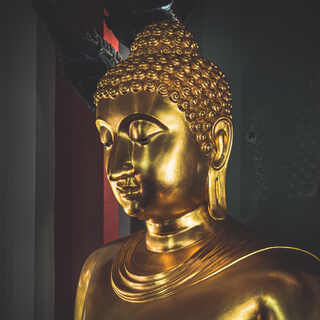
The Buddha taught us to recollect the virtues of the Buddha.
May we be firmly with the word BUDDHO.
Whatever happens,
May our mind be with BUDDHO.
Though our body may die,
But our mind will be good.
Both for the monks and laypeople who practice in a place of danger,
Their hearts should be determined to practice and to recollect the virtues of the Buddha as an object of the mind.
And at the time we stop meditating on BUDDHO,
Then the mind will proliferate and fear comes up.
The proliferating of the mind is just from delusion.
When I stayed in the cremation ground,
The mind would proliferate every day.
It was like I was going out to war.
The mind was proliferating every day.
During the day I had to gather all the energies of the mind well,
To speak little and to put forth effort all through the day.
Then in the evening I had to fight.
I had to establish a satcha adhitana,
A vow of truth that I would stay there for one month.
The mind would proliferate to all the spirits and ghosts and do various tricks on me.
It would follow the old memories and perceptions that had been in the mind.
As the proliferations got more and more,
Then mindfulness started to know that,
Hmm,
I don't see any ghosts or spirits coming.
What comes to trick us is the thoughts that proliferate up delusion and fear.
So I got more intelligent.
Though on some days there would be lots of fear,
The strength of the mind would be lowered and mindfulness was weak.
So I had to gather the mind's energies and sit meditation.
And the mind gathered together in samadhi,
Concentration.
It was stilled.
I contemplated that life must end in death.
There was emptiness arising in the heart.
The mind had strength.
And I went out of my resting place to walk meditation,
And then to sit meditation.
I saw many piles of bones,
But I saw it as something natural and normal.
So if we have no mental strength,
The mind will proliferate in one way.
But when the mind has dhamma,
It sees a truth.
Why?
It is from the virtues of the Buddha,
Dhamma,
Sangha.
So we chant every day,
Or on the weekends,
Or weekly lunar observance days.
This is making merit and building goodness.
We come to the monastery and we have a chance to listen to dhamma,
Which purifies the mind.
It makes the level of the mind higher.
When I listened to the dhamma talk of Venerable Ajahn Chah,
It was as if I could see Nibbāna really close to me.
I saw the emptiness that is purity.
At the moment,
Our mind has avicca,
Ignorance,
That makes it proliferate continually.
To all the liking and disliking,
The hate,
The love,
The detesting,
The fear,
It will all cover over our minds.
When the eye sees forms,
Ear hears sounds,
Nose smells odours,
Tongue tastes flavours,
The body contacts tactile sensations,
The mental phenomena is known with the mind,
The thoughts arising in the mind.
Then the liking and disliking arise instantly.
The kilesas,
The mental defilements,
Have arisen already.
If we can know it in time as it happens,
Then we let go of upadana,
Clinging and attachment,
And our mind is empty of any object temporarily.
We then can kind of see the path,
That if we do this a lot,
We have lots of mindfulness,
We can let go,
Then the mind has peace and happiness,
And has coolness,
Which is Nibbāna.
So put down doubts.
These days dhamma practitioners have so many doubts.
It's all over the place.
They want to get it quickly.
They're scared of getting lost.
When the mind is not peaceful,
They take out the books and texts,
And don't know what to do.
In reality,
There's nothing else to do.
Just go walk meditation,
And sit meditation.
We can establish our minds with bhutto,
Bhutto,
Bhutto in the heart.
It can be with the in-breath thinking bhutt,
The out-breath thinking to.
It can be in-breath bhutto,
Out-breath bhutto.
May you have sati,
Mindfulness,
With the meditation word.
Don't attach to thoughts that our way is the only correct way.
There are some people who meditate with samma sambuddho,
And we don't understand it.
We've only heard of bhutto.
Many arahants,
Fully enlightened beings,
Came up from meditating on bhutto.
So samma sambuddho doesn't sit right with us.
Why does it have to be samma sambuddho?
Samma means rightly.
Bhutto is the rightly knowing one,
Awakened one,
The joyous one.
It is the same.
It's just a bit longer.
Therefore it can be samma sambuddho,
Or bhutto,
Or arahant bhutto,
Or bhuttang saranam gacchami.
It can be bhutto me nato,
Or bhutto me saranam warang.
It is a meditation repetition.
It's so that the mind stays with the meditation repetition and gets peaceful.
If our mind does not stay with the meditation repetition,
Then the mind proliferates and thinks of other things,
Right?
The sense object has entered already into our minds.
So we have to have a kamatana,
A meditation object.
There are the kamatana monks and the kamatana laypeople.
So we have to have the kamatana with us.
When we go out to war,
We need weapons to fight them with.
When we are going to fight the defilements,
We need a kamatana.
It is the foundation where we establish our work that we will do.
We will walk,
Stand,
Sit,
Lie down,
While repeating the meditation word internally as well,
Till our mindfulness is fully established.
Then we don't need to repeat the meditation words here.
We stand,
Walk,
Sit,
Lie down,
Drink,
Do,
Talk,
Think,
And we have mindfulness.
In some places,
They do walking,
Walking.
This means knowing.
Knowing one is walking.
Bhutto is knowing,
Awareness there.
The knowing one,
Awakened one,
Joyous one.
Knowing while one is walking.
We don't need to mention this or that meditation system.
They are all to make the mind peaceful.
It's all to know about this body.
If we understand this,
Then we don't need to argue.
You do vipassana,
Insight meditation,
But I do samatha,
Tranquility meditation.
There's no need to argue.
May you just get the mind peaceful.
Sometimes we use wisdom to contemplate.
We don't repeat the word bhutto.
We don't use the meditation repetition,
Kesa,
Loma,
Naka,
Tantra,
Tacho.
But we use contemplation into the virtues of the Buddha.
They are vast,
Incomparable,
And unequalled.
We recollect this,
And the mind is at ease.
The mind is peaceful.
This is buddhanusati,
Recollection of the Buddha.
So we recollect it often.
And we have done lots of acts of goodness,
And so we can write these down.
Today we do chanting.
We go to give alms on what day,
And what merit do we do.
How have we helped people?
We see it,
And contemplate it.
And we take it up to reflect on.
We think about it often.
It is chagga.
Chagga is generosity.
Selfless acts to benefit others.
Mindfulness recollects chagga,
Generosity,
Good deeds,
As an object of the mind.
It is a kamatthana,
A meditation object as well.
So may we stay within the kamatthana.
In the time of a meditation retreat,
We are with the kamatthana.
Like here we are listening to dhamma.
And then when we walk to go eat after,
We take the kamatthana along as well.
Have mindfulness to watch the mind.
Eat just the right amount.
We are generous.
We don't eat too little,
Or too much.
We eat with mindfulness,
And without chatting.
We are disciples of the kamatthana tradition monks,
So we don't talk as well.
We don't chat.
We've talked about household things and politics for many days already.
About war,
And the economy.
So put it aside first.
Venerable Ajahn Chah would sometimes teach,
Don't harvest the crops in the monastery.
Meaning,
Don't talk about work in the monastery.
Do bhavana,
Cultivate the mind.
If we can do it,
It's merit.
So we try to make merit arise as much as we're able to.
This is called practicing the kamatthana.
The kamatthana for a lay person.
Sometimes do we have anger?
We do have.
Anger arises,
But never mind.
Have mindfulness.
Who is having anger right now?
Is the anger anyone's?
Our mind is currently running with the anger.
Anger is covering the mind.
So have mindfulness to teach it.
Who are we angry at?
Are we angry at that person?
Does that person really exist?
Isn't the body the four elements?
Contemplate the elements of earth,
Water,
Fire,
Air.
See it as being the four elements,
And the mind is at ease.
It doesn't get angry at anyone.
Not hating anyone.
Not being scared of anyone.
It's worth thinking about the skeleton that hangs in the monastery in a glass cabinet.
There was a lay person sleeping in the monastery who got scared of it.
And Venerable Ajahn Chah gave them a teaching to bring up mindfulness.
When we are sleeping,
And our skeleton is covered in one piece of clothing,
Why are we not scared of it?
But the skeleton in the cabinet,
I've never seen it come out at all.
If we don't get the key and carry it out,
It can't come out.
We think of a ghost guarding over the bones.
Do we think that if we die we will guard over our bones?
We would guard over the decaying and rotting bones that aren't beautiful.
The mind won't want it,
Right?
It's better for us to be a Deva,
A heavenly being.
Though the skeleton is important.
If we don't have a skeleton,
Can we walk?
Could we walk or speak?
I wouldn't be able to give this talk.
I need to use bones as well.
To move,
Using the muscles,
The neck bones.
And sitting needs bones again.
So the bones have benefit.
But when the decay sets in,
It is dangerous.
So we contemplate and accept that it is normal to be like this.
Here we can contemplate with wisdom to instruct the mind to have Samadhi arise.
We do it often and the Samadhi gets firmly established.
Those who are skilled in Samadhi,
Then establish the mind in Samadhi.
See the in and out breath.
Repeat the meditation word Bhutto until it is firmly established and the mind is peaceful.
We may think that we have good Samadhi and think that those who contemplate have very little Samadhi.
But those who can contemplate and are peaceful and let go,
They say,
Mine is really good.
They let go and they're at ease.
In the beginning,
We each hold and attach to ours as being good.
But when those who contemplate in order to give rise to Samadhi,
And their Samadhi is well established,
Then they contemplate and see the Dhamma.
Those who develop peace only,
They are holding down the defilements.
But later on,
They contemplate the body as being impermanent,
Unsatisfactory and not self.
And they see the Dhamma as well.
So we should understand that both of these methods can be used.
Sila,
Samadhi,
Bhanya,
Morality,
Concentration,
Wisdom,
Will gather together.
Then one sees the Dhamma.
When the mind is peaceful to a good level,
It can see the Sabhava,
The nature of truth,
That all things are currently arising and ceasing,
Arising and ceasing,
Arising and ceasing.
This is seen with Jhāna,
Insight.
And we can put things down.
The things of the world have value in this world only.
They are used,
But are arising and ceasing.
We put down the things of this world.
We just want the Dhamma.
One who sees the Dhamma is like this.
And we continue to practice.
And we can see many truths of nature arising.
We see the body as simply a body.
Or we can see it as being a robot.
The mind is calmed and empty.
We contemplate this body.
And having seen it clearly,
We have lots of rapture arising.
The mind is fully joyous.
We can see it.
We see the body as a heap of bones.
The body as a heap of worms.
The body as a heap of blood and pus.
There's great rapture arising.
It is seen clearly that ultimately the body decays and breaks apart.
And this requires support from good Samādhi.
So that the body can be seen with wisdom.
As Samādhi grows more firmer,
Then we will see the body as tiny molecules that decay and break apart.
It's an energy that is in motion.
We see many things.
And ultimately,
It's as if the body explodes.
The mind is emptiness.
And the wisdom follows in progressive levels.
Until we get to the highest wisdom.
So may you be determined to practice the Dharma.
May you grow in blessings.