Being born in this world,
We have to meet with the lokadamma,
The worldly conditions.
There are the aramana,
Sense impressions that we don't want to get.
There are the sense impressions that we like a lot as well.
These are the gain,
Fame,
Praise,
Happiness.
This is of the part that we like,
Or is called itta aramana.
The anitta aramana are the sense impressions that we don't like,
Which are loss of wealth,
Loss of fame,
Criticism,
Suffering.
And ever since being born as babies,
We have had sense impressions that we like and that we don't like.
Being a baby,
When we experience a sense impression that we don't like,
We want someone to help us,
Then we cry out,
Because we can't communicate yet.
And the one looking after us needs to have wisdom to understand us.
Usually this is the mother,
Who will understand well what is wrong with their child,
Because their feelings are connected with their child.
But even after we grow up,
We will experience these sense impressions that we like and that we don't like,
Constantly.
So our mind is not peaceful and still.
Or for the weather in this world,
Some years it is really hot,
Some years it rains a lot and floods,
Some years it is abnormally cold,
Some years there are big storms and heavy rain.
So can we see that the world changes according to causes and conditions,
Following greater material prosperity and advancement?
When the world prospers more,
This is darkness that prospers more.
People receive convenience and ease,
But it has to use up natural resources.
That which we consume,
It uses up energy.
And when we use it a lot,
Then it becomes a world disaster,
Global warming.
And this comes back to us humans.
So humans born into this world need to have patient endurance.
Our previous generations,
The time of our grandparents,
Great-grandparents,
They had to have forbearance in traveling and treating various sicknesses.
If it was cholera,
Tuberculosis,
Or the plague,
Then there was only death.
But these days we can treat it and prevent it well.
But there are new sicknesses coming up,
So we need to bear with it as well.
When we are born,
We can see that this body is a heap of suffering.
It is dukkhang.
The suffering is contained within it.
It is ringing in suffering.
Try sitting for a long time,
And the suffering is contained in there.
Stand,
Walk,
And the suffering is contained within it.
We do it for a long time,
Then there are aches and pain.
The blood in the body doesn't flow,
And there are all sorts of problems.
It is dukkhang,
Anicchang,
Anatta.
Anicchang is impermanent.
But why not start with anicchang first?
It can be anicchang,
Dukkhang,
Anatta.
But dukkhang,
Suffering,
We can see it easier.
We don't eat,
We don't drink.
It is dukkhang.
Especially these days,
If in the hot countries we do not drink water,
It is so hot that we have no sweat.
It just evaporates.
It's so hot.
If we exercise and it's not so hot,
We will still sweat.
We can see that we are losing water.
But these days it's not like that.
It's a dry heat.
It's dangerous.
This is called dukkhang.
The change that follows causes and conditions,
This is anicchang.
These things that we can't control is anatta.
But our mind attaches to it as a me.
It is ours.
When we attach to it as me and mine,
Then the Buddha will teach,
Because he wants us to have wisdom.
Our wisdom is not enough,
So suffering still arises.
So we need to train to have sacca,
Honesty,
Sincerity,
Dhamma,
Self-restraint,
Self-control,
Khanti,
Forbearance,
Patient endurance,
Cagga,
Charity,
Abandoning,
Both on the outside and inside.
If we have these noble virtues,
It will make us live with happiness.
Sacca is honesty to each other,
To friends,
And we share with them.
We give consideration to friends,
To our kalyāṇamitta,
Our good friends.
Because meeting in this birth,
It is up to merit and spiritual development that has been built together,
Leading us to meet and come together.
Merit leads us to meet good friends.
We have friendliness to each other.
We give concern for each other,
According to our inner means.
We don't harm ourselves and don't harm others,
But we can't just blindly trust.
There may be a beloved friend who comes to borrow money,
And in the end they don't return it.
So here we have to be careful as well.
We have metta,
Goodwill,
Kindness,
To others.
But we have to have metta to ourselves as well.
We help others,
But we need to help ourselves first.
If we think about helping others completely,
We may end up having restless thoughts and worry,
To the point of not being able to fall asleep.
So we have to do it in the appropriate amount.
It is important to know the right amount.
We have metta that is appropriate,
Not too much.
When we know this,
And we have honesty,
And we have silodhamma,
The quality of morality,
Virtue,
Then we can live in this world together,
With trust and sincerity to each other.
But however it is,
Sometimes moods,
Mental states,
Enter into the heart.
It is the greed,
Hatred,
And delusion,
As we have heard of often.
And when it enters into the heart,
What is it like?
We have to patiently endure it.
Dhamma is self-restraint,
Self-control.
We have received the sense impression,
The mood,
And we want to respond and say it back.
So can we do it?
We can do it,
But we don't do it,
Which is painful as well.
But when we keep sila,
Then we have peace arising in our actions and speech,
But the mind is still not yet peaceful.
It still thinks about this and that,
Constantly.
It still wants to fight back.
It doesn't want to lose and give in to them.
All dhamma practitioners are the same in this,
Both monks and laity.
But when we patiently endure,
Then we see that to say it out does not bring any benefit.
There are just drawbacks and dangers.
We press our tongue to the roof of our mouth.
The bodily actions,
We restrain them to be beautiful,
To be peaceful in the body.
And this is not done easily.
It needs to be trained in,
To make the body peaceful and speech peaceful.
Our brain feels like it's going to burst,
Because it wants to respond and talk back.
But we don't do it.
We restrain the heart.
It feels like we're going to lose it.
We want to speak and fight,
But we restrain ourselves more.
If a dhamma practitioner can do this,
They are close to magga pāla nibbāna,
The path and fruits of nibbāna.
Samādhi,
Concentration,
Has arisen on the level of sila.
Being born,
We need to patiently endure all things,
Of all types.
We think of the Buddha.
The Buddha practiced kanti-parami,
The spiritual perfection of forbearance,
A lot.
The Buddha's perfection of forbearance was supreme.
We read of it in the life of the Buddha,
In the suttas.
But can we do it?
It is not easy.
The Forbearance of the Buddha In a past life,
He had his flesh cut off,
His arms and legs cut off,
And he could still praise the virtue of forbearance.
It shows the samādhi of the Buddha was of a high level.
He could endure vedanā,
With painful feelings.
He had his ears cut off,
And could endure it.
And he still praised the virtue of forbearance.
For us,
We may receive some sense impressions,
But nobody has harmed our body.
But we can't endure it.
Especially these days,
In the developed world,
There is harming each other.
On the road,
There are accidents,
Altercations,
Shootings.
The heart is more hot.
Can we see this?
There is the saṅkhrāṇa ceremony,
Where there is the pouring of water to the elders.
This is having respect and reverence.
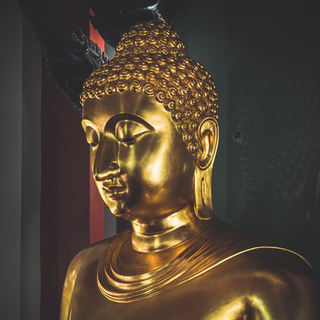
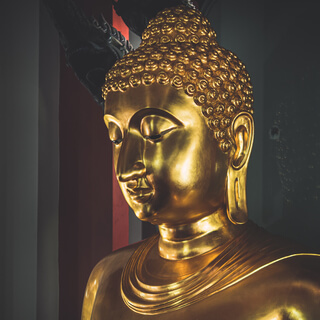
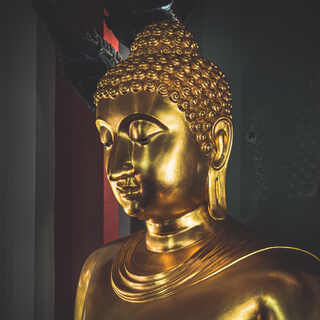
We pour water on the Buddha statue and give our homage,
So that our mind will be more cool.
It may be hot,
But we have sati,
Mindfulness,
Coming up.
We have respect and reverence.
We establish our mindfulness well.
Those with sila-dhamma,
They have forbearance,
Have self-restraint,
Have patient endurance,
They have self-control.
They abandon the feelings of the bad moods away.
There is cārgha,
The charity,
Abandoning of wealth and money,
Giving up personal happiness to give others wisdom,
Giving up the bad things in the heart,
Giving up the greed,
Hatred,
Delusion.
These sense impressions,
Moods,
That we don't like,
That we experience,
We throw it away.
Our heart has the Buddha,
Dhamma,
Saṅkha as our refuge and objects of recollection.
So Dhamma practitioners need to train in it.
For us to train in having honesty,
Self-restraint,
Forbearance,
Charity,
We need to train in samādhi.
The samādhi that we train in well will give us more inner strength.
And then even when we have sense impressions,
The moods that we don't like,
It's just simply a sense impression.
What which we like is also simply just a sense impression.
It arises,
Stays,
Then ceases.
We have mindfulness to see our own mind,
And we see it clearly.
We have the sense impressions,
The moods that we don't like,
But it arises and ceases.
When it's like this,
Our heart is cool.
Sometimes Dhamma practitioners receive hate and people bully us,
But we endure and bear with it.
We don't want to fight against them,
To say or scold them,
Because this would break our sila.
So there arises peace.
But living in this world,
It may be that we give in,
But the other party hates even more then.
Like this,
So what do we need to build?
What do we build in order to protect us?
We need to build thorns,
Build a shield to protect ourselves.
When others are bullying us,
Then we build mindfulness.
It is our shield.
Until we can have samādhi and wisdom arise,
Then this will help our minds to let go.
The mind and the sense impression can be separated out.
We see there is no self.
There is no being,
Self,
Me,
Or other.
The thoughts,
Ideas,
Proliferations that come out of the mind and go to the brain,
It is all subjected to a sense of self.
But the Buddha taught that there is no self of ours.
But when ignorance proliferates the mind,
Then it is subjected to a sense of self,
A me,
And them.
When it is to the ultimate level,
Then we let go.
We know in time as we experience it.
Mindfulness and wisdom has to know it in time.
But we can't do it all the time,
All day.
Our samādhi isn't yet stable all the time.
So we have to train to have samādhi be stable.
If it is khanika samādhi,
A momentary concentration,
Then we are walking māgha,
The noble eightfold path already.
We can kind of overcome some of the mental defilements.
We have anger arise,
Then we contemplate it and spread metta.
Our life,
We must die.
What will we take with us?
Why get angry?
Why hate?
We have to die.
Why have so much greed?
We must die.
So self-restraint,
Honesty,
Forbearance,
And charity,
These are noble virtues that are a foundation we need to train in,
And we will gain happiness and peacefulness until we meet with the Dhamma.
May you grow in blessings.