This quality of samadhi,
Meditative concentration,
We can't say it's only just samadhi.
Venerable Ajahn Chah gave a good comparison of it to like when we lift up the handle of a knife.
We are lifting all of the handle,
The blade,
The back of the knife and the knife's edge.
It comes up together.
When we sit and develop samadhi and are developing sati,
Mindfulness,
Then wisdom is in there already.
When peace arises,
We take the peace to contemplate rupa,
Material phenomena,
And nama,
Mental phenomena,
Seeing it as anicca,
Dukkha,
Anatta,
Impermanent,
Unsatisfactory and not a self.
And this will be wisdom.
And those who can train in developing this have faith.
And they can see that it arises from giving dana as well.
We have faith to give dana and offerings.
This is having self-sacrifice to one level.
And one gives dana with a mind that is pure as well.
Our material offerings are pure.
We didn't obtain our money from unlawful or bad means.
Then,
Even though it may not be a big amount,
But it's done from a mind that is pure.
The mind that is intent in doing goodness.
And this has a lot of resulting benefit arising.
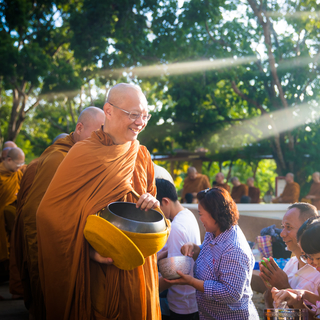
And those who receive dana from laypeople need to be established in sila,
Moral conduct,
And in dhamma.
Then our resulting benefit is greater.
So giving dana with faith is important.
There is dana on the outside and the dana on the inside.
The dana on the inside is abhaya-dana,
Giving fearlessness.
It is not holding on to anger,
Not holding on to ill-will and harmful thoughts.
This is a higher dana and it makes our samadhi be able to be firmly established.
Because we know that the obstacles to samadhi are pleasure and liking in forms,
Sounds,
Odors,
Tastes,
Sensations and mind objects.
And anger,
Ill-will,
Harmful thoughts,
Drowsiness,
Restlessness,
Irritation,
Anxiety and doubt are all obstacles.
These have been old friends to our mind for a long time.
Our new friends are the breath,
Uttho.
Our new friends are mindfulness and samadhi that we're training here now.
So we need to associate with this friend well.
If we don't associate with these friends,
Then the old friends will pull and invite us again for us to have liking,
Disliking,
Be drowsy,
To have doubts,
And our mind becomes all stirred up again.
The water in our mind gets more murky and shaken up.
So we need to nurture our mind to associate with friends.
Asevanacabalanam.
We associate with good friends.
The bad ones we don't associate with anymore.
Panditanamcasevanam.
We associate with pandita,
Which is the goodness that we do.
Like we give dana with faith.
We keep our sila from faith.
We bhavana,
Meditate with faith.
Faith leads us,
And wisdom follows later.
Later on wisdom will arise.
And when we do this often,
Ultimately we will have wisdom.
We will see and know that which is conventional and ultimate reality.
Those who are determined to practice like this are those who aren't heedless.
They are not heedless in their life.
Life is uncertain,
Death is something certain,
We must die for sure,
Ultimately life ends in death.
Life is not sure,
Death is a surety.
We can compare it to mountains coming from each of the compass directions,
Which are crushing living beings.
If in seven days it will get to us,
What will we do?
Death is coming close,
Death is close to us.
We have to not be heedless anymore.
So the Buddha gave the final teaching,
May you all bring heedfulness to its completion.
The Buddha had metta,
Goodwill and compassion.
Even when about to attain to final nibbana,
He gave his final teaching.
Gathering all the 84,
000 teachings into the teaching of to not be heedless.
When we practice dhana,
Sila,
Bhavana,
Then we aren't being heedless.
We are learning dhamma.
This is us not being heedless in our life.
Because life is so short.
The Buddha said it's like a dew drop on a blade of grass.
When the sunlight hits it,
The dew evaporates.
And especially during this season,
In the Asia-Pacific region,
It's so hot.
The fruit orchards,
Durian and mango orchards,
They water the trees and usually the wetness stays long.
But now they water it and the water evaporates quickly away.
It's so hot.
In this life we see that life evaporates like this.
Life is coming closer to death with each moment.
So we can contemplate and meditate on this as being dhamma.
The heat outside and the heat inside.
The heat outside is hot like this.
But the hell realm is way more hot than this.
We don't want to go to the hell realm.
It's got to be torturous.
In the human world,
Being this hot is torture already.
And sometimes so hot that people die from it.
In the hell realm,
They have a body,
But we don't call it a divine body,
But it's a body that we can't see,
And it can melt away.
It's a feeling of torture until death.
We don't want to be like that,
To suffer like that.
So we bhavana,
We develop our minds.
We have dāna,
We have sila,
We have bhavana.
We do it out of faith,
And wisdom follows after.
And our mind gets better and better.
Even if we have hardships and troubles in life,
We need to have wisdom.
There was one layman who had wisdom.
The Venerable Elder Sariputta was walking past him in the hot season in the city of Rajagir.
It was very hot too.
The temperature,
Not less than 40 degrees for sure.
Venerable Sariputta would have been so hot.
This layman was an orchard keeper,
Looking after a mango orchard.
He invited Venerable Sariputta to rest underneath the mango tree.
Sariputta had kindness and assisted this layperson by resting under the mango tree,
So the layman would gain good benefit from it.
The man gave water for Venerable Sariputta to bathe.
So Venerable Sariputta bathed,
So the man would get the results of goodness.
And then he gave drinking water as well,
And Venerable Sariputta drank it and left.
This layperson gained faith and confidence.
See this is dana-bharami,
The perfection of giving.
He did it with faith.
And dying from that realm,
He was born as a deva,
Having a heavenly mansion,
Having completeness and abundance.
But actually he was a devata since the human realm.
He had a mind that was full,
Uplifted,
Joyous,
Happy and radiant.
It can be compared to having lots of wealth.
It's like that in the heart.
Even though he was just someone who looked after a mango orchard,
But he had a full heart and was greatly uplifted.
His merit arising was great.
And he had done it to the Venerable Elder Sariputta,
The chief right-hand disciple of the Buddha.
This was also from his merit,
Because he had faith and had the wisdom as well to do that good deed.
Someone who has wisdom can do it.
Even not doing a large amount,
As he didn't have much wealth,
He was a mango orchard keeper.
But he could invite the monk to come rest a little bit,
Give a bit of drinking water,
And water to bathe.
And it had lots of resulting benefits for him.
In the Buddha's time,
Venerable Sariputta had radiant features.
And there was a female ascetic who ordained outside of the Buddha's dispensation.
She saw Venerable Sariputta and wanted to argue with him.
So she asked,
Do you eat facing downwards?
Or eat facing upwards?
Or facing left and right?
Or looking far and close before eating?
She asked with wisdom.
And when we hear this,
We won't understand this question.
Why is she saying eat facing upwards,
Eat facing downwards,
Eat looking around in the directions,
Eat looking far and near?
So Venerable Sariputta answered,
I'm a samana,
A monk.
We don't look up to the sky and eat,
Because we eat food given from alms.
Eating like that is not correct according to Dhamma-vinaya,
The monastic discipline.
We don't look down,
As in predicting good and bad fortune.
We don't do that.
We eat following Dhamma-vinaya.
We don't do palmistry.
We don't predict auspicious times,
Auspicious signs,
Or for fortune.
We don't do that.
We don't run errands and messages to this and that house.
So this is the meaning of near and far.
We don't do that.
A samana must follow Dhamma-vinaya.
And here the female ascetic had a lot of faith arise.
She went around Rajagir city and announced and spread it that Venerable Sariputta is a great monk.
She had faith,
And for the public to also come to gain faith in him.
Here Venerable Sariputta had taught Dhamma to bring up faith and confidence.
And he could change one from wrong view to have right view.
And with this faith,
Even though she did not offer food,
She went to go announce to others the goodness of Venerable Sariputta.
And this ascetic got a lot of benefit from this.
Because for a monk to ordain,
It is not easy.
Before one can ordain,
Do they need to have given dana?
There was one of my monk disciples who liked to give dana.
He felt very bad and asked me,
What do I do?
I've ordained now,
But when I was a lay person,
I gave alms and offerings like the lay people here.
I earned wealth,
I made offerings,
And it gave me a lot of happiness.
But now I have ordained and I don't do that anymore.
So how do I make merit and varami?
I explained to him,
You are also practicing generosity and self-sacrifice.
If you had a wife,
Child,
Land,
Property,
Wealth,
Money,
Car,
Credit card,
And you've given all that up and have come to ordain,
So we can see that to ordain as a bhikkhu sangha member is not done easily.
They have to sacrifice all of this,
And this is merit already.
We also have the opportunity to make a great merit,
Which is doing samadhi bhavana.
All the lay people have given us the four requisites,
And they need to go to do their work and duties.
But we have the opportunity to walk meditation,
Sit meditation,
Do chanting,
Go to morning and evening group chanting,
So we should not miss out on any of it.
We need to have resolve,
Have determination,
That in this life we won't miss out on it.
If our mental strength is weak,
We look at the sangha members who are strict in the practice.
We see senior monks that may be 70 years old already,
And they're still leading morning and evening group chanting.
We are still young,
So we should be able to do it.
We look to them as an example.
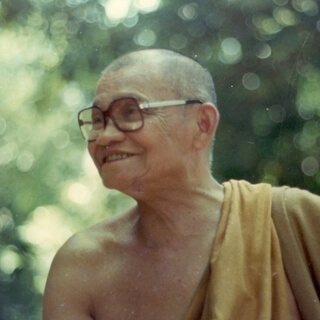
If we never saw the senior monks of the time of Venerable Ajahn Chah,
But we look at the senior monks of this present time,
We look at their example and see that they can do it,
So we must be able to do it.
They pull us so that we have faith to go to morning and evening chanting,
And so we must be able to do it.
When being a monk,
We need to have resolve to do the korwat patipada,
Monastic routines and practices well.
We become a worthy field of merit to the people who come to give dana and alms to us.
Some lay people wake up at 5 a.
M.
Often they buy food from the evening before,
And the next morning wake at 5 a.
M.
And cook the rice,
And they prepare themselves,
Then drive here.
There are those coming from near and far,
Some from overseas,
From Bangkok,
A lot from this district of Rayong,
Who come to give dana and offerings.
So monks need to have the resolve to go to the morning group chanting before we can eat the food of the lay people.
If we don't go to morning chanting,
We have to torture ourselves.
One way is we don't eat the food,
We only eat plain rice.
We have to torture the defilements.
We are not torturing ourselves,
We are harming the defilements.
The defilements attach to this body,
Loving it so much as ourself.
So we need to torture it to make it suffer a bit.
When it suffers,
Then the defilements get hot.
They don't want it that way.
They want good food.
So we need to give a reward.
If it wants good food,
Then we need to come to morning chanting,
Do sitting and walking meditation,
Come to go for alms,
Building merit and goodness.
And it is all done from faith.
For lay people they do it from faith.
For monks they practice out of faith.
And this will bring good results.
The lay people and monks will have great results from doing goodness.
Venerable Asariputta lived on alms food.
He contemplated the food.
He contemplated taking food to the right amount,
To eat just the right amount,
And to put forth effort.
So he taught as an example.
And Venerable Ajahn Chah taught with his example that we should eat until we will be full in five more mouthfuls and then drink water so as not to be full and bloated,
Which will bring troubles to the body.
So we need to be intelligent.
Being a monk needs to be intelligent.
Have self-sacrifice,
Which counts as merit and goodness.
Whatever we have,
We relinquish it out of the heart so that we'll have samadhi arise.
If we still have worries,
Then we'll have a problem.
This shows it's not easy to practice the holy life.
For monks,
They need to do it fully.
The lay people support and get merit and goodness.
So we are not heedless.
We follow the Buddha's teaching that one who is not heedless is one who does not die.
They don't die from goodness.
And Ajahn Chah would say strongly of one who is heedless,
It's like one's walking around with no mindfulness.
This is like seeing a dead person that can walk and speak.
And there's a lot dead.
In this world,
It's just full of dead people.
But those who are not heedless are people who have mindfulness.
And there are just few of them.
Those with mindfulness are those who are not dead.
May you be determined to practice and to build goodness.
May you grow in Dhamma.
May you grow in blessings.
Thank you.