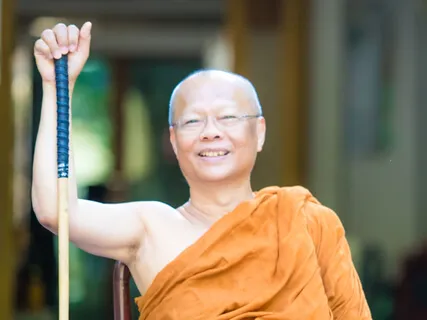
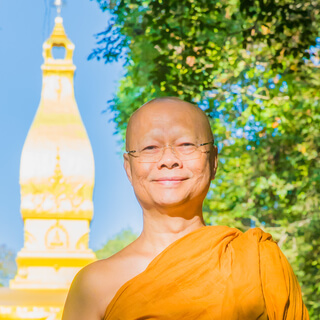
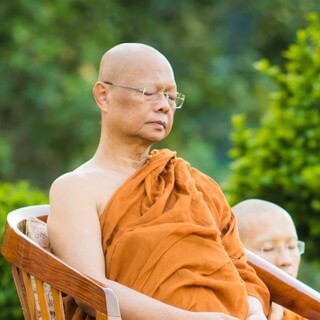
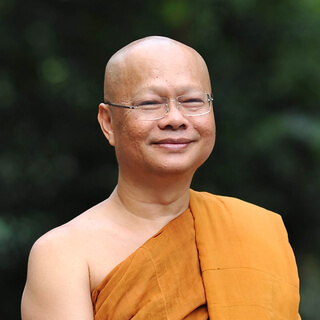
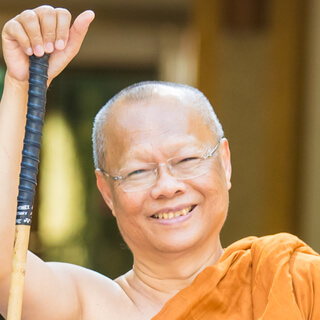
Sikkim Bhutto – Translator's Introduction This book aims to serve as an introduction to the Dhamma teachings of Venerable Ajahn Anand Akincino.
These teachings provide both a guide to the fundamentals of meditation practice and also an overview of the entire noble path from beginning to end.
Both these aspects stress not only the development of Samadhi and wisdom,
But also the cultivation of other essential virtues such as generosity,
Patience,
Loving-kindness,
And moral discipline that together emphasize the integrated and harmonious nature of the Buddhist path.
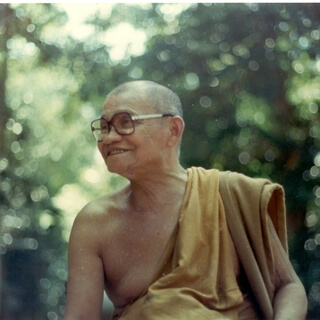
Ajahn Anand is a distinguished first-generation disciple of Venerable Ajahn Chah Bodhinyana Thera,
1919-1992,
Who was a spiritual mentor and teacher of teachers revered throughout the Buddhist world and one of the most influential Theravadan bhikkhus of recent times,
Both inside and outside his native Thailand.
After the passing away of Ajahn Chah,
Who was affectionately called wung pu or Venerable Grandfather,
It seemed natural that Ajahn Anand,
As an accomplished student of this celebrated master,
Should begin to exert a similar influence over a new generation of Buddhists who looked towards him for guidance and inspiration.
The teachings contained within this book were originally extemporaneous talks delivered to mixed audiences of both monastics and laity without any formal planning in advance,
As is the style of meditation teachers in Thai forest monasteries.
Developing Samadhi,
A Guide to the Fundamentals of Meditation by Venerable Ajahn Anand Akinchano When sitting in meditation,
We assume a posture that feels just right,
One that is balanced and relaxed,
Which should lean neither too far left nor too far right,
Neither too far forward nor too far back.
The head should be neither raised nor drooping,
And the eyes should be closed just enough that we don't feel tense and uptight.
We then focus awareness upon the sensation of breathing at three points,
The end of the nose,
The heart,
And the navel.
We focus awareness,
Firstly,
On following the in-breath as it passes these three points,
Standing at the nose,
Descending through the heart,
And finishing at the navel,
And then,
Secondly,
On following the out-breath in reverse order,
Starting at the navel,
Ascending through the heart,
And ending at the tip of the nose.
This preliminary means of focusing awareness can be called following the breath at three points.
Once we are mindful of the in-and-out breathing and proficient at focusing awareness on these three points,
Then we continue by clearly knowing the in-breaths and out-breaths just at the tip of the nose.
We maintain awareness of the sensation of breathing by focusing on only the end of the nose.
Sometimes,
As we focus on the breathing,
The mind wanders off thinking and fantasizing about the past or the future,
And so we have to put forth effort to maintain this present moment awareness of the breath.
If the mind is wandering so much that we cannot focus our awareness,
Then we should breathe in deeply,
Filling the lungs to maximum capacity before exhaling.
We should inhale and exhale deeply like this three times,
And then start breathing normally again.
As the in-breath passes the nose,
We count one.
As it passes the heart,
Two.
The navel,
Three.
With the out-breath,
We count one as it moves up from the belly,
Two as it passes the heart area,
And three at the nose tip.
We should count in this way until we are skilled and proficient.
This is the first method of focusing awareness upon the breathing.
Alternatively,
We can focus our awareness using the second method of counting in pairs.
We count one as we breathe in,
And one as we breathe out.
With the next in-breath,
We count two,
And with the out-breath,
Two.
Then in,
Three.
Out,
Three.
In,
Four.
Out,
Four.
In,
Five.
Out,
Five.
Firstly,
We count in pairs of in-and-out breaths up to five.
After the fifth pair,
We start again at one,
And increase the count of in-and-out breaths one pair at a time.
For example,
In-out,
One.
In-out,
Two.
In-out,
Three.
In-out,
Four.
In-out,
Five.
In-out,
Six.
After counting each new pair of in-and-out breaths,
We start again at one,
And increase the pairs incrementally up to ten.
Using this method,
We will be aware of whether our mindfulness is with the counting,
Totaling the numbers correctly,
Or whether it is distracted and confused.
When competent at counting the breaths,
We will see that the breathing is perceived with increased clarity.
The rate of counting can now increase in speed as follows.
With the in-breath,
We count one,
Two,
Three,
Four,
Five,
And with the out-breath,
One,
Two,
Three,
Four,
Five.
When proficient at counting up to five like this,
We can increase the number to six,
Breathing in,
Count one,
Two,
Three,
Four,
Five,
Six,
And breathing out,
Count one,
Two,
Three,
Four,
Five,
Six.
Alternatively,
We can continue counting up to five,
Whichever feels more comfortable.
We can experiment to see whether counting up to five is enough to hold our attention or not.
If we cannot remain mindful and wander off into thoughts,
Then we should count rapidly on the in-breath,
One,
Two,
Three,
Four,
Five,
And similarly on the out-breath,
One,
Two,
Three,
Four,
Five.
We should count in this way until we become skilled and proficient.
Eventually,
We will become aware that the mind is let go of the counting all by itself and feels comfortable knowing the in-and-out breathing just at the tip of the nose.
This can be described as a mind brought to peace through the method of counting in pairs.
Just meditating at home,
We begin by reciting the qualities of the Buddha,
Dhamma,
And Sangha.
We can recollect these qualities by chanting the daily devotions to the Triple Gem,
Either in full or in brief.
We then generate thoughts of loving-kindness directed firstly towards ourselves,
Reciting the verse,
May I abide in well-being.
We then spread these thoughts of loving-kindness to include all beings.
May they be happy and free from suffering.
May they not be parted from the good fortune they have attained.
We focus next upon knowing the in-breath and out-breath at the three points,
Or according to the method of counting in pairs,
As has already been explained.
We establish mindfulness by focusing awareness completely upon counting breaths.
When mindfulness has been properly established,
Then the heart will be continuously aware of the process of counting,
Recollecting nothing else,
Especially those mental objects conducive to sensual desire,
Ill-will,
Sloth and torpor,
Restlessness and agitation,
And doubt.
When mindfulness has been properly established,
These five hindrances do not arise.
Concentration then becomes firmer and samadhi arises,
Characterized by a momentary peacefulness of mind called kanaka-samadhi.
This is only a slightly concentrated state of mind.
If we are focused in samadhi with continuous mindfulness,
Then sometimes the state known as piti will arise.
Piti is characterized by physical sensations of coolness or of a rapturous energy thrilling throughout the body,
Like waves breaking on the shore,
Which can cause the body to sway and the hair to stand on end.
These sensations are accompanied by mental perceptions of physical expansiveness.
When mindful awareness is focused continuously,
It can seem that the hands and feet have vanished.
The feelings in other areas of the body,
Even the sensation of the whole body itself,
Can likewise entirely disappear from consciousness.
The body feels completely tranquil.
During this period that the heart is peaceful,
The mind temporarily lets go of its attachment to the physical body,
And consequently mind and body feel light and tranquil.
As we sit in meditation and this tranquility increases,
It can seem as though we are floating in space,
Giving rise to feelings of happiness and well-being.
At this point we can say that the power of our concentration has deepened to the level of upajara samadhi.
As samadhi deepens further,
The heart experiences even greater rapture and bliss,
Together with feelings of profound inner strength and stability.
All thoughts completely cease and the mind becomes utterly still and one-pointed.
At this stage we cannot control or direct the meditation.
The heart follows its natural course,
Entering a unified state with only a single object of consciousness.
This is the unification of mind in samadhi.
The heart has been stilled and brought to singleness.
Each of these levels of peace provide us with inner strength.
They empower the heart for developing wisdom.
When we contemplate the body through the modest peacefulness of kanaka samadhi,
For example,
Then we will gain a modest degree of insight.
Through investigation we will clearly see that the body is impermanent.
We can contemplate the nature of the body right from its beginnings.
How did it look at conception?
What was it like in the womb?
We can consider the body's appearance as a child,
Gradually growing and maturing but always inconstant and changing.
The sense organs,
The eyes,
The ears,
The nose,
The tongue,
And physical body gradually deteriorate with age along with the faculties of seeing,
Hearing,
And so on.
When degeneration sets in to a greater degree,
We say that the body is old and then becomes sick and eventually dies.
When samadhi is strong,
Then the heart is strong,
Capable of contemplating and clearly seeing the physical body as impermanent.
The deeper the samadhi is,
Then the deeper the insight into impermanence.
We clearly see the truth of the Buddha's teaching that the body is a nica,
Dukkha,
Anatta,
Inconstant,
Stressful,
And neither a self nor a soul.
At this stage we are possessed of the deepest type of wisdom.
We see the truth with a clarity that is neither questionable nor dubious.
There are three levels of wisdom and understanding.
The first of these is the understanding acquired through learning or the wisdom which results from listening to and studying the teachings of the Buddha.
The second level of wisdom arises through contemplation and investigation of the truth.
The third and deepest level of wisdom is acquired through the practice of meditation.
This is the wisdom that arises from a peaceful heart and sees things according to reality.
We practice mindfulness of breathing to make the heart peaceful.
We can count breaths or use the additional mantra bhut do,
Internally reciting bhut,
With the in-breath,
And do on the out-breath.
When the heart is calm and concentrated,
We can use the power of the samadhi for investigation because even with momentary concentration,
The mind is supple and at the stage where it can clearly contemplate the physical body and the mind,
Whether feelings,
Perceptions,
Mental formations,
Or consciousness.
When memories and perceptions arise,
For example,
We can see that they are clouded and hazy,
Like a murky and overcast sky,
Incapable of penetrating to things as they actually are.
Thoughts and mental formations are sometimes wholesome,
Sometimes unwholesome,
Or else neutral,
Neither one nor the other.
These sankaras have no abiding essence at all.
Consciousness refers to the awareness of knowing,
Seeing,
Hearing,
Smelling,
Tasting,
And touching.
There are six classes of consciousness based on these six senses,
Arising and ceasing in succession.
While listening to the dharma,
For example,
If the ear and the faculty of hearing are normal and unimpaired,
Then we can hear what is being said.
If this sensory apparatus has deteriorated,
Then the hearing will not be clear.
Hearing therefore is dependent upon sounds,
Making contact with the ear,
And the faculty of hearing being in a healthy state.
When we hear sounds,
There is also the awareness of hearing.
The mind is conscious of hearing sounds.
However,
We attach to this awareness and identify with the hearing as oneself,
That is,
I hear,
Or hearing belongs to me.
The process of hearing is dependent upon many causes and conditions.
If there are no sounds,
Then there is no experience of hearing.
If there is no contact between the ears and sounds,
Then likewise,
There is no experience of hearing.
If the faculty of hearing is impaired,
Then we feel that we haven't heard properly.
Therefore,
When there are sounds,
The faculty of hearing is unimpaired,
And there is contact between these sounds and the auditory sense base,
Then consequently ear consciousness arises and hearing takes place.
The same is true of the other senses.
Without exception,
All these six classes of consciousness that arise,
By way of the eye,
Ear,
Nose,
Tongue,
Body,
And mind,
Are merely types of elements.
If our heart is peaceful,
Then we will see all these types of consciousness as just elements arising and ceasing,
Without a self or soul.
In reality,
The self is like a conjurer's trick,
Arising and passing away at the six sense doors.
However,
The mind that lacks the inner strength of wisdom grasps onto the body feelings,
Perceptions,
Mental formations,
And consciousness,
And identifies with them as oneself.
This attachment causes suffering to arise.
When we have brought the heart to peace,
However,
Wisdom in the clear understanding that is called vipassana arises,
Enabling us to abandon this sense of self.
Therefore,
In the beginning,
It is essential that we practice meditation.
We must train ourselves in present-moment awareness,
In all postures,
Using a preliminary meditation object to focus and guide our heart.
Practicing this way will greatly strengthen our mindfulness.
We should put forth effort to observe our mind and feelings continuously.
When there is contact between the senses and their objects—the eyes and forms,
The ears and sounds,
The nose and odors,
The tongue and flavors,
The body and physical sensations,
The mind and mind objects—we must mindfully contemplate how these sense objects affect our heart.
The one who guards and cares for their heart will be liberated from all suffering.
We must look after our heart with mindfulness.
Otherwise,
It will just grasp onto everyday objects of consciousness,
Creating a sense of self.
The untrained heart lacks the wisdom to see that this attachment causes suffering.
Nobody wants to suffer,
But through this attachment to the objects of consciousness,
Stress and discontent always arise.
Therefore,
We have to train our heart following the way of the Buddha,
Who exhorted us to be mindful at all times,
Whether standing,
Walking,
Sitting,
Or lying down.
Focusing awareness on the in-and-out breathing is also a form of mindfulness practice called anapanasati,
Mindfulness of breathing.
Every day we can focus our awareness through this practice for thirty minutes,
Or,
If we have more energy,
For forty-five minutes,
Or even for an hour.
Whenever we have time,
We should try to practice mindfulness until it becomes firm and focused continuously.
When we are accomplished in mindfulness,
Concentration and wisdom arise.
Whenever we are mindful,
We are perfecting the factors of the Noble Eightfold Path.
Right effort means striving to develop mindfulness in the present moment,
Abandoning the past and the future.
Right effort also includes the effort to prevent unwholesome mental states from arising in the mind,
And the effort to evoke and maintain wholesome,
Skillful qualities.
The factors of right mindfulness and right samadhi are also developed with and through the factor of right effort.
As for those aspects of the Noble Eightfold Path concerning moral conduct,
Such as right speech for example,
These are also developed through the practice of mindfully sitting and walking in meditation.
While in meditation,
Our actions of body and speech are focused in a wholesome way,
And we are engaged in an activity that is skillful and pure in accordance with right livelihood.
By contemplating the hindrances to meditation,
Such as restlessness,
And also reflecting upon how suffering is caused through attachment,
We are developing the path factors of wisdom that is right view,
Together with the right aspiration to be free from suffering once and for all.
Therefore,
All the components of the Noble Eightfold Path,
Or in short,
Sila,
Samadhi,
Panya,
Are perfected through the practice of meditation,
Because while practicing meditation,
We are simultaneously developing all eight factors of the path.
Mindfulness can also be developed through walking meditation.
We should walk with composure,
The hands clasped lightly in front,
Right over left.
The head should be neither raised too high nor hung too low.
The eyes should be focused forward to an even distance,
And stray neither left nor right,
Neither behind nor too far ahead.
While walking back and forth,
We coordinate the movement of our feet with the mantra bhutto.
As we step forward,
Leading with the right foot,
We internally recite bhutto,
And with the left foot,
Do.
Lumpu Chah taught that while walking in meditation,
We must be aware of the beginning,
Middle,
And end of the path.
While reciting bhutto with the right foot,
And do with the left,
We should also fix our mindfulness on knowing our movements in relation to these three points along the path.
That is,
As we begin,
As we pass the middle,
And as we reach the end.
Upon reaching the end of the path,
We stop and establish mindfulness anew,
Before turning around and walking back,
Reciting bhutto,
Bhutto,
Bhutto,
As before.
Focusing upon the activity of walking while pacing to and fro is called jnkama,
Or walking meditation.
We can adjust our practice of walking meditation according to time and place.
If space allows,
We can establish a walking path 25 paces long.
If there is less room than this,
We can reduce the number of paces and walk.
If there is less room than this,
We can reduce the number of paces and walk more slowly.
While practicing walking meditation,
However,
We should walk neither too fast nor too slow.
In listening to others,
We can also focus on reciting bhutto in our heart while mindfully noting that we are listening.
We should strive to be mindful whatever our activity,
Be it sitting,
Talking,
Or listening.
Mnputra greatly stressed the practice of mindfulness.
When the heart is peaceful,
We can turn to the contemplation of the physical body,
Feelings,
Perceptions,
Mental formations,
And consciousness.
We will see that these five aggregates merely arise,
Exist briefly,
And then completely pass away.
There is no real abiding self or soul or person or being or me or you to be found.
Although the Lord Buddha is referred to as the Enlightened One,
He taught that we should not identify with this knowledge of the truth.
Nevertheless,
We can listen to and investigate the teachings without understanding that we shouldn't attach to our knowledge and insight.
Because we still have self-view and the desire to identify with our experience,
We can become confused about how to proceed.
The Lord Buddha taught that even with knowledge and a clear understanding of the truth,
We should recognize this knowledge as being simply dhamma arising,
Establishing itself,
And then passing away,
The completely pure heart that arises.
As we develop mindfulness,
We can see that sometimes the heart is possessed by greed,
Hatred,
And delusion.
Recognizing this,
We should also be aware that this is just the nature of the unenlightened mind.
It is also just the nature of the mind to be,
At times,
Without these defilements.
The mind that is sometimes wholesome,
Sometimes unwholesome,
Sometimes bright,
Concentrated,
Blissful,
Calm,
And wise,
Is also just the mind as it is,
According to its nature,
And not to be clung to as me or mine.
The mind is just the mind,
Not a self or soul or person or being or me or you.
Even this knowledge,
However,
Should be let go of.
This insight that body and mind are not self is called wisdom.
Wisdom too must be let go of and relinquished.
By training our heart this way,
It becomes peaceful,
Pure,
And radiant.
The mind that has been well trained naturally brings happiness.
The untrained mind is a danger.
It has no refuge,
And out of ignorance,
Continually races along with its moods and desires.
However,
The mind that has been properly trained brings us happiness.
Most of us have already received an education or some kind of training,
And are knowledgeable in the various arts and sciences of the world.
However,
We have to further train our minds to be peaceful,
To recognize the danger of being immoral and undisciplined.
We have to keep our actions of body and speech within the bounds of virtue,
And see the danger in the hindering defilements of desire and aversion,
Cruelty,
Ill will,
Doubt,
Agitation,
And restlessness.
As we learn to see the harmful consequences of such mental states,
We develop loving kindness,
Aspiring towards the happiness of ourselves and others,
Freed from hatred and ill will.
Initially,
We cultivate loving kindness towards ourselves and those that we love,
Such as our mother and father,
And then we extend these benevolent thoughts to include beings everywhere.
Through the cultivation of loving kindness,
We sleep well and our heart is peaceful.
We then turn towards the contemplation of the body,
Feelings,
Mind,
And mind-objects.
Seeing that these things are just that,
Body,
Feelings,
Mind,
And mind-objects,
Nothing more.
They are neither a self,
Nor a soul,
Nor a person,
Nor a being,
Nor me,
Nor you.
Wisdom then arises,
And suffering steadily diminishes.
Therefore,
We must train and develop our hearts.
If we do not train ourselves in this life,
Then we'll leave the world empty-handed.
We have to study this physical body.
It is born,
Gradually ages,
And eventually dies.
It is evident,
Therefore,
That only suffering lays ahead,
Not happiness.
Old age,
Sickness,
And death are waiting for us.
At present,
We may not be aware of this process of degeneration,
But later on it will become obvious.
Our eyesight,
Hearing,
And physical strength will deteriorate.
Some people have a long life,
But eventually they die of old age.
When the body reaches its end and can no longer sustain itself,
Then we call this dying of old age.
When the body is at the point where it can just keel over and die,
Then we say it has reached old age.
When very old,
The body sickens,
And when very sick,
It dies.
At present,
We are still physically strong and can sit and walk and meditation with ease.
We can practice mindfulness easily and should therefore strive to train ourselves.
Training the mind in meditation is much more meritorious than practicing generosity and observing precepts.
Therefore,
Whether living at home or in a monastery,
We should put forth effort to train ourselves according to the methods that have been explained here.
We should train our hearts in peace and then contemplate the truth to bring forth wisdom.
We will then realize the fruits of practicing Dhamma.