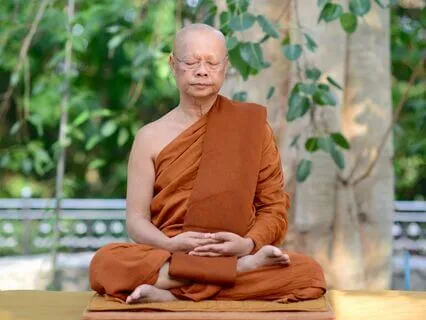
To be still,
Peaceful and firmly concentrated,
This peace will keep in check the mental defilements first,
Because the nature of the mind is a conscious element.
When the mind without wisdom experiences sense or mental objects,
Then it will sway along with that object.
It wavers.
With the sense object that typically brings up greed,
Anger or delusion,
The mind will sway along with it.
Normally the mind is still,
Indifferent and peaceful.
It can be compared with a leaf.
If there is no wind to blow on the leaf,
Then the leaf stays still.
It doesn't sway.
But when the wind blows on it,
Then the leaf moves with that wind.
The mind is the same.
So we need to come to train the mind.
Bring up peace first.
When we have peace,
Then in the time it has samadhi,
Meditative concentration,
The mind does not sway.
Then coming out of samadhi and experiencing sense or mental objects,
The mind starts to sway again.
But with this swaying,
We have some mindfulness and wisdom.
There is mindfulness and wisdom to know the swaying.
Before,
We did not know at all when the mind was swaying.
We did not know when the defilements arose.
The greed,
Anger,
Delusion or raga,
Dosa,
Moha.
Raga,
Which is the liking and satisfaction,
It was all taken as ours.
But when we meditate,
We can see the mind swaying.
So we try to train in samadhi to be able to keep the mental defilements in check first.
But they aren't gone.
They are just suppressed initially,
Like a rock placed on top of the grass.
When we take off the rock,
The grass grows again.
So we haven't yet gotten rid of the defilements.
We haven't pulled out the roots.
When our mind is peaceful,
Then we investigate and contemplate on that which we have known already.
We know the body is not beautiful.
There are the various parts of the body.
We have head hair,
Body hair,
Nails,
Teeth and the skin which covers over.
And on the inside are many organs,
All of which are not beautiful.
But when the eye sees form,
It sees the exterior,
As it has been deluded for a long time.
So it takes what it sees as beautiful.
We see a form that we don't like and we have displeasure arising.
It is tanha,
Craving of another type.
There is pleasure,
Which is craving,
And displeasure is craving again.
We can call it another name,
Which is not wanting to have or be.
With pleasure,
Then one indulges in it,
Which is kamma tanha,
Craving for sensuality.
And wanting to get what we like is bhava tanha,
Wanting to have or be.
This craving is a cause for upadana,
Clinging to arise.
And then there is the arising of becoming and existence,
Which is the cause for suffering to arise.
But however suffering may arise,
We have mindfulness to restrain it,
To be within sila,
Moral conduct.
And then there is peace and order arising in our own mind first,
And in our family and in society.
But if the quality of mindfulness and wisdom is small,
And the power of the mental defilements is greater,
Then it pulls our mind to act following it.
And these days it is very dangerous.
Things are quicker.
When there is greed,
Then one acts following the greed.
We follow the anger and delusion.
Especially for angry thoughts,
Which is coming from the wrong view in the heart,
That there is a me and mine.
There are thoughts of finding fault and ill-will.
And what is the cause that we find fault and have ill-will?
It is because we focus our attention,
Stare,
Observe,
Notice,
Scrutinize,
Really look for faults,
And doing it deliberately.
We must find the wrong with others.
We think badly of others,
Have ill-will,
And intend to harm as well.
This is the mind that is in a bad or unskillful state already.
Or these days we say it is seeing them in a negative way constantly.
When we look at it in this way,
Then our mind falls lower.
It goes down.
It is covered by the mental defilements already,
Of me and mine,
And seeing others to look for the bad in them.
This is the mental defilements already covering over us.
So this is the cause that we set our sights to look for their faults.
What for?
For us to make ourselves be better.
Seeing others as no good,
So we feel that we are better than them.
And like this,
It is ill-will to others already.
So this is wrong.
One who is a wise person and not a fool must have the wisdom to get out of suffering.
This is done by not finding fault with them,
Not having ill-will towards them,
Not following the power of the mental defilements,
Not arguing,
Not speaking bad of anyone.
We try not to think in these ways,
But if we have thoughts about it,
Then we try to give it up.
It is normal for us to have these types of thoughts,
To have fault-finding and ill-will.
We may have those thoughts,
But we know now that it isn't good,
And so we abandon it.
We do not find the shortcoming of others,
But see our own shortcomings,
And we change ourselves.
In this way,
Then,
We can be peaceful.
We think,
Why should we look for fault with others?
Our heart is still beating,
And we can still breathe.
When we have the breath,
Then our heart can still beat.
If we don't have the in-and-out breath anymore,
Then the heart will stop beating.
And when the heart stops beating,
There is no more breath,
And then we die.
So we think about how many more breaths we have in this life.
How many more heartbeats do we have left?
There are not too many left.
In this way,
We don't look at others,
But we look at ourselves.
There is only a little bit left of our life.
Our heartbeats remaining in this world are few.
So we will build goodness.
We won't find faults with others.
Even for ourselves,
Don't find faults to the point that we are suffering.
This is ill-will for oneself.
Sometimes we think bad of others more than necessary.
They may make a small mistake,
But we fault them greatly.
And these days,
People in the online social world,
They speak bad of them so much,
Till that person may even think of committing suicide.
It is very dangerous.
So we see the cause,
Where we are sometimes looking for sureness in ourselves by finding faults with others.
Bullying and intimidating others for us to feel we have power,
And in order to compensate for the lack in our mind.
We have to be careful of this.
Sometimes we go condemning others,
Following along the group that is criticizing them.
This is wrongdoing,
And it's a bad deed that can come up very quickly.
So merit can arise quickly,
Just as demerit can arise quickly,
And can come up many times as well.
So we have to be careful of our minds,
In it looking for fault and seeing the wrong of others,
And having ill-will to others.
We have to see the positive side of them,
The side of them that has value.
Even if they have no value,
We think that one day they will get or become good.
We have met their goodwill and love for them in this way.
So like this,
Then this is a good person,
With right view.
Because the more we find fault with others,
Then at that time,
The mental defilements have grown that much.
There is just a sense of self and me.
There is just an accumulation of mental defilements.
Like we may have heard the saying of faulting others like a mountain.
We fault ourselves just a tiny bit.
However big or huge it is,
We see it as tiny.
But when others do a little,
We see it as a lot.
So we have to train the mind.
If we have fault-finding and thoughts of ill-will,
This is bad and unskillful,
So we have to give it up.
When we have good things arise,
Then we cultivate them,
And we try not to have fault-finding arise.
Even for the monks who live together,
They may compete and find fault with each other.
Venerable Ajahn Mun was once going for alms round,
And he suddenly stopped walking.
And he gave a teaching that these two certain monks should adjust their minds first,
To not find fault and not to have ill-will for each other.
This will obstruct samadhi,
Concentration.
It will obstruct wisdom.
And it pulls down one's mind.
And samadhi doesn't arise.
When samadhi doesn't arise,
And there is fault-finding and ill-will,
Then it is unskillful and bad karma.
So we have to be careful.
Even if they made a mistake,
We have to be careful and see whether it is correct to criticise them or not.
Would it be good?
Is it right?
If we are not careful of this,
Then we may have problems arising.
These are coming from the three types of latent mental defilements,
And this has been in our minds for a long time already.
So we need to be careful.
We need to do good,
Speak good,
And think good.
If others do no good,
We don't go carrying it around.
When I stayed with Venerable Ajahn Chah,
Once he said,
Oh,
We people,
Sometimes we aren't carrying it,
But we feel heavy.
Others do bad,
And it is them that carry something heavy,
But we get heavy instead of them.
That is,
We criticise and blame them.
So we need to have kindness to each other,
Have metta to each other,
Don't get excessively involved with others,
Cultivate yourself a lot,
And see yourself a lot,
Look at yourself about 90 percent,
And look at others about 10 percent,
So that we can be an example and to change ourselves.
We learn about it by looking at ourselves 90 percent.
Then we can see that,
Oh,
Their faults are the size of a needle,
But we see it like a mountain.
Our own faults,
However big they are,
We see it as the size of a needle.
It is all the cause of suffering to arise.
So training in the Buddha's dispensation,
We can think that the number of our heartbeats are diminishing,
Getting less every day.
The heart is beating all the time.
When we are sleeping,
It is beating.
When we are awake,
It beats.
It is working all the time,
And so we need to come to train our minds to be good.
If we go criticising and faulting others,
This is like we are carrying a bad thing in our hearts.
We think,
That person is no good,
This person is no good,
The teacher is no good,
The place is no good,
All of it is no good.
This is called taking the bad things to be in our hearts.
We like to carry dirty things in our bag,
Carrying it around with us all the time.
And this is something we do ourselves.
So we say that we people carry bad things around,
Like disgusting things,
Urine,
Excrement,
Dirty things,
And we put it in our bag,
Put it in our monk's bag.
But we then complain that our bag has a problem.
There is something wrong with our bag,
It has a bad smell.
But we are the ones who put the bad things in it ourselves.
We put the disgusting thing in there,
And then we complain about it.
So we need to look at what our mind is like.
Is it complaining?
Are we taking bad things and carrying them around?
We should try to abandon it.
Try to take all these things out and make it clean.
This is in the beginning of training our mind.
Training it to be peaceful,
To have goodness,
To have wisdom arise.
When we think good thoughts which have benefit,
We think thoughts free of sensual delight,
Thinking free of ill will and harm.
Then it is right thought.
It is coming from wisdom,
From right view,
Sammādhiti.
Then we will have right speech,
Right livelihood.
And it is all right concentration.
So this is walking the noble eightfold path.
We train in this,
Do this,
And then our mind is at ease.
But sometimes it is normal that when the I sees form,
The mind proliferates already.
So we teach the mind that it is not a sure thing.
It is impermanent.
There is no self to it.
There is no one doing bad.
And there is no one knowing which person does bad.
There isn't anyone.
That body is the four natural elements.
With proliferation,
It is the five aggregates.
And our recognition and knowing is the five aggregates as well.
It relies on the four elements.
There is no self,
No me at all.
It is emptiness.
It is empty.
When it is empty like this,
Then it has ended.
There is no suffering anymore.
There can be no suffering arising in the heart.
So try to train in it.
We train each day to build merit and build goodness,
To build dāna,
Generosity,
And to build sila,
In order to have wisdom arise before our heart will stop beating.
And this is in not a long time.
We don't know when it will be,
So we are not careless.
In this one minute of the breath we have,
We will give up bad,
Do good,
And have skillfulness arise within our mind.
So try to have a lot of mindfulness.
Look after the mind well.
Keep it within moral conduct.
And this is the path that we will see the Dhamma.
When we don't have thoughts affected by liking and disliking,
Then our mind is correct,
Within right view.
Here is where we will see the Dhamma.
We make our samādhi firm.
We contemplate the body,
Seeing it as asubha,
Not beautiful or attractive.
And then the mind is released from liking.
There is no fault-finding,
Thoughts of harm and ill-will.
And we spread mettā,
And our mind becomes peaceful.
We see that all things are emptiness.
Rūpa,
Nāma,
Material and mental phenomena are empty.
There is no me,
No mine.
There is no one.
There is no one coming,
No one staying,
No one knowing,
No one seeing.
The mind is empty,
Free from suffering.
It is lokuttara,
Gone beyond the world.
And we can develop this.
But we need to have patient endurance first.
In the beginning,
We restrain the mind through samādhi,
And we have wisdom arise.
So try to make an effort.
We have known many things already,
And have gained worldly subjects and knowledge.
So we learn now another knowledge,
Which is the knowledge to be free from suffering,
Or to alleviate suffering.
May you set your hearts on this.
May you grow in blessings.