So with creating acts of goodness,
Meritorious deeds,
Skillful deeds that you had just done,
And now we come to take the time to train our minds so that they grow and they become better.
Because the nature of our minds is that if they have delusion overpowering them,
Then they'll have a sense of self.
And if that sense of self is excessive,
Then all the things that we do are just for the sake of me.
It's all about me and just that.
And then through that,
The mind drops and becomes gloomy and sad.
So to bring the mind to a bright and joyous state,
We need to abandon this feeling of self and to reduce that,
Make it less and less.
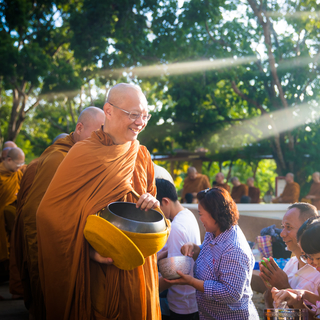
So the Buddha taught in the beginning for us to give,
For us to create these meritorious acts of generosity,
Of dana.
And even though the things that we offer,
It may not be a lot or very grand,
But if we have a heart of faith when we offer,
Then just one ladle of rice is of great value.
Or we just offer a little bit of fruit,
Or whatever it is that we have the faith to give.
This all brings great value to our hearts.
So the story from King Asoka that previously,
There was a time when he was a child,
And he gathered together a handful of earth and offered that to a Pacheco Buddha.
And from that offering,
The benefit that arose was that when he became a king,
That his kingdom expanded into this empire.
So the dana,
Barami that we cultivate,
It supports us to be able to know the Dhamma and to see the Dhamma.
And even beings with huge amounts of barami,
Arahants,
People who became arahants at the time of the Buddha,
That when the Buddha taught them initially,
He started off with dana,
With generosity.
So like Yassa,
He was from a child of a very wealthy family in Varanasi,
And the Buddha taught him about dana first,
Even though he had been so incredibly generous beforehand.
And so through hearing this teaching,
His mind became very bright and happy.
But initially,
He was in a state that was really confused and chaotic.
But when he listened to these Dhamma teachings about generosity,
Then his heart became joyous.
So it's like us,
That we are all very generous,
And we come to this meditation retreat as well.
So as Buddhists,
We are all really exceptional in the kindness and the thoughtfulness that we have to give and in our giving.
And these acts of giving,
When we look at it,
It may not seem like they're really a big deal.
It may seem like something insignificant.
But for that to arise,
It's really not easy at all.
Because that giving,
It comes from a heart that has faith.
And for us,
Finding the time,
Creating this opportunity to be able to do that as well.
And sometimes we have the time,
We have the opportunity,
But we don't have the materials to give.
And sometimes we have the materials,
But we don't have the time and the opportunity.
But when those both come together,
Then that act of giving can arise.
And the heart can really fill up with happiness through that.
So at the time of the Buddha,
There was a lay man who wished to make offerings to the monks on alms round.
But there were some days that he wished to make that offering,
But he didn't have anything to give on that day.
And then on the days that he did have something to give,
The monks didn't go on alms round past his house.
So this happened for a while.
But then when both of those factors met,
When he had something to give,
And the monks came,
And he was able to make that offering.
And there was great goodness,
Great benefit that came up from that.
So in order for that to arise,
That giving to arise,
We need to have the faith first.
And for us to have that faith,
We need to have listened and studied the Dhamma,
The teachings of the perfectly self-awakened Buddha.
These teachings which have been preserved in the Pali Canon,
And also that have been preserved through the lives and the practice of the awakened beings that have been passed down from the time of the Buddha,
And to Venerable Ajahn Man,
Ajahn Chah.
And there have been these awakened beings in various Buddhist countries who have helped to pass these teachings down.
So we listen to these teachings,
These teachings about creating goodness,
Then having heard them,
Then we practice them as well.
Because if we just have faith,
But we don't have these teachings on the Dhamma,
They're not available to us,
Then we won't know about the way of practice.
We won't know right from the very beginning about generosity,
About Dhamma.
So these come from the perfectly self-awakened Buddha.
And for him to have arisen,
To have awakened,
Was something that was very difficult.
So we see that this faith that we have,
It's really not easy for that to come about.
And therefore we should be really proud that we have such faith like this.
And also that we have this opportunity to have been born as a human.
So we can reflect on just how difficult that is to arise.
And in the scriptures it says that the chance to be born as a human,
It's the same as there being a blind turtle in the ocean.
And on the surface of the ocean,
There is a bamboo log with a hole in it.
It gets blown around by a storm that blows from the four directions.
And that turtle,
It surfaces every 100 years.
So what are the chances that that turtle will surface and it will stick its head through the hole in that bamboo log?
It's extremely small,
Isn't it?
You know,
The percentage chance for that to happen is very,
Very low.
But even though we hear that,
We see that there are more and more humans being born into this world.
But the meaning of this teaching is a human in the heart.
It's an internal birth.
But even though there are a lot of people,
The vast majority of those are not very generous and they aren't very virtuous either.
Those who are able to change their state from a Putujana,
Someone thick with defilements,
To a Kalyanacana,
One with a beautiful heart,
It's very few who can do that.
So there was a time that I was listening to Ajahn Chah give a talk at Wat Nong Bapong,
His monastery.
And he had started that monastery 25 years ago,
Been teaching there for 25 years.
And he asked the lay people who had gathered,
How many of you are determined to keep the five precepts for the rest of your life?
And so Ajahn Chah,
He said that,
But the lay people,
They just looked at the ground or looked at one another.
They avoided eye contact with him.
And I was waiting for someone to stick their hand up and say,
I'm ready to do this.
But not a single person did that.
And so Ajahn Chah says that,
Amongst all of you here,
There's only half people,
And that there's not a full human being here.
And so do we see that this great teacher,
He'd been teaching for 25 years,
And still no one was prepared to determine to keep the five precepts for the rest of their life.
And so being born as a human and keeping these five precepts,
It's very difficult.
And so us as practitioners,
We do keep those precepts.
And perhaps in the beginning of our practice,
Then on the Uposatha days,
That we increase that to the eight precepts as well.
Or maybe we can do that on our days off on Saturday and Sunday,
Be determined to keep the eight precepts,
And then use that time to meditate as well.
Because the benefit of that level of sila is that it helps us to grow our inner peace,
A peace through our body and our speech as well.
Because we don't argue with the people around us.
And even though maybe a lot of anger comes up within us,
There may be greed or delusion,
We endure with that,
We forbear,
We train in this quality of forbearance.
And we don't follow all of the moods that come up within our minds.
We don't follow our own thoughts.
Because these thoughts,
These concoctions,
Stories that the mind constantly brings up,
That these come up through ignorance,
Through avicca,
They come up through a sense of self.
So we need to be really careful around them,
We need to be very cautious here.
So when we talk about the developing of goodness,
So there's generosity on the external level,
So like the physical gifts that we've given to the monks.
And then that's on the internal level as well,
Which is the generosity of forgiveness,
Giving forgiveness,
Giving fearlessness to others.
And when we practice on that level,
Then that is a cultivation of our hearts as well.
And so we have generosity,
We've all taken the precepts already.
And so this is like a new birth that's happened for us,
An internal birth.
So we're all very fortunate to have been born with the body of a human.
But this is a great goodness for us because we can use that body to create goodness.
And we should recollect just how extremely fortunate we are to have this birth and to have this opportunity to practice the Dhamma that a human body gives us.
Through that we are capable of knowing and seeing the Dhamma,
Gaining an understanding into it.
Because we can listen to these teachings,
That we all have eyes and we have ears,
Nose,
Tongue,
A body.
So we can know and receive these useful sense impressions that help us to grow our understanding of the Dhamma.
And the Buddha gave 84,
000 Dhamma teachings.
And if we're going to explain these in a concise way or take the essence of that,
It's all about this form and feeling,
Perception,
Mental formation,
Sense consciousness,
These five khandhas and how they have arising,
Persisting and ceasing as their nature.
And if we see just that,
Then that's wisdom arising.
But in order to gain that wisdom,
We need to train our minds,
Don't we?
We need to cultivate this path of generosity,
Virtue and meditation.
So to do that,
We've taken on the holy life.
We've determined to be celibate.
And we've done that because we see the drawbacks in chaos and how we can waste our time with delighting in the entertainments of this world.
We can waste our time through being overly concerned about our own body.
And so we reduce those things.
So we eat less than what we had before.
Maybe previously we've had three or four meals and now we reduce that to two.
So we eat less and maybe even just once a day.
And we can have some drinks in the evening or maybe a little bit of fruit before midday as well.
And that gives us time to meditate.
Because it's possible that when we eat,
We're not peaceful,
That our mindfulness isn't really there.
So if we reduce the amount that we eat,
Then we have time to meditate,
Time to sit,
Time to walk,
Creating a mind which is peaceful and gathers together and it's easier for us to do that.
And so the samadhi can arise.
We see the drawbacks of agitation and chaos and the benefits of having or of being generous and virtuous and of cultivating the mind.
See the benefits of nekamma,
Renunciation,
Keeping these eight precepts.
And we take up this holy life in homage to the Buddha,
The Dhamma,
The Sangha.
In homage to the purity of the Buddha.
And we pay homage to the purity of the Buddha by making ourselves pure.
Because the Buddha,
He didn't want anything from us.
That all he wanted was for us to have minds which are good and beautiful.
That he sacrificed his own flesh,
His own life,
Countless times,
Through the immense compassion that he had for us.
And that he wanted us to benefit,
Wanted our minds to grow,
And for the minds of all beings to be free from suffering.
And it's extremely difficult to find a being like that.
And who can equal the Buddha.
So in recollecting the virtues of the Buddha,
We can then use that as inspiration for us to cultivate and train our own minds.
Bringing our minds to a state of peace,
Really trying to get them there.
Using the methods that are effective for us.
So maybe contemplation is useful,
Contemplating to give rise to samadhi,
Which then leads into emptiness.
You see,
Bring the mind to a state where it's empty from all sense impressions,
And empty from all attachment.
And this is a small nibbana.
It's a coolness in the heart.
And then we see the results of the practice arise for us.
So we could say that virtue,
If we're going to use a simile or a metaphor,
We say that virtue is like a very small mango,
A very young mango.
And then when that grows,
And it becomes larger,
Starts getting a bit more ripe,
Then it starts developing a firmness to it,
And a juiciness to it.
But it's not yet really sweet.
So we can say that virtue is on that level.
But then when samadhi arises,
Then it starts becoming a little bit sweet,
That mango,
And a little bit fragrant.
And then when the wisdom arises,
Then it's like that mango has reached a state of ripeness that's just right,
That it has a delicious flavor,
That it's fragrant,
And it's juicy,
And it's sweet as well.
And so it has a very good flavor to it.
And so we can see that the dhamma,
That it has an exceptional flavor that surpasses all other flavors.
When we experience the dhamma,
Then this great joy fills up the heart,
And through this understanding that we have.
So we should understand that we have bodies that are humans already.
But when we create goodness,
And when our minds fill up with happiness,
Then our minds are devas already.
And any being that has these qualities of hiri and ottappa,
So like a sense of conscience,
Or a wholesome shame and fear of wrongdoing,
Then they are on the level of a deva.
They're a deva in their heart.
They have these qualities of hiri and ottappa.
So there's this,
The joy of a deva that comes up in the heart.
So there's a joy that we gain from giving,
That we do,
That we get from doing good deeds,
From meritorious deeds,
From skillful deeds.
And those bring the mind up from the level of a human to a deva.
So beings that are cultivating barami,
That when they pass away from the human world,
They go into the heaven world,
And they pass away from that,
And they come back into the human world.
And so they go between these two levels until their barami is full,
Their samadhi becomes firm,
And they're able to truly see into the teachings of the Buddha.
They're able to see the nature of rupa,
Of form,
That the body is just a body.
Because rupa is this body,
You can see that break apart,
See it decay,
See it disintegrate.
But through the delusion of the mind,
We take this form to be self.
So we have the self here,
So we should use the self that we have to create goodness,
And carry on creating that until our minds enter into the Dhamma.
And when we do that,
Then we see the true self.
So may you all be intent in participating in this retreat.
It's the fourth day today that you had the opportunity to practice the Dhamma.
So may you receive peace,
May you have mindfulness and wisdom,
And may you grow in blessings.